
Review · BERLIN
Berlin: History of the Third Reich Guided Walking Tour
Berlin’s Nazi past is not locked away in one museum. It is scattered across ordinary streets, office blocks, memorials, and empty spaces. This two-hour walking tour connects those places into a clear story, showing how the Third Reich took power, enforced control, and finally collapsed in Berlin.
I like two things especially. First, the tour includes major sites that are easy to miss, including the surviving Luftwaffe headquarters and the former SS and Gestapo address. Second, the guides turn difficult history into a chronological explanation rather than a jumble of dates. The main consideration is that this is a serious subject, and you will spend much of the time on your feet, with public transport needed between some stops.
Key points at a glance
- See surviving Nazi-era architecture: Visit Hermann Göring’s former Luftwaffe headquarters, one of Berlin’s clearest surviving examples of Third Reich design.
- Follow the machinery of control: Learn how Goebbels used propaganda and how the SS and Gestapo helped the Nazis hold power.
- Stand above Hitler’s bunker: The bunker is gone, but the location offers a stark final stop.
- Connect Berlin to the Soviet victory: Visit a Soviet memorial honoring the soldiers killed in the Battle of Berlin.
- Expect strong guides: Dani, India, Theo, Elizabeth, and others have been praised for clear explanations, humor, and strong storytelling.
- Plan for practical walking: Wear comfortable shoes, bring weather protection, and budget for an AB transport ticket.
A clear route through Berlin’s Nazi past
The strength of this experience is its structure. You are not simply taken from one famous address to another. The guide explains how the Nazi movement rose, how it reshaped the German state, how fear and propaganda worked together, and how the regime ended in destruction.
That order matters. Berlin has many memorials, but without context, it can be hard to understand what happened at each place. A good guide gives you the political and human meaning behind the buildings, then shows how each location fits into the larger story.
The activity is advertised as a two-hour tour in English. Some older booking comments describe outings lasting three or even four hours, so timing may vary with the group, route, or version of the tour. Check the current start time and duration when booking, especially if you have a museum reservation or train to catch.
More History Walking Tours in Berlin
- Berlin Historical Highlights Walking Tour
★ 4.9 · 657 reviews - Berlin Private Complete History All Day Walking Tour
★ 5.0 · 474 reviews - Berlin: Charité Hospital Walking Tour of Medical History
★ 4.9 · 276 reviews
The Luftwaffe headquarters and the look of Nazi power
The first major stop is the former Luftwaffe headquarters, linked to Hermann Göring. The building survived the Allied bombing and remains an imposing example of Third Reich architecture.
This is a useful place to begin because the architecture itself helps explain the regime. Nazi government buildings were designed to look severe, permanent, and powerful. Broad surfaces and formal lines were not just decorative choices. They helped create an image of discipline and authority.
You will not simply admire the façade. The guide uses the building to explain the role of the Luftwaffe and Göring’s place inside the Nazi leadership. That makes the stop more valuable than a quick photograph. You learn how military institutions, party officials, and government offices worked together.
The drawback is that the building is an exterior historical site rather than a conventional museum visit. The interest comes from the guide’s explanation and from seeing the structure in its urban setting. If you prefer displays, artifacts, and long indoor exhibits, you will need to add a museum visit elsewhere in Berlin.
Goebbels’ Propaganda Ministry and the battle for public opinion
The route continues to the former Propaganda Ministry of Joseph Goebbels. Before the war, the building served as the Berlin Press Office. Under the Nazis, it became the center of a system designed to control news, images, language, and public feeling.
This stop gives the tour one of its most useful lessons: dictatorship is not maintained by force alone. The Nazis also shaped what people heard, saw, and believed. The guide explains how propaganda helped the regime present its policies, silence opposition, and maintain support after taking control of the government.
I find this part particularly helpful for understanding the rise of the Third Reich. It moves the subject beyond Adolf Hitler as a single powerful figure and shows the network of ministries and institutions that made the regime function.
Again, you should expect interpretation rather than a full interior tour. The building’s significance comes from what happened there and from how the guide connects it to censorship, public messaging, and political control.
The SS and Gestapo address at Prinz-Albrecht-Straße
The tour then reaches what was once one of the most feared addresses in Nazi Germany: the former SS and Gestapo headquarters on Prinz-Albrecht-Straße.
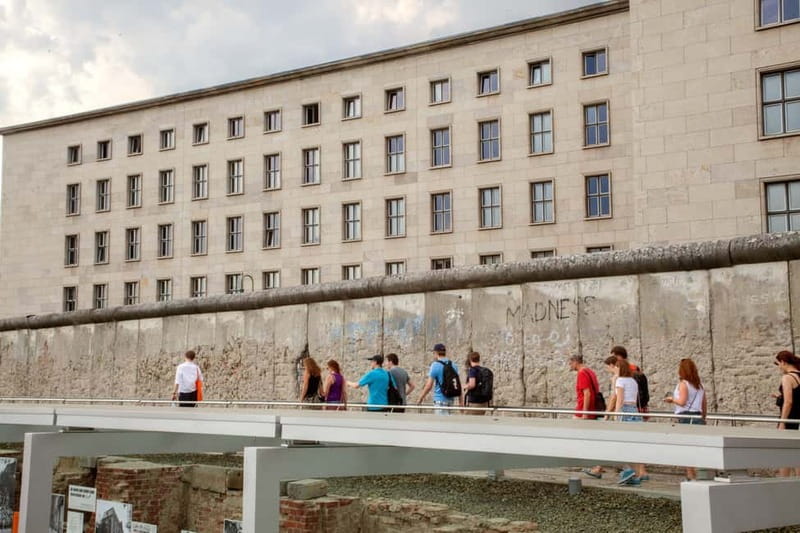
The site is now linked to an exhibition in the basement remains of the buildings. It documents the Nazi rise to power and the institutions behind political terror. The location is also near one of the remaining stretches of the Berlin Wall, adding another layer of twentieth-century history to the walk.
This is one of the most important stops because it makes the regime’s violence feel organized and administrative. The SS and Gestapo were not vague forces operating somewhere in the background. They had offices, records, staff, and systems for surveillance and repression.
The exhibition provides more visual and documentary material than the exterior stops. Still, do not expect a large museum visit with hours of gallery time. The tour moves on, so listen closely and use the guide’s explanation to make sense of what remains.
The subject can be emotionally heavy. The best guides handle it carefully, without turning suffering into spectacle. Several guides, including India, Dani, and an Australian guide whose name one guest could not recall, were praised for explaining the material with sensitivity while keeping the group engaged.
More History Walking Tours in Germany
- Berlin Private Half-Day Walking Tour: Discover the German Capital’s History
★ 5.0 · 244 reviews - Berlin: Historic Center Walking Tour with a Real Berliner
★ 5.0 · 134 reviews - Leipzig: 1.5-Hour Historical Walking Tour in German
★ 4.7 · 2,217 reviews - Trier: Guided Old Town Highlights and History Walking Tour
★ 4.7 · 687 reviews
The Berlin Wall and layers of twentieth-century history
The surviving stretch of the Berlin Wall near the former SS and Gestapo site is a reminder that Berlin’s twentieth-century story did not end in 1945. The Nazi dictatorship was followed by occupation, division, and the Cold War.
You will not get a full tour of Berlin’s Wall history here, and that is not the point. Instead, the wall appears as a physical reminder of how one authoritarian period was followed by another divided chapter. The guide may use the setting to help you see Berlin as a city shaped by repeated political upheaval.
This is also where the walking route can feel less like a list of monuments and more like a lesson in how ordinary streets carry several layers of history. A building, basement, or wall fragment may connect to more than one era.
The Battle of Berlin and the Soviet memorial
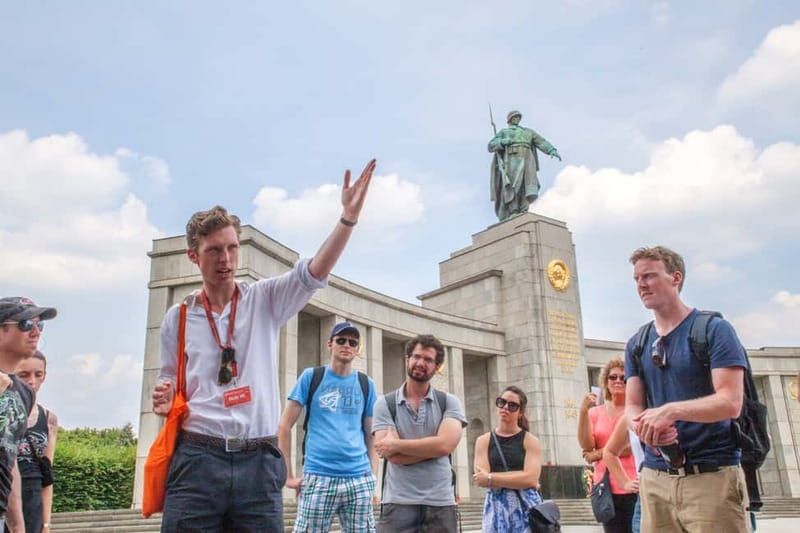
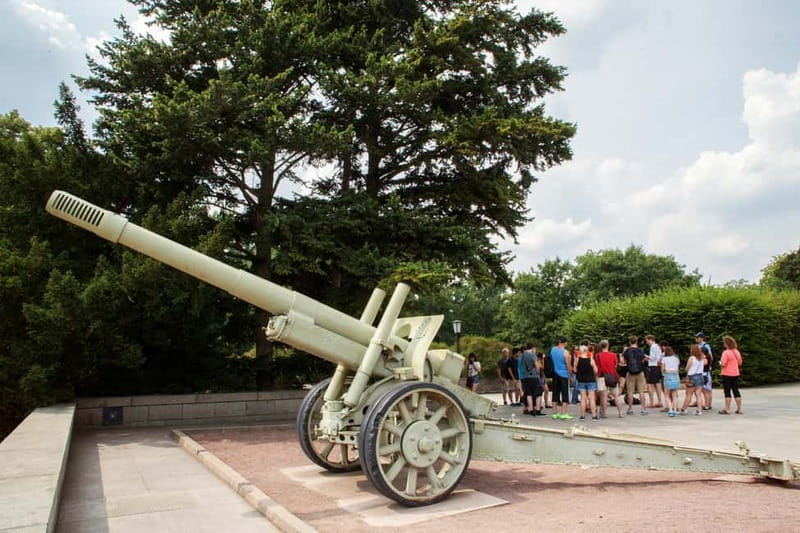
The itinerary includes one of Berlin’s Soviet memorials, dedicated to the Soviet soldiers who died liberating the city. The stated figure is more than 80,000 lives lost in the Battle of Berlin.
At the memorial, two artillery pieces and two tanks stand as silent reminders of the final fighting. The guide explains the battle and the Soviet role in defeating Nazi Germany, placing the end of the regime within the enormous human cost of the war.
This stop broadens the tour beyond German political history. You are asked to consider the soldiers who fought their way into Berlin and the civilians caught in the final destruction. It also gives the route a sense of military scale after the earlier focus on offices, ministries, and police institutions.
The memorial is not just a photo stop. Take time to listen to the explanation and look at the placement of the weapons. The setting helps show how the war ended in Berlin, not with a neat political handover, but with a battle that devastated the city.
Hitler’s bunker and an unmarked ending
The final stop is the site of Hitler’s former bunker. Hitler ended his life there as Soviet forces closed in, and the location now lies beneath an ordinary area with no grand monument announcing what happened.
That lack of spectacle is part of the point. You stand above the site, but the bunker itself is not open as a historic attraction. There is no dramatic underground chamber to explore. Instead, the guide explains the final days of the Nazi leadership and the collapse of the regime.
I appreciate this restrained ending. The site does not turn Hitler into a tourist attraction. It places the end of the dictatorship in a plain urban setting, where the absence of a monument says something about how Berlin has chosen to remember and reject that past.
For some people, this will be the most memorable part of the tour. For others, the earlier SS and Gestapo site or the Soviet memorial may carry more weight. The route wisely leaves the bunker for last, after you understand how the regime came to power and what its rule caused.
Guides make or break this experience
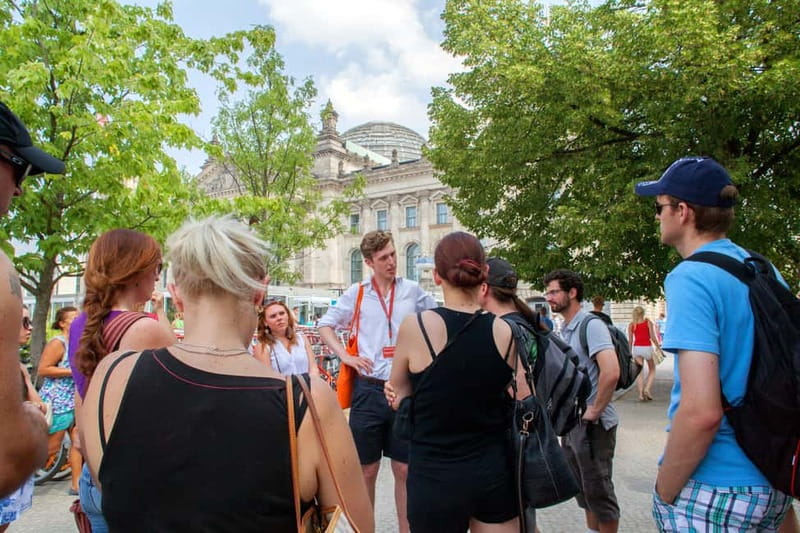
The strongest feature here is the live guide. Names praised in past sessions include Dani, India, Theo, Elizabeth, Lizzie, Lucy, Martin, Maria, Max, Chris, Amy, Hannah, Marcel, and Jasper. Guides change, so you cannot assume you will receive a particular person, but the pattern is clear: the tour depends heavily on presentation.
Dani was repeatedly singled out for his storytelling, clear answers, and ability to handle a large group. India was praised for making a difficult subject easy to follow, while Theo was described as energetic and exceptionally well informed. Elizabeth and Lizzie received similar praise for explaining the material in detail and keeping the walk approachable.
The best guides do more than recite facts. They explain how the Nazis gained power, how the government changed after the takeover, and how ordinary structures helped carry out persecution. They also address myths and misconceptions, which is useful if your previous knowledge comes mainly from school or popular history.
Group size can vary. Some sessions have been small, including one with only three people, while other sessions became large when a second guide was unavailable. In one case, a large group was split into two. A small group makes it easier to ask questions and hear every explanation, but a strong guide can still manage a bigger crowd.
Walking, transport, weather, and comfort
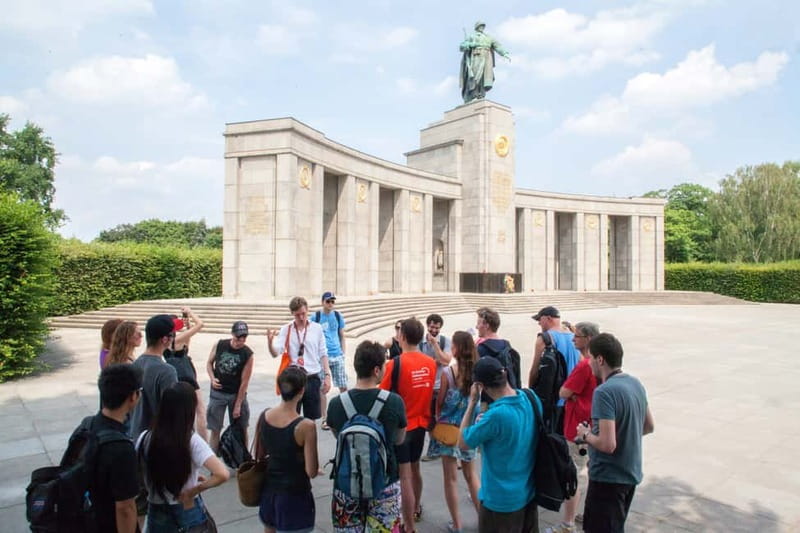
Wear comfortable shoes. You will walk between several sites, stand during explanations, and may use public transport. The tour requires an AB transport ticket, which is not included in the price.
Bring clothing suited to the season. A winter session was described as very cold and rainy, while another visitor advised wrapping up well. Berlin’s weather can change quickly, and the tour continues outside in most conditions. A small umbrella or rain jacket is sensible.
There is a break partway through the tour. That helps, particularly because the subject is demanding and the route includes extended periods of standing. Food and drinks are not included, so use the break to buy something if needed.
The activity is listed as wheelchair accessible. Because the route involves walking, public transport, historic sites, and basement remains, I would still confirm the exact route and access arrangements before booking if you use a wheelchair.
Is $30 good value?
At $30 per person, this is a reasonable price for a live, guided introduction to Nazi Berlin. You are paying for the route, the guide’s preparation, and the ability to connect several sites that would be difficult to understand on your own.
The value depends largely on your guide. A strong storyteller can turn a plain building into a meaningful historical stop. A weak presentation would leave you looking at façades and empty spaces. The high overall rating and repeated praise for guides suggest that the experience usually delivers well, but guide quality can never be guaranteed in a rotating operation.
Remember to add the cost of the AB transport ticket. Entrance fees, food, and drinks are also excluded. The tour is best viewed as a framework for understanding Berlin, not a replacement for a full museum day.
Who should book this tour?
I would choose it if you want a serious introduction to the Third Reich and prefer learning through places rather than sitting in a lecture hall. It suits first-time visitors, history-minded families with older children, and anyone who wants help making sense of Berlin’s scattered Nazi-era sites.
Children up to age 13 can join free, though the operator may ask for identification. The topic is difficult, so parents should decide if the material is suitable for their children.
I would not choose it if you want a light sightseeing walk, a short list of famous landmarks, or extensive indoor exhibits. The tone is sober, and the subject includes dictatorship, war, persecution, and mass death.
The tour offers free cancellation up to 24 hours before the start and lets you reserve now and pay later. Those policies are useful if your Berlin plans are still shifting, but the real booking decision is simple: do you want a guide to connect the places and explain the machinery behind the Nazi regime?
Should you book the History of the Third Reich tour?
Book it if you want a focused, affordable introduction to Berlin’s darkest twentieth-century history. The route covers the Luftwaffe headquarters, Propaganda Ministry, SS and Gestapo site, Soviet memorial, Berlin Wall remains, and Hitler’s bunker location. That is a lot of context for roughly two hours.
I especially recommend it early in your Berlin stay. You will gain a map of the city’s Nazi history, then understand later museum visits more clearly. Give yourself extra time afterward if you want to sit quietly, visit another memorial, or process the material.
Choose another activity if you dislike walking, need a fully indoor program, or want detailed access to historic buildings. For most people interested in the subject, though, this is a thoughtful first step, with strong guides and a route that shows how Berlin remembers a terrible past without turning it into spectacle.
FAQ
How long does the tour last?
The activity is listed as lasting two hours. Some past sessions have been described as longer, so check the current details when booking.
What language is the tour in?
The live tour guide speaks English.
Where does the tour meet?
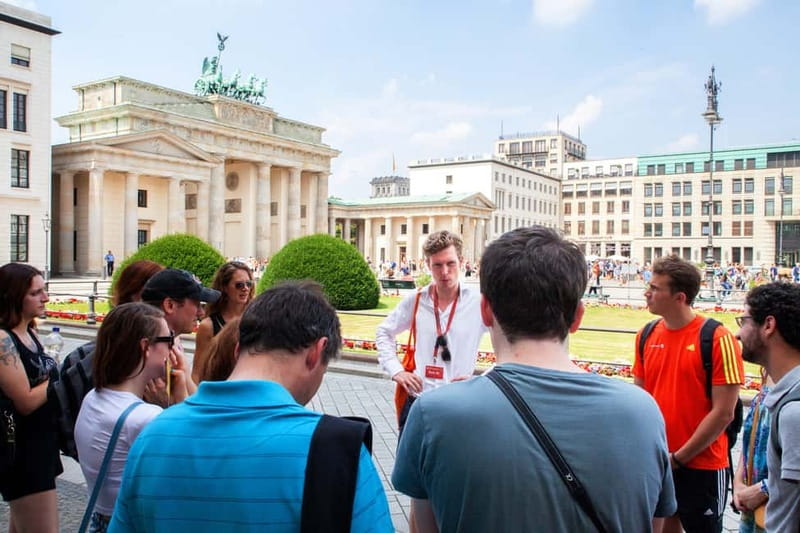
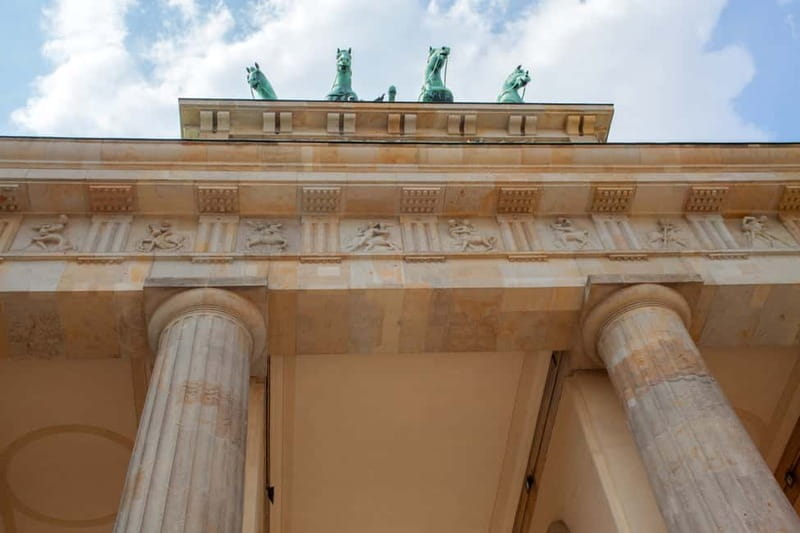
Meet in front of the Starbucks Café near Berlin’s historic Brandenburg Gate. Look for the operator’s team wearing red shirts and carrying red umbrellas.
Is public transportation included?
No. You need to purchase an AB transport ticket for the tour.
Are food and drinks included?
No. Food and drinks are not included. There is a break partway through the tour.
What should I bring?
Bring comfortable shoes. Weather-appropriate clothing is also sensible because much of the experience takes place outdoors.
Is the tour wheelchair accessible?
The activity is listed as wheelchair accessible. Because the route includes walking, public transport, and historic remains, confirm the precise arrangements if you have specific access needs.
Can children join the tour?
Children up to 13 years old can join for free. The local operator may request valid identification for children.
Can I cancel the booking?
You can cancel up to 24 hours in advance for a full refund. You can also reserve now and pay later, according to the booking terms.
New routes in Berlin
- Small Group Walking Tour: “Wild Kreuzberg”★ 4.8 · 199 reviews
- Sachsenhausen Memorial: Walking Tour from Berlin★ 4.7 · 132 reviews
- Berlin: Prenzlauer Berg District Guided Walking Tour★ 4.9 · 316 reviews
- Berlin: 2.5-Hour Walking Tour through Kreuzberg 61★ 4.9 · 525 reviews
- From Berlin: Potsdam & Sanssouci half day Walking Tour★ 4.9 · 85 reviews
- Explore Berlin: Walking Tour of All The Iconic Sites★ 4.9 · 855 reviews
- East Berlin and the Wall: Walking Tour★ 4.9 · 407 reviews
- Cold War, Berlin Wall, Spies and the East Side Gallery★ 4.8 · 254 reviews
Berlin Walking Tours, compared.
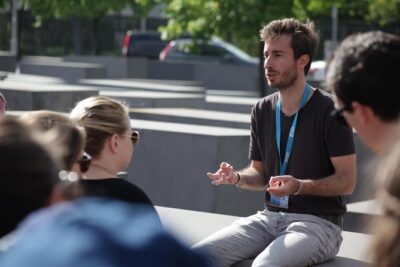
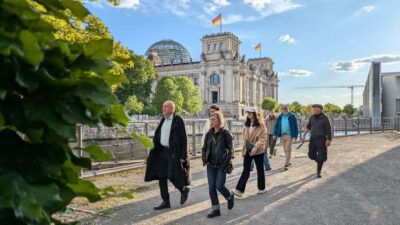
Berlin City walk Government District and Places of Democracy
Read our review →
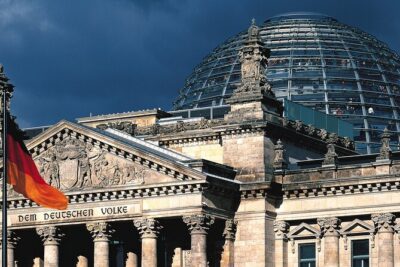
Berlin’s Best: 2 Hour Walking Tour Third Reich and the Cold War
Read our review →
Explore Berlin: See All The Iconic Sights & Some Hidden Gems
Read our review →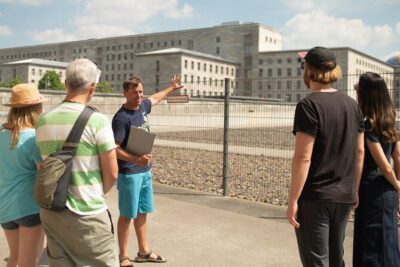
Third Reich Berlin: Hitler and WWII Walking Tour
Read our review →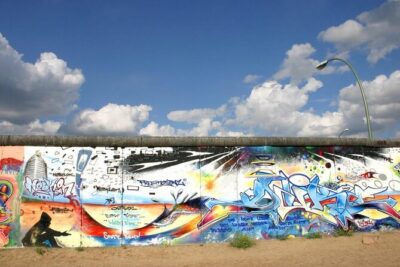
Berlin Center Food Tour with 8+ Authentic Local Tastings
Read our review →
Browse the lists this tour appears in