
Review · BERLIN
Berlin’s Best: 2 Hour Walking Tour Third Reich and the Cold War
Berlin’s most painful and important stories sit close together in central Berlin. In two hours, this walk connects the Third Reich and Cold War through landmarks that make the past feel tied to the pavement beneath your feet.
I like the route for two clear reasons: it reaches places a bus cannot, and it gives you a strong framework for understanding the city. Guides such as Glen, Maggie, Mikey, James, Mikhail, and Peter F. are praised for clear explanations, thoughtful humor, and answers that go beyond a memorized script.
The drawback is the pace. You cover a lot of ground and several grim subjects in a short time. The tour is also outdoors from start to finish, so winter means warm clothes, gloves, and sensible shoes.
Key points to know before booking
- Brandenburg Gate to Checkpoint Charlie: The route links two of Berlin’s best-known landmarks in a logical two-hour walk.
- Nazi and Cold War history together: You move from the Reichstag fire and Hitler’s bunker to the Berlin Wall and the 1961 tank standoff.
- A guide-led history lesson outdoors: Historic photographs, stories, and question time help explain what happened at each stop.
- No attraction admission is needed: The listed stops are viewed from public areas, with no entry tickets included or required.
- Small enough to follow, but not private: The group can reach up to 30 people.
- Good value at $24.07: For a compact orientation to central Berlin, the price is modest, especially if this is your first visit.
Why this two-hour Berlin walk works
I see this experience as a fast, serious introduction to central Berlin. It is not built around entering museums or spending long periods inside one building. Instead, you walk from site to site while a guide explains how dictatorship, war, occupation, division, and reunification shaped the city.
That approach matters in Berlin. Many key places are open squares, ordinary-looking streets, or empty plots. Without context, the former location of Hitler’s bunker can seem like little more than a parking area. The Soviet memorial may look like a cluster of tanks. A section of the Wall can seem small until you understand the barrier system that once cut through the city.
The guide provides the missing layer. Several guides, including Mikhail and Glen, use old photographs to show how the same place looked during the Nazi period or the Cold War. That simple technique can make the walk far easier to follow.
The tour is offered in English and costs $24.07 per person. For two hours of guided sightseeing, that is a fair price. You are paying for interpretation and route planning rather than admission to a museum, so the value is strongest if you want a clear first look at Berlin’s major political landmarks.
More Two-Hour Walks in Berlin:
- Budapest City Landmarks Walking Tour in 2 Hours
★ 5.0 · 2,048 reviews - Leipzig: 2-Hour Guided Walking Tour in German
★ 4.8 · 1,612 reviews - Lucca: 2-Hour City Center Walking Tour
★ 4.7 · 1,314 reviews
Meeting at Brandenburg Gate
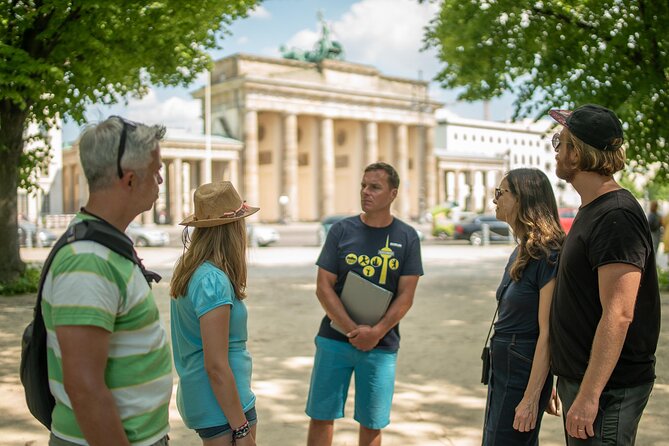
You meet 15 minutes before the start at the Tourist Information office on the Pariser Platz side of Brandenburg Gate. Look for the guide with the pink umbrella. That detail matters in a busy square, and it makes the meeting point easier to spot.
The gate is the right place to begin. Once a symbol of Prussian power, it later became a powerful image of division when the Berlin Wall stood nearby. After reunification, it became one of the clearest symbols of a single Germany again.
Your guide explains why the monument matters beyond its appearance. You get an early lesson in how Berlin repeatedly gave old buildings new political meaning. This opening also helps set the tone for the rest of the walk: the focus is not simply on pretty buildings, but on what took place around them.
The square is easy to reach by public transport, and confirmation arrives at booking. Still, do not cut it close. A late arrival can be awkward when the group has already left the square.
The Reichstag and the fire that changed Germany
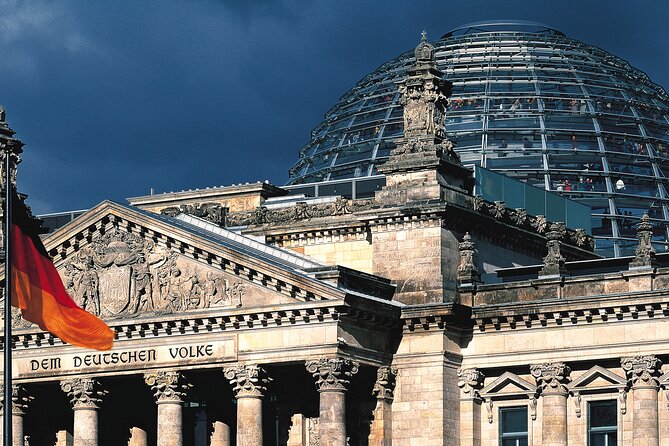
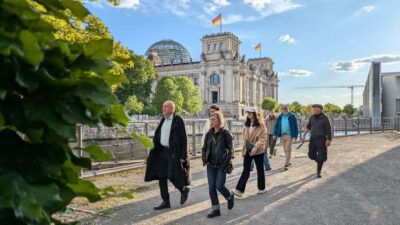
The Reichstag Building is only about a 10-minute stop, but it carries a large share of Germany’s modern political story. Your guide explains how the building reflects the country’s shifts over the past century, from empire and republic to Nazi rule, division, and democracy.
The key episode here is the Reichstag fire of 1933. You hear how Adolf Hitler used the event to attack political opponents and help dismantle democratic freedoms. Seeing the building while hearing that story gives the event a fixed place in your mind, rather than leaving it as a date in a textbook.
You will not tour the interior on this walk. The building is viewed from outside, and the stop is brief. That is a limitation if you hoped to see the parliament chamber or dome, but it keeps the tour moving toward the next part of the route.
Soviet tanks and the Victory Column
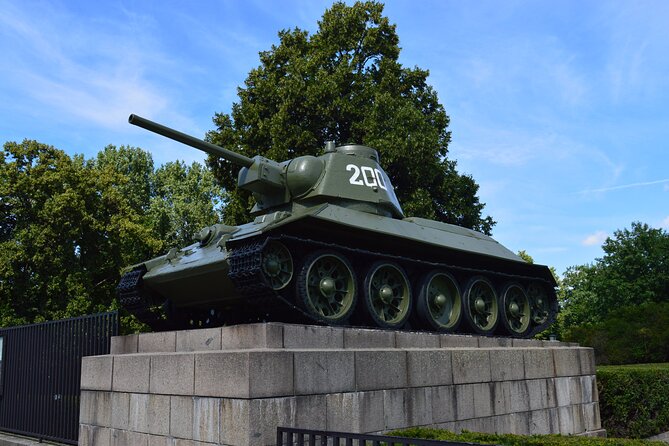
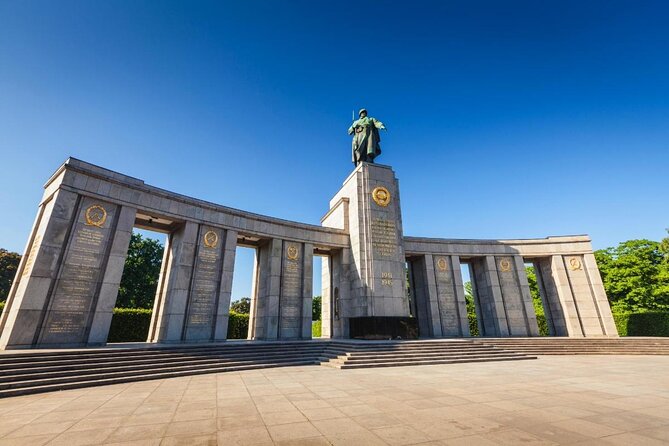
The walk continues to the Soviet Memorial in the Tiergarten. Here, T-34/76 tanks and field artillery sit beside a memorial built in the aftermath of the Second World War.
This stop gives you a visible reminder of the Soviet military role in defeating Nazi Germany. It also adds a useful counterpoint to the earlier discussion of German institutions and Nazi power. The memorial is not just a military display. It reflects the postwar political order that would soon divide Berlin and Germany.
The listed stop lasts about seven minutes, so expect a focused explanation rather than a long visit. You will have time to see the tanks and understand the site, but not to linger at length.
The route also includes the Victory Column. You learn why Albert Speer moved it from its original location and how it related to his plans for Germania, the proposed remaking of Berlin as a monumental capital. The plan was tied to Nazi ambitions for a victorious new world order. The discussion helps you see how architecture and city planning were used to project political power.
More Walking Tours in Berlin:
- Discover Berlin Half-Day Walking Tour
★ 5.0 · 9,624 reviews - Berlin City walk Government District and Places of Democracy
★ 4.7 · 8,467 reviews - Berlin: Third Reich & Cold War Guided Walking Tour
★ 4.9 · 8,378 reviews - Berlin: Discover Berlin Walking Tour
★ 4.9 · 5,998 reviews
Walking through the Holocaust Memorial
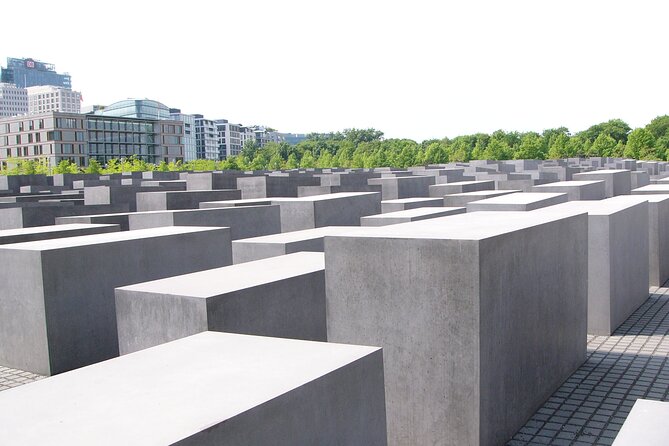
The Memorial to the Murdered Jews of Europe is one of the walk’s most powerful stops. You move among its field of concrete slabs, a space that feels different as you walk through it rather than simply viewing it from the edge.
The guide explains the memorial’s purpose and gives you time to take in the setting. This is a place where the physical design carries much of the emotional weight. The experience is quiet and personal, even within a group.
The stop lasts about 10 minutes. That is enough for an introduction, but not a full discussion of every aspect of the memorial or the Holocaust. I recommend treating the stop with care and allowing yourself a little silent time as you walk.
The tour handles other difficult subjects with the same balance. Guides such as James, Georgia, and Mikey have been praised for using gentle humor when appropriate while keeping respect for the victims at the center. That balance matters on a route with so many grim chapters.
Standing above Hitler’s bunker
The former Führerbunker site is one of the strangest places on the route because there is no grand ruin to look at. You stand above the location while the guide explains the final days of the Second World War, Hitler’s suicide on April 30, 1945, and what happened to the site afterward.
The absence of a dramatic building is part of the lesson. Berlin has had to decide how to mark places tied to Nazi leaders without turning them into shrines. Your guide also discusses how Germans have faced this destructive past in the decades since the war.
This stop is brief, about 10 minutes, but it often stays with you. The guide’s explanation gives the ordinary-looking surroundings a difficult clarity. You understand why the site is treated with restraint.
If you want a full museum treatment of Nazi Germany, this walk cannot provide it in two hours. What it can do is show you where the final chapter happened and point you toward the questions you may want to explore later.
The Aviation Ministry and East Germany’s birth
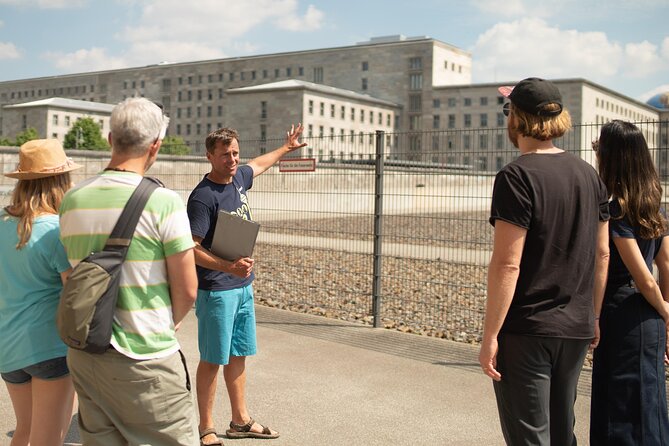
The former Aviation Ministry of Berlin adds another layer to the route. The building was associated with Hermann Göring’s air force ministry during the Nazi period, and it later became the location where East Germany, or the GDR, was proclaimed in 1949.
The guide walks you along the length of the building and explains its changing role. That change is central to Berlin’s story. A structure created under Nazi rule did not vanish when the war ended. It remained part of the city’s political life under a new state.
The stop is only about five minutes, so expect a compact explanation. It works well as a bridge between the Nazi period and the Cold War section of the tour.
The Topography of Terror site
At the Topography of Terror, you see the former headquarters area of the SS, Gestapo, and SD. The site now houses an exhibition about the crimes carried out by those institutions during the Nazi period.
The walk usually focuses on the location and the meaning of the exhibition site rather than giving you time for a full museum visit. That distinction is important. If you want to read the displays in detail, return later with more time.
Even a short stop helps explain how persecution was organized. The Nazi system depended on institutions, offices, records, and officials, not only on speeches and battlefield violence. Standing at the former headquarters area makes that machinery easier to picture.
This is another point where a clear guide matters. A good explanation can connect the building, the agencies, and the crimes without reducing the subject to a list of names.
A piece of Wall on Niederkirchnerstraße
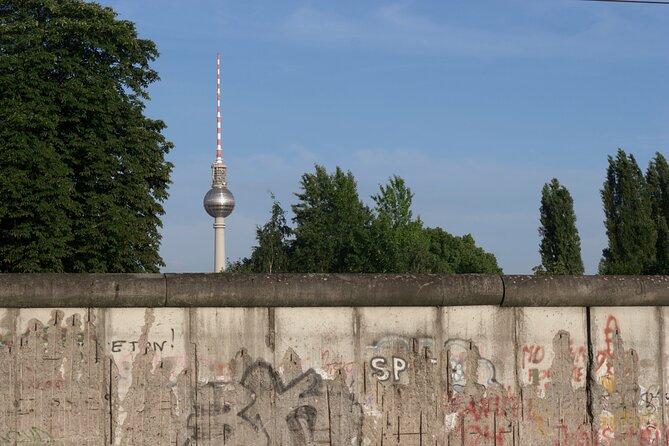
The route then reaches Niederkirchnerstraße, where a large section of the Berlin Wall remains. Here, the focus shifts from dictatorship and war to the daily reality of a city split in two.
You hear stories of people who tried to escape across the Wall, including what happened to those who failed. The guide also explains differences between life in East and West Berlin. Those details give the Wall a human scale.
A seven-minute stop cannot cover every part of division, surveillance, or escape history. It can, however, provide a useful outline before you explore Berlin’s larger Wall memorials on your own.
The preserved section is especially useful because it makes the barrier visible. Photographs of the Wall can seem abstract. A surviving piece lets you see the height, texture, and force of the object that once cut through neighborhoods and separated families.
Ending at Checkpoint Charlie
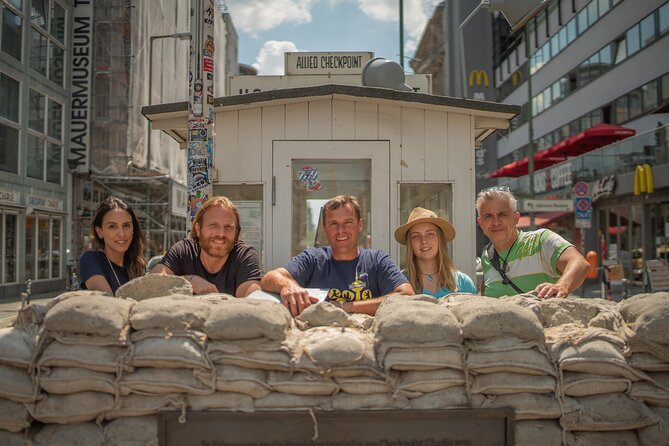
The tour ends at Checkpoint Charlie on Friedrichstraße. This was the best-known crossing point through the Berlin Wall, and it became a symbol of the Cold War confrontation between the United States and the Soviet Union.
Your guide recounts the 1961 tank standoff, when American and Soviet forces faced one another in the street. You also hear how the Wall came down on November 9, 1989, and how Berlin and Germany handled reunification in the more than 30 years that followed.
Checkpoint Charlie is a fitting endpoint because it brings the story into the present. You have moved from Nazi control to Soviet occupation, divided Berlin, escape attempts, the Wall’s collapse, and the question of how successful reunification has been.
The area is also busy and commercial. The original checkpoint structure is not the whole story, and the modern setting can feel less solemn than the history suggests. Your guide helps separate the symbolic importance from the present-day street scene.
Guide style and group size
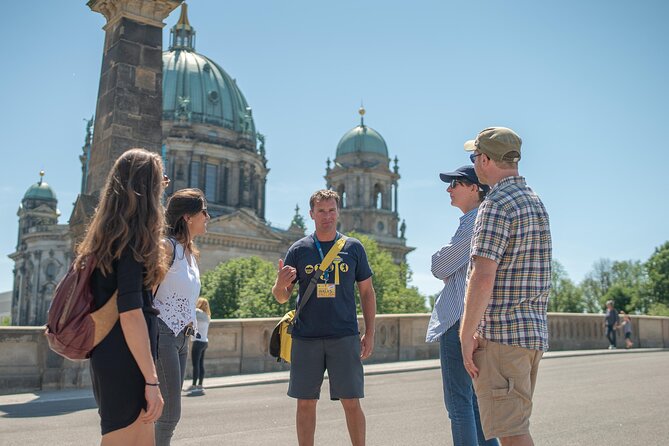
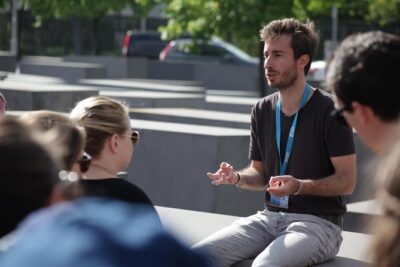
The operator uses English-speaking local guides, and the experience can include up to 30 people. That is not a private walk, but it is still small enough for a guide to address questions and keep the group together on city streets.
The strongest part of the guide service is the mix of information and personality. Glen and Ben are praised for answering questions clearly. Maggie is noted for making difficult history accessible and offering fresh ways to think about Berlin. Mikey is described as friendly, humorous, and careful with sensitive subjects. Peter F. is also praised for adding thoughtful recommendations after the walk.
Those names do not guarantee who will lead your departure. The important point is the style you can expect: a spoken history lesson with room for questions, rather than a silent march from landmark to landmark.
Families can also make this work. One family with children aged 11 and 16 found the format approachable, with the young people comfortable asking questions. The subject matter is serious, but the guide’s delivery can keep it understandable for older children and teenagers.
Timing, walking, and practical comfort
Two hours is a smart length for this route. It is long enough to connect the major sites, but short enough to fit into a busy Berlin day. The end at Checkpoint Charlie also puts you near public transport and other central sights.
You will be outside for the whole experience. Wear shoes suited to walking on city streets, and check the weather before you leave. In winter, take a warm coat and gloves. One practical tip is worth taking seriously: use a restroom before the tour, since stops are short and the route is continuous.
The group pauses at each site, but this is not a slow stroll. You need to keep pace and listen while standing. If you prefer long museum visits, indoor seating, or plenty of time for photographs, choose this as an orientation rather than your only Berlin history experience.
The tour is accessible to most people, and service animals are allowed. No admission tickets are listed for the stops, since the route views them from public areas.
Is $24.07 good value?
At $24.07, this is good value if you want an organized introduction to central Berlin’s major political sites. You get a local English-speaking guide, a planned route, historical context, and two hours of sightseeing without needing to work out the connections yourself.
The value is less clear if you already know Berlin well or plan to spend most of your time inside museums. You will not receive a long visit to the Topography of Terror, a tour of the Reichstag interior, or a detailed study of the Holocaust Memorial.
I would book it early if the timing matters to you. The experience is booked around 16 days ahead on average, and its popularity means a preferred departure may not remain open close to your visit.
Should you book this Berlin history tour?
Book it if you want a focused first orientation to Berlin’s Nazi and Cold War past. It suits first-time visitors, families with older children, and anyone who prefers a guide to connect places that can otherwise seem scattered.
Skip it if you want a relaxed walk, a museum-heavy day, or a private guide. The route is brisk, the subjects are heavy, and the group can reach 30 people.
For most people, I would take it near the start of a Berlin stay. It gives you a map of the city’s hardest stories, points out where to return for longer visits, and leaves you at Checkpoint Charlie with plenty of time to continue exploring.
FAQ
How long is the Berlin Third Reich and Cold War walking tour?
The tour lasts approximately two hours.
Where does the tour start?
It starts at Brandenburg Gate, at Pariser Platz in Berlin, on the side near the Tourist Information office.
Where does the tour end?
It ends at Checkpoint Charlie, at Friedrichstraße 43-45.
How early should I arrive?
Arrive 15 minutes before the scheduled start time. Look for the guide carrying a pink umbrella.
What language is the tour offered in?
The tour is offered in English only.
What sites are included?
The route includes Brandenburg Gate, the Reichstag Building, the Soviet Memorial in the Tiergarten, the Victory Column, the Holocaust Memorial, the former Führerbunker site, the former Aviation Ministry, the Topography of Terror, a section of the Berlin Wall on Niederkirchnerstraße, and Checkpoint Charlie.
Is admission included?
The listed stops have free admission, and the experience is a walking tour of the sites. The tour does not include a separate interior visit to buildings or exhibitions.
How many people can join the tour?
The group can include a maximum of 30 travelers.
Can I cancel for a full refund?
Yes. You can cancel at least 24 hours before the experience start time for a full refund. Cancellations or changes made within 24 hours are not refunded or accepted.
New routes in Berlin
- Small Group Walking Tour: “Wild Kreuzberg”★ 4.8 · 199 reviews
- Sachsenhausen Memorial: Walking Tour from Berlin★ 4.7 · 132 reviews
- Berlin: Prenzlauer Berg District Guided Walking Tour★ 4.9 · 316 reviews
- Berlin: 2.5-Hour Walking Tour through Kreuzberg 61★ 4.9 · 525 reviews
- From Berlin: Potsdam & Sanssouci half day Walking Tour★ 4.9 · 85 reviews
- Explore Berlin: Walking Tour of All The Iconic Sites★ 4.9 · 855 reviews
- East Berlin and the Wall: Walking Tour★ 4.9 · 407 reviews
- Cold War, Berlin Wall, Spies and the East Side Gallery★ 4.8 · 254 reviews
Berlin Walking Tours, compared.
Berlin City walk Government District and Places of Democracy
Read our review →

Explore Berlin: See All The Iconic Sights & Some Hidden Gems
Read our review →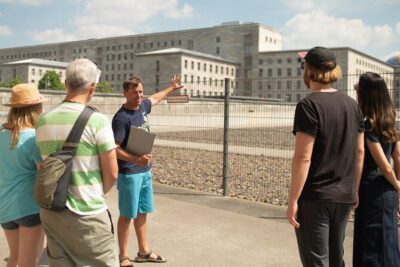
Third Reich Berlin: Hitler and WWII Walking Tour
Read our review →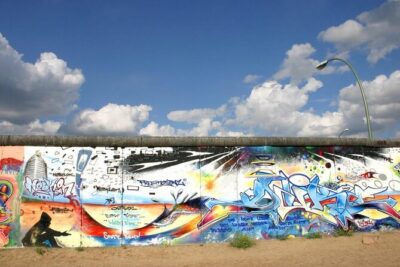
Berlin Center Food Tour with 8+ Authentic Local Tastings
Read our review →

Browse the lists this tour appears in