
Review · BERLIN
Explore Berlin: See All The Iconic Sights & Some Hidden Gems
Berlin’s most important stories are packed into a walk from Friedrichstrasse to Brandenburg Gate. In three hours, you move from the Palace of Tears and Berlin’s divided past to Hitler’s bunker site, the Holocaust Memorial, Checkpoint Charlie, the Berlin Wall, and the Reichstag. It is a serious history lesson, but good guides add humor, personal stories, and clear explanations.
I like the route for two reasons: it links famous sights in a sensible order, and it shows how the same streets changed under Nazi rule, East German communism, and reunification. Guides such as Joseph, Hannah, Jimmy, Tina, and Jef have been praised for clear English, patient answers, and an ability to make difficult subjects understandable.
The trade-off is simple: you walk about three miles, often at a steady pace. A large group or a soft-spoken guide can make it harder to hear, and there is limited time for long photo stops. Come ready to listen while walking, not to linger at every monument.
Key points to know before you book
- Three hours, many major sights: The route covers Brandenburg Gate, the Reichstag, Checkpoint Charlie, the Holocaust Memorial, Bebelplatz, the Wall, and more.
- History is the main event: Expect detailed discussion of the Third Reich, World War II, the Holocaust, the Cold War, and German reunification.
- A walking tour with real distance: You may cover roughly three miles, with short stops rather than long visits inside buildings.
- No major admission fees are included: The tour is mainly an outdoor visit. Entry to museums and churches is not part of the experience.
- The guide makes a big difference: Joseph, Tina, Hannah, Jimmy, Rohan, Paul, and others have been praised for clear delivery and lively storytelling.
- Best for first-time Berlin visitors: It gives you a useful map of the central sights so you can return later to the places you want to explore in depth.
Why this Berlin history walk works so well
This is not a tour built around one monument. It is a connected story told across the city center. You begin near Friedrichstrasse, see how Berlin dealt with the Cold War, pass through the Museum Island area, and then move into the locations tied to Nazi rule and the Holocaust.
I like that structure. Berlin can feel scattered at first. One major sight sits beside a modern government building, which sits near a memorial, which sits on a former political fault line. A guide helps you understand why these places belong together.
The tour is also useful early in a Berlin visit. You get a broad sense of the center, then you can decide where to spend more time later. The route does not replace a museum visit, but it gives those museums a stronger frame.
The experience is offered in English and normally has no more than 25 people. That is small enough to feel organized, though not small enough to guarantee a private conversation with the guide. Arrive 15 minutes early. The meeting details identify Reichstagufer 17, near Friedrichstrasse, while the walk begins around the central station area, so check your confirmation carefully before setting out.
More Hidden Gems Walking Tours in Berlin:
- Private Berlin: Iconic Sights and Hidden Gems Walking Tour
★ 5.0 · 292 reviews - Dublin Highlights and Hidden Gems Guided Walking Tour
★ 5.0 · 6,020 reviews - Kyoto Geisha Walking Tour: Gion District & Hidden Gems
★ 4.7 · 3,273 reviews
From the Palace of Tears to Berlin’s older center
The Palace of Tears, or Tränenpalast, is an excellent early stop because it puts a human face on the Cold War. This former checkpoint handled crossings between East and West Berlin. The name comes from the emotional farewells that took place there when people had to separate after a visit.
You do not spend long here, but the stop prepares you for the rest of the tour. Berlin’s division was not only about grand political speeches. It affected families, friendships, work, travel, and daily choices.
The route then moves toward Neue Wache, a national memorial connected with war and tyranny. This is one of the places where your guide can explain how Germany has tried to remember violence without turning remembrance into easy ceremony.
At Humboldt University, the focus shifts to Berlin’s intellectual life. Marx, Engels, and Einstein studied or taught here. That detail helps balance the darker material. Berlin was not shaped only by dictators, armies, and walls. Its universities, architects, artists, and musicians also helped define the city.
Museum Island from the outside
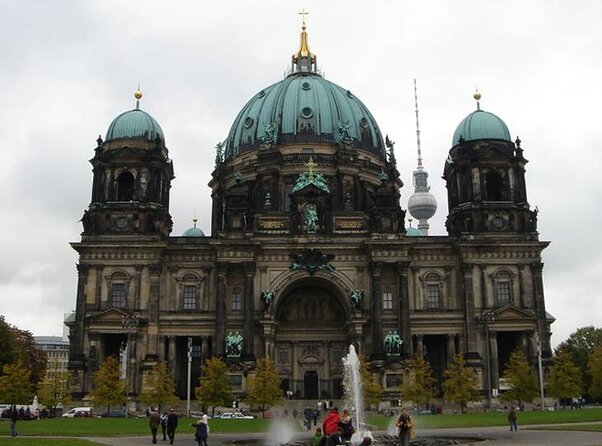
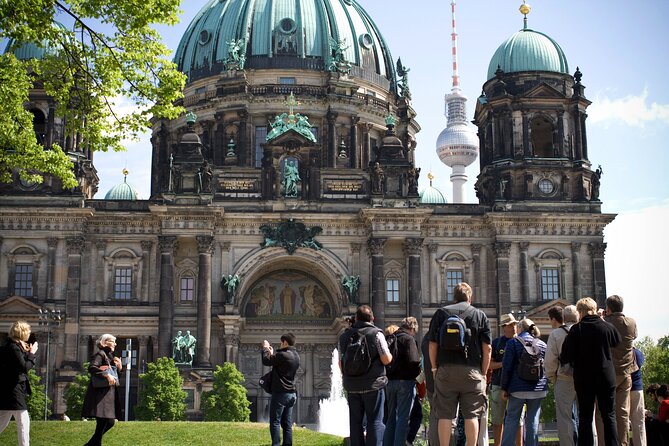
The walk passes Berlin Cathedral, Lustgarten, the City Palace, and the Humboldt Forum. You see the biggest church in Berlin and the rebuilt palace complex that now houses the Humboldt Forum.
You also pass the Pergamon Museum, Neues Museum, and Altes Museum. These stops are mainly orientation points, not museum visits. Admission is not included, and the short timing means you should not expect to see the Ishtar Gate, the Market Gate of Miletus, or the Egyptian collection during this walk.
That is not a flaw, as long as you understand the format. I find this portion useful because Museum Island can be confusing when you first arrive. The guide can explain which museum holds Islamic art, which is known for ancient Egyptian material, and why the Altes Museum matters in Berlin’s architectural story.
If one of these museums is high on your list, note its location and return later with a ticket and several hours. This tour gives you a preview, not a museum tour.
Bebelplatz and the warning beneath the square
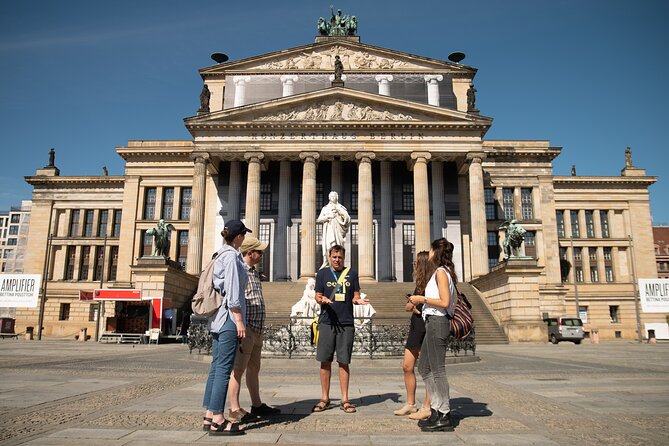
Bebelplatz is one of the most powerful stops because it looks so elegant. The 18th-century square is surrounded by major buildings, including the Staatsoper and the Konzerthaus. The French Cathedral and German Cathedral at nearby Gendarmenmarkt add another layer, showing Berlin’s tradition of religious tolerance and grand public architecture.
Then the guide brings you to the Book Burning Memorial. In 1933, Nazi supporters burned tens of thousands of books here. The memorial is easy to miss if you walk through the square alone, which is exactly why a guide adds value.
This is a good example of the tour’s method. You see the polished surface of central Berlin, then learn what happened beneath that surface. The city’s beauty does not erase its past, and the past is often hidden in plain sight.
More Walking Tours in Berlin:
- Discover Berlin Half-Day Walking Tour
★ 5.0 · 9,624 reviews - Berlin City walk Government District and Places of Democracy
★ 4.7 · 8,467 reviews - Berlin: Third Reich & Cold War Guided Walking Tour
★ 4.9 · 8,378 reviews - Berlin: Discover Berlin Walking Tour
★ 4.9 · 5,998 reviews
Checkpoint Charlie and the Cold War
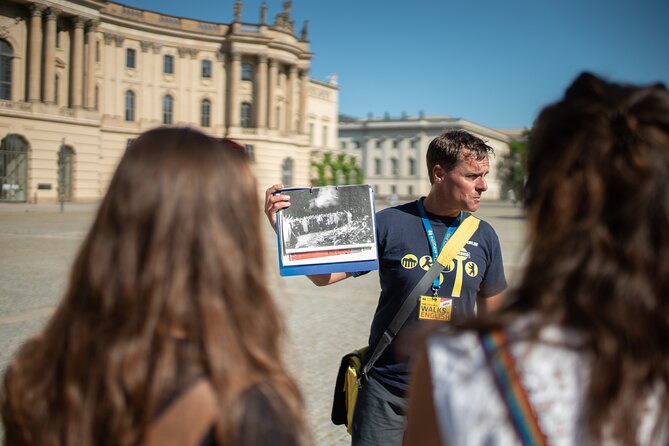
Checkpoint Charlie is one of Berlin’s best-known Cold War locations. It was a crossing point for civilians and military personnel between East and West Berlin. In 1961, American and Soviet tanks faced each other here, creating one of the most dangerous confrontations of the Cold War.
The stop lasts about ten minutes, so expect an explanation and time to look around, not a long historical workshop. Checkpoint Charlie is also one of the city’s most commercialized sights, and the current setting can feel busy and theatrical. A good guide helps separate the real political importance from the modern souvenir atmosphere.
I value this stop because the guide connects it to everyday life. The Wall was not an abstract line on a map. It divided neighborhoods and limited movement. The Cold War becomes easier to understand when you picture people trying to cross, visit relatives, or build ordinary lives around an extraordinary barrier.
The Wall, the Nazi security system, and Hitler’s bunker
At the Topography of Terror, you see a roughly 200-meter section of the Berlin Wall. This is one of the strongest Wall stops because it combines physical remains with a site linked to the Nazi security system.
The former Aviation Ministry is nearby. The building has served as Hermann Göring’s air force ministry, the East German house of ministers, and the German Finance Ministry. Its changing uses show how political power can occupy the same rooms under different governments.
The route then reaches the location of Hitler’s bunker. You stand above the site where Hitler spent his final days in World War II. There is no grand monument to visit here, and that restraint matters. The point is not to turn the bunker into a shrine. It is to understand the final collapse of the Nazi regime and the destruction left behind.
Your guide’s handling of this section is important. Several guides have been praised for explaining difficult material in a calm, direct way. Grayson, for example, was especially noted for his thoughtful treatment of the Holocaust, while Rohan was praised for making the story engaging and easy to follow.
The Holocaust Memorial and Brandenburg Gate
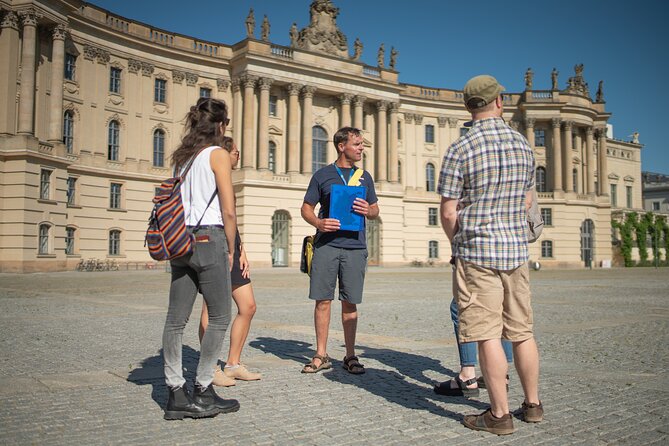
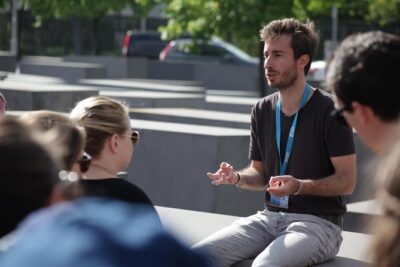
The Memorial to the Murdered Jews of Europe is one of the tour’s essential stops. You walk among the concrete slabs and hear about the memorial’s purpose and the Nazi murder of Europe’s Jews.
Allow yourself a serious moment here. The route is busy, and the schedule keeps moving, but this is not a place to treat as a quick photo backdrop. The guide can provide the historical setting, while your own walk through the memorial gives the subject a quieter, personal weight.
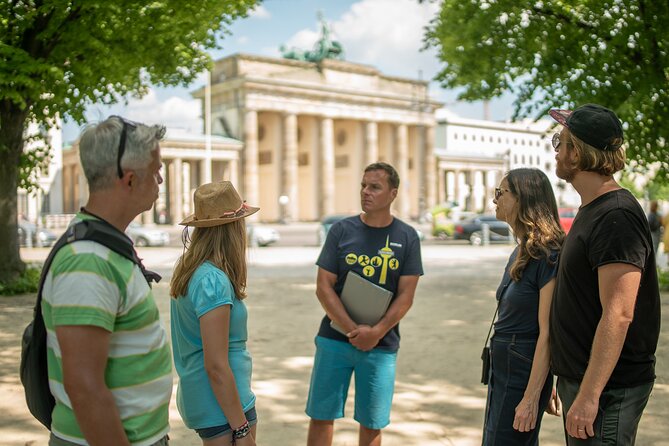
The final major sight is Brandenburg Gate. Once linked with division between East and West Berlin, it is now a national symbol of peace and unity. It is also a practical ending point because Pariser Platz places you beside the American and French embassies, Hotel Adlon, and the Academy of Fine Arts.
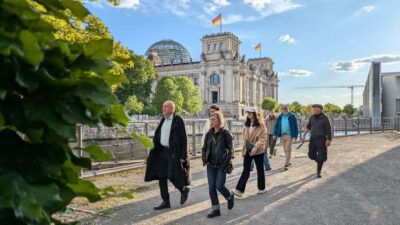
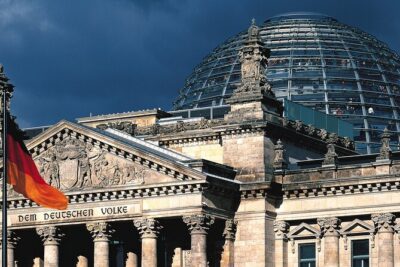
The Reichstag and the government quarter are included in the final stretch, though the tour ends at Brandenburg Gate rather than inside the parliament building. If you want to visit the Reichstag dome, you will need to arrange that separately.
What the guides add
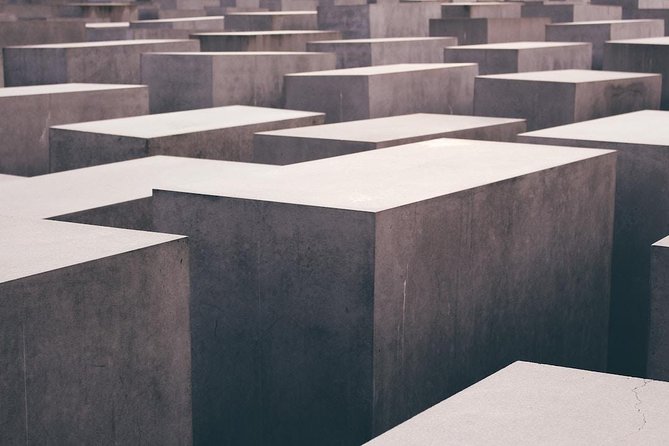
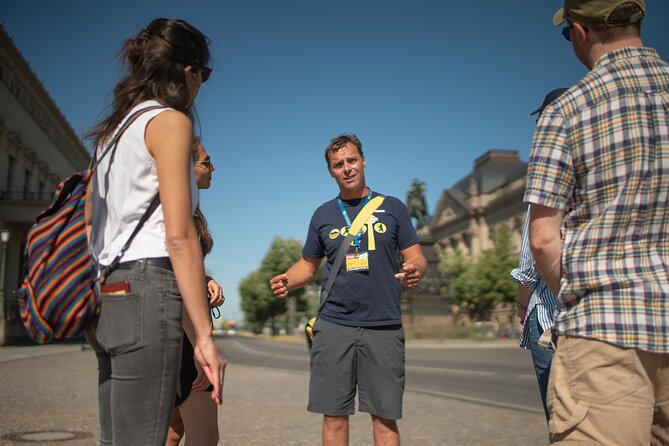
The strongest feature of this experience is the guide. The subject matter is dense, and a flat delivery would make three hours feel long. The best guides turn a list of places into a story.
Joseph has been praised for strong English, useful answers, and a lively style. Tina was noted for explaining several hundred years of history in plain terms while keeping the group on time. Hannah combined clear information with a steady pace and short warm-up stops on a cold day.
Jimmy is a good choice for anyone who likes a friendly, relaxed style. He has been praised for humor, patience, and practical recommendations. Jef, Tom, Pete F, Jasper, Brian, Georgia, Paul, Artie, and Rohan have also been singled out for clear explanations, warmth, or strong command of Berlin’s past.
Of course, you may not be assigned a particular guide. That is worth remembering when reading enthusiastic praise for an individual person. The company uses several guides, so the personality and speaking volume can vary. One poor experience involved a guide moving too quickly for photographs, while another noted that a large group made it hard to hear.
Stay near the guide, ask for a repeat if you miss something, and tell the guide if you need a brief pause. That is practical advice on any walking tour, especially one covering this much ground.
Price, pace, and who gets good value
At $24.07 per person, this is inexpensive for a three-hour guided introduction to central Berlin. The value comes from the route and the explanations, not from included admissions. You are paying for a local English-speaking guide who links places that would otherwise feel disconnected.
I would not choose this tour if you want long museum visits, a slow photography walk, or detailed interior access. The museums, Berliner Dom, and other paid attractions are viewed from the route, with admission not included.
I would choose it if you are in Berlin for the first time, have limited time, or want to understand the city before exploring alone. It is also a good fit if Nazi and Cold War history is central to your trip.
The walk is less suitable for anyone who finds three miles difficult. Most of the stops are short, and the group keeps moving. Wear comfortable shoes and bring clothing suited to the weather. One practical strength is the number of brief stops, which can help you catch your breath, warm up, or take notes, but you should not expect a long break built into the schedule.
Free cancellation is available up to 24 hours before the start time. Changes or cancellations inside that window are not accepted for a refund.
Should you book this Berlin walking tour?
Book it if you want a strong first look at Berlin’s major central sights and the forces that shaped them. The route covers a remarkable amount in three hours, from the Palace of Tears and Museum Island to Checkpoint Charlie, the Wall, Hitler’s bunker site, the Holocaust Memorial, the Reichstag, and Brandenburg Gate.
Skip it if you prefer to explore at your own pace or need frequent, extended photo stops. Also think twice if you want to go inside the museums and monuments, since this is mainly an outdoor walk.
For most first-time visitors, I consider the $24.07 price fair. You get a useful map of central Berlin, a serious introduction to the Nazi and Cold War eras, and the chance to return later to the places that catch your interest. Arrive early, stay close to the group, and treat the tour as a beginning rather than your entire Berlin education.
FAQ
How long is the Berlin walking tour?
The tour lasts approximately three hours.
How much does the tour cost?
The listed price is $24.07 per person.
What language is the tour offered in?
The tour is offered in English with a local English-speaking guide.
Where does the tour begin?
The meeting details give Reichstagufer 17, 10117 Berlin, Germany. The tour information also describes the start as being near Friedrichstrasse station, so check the exact meeting instructions in your confirmation.
Where does the tour end?
The walk ends at Brandenburg Gate in Pariser Platz.
Which major sights are included?
The route includes Brandenburg Gate, the Reichstag area, Checkpoint Charlie, the Holocaust Memorial, the Berlin Wall, Hitler’s former bunker site, Bebelplatz, Gendarmenmarkt, Museum Island, Neue Wache, and the Palace of Tears.
Are museum admission fees included?
No. Admission to places such as the Berliner Dom, Pergamon Museum, Neues Museum, Altes Museum, and Aviation Ministry is not included. The tour mainly visits outdoor locations.
How far do you walk?
The route covers about three miles according to the activity information. Expect a steady walking pace with many short stops.
How large is the group?
The tour allows a maximum of 25 people.
Can I cancel for a full refund?
Yes. You can cancel at least 24 hours before the experience starts for a full refund. Cancellations or changes made less than 24 hours before the start time are not accepted for a refund.
New routes in Berlin
- Small Group Walking Tour: “Wild Kreuzberg”★ 4.8 · 199 reviews
- Sachsenhausen Memorial: Walking Tour from Berlin★ 4.7 · 132 reviews
- Berlin: Prenzlauer Berg District Guided Walking Tour★ 4.9 · 316 reviews
- Berlin: 2.5-Hour Walking Tour through Kreuzberg 61★ 4.9 · 525 reviews
- From Berlin: Potsdam & Sanssouci half day Walking Tour★ 4.9 · 85 reviews
- Explore Berlin: Walking Tour of All The Iconic Sites★ 4.9 · 855 reviews
- East Berlin and the Wall: Walking Tour★ 4.9 · 407 reviews
- Cold War, Berlin Wall, Spies and the East Side Gallery★ 4.8 · 254 reviews
Berlin Walking Tours, compared.
Berlin City walk Government District and Places of Democracy
Read our review →
Berlin’s Best: 2 Hour Walking Tour Third Reich and the Cold War
Read our review →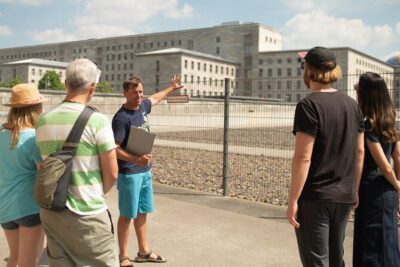
Third Reich Berlin: Hitler and WWII Walking Tour
Read our review →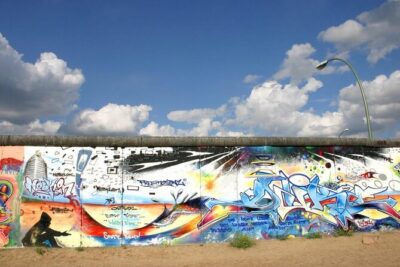
Berlin Center Food Tour with 8+ Authentic Local Tastings
Read our review →

Browse the lists this tour appears in