
Review · BERLIN
Third Reich Berlin: Hitler and WWII Walking Tour
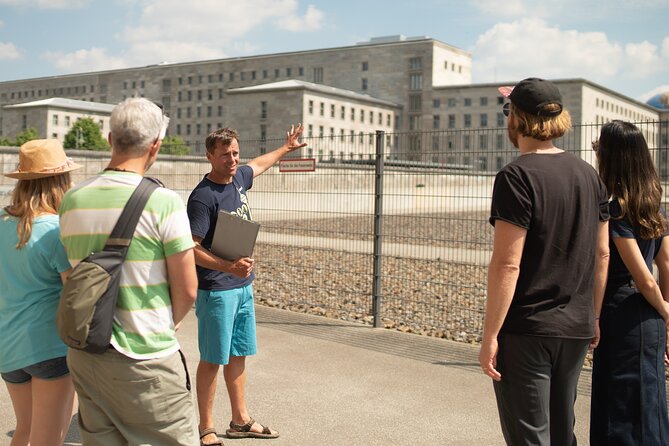
Berlin’s wartime story becomes far clearer when you walk through the places where decisions were made. This three-hour Third Reich tour links Hitler’s bunker, the Reichstag, Goebbels’ propaganda office, the Soviet War Memorial, and the Topography of Terror into one sober route through the final days of Nazi rule.
I like two things here. First, the guide provides the missing links between scattered buildings and events. Second, the tour includes resistance figures such as Claus von Stauffenberg, along with the daily experience of Berliners under dictatorship and air raids. The drawback is just as clear: you will be outside for three hours, covering roughly 5,000 brisk steps, so cold weather and poor shoes can spoil an otherwise excellent history lesson.
Key points to know before booking
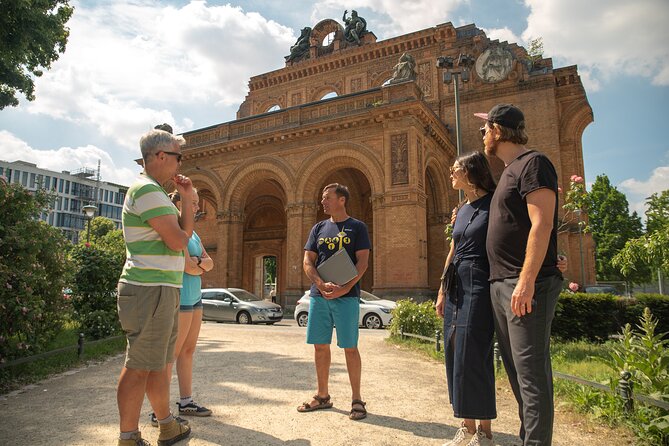
- Hitler’s bunker site is an empty location: You stand above the former bunker and hear about Hitler’s final days and death in April 1945.
- The route connects power and persecution: See the former Air Ministry, Propaganda Ministry area, Wilhelmstrasse, and the old Nazi government center.
- The Holocaust is treated directly: Stops include the Trains to Life, Trains to Death memorial and the Memorial to the Murdered Jews of Europe.
- Expect a brisk outdoor walk: The route lasts about three hours and may cover around 5,000 steps.
- Guides shape the experience: Named guides including Paul, Ru, Maria, Chris, Ciarán, Tina, and Tom have been praised for clear storytelling and thoughtful answers.
- The price is strong for a guided history tour: At $24.07 per person, you get a local expert and three hours of interpretation, with no entry tickets required for most stops.
Why this walk makes Berlin’s Nazi past easier to understand
Berlin has no single Third Reich museum that explains everything. The important sites are spread across central Berlin, and some are easy to miss because little remains above ground.
That is where this tour earns its price. You are not simply shown a building and given a date. The guide explains how Hitler’s rise, Nazi propaganda, military planning, persecution, resistance, and the 1945 battle fit together.
The route also helps you see the difference between visible history and erased history. The Reichstag still dominates its surroundings. The former Nazi government quarter is less obvious. Hitler’s bunker has no grand entrance or preserved interior. The guide has to supply the context, and the best guides make the empty spaces meaningful without turning them into spectacle.
The subject is grim, but the tone is intended to be clear and respectful. Paul, Ru, Ciarán, Maria, Chris, Tom, Tina, and others are specifically noted for making difficult material understandable, answering questions, and keeping the pace manageable. You may not receive one of those exact guides, but the provider uses a range of English-speaking guides for the experience.
More Walking Tours in Berlin:
- Discover Berlin Half-Day Walking Tour
★ 5.0 · 9,624 reviews - Berlin City walk Government District and Places of Democracy
★ 4.7 · 8,467 reviews - Berlin: Third Reich & Cold War Guided Walking Tour
★ 4.9 · 8,378 reviews
Starting near Friedrichstrasse and the Reichstag
The tour begins at the central meeting area listed at Reichstagufer 17, with Friedrichstrasse Station used as the opening point in the route description. Arrive 15 minutes early. This part of Berlin has several major sights and busy transport links, so a little spare time is useful.
The opening explanation sets up the main themes: Nazi control, the 1933 destruction of democratic safeguards, Berlin under air attack, and the final Soviet assault in 1945.
The Reichstag is an ideal early reference point. In 1933, a fire in the building gave the Nazis a pretext to suspend civil liberties and crush democratic opposition. In 1945, Soviet troops fought for the building, and the raising of the Soviet flag became a powerful symbol of Nazi defeat.
You view the building from outside. Admission is not included, and this is not a tour of the dome or interior. That is not a serious weakness for this particular experience, since the focus is on the Reichstag’s political and wartime role.
Trains to Life, Trains to Death
This memorial recalls the deportation of Berlin’s Jewish population to Nazi concentration camps. It is a short stop, but the subject is heavy.
The value here is that the tour places the Holocaust within the city’s everyday geography. Deportation was not an abstract process carried out somewhere far away. It involved homes, railway stations, government offices, police orders, and people being removed from their own neighborhoods.
Expect about 10 minutes at this memorial. The guide’s explanation matters because the sculpture itself cannot tell the whole story. You will have time to reflect, but not an extended museum visit.
The Reichstag and the end of democracy
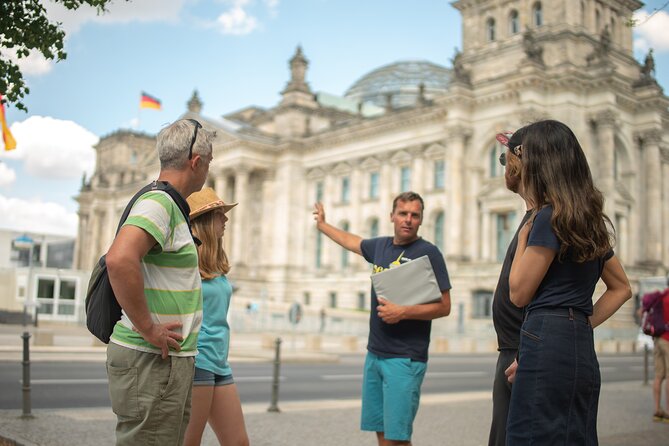
The Reichstag combines two points in the tour: the destruction of German democracy in 1933 and the military collapse of Nazi Germany in 1945.
The guide explains how the Nazis used the fire to suspend civil rights and arrest political opponents. That is an important lesson for anyone who wants to understand how dictatorship can grow through legal-looking steps, emergency powers, and public fear.
The later battle for the building shows the other end of the story. By April and May 1945, Berlin was a ruined city surrounded by Soviet forces. The Reichstag became a military objective and a symbolic prize.
You spend about 15 minutes here. Crowds and traffic can affect how easily you hear, so stay close to the guide. The building is also a useful orientation point before the route continues toward the Brandenburg Gate and Tiergarten.
Same streets, a different guide:
- Berlin: Discover Berlin Walking Tour
★ 4.9 · 5,998 reviews - Berlin’s Best: 2 Hour Walking Tour Third Reich and the Cold War
★ 5.0 · 5,486 reviews - Berlin: Hidden Backyards Guided Walking Tour
★ 4.8 · 5,360 reviews - Explore Berlin: See All The Iconic Sights & Some Hidden Gems
★ 5.0 · 4,429 reviews
The Soviet War Memorial in Tiergarten
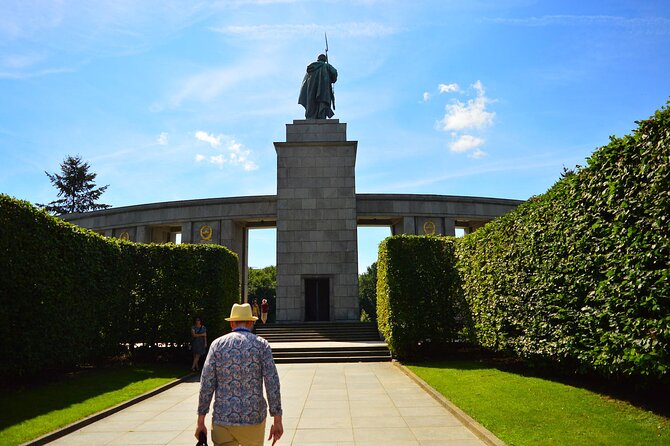
The Soviet War Memorial honors Red Army soldiers killed in the Battle of Berlin. Its large statue of a Soviet soldier and military cemetery give this stop a formal, imposing feel.
The memorial also raises a point that can be missed in simplified accounts of the war. The Soviet Union paid a huge human cost in the campaign against Nazi Germany, and Soviet forces carried out the final assault on Berlin.
At the same time, the memorial is not a simple celebration of liberation. The Battle of Berlin was intensely destructive, and the Soviet occupation that followed became part of Berlin’s later division. A good guide can hold those facts together without reducing the site to a single message.
Plan on about 15 minutes here. It is outdoors, so the wind and cold can be sharp, especially in winter.
Brandenburg Gate and the Academy of Arts
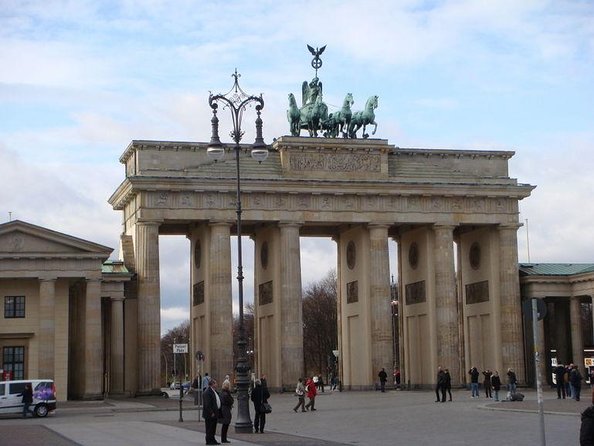
The Brandenburg Gate is one of Berlin’s most familiar sights, but its Nazi-era role is easy to overlook beneath the modern image of reunification.
The gate was used as a backdrop for Nazi public events and propaganda. It represented the regime’s preferred image of order, power, and militarism. The guide helps separate the gate’s older history and later reunification symbolism from its use during the Third Reich.
Nearby, the Akademie der Künste opens a discussion about art, architecture, and political power. Albert Speer’s monumental architectural ideas supported the Nazi image of authority and control. The academy’s later reckoning with that period fits the tour’s larger question: how did institutions and professionals become tied to dictatorship?
Each stop lasts about 10 minutes. These are brief outdoor explanations rather than visits inside the institutions. Their value comes from showing that Nazi power was not limited to military headquarters. It also used architecture, public ceremony, and culture to shape how people saw the state.
The Holocaust Memorial
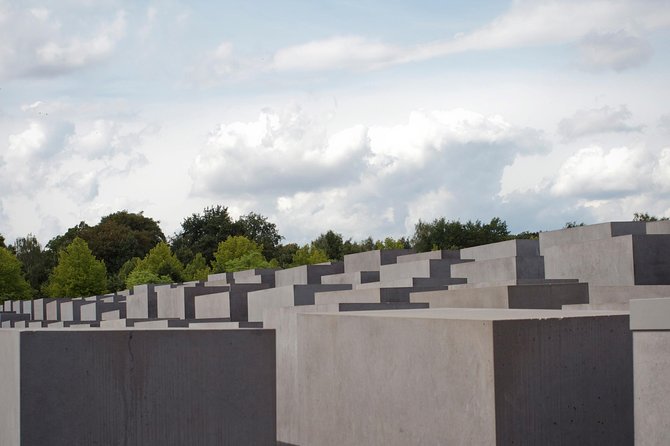
The Memorial to the Murdered Jews of Europe consists of 2,711 concrete blocks set across an uneven field. As you walk among them, the paths rise and fall, and the experience can feel disorienting.
The memorial does not provide a long written explanation on the surface. That makes the guide’s context especially useful. You learn why the memorial was created and how it fits within Berlin’s effort to confront the murder of Europe’s Jews.
This is another short stop, about 10 minutes. The tour does not replace a full visit to the memorial’s underground information center, and no separate interior visit is listed. If you want more personal stories and documentation, plan extra time after the walk.
The memorial is also a quiet change of pace. Much of the route deals with government offices, military operations, and political decisions. Here, the focus shifts more directly to human loss.
Hitler’s bunker and the old Reich Chancellery
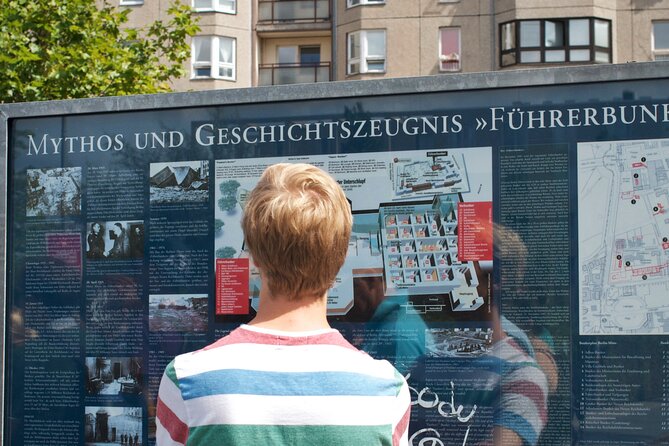
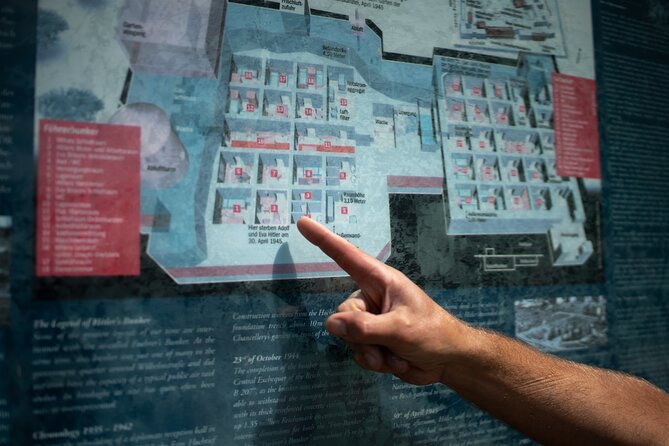
At the bunker site, you stand above the place where Hitler spent his final days. The former Reich Chancellery, associated with Albert Speer, once occupied this area, but the Nazi buildings are gone.
That absence is the point. There is no preserved command room to tour and no dramatic underground chamber waiting below. The guide explains the final collapse of the regime, Hitler’s death in April 1945, and the fighting around the government district.
One guide, Eran, was praised for revealing the bunker location only after reaching the relevant sign. That approach works because it avoids turning the site into a theatrical attraction. You first understand the setting, then learn what happened there.
This stop lasts roughly 10 minutes. Do not expect a bunker entrance or interior access. You are seeing the location and reconstructing the events through the guide’s explanation.
Wilhelmstrasse and the Nazi government quarter
Wilhelmstrasse was the administrative spine of Nazi Berlin. Offices connected to foreign affairs, the Reich Chancellery, propaganda, and military planning were concentrated here.
The important thing for you is to imagine the street as a working government district, not just a collection of old facades. Decisions made in these offices affected military campaigns, persecution, deportations, and the Holocaust.
Much of the area was destroyed or repurposed after the war. The modern surroundings can make the Nazi past hard to read without help. This is one of the clearest examples of why a guided walk gives you more than wandering alone.
The guide also connects Wilhelmstrasse to figures such as Joseph Goebbels and other senior Nazi officials. You hear how propaganda, bureaucracy, and force worked together. That broader explanation is more useful than memorizing another list of names.
Göring’s Air Ministry and Goebbels’ propaganda office
The former Reich Air Ministry was Hermann Göring’s headquarters and one of the most imposing surviving Nazi-era government buildings. It was tied to the Luftwaffe and to the administration of Germany’s air war.
The building’s scale and formal design reflect the regime’s desire to project authority. The guide places it within the wider story of military planning, including the Luftwaffe’s role in the Battle of Britain.
The tour also points to the former Ministry of Propaganda, associated with Joseph Goebbels. This is where the discussion turns from weapons and offices to the power of speeches, mass messaging, censorship, and political theater.
You do not simply hear that Goebbels made propaganda. You learn how propaganda helped build support for the regime and sustain it during war. The stop is especially useful if you want to understand why Nazi rule depended on both terror and persuasion.
The Topography of Terror finish
The walk ends at the Topography of Terror on Niederkirchnerstrasse, close to Checkpoint Charlie. The museum occupies the site of the former SS and Gestapo headquarters and focuses on Nazi repression, persecution, and the Holocaust.
This is a fitting final stop because it brings many earlier themes together. The tour has shown you where officials planned, spoke, administered, and fought. Here, you confront the institutions that carried out state terror.
The tour ends outside the museum, and the admission ticket is not listed as included. You can visit on your own afterward if time allows, but check the museum’s current opening arrangements separately.
The location is convenient for continuing your Berlin sightseeing. Checkpoint Charlie is nearby, and the area offers an easy transition to other central sights.
The resistance story behind the official buildings
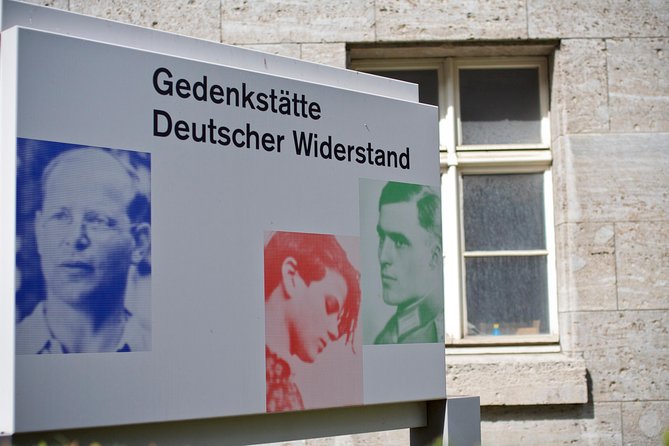
The tour does not present Nazi Berlin only through Hitler and his senior officials. It also covers opposition figures such as Henning von Tresckow, Hans Oster, and Claus von Stauffenberg.
Their stories show that resistance existed inside Germany, though it was dangerous, limited, and often divided. The focus on von Stauffenberg helps explain the failed July 20 plot and the risks taken by military and civilian opponents of Hitler.
You also hear about ordinary life under dictatorship. Air raids, fear, propaganda, restricted freedoms, and the pressure to conform are part of the picture. This makes the tour more useful than a purely military route.
The discussion of Lebensraum is another important piece. The policy was not just an expansion plan. It supported a racist and militarized worldview that helped drive invasion, occupation, mass murder, and the Holocaust.
Price, pace, and practical comfort
At $24.07 per person, the tour offers solid value if you want a structured history lesson. You receive about three hours with a local English-speaking guide, and most stops are free outdoor locations.
The price does not include hotel pickup, drop-off, or entry to the Reichstag, Holocaust Memorial information center, or Topography of Terror. Those exclusions matter less if you mainly want the route and the guide’s explanations.
The maximum group size is 25 people. That is small enough for a guide to answer questions, though a full group can be harder to hear in traffic or wind.
Wear comfortable shoes. The route is brisk and covers roughly 5,000 steps. Bring layers, especially from late autumn through early spring. One group completed it in temperatures as low as minus 7 Celsius, but cold conditions make a long outdoor walk much harder.
Service animals are allowed, and the tour is near public transportation. Most people can take part, but the walking distance and outdoor setting are the main physical considerations.
Free cancellation is available if you cancel at least 24 hours before the start time. Changes or cancellations inside that window are not accepted for a refund.
Who should book this Berlin walk?
I would choose this tour if you want the story of Nazi Berlin explained in place, rather than assembled from separate museum visits. It suits history-minded adults, older children, and teenagers who can handle serious subject matter. One family found the experience engaging for a 15-year-old, especially because the guide connected history with the fragility of democracy.
It is also useful on a short Berlin visit. In three hours, you cover sites that could take much longer to identify and connect on your own.
I would skip it if you dislike long outdoor walks, need frequent indoor breaks, or want extensive time inside museums. You should also avoid booking it without checking the weather. Cold, wet conditions can change the whole experience.
Should you book the Third Reich Berlin tour?
Book it if you want clear connections between places, people, and events, and if you are willing to walk through difficult history in all weather. The best guides, including Paul, Ru, Maria, Ru, Chris, Ciarán, Tina, and Tom, are praised for strong storytelling, clear answers, and a balanced tone.
At $24.07, it is a sensible buy for a first visit, especially when the Nazi period is a major reason for coming to Berlin. Just remember what you are booking: an outdoor walking lesson, not a bunker entry or a museum tour. Wear good shoes, dress warmly, and save time afterward for the Topography of Terror or the Holocaust Memorial information center.
FAQ
How long is the Third Reich Berlin walking tour?
The tour lasts approximately three hours.
How much does the tour cost?
The listed price is $24.07 per person.
What language is the tour offered in?
The tour is offered in English.
Where does the tour begin?
The meeting point is listed at Reichstagufer 17, 10117 Berlin. The route description also refers to Berlin Friedrichstrasse Station as the opening stop, so check the booking confirmation for the exact meeting instructions.
Where does the tour end?
It ends at the Topography of Terror, Niederkirchnerstrasse 8, close to Checkpoint Charlie.
Is hotel pickup included?
No. Hotel pickup and drop-off are not included.
Is admission to the Reichstag included?
No. Admission to the Reichstag is not included.
Which major sites are included?
The route includes the Reichstag, Soviet War Memorial in Tiergarten, Brandenburg Gate, Holocaust Memorial, Hitler’s bunker site, Wilhelmstrasse, the former Air Ministry, the former Propaganda Ministry area, and the Topography of Terror.
How much walking is involved?
You should expect a brisk three-hour walk. One practical estimate given for the route is around 5,000 steps.
What should I wear?
Wear comfortable walking shoes and dress for the weather. The tour is outdoors, and warm layers are especially important in cold conditions.
How large can the group be?
The maximum group size is 25 people.
Can I cancel for a refund?
Yes, you can receive a full refund if you cancel at least 24 hours before the experience begins. Cancellations or changes made less than 24 hours before the start time are not accepted for a refund.
New routes in Berlin
- Small Group Walking Tour: “Wild Kreuzberg”★ 4.8 · 199 reviews
- Sachsenhausen Memorial: Walking Tour from Berlin★ 4.7 · 132 reviews
- Berlin: Prenzlauer Berg District Guided Walking Tour★ 4.9 · 316 reviews
- Berlin: 2.5-Hour Walking Tour through Kreuzberg 61★ 4.9 · 525 reviews
- From Berlin: Potsdam & Sanssouci half day Walking Tour★ 4.9 · 85 reviews
- Explore Berlin: Walking Tour of All The Iconic Sites★ 4.9 · 855 reviews
- East Berlin and the Wall: Walking Tour★ 4.9 · 407 reviews
- Cold War, Berlin Wall, Spies and the East Side Gallery★ 4.8 · 254 reviews
Berlin Walking Tours, compared.
Berlin City walk Government District and Places of Democracy
Read our review →
Berlin’s Best: 2 Hour Walking Tour Third Reich and the Cold War
Read our review →
Explore Berlin: See All The Iconic Sights & Some Hidden Gems
Read our review →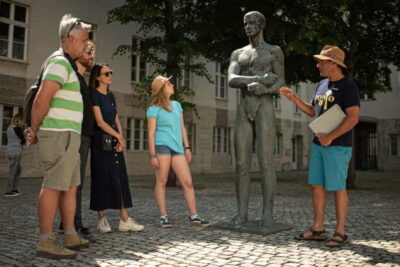
Berlin Center Food Tour with 8+ Authentic Local Tastings
Read our review →
Browse the lists this tour appears in