
Review · OSAKA
Osaka: Castle History Walking Tour / Castle Tower Admission
Osaka Castle makes far more sense when you see it as a fighting machine rather than a pretty landmark. This 90-minute walk follows the moats, gates, walls, and crooked approaches designed to slow an army, then takes you into the tower for city views and a closer look at the castle’s final defense.
I like the focus on military design, especially the masugata entrances and routes that forced attackers into exposed turns. I also like that admission to the tower is included, with a separate entrance that can save time. The main consideration is pace: the castle grounds are broad, and the tower museum itself is not guided floor by floor.
- The biggest lesson is defensive design: moats, gates, angles, and firing positions tell the story before you even enter the tower.
- The castle’s largest stone gets proper attention: you learn how builders moved huge blocks in the 16th century.
- Tower admission is included: use the separate entrance and keep more of your visit for the castle itself.
- The 1614 to 1615 siege gives the tour a strong ending: an apparently invincible fortress still fell.
- The English-speaking guides are a major part of the experience: guides have included Mao, Saya, Spike, Yuta, Kaz, Ken, Yu, and others.
- An early start can help: a 9 a.m. group may reach the castle before lines and elevator waits grow.
Why Osaka Castle Is Best Understood as a Fortress

Osaka Castle is easy to admire from a distance. Its white walls, green rooflines, and gold details look grand, but a casual visit can leave you with little sense of how the place worked. This tour starts with the less glamorous parts, the parts that mattered most to soldiers.
You’ll walk through layers of defense built to delay, confuse, divide, and expose an attacking force. The castle used triple moats, heavy stone walls, multiple gates, and controlled approaches. The point was not simply to keep an enemy outside. It was to make every step toward the center costly.
The route also explains the masugata gate design, a square enclosure that forced attackers to enter, turn, and lose momentum before reaching the next gate. An enemy could not simply charge straight through. Once trapped in the turn, soldiers could be attacked from several directions.
That idea gives the grounds a new purpose. A zigzag path is no longer just an inconvenience. A broad open area near a gate becomes a place where defenders could watch movement. A sharply angled wall becomes part of a larger plan to make climbing difficult and attacking dangerous.
I appreciate this beginning because it gives you a way to read the castle on your own later. Without that explanation, you might photograph the stones and move on. With it, the walls become a diagram of strategy.
The Meeting Point at Lawson S Otemae Rest House Store
The tour starts in front of Lawson S Otemae Rest House Store. This detail matters because there are several Lawson convenience stores nearby. Check the exact location on Google Maps before setting out, and look for the Local Guide Stars sign.
Give yourself enough time to find the correct shop. The meeting point is not simply Lawson near Osaka Castle, and arriving at the wrong branch could create a stressful start.
The walk involves historical grounds and outdoor paths, so wear comfortable shoes and dress for the weather. You will spend much of the experience outside before entering the tower. The tour is a good match for anyone interested in architecture, military planning, and Japanese history, but it is not a sit-down museum talk.
More History Walking Tours in Japan
- Tokyo: Imperial Palace and Shogun Historical Walking Tour
★ 5.0 · 2,251 reviews - Kyoto Gion: 2-Hour Geisha Culture & History Walking Tour
★ 5.0 · 1,186 reviews - Tokyo: Imperial Palace Japanese History Walking Tour
★ 4.9 · 987 reviews
Moats, Gates, and Routes Built to Trap an Army
The first major section takes you through the castle’s outer defensive system. The guide explains how the moats created distance and slowed the approach, while each gate added another obstacle.
The triple moats are especially useful to see with an explanation. Water alone does not make a fortress secure. The real strength came from combining the moats with walls, gates, narrow passages, and positions from which defenders could fire on anyone who got too close.
You’ll also walk routes that once forced attackers to change direction under fire. These turns were not accidental. They broke up an advancing formation and made it harder for soldiers to protect one another.
This is where guides such as Mao, Saya, Spike, and Yuta have earned strong praise for making the story easy to follow. Their role is not just to name a gate or repeat a date. They connect the physical layout to the problem facing an attacking army.
The amount of walking is reasonable for a 90-minute visit, but do not expect the castle grounds to feel compact. You will cover several outdoor sections, pause for explanations, and climb or move through areas leading toward the tower. If you have an older family member or someone recovering from an injury, tell the guide at the beginning. Guides have adjusted the pace for groups with mobility concerns.
The Giant Stone and the Work Behind the Walls
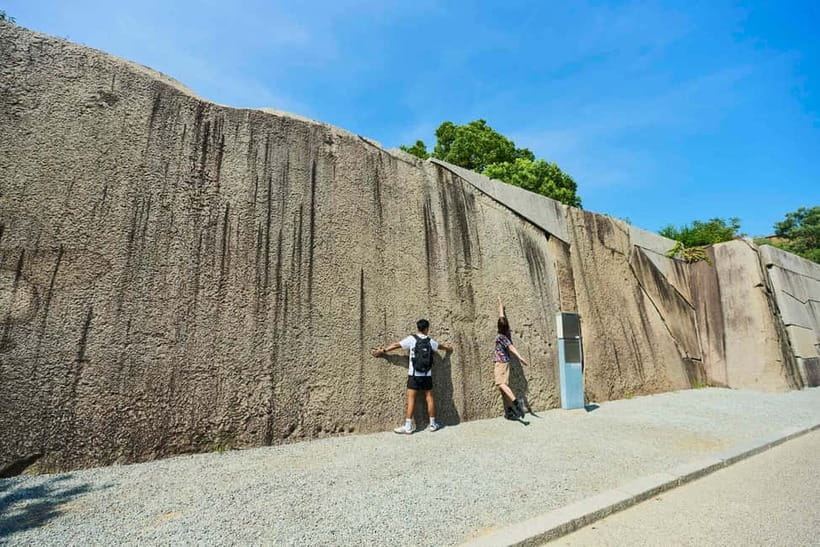
One of the tour’s most memorable stops is the castle’s largest stone. Its size makes the old construction effort easy to picture, and the guide explains how builders transported huge blocks during the 16th century.
This is a welcome change from simply admiring the wall as a finished object. You begin to notice the labor behind it: quarrying, moving, positioning, and fitting stones without modern cranes or trucks.
The guide also points out marks left by master craftsmen. These hidden symbols can be easy to miss when you explore alone. They add a human detail to the military story. The walls were built for defense, but they also reflect the skill and organization of the people who made them.
Pay attention to the stonework and wall angles. The construction was intended to make climbing difficult, not merely to look impressive. The angle, height, and smoothness of the surface all worked against an attacker trying to scale it.
This portion is particularly good for photographers because the enormous stones and carefully fitted walls give you details beyond the usual tower photograph. Still, the emphasis is on explanation, not a long stop for posed pictures.
Hokoku Shrine and the Story of Toyotomi Hideyoshi
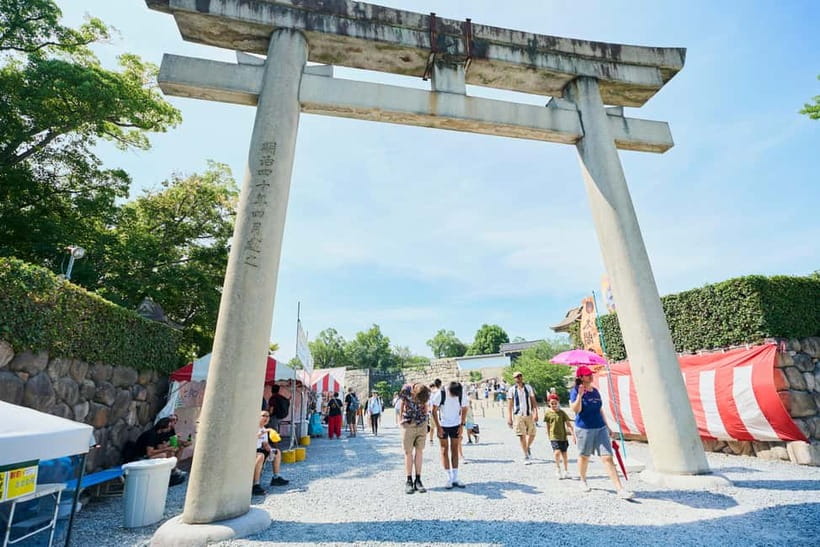
The route includes Hokoku Shrine, where you receive a guided introduction lasting about 20 minutes in the listed schedule. The shrine adds a cultural and historical layer to the castle visit because Osaka Castle is closely tied to Toyotomi Hideyoshi and the legacy he left behind.
Here the story shifts from walls and moats to power, memory, and political ambition. The castle was not just a defensive post. It represented authority, wealth, and the reach of its ruler.
A traditional wedding ceremony may sometimes be taking place at the shrine, as one guide-led visit happened to coincide with one. That is not something you can count on, but it shows why a shrine stop can add a more immediate sense of Japanese life to a history-focused outing.
Your guide can also help connect the shrine to the broader history of Osaka and Japan. Guides have been praised for answering questions about culture as well as the castle itself. That makes the stop useful even if your main interest is architecture.
More Castle and Palace Walking Tours in Japan:
- Tokyo Castle & Imperial PalaceーShogun Walking Tour
★ 4.7 · 1,068 reviews - Tokyo: Imperial Palace and Shogun Walking Tour
★ 4.9 · 935 reviews - Ultimate Osaka Walking Tour: Castle, Dotonbori & Hidden Gems
★ 5.0 · 862 reviews - Kyoto: Imperial Palace & Nijo Castle Guided Walking Tour
★ 4.7 · 453 reviews
Entering the Tower by a Separate Entrance
The tour includes an Osaka Castle Tower admission ticket. It also uses a separate entrance, described as a skip-the-line arrangement. This is one of the clearest practical benefits of booking a guided visit.
The time saved depends on the day and the crowd, so do not treat it as a guarantee of instant entry. Still, avoiding a long ticket queue can make a real difference, especially when you have a full Osaka schedule.
One guide-led group taking the 9 a.m. start found that the castle area was much busier by around 11 a.m., with longer lines for entry and the elevator. An early start is therefore worth considering if your schedule allows it.
The tour generally brings you to the tower, then leaves time for you to explore the interior on your own. This arrangement works well for many people. You get a clear explanation of the building and its setting first, then can browse the museum displays without being hurried through every room.
The limit is equally clear: there is no guided tour of every museum floor. If you want a detailed explanation of every exhibit, allow extra time after the guided portion and read the displays at your own pace.
Arrow Slits, Gun Ports, and Gold as Psychological Warfare
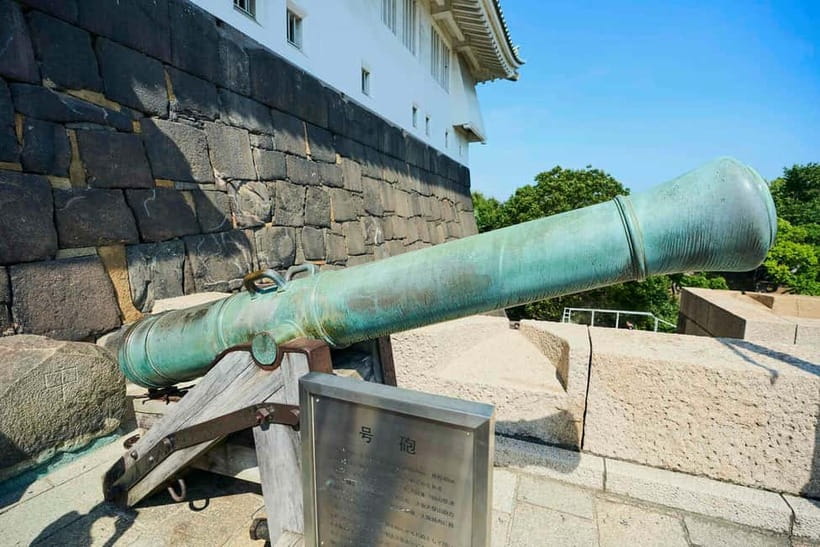
Inside and around the tower, the guide explains how the building served as a command post and final place of defense. Arrow slits and gun ports show that the tower was designed for combat, even though its appearance also projected power.
The gold decoration deserves attention. It was not merely decoration for decoration’s sake. Gold helped communicate wealth and authority, and it could intimidate an enemy before the fighting began.
That combination is one of the tour’s best ideas: a fortress could defend itself physically while also trying to shape an opponent’s expectations. Huge walls discouraged assault. Gold suggested resources and power. A commanding tower gave the ruler a visible symbol over the city.
The tower museum adds context, but the supplied experience focuses on the main points rather than a full floor-by-floor lecture. I would treat the guided portion as a strong introduction, not a replacement for independent museum time.
The View from the Top and the Castle’s Fall
The final reward is the view from the top of the castle. You can look across Osaka from a place built to watch for threats and direct defense.
The view also helps you understand scale. From ground level, the outer walls and moats can feel disconnected. From above, the castle’s position and layered layout become easier to grasp.
The story does not end with the claim that Osaka Castle was invincible. The tour explains how the fortress fell during the conflicts of 1614 and 1615, when Tokugawa Ieyasu’s ambition collided with the legacy of Toyotomi Hideyoshi.
That ending gives the entire visit a sharper edge. The castle’s defenses were clever, but clever defenses could not settle a political struggle forever. The rivalry, the sieges, and the changing balance of power matter as much as the masonry.
Several guides have used a final visual recap to tie the main points together. That can be helpful after so many gates, dates, names, and defensive features. You leave with a storyline rather than a pile of disconnected facts.
Guides, English, and the Value of Human Explanation
The listed language is English, with a professional English-speaking guide. Guide names associated with this experience include Mao, Saya, Spike, Yuta, Ken, Kaz, Yu, Kat, Ami, Sayaka, Kazu, Ukyo, and others. Your guide will depend on the day, but the repeated pattern is clear: the guide is central to the experience.
The best use of a guide here is pointing out details you would likely walk past. That includes marks on stones, the purpose of unusual wall angles, the logic of a gate, and the relationship between the castle and the shrine.
The guides also appear comfortable with questions. Some have helped families with young children stay engaged, while others have adjusted for older participants or mobility concerns. One booked visitor had a private experience because nobody else joined that departure, but you should not assume your group will be private.
The tour has earned a 4.9 rating from 230 reviews, and the praise is unusually consistent around friendliness, clear English, historical explanation, and good photo locations. That does not remove the normal limits of a group walk. The guide must balance different interests and keep the schedule moving.
Is the $33 Price Good Value?
At $33 per person, this is not the cheapest way to enter Osaka Castle. You are paying for the tower ticket, an English-speaking guide, the defensive-history walk, and the separate entrance arrangement.
I think the price is reasonable if you care about understanding what you are seeing. Osaka Castle is visually striking, but its scale and design can be hard to interpret without context. The guide turns the moats, gates, stones, and walls into a connected story.
The value is strongest if you are short on time, visiting Osaka for the first time, or likely to skip the details when exploring alone. The separate entrance can also matter on a crowded day.
The value is weaker if you prefer to move at your own pace, read every museum display, or spend a long time taking photographs. In that case, enter independently and plan a longer self-guided visit. You will still need to handle the history yourself.
The advertised duration is 90 minutes. The stop descriptions list 75 minutes at Osaka Castle, 20 minutes at Hokoku Shrine, and 25 minutes at Osaka Castle, which adds up to more than 90 minutes. Treat the timing as an approximate structure rather than a minute-by-minute promise, and check the departure details when you book.
Who Should Book This Osaka Castle Tour?
You should consider it if you enjoy history, military strategy, architecture, or stories about how rulers used buildings to project power. It also suits families because the guide can turn walls and gates into a puzzle about how an army would attack.
I would especially recommend it to anyone who wants the castle to mean more than a photograph. The explanation of the largest stone, the marks left by craftsmen, and the masugata gates gives you specific things to notice.
You may want to skip it if your priority is complete museum coverage or an unhurried photography session. The tour has a set route and a strong history focus. You will have some independent time in the tower, but not a private lecture on every floor.
Practical Details Before You Go
Book with free cancellation up to 24 hours before the activity if your schedule is uncertain. A reserve-now, pay-later option is also available.
Meet in front of Lawson S Otemae Rest House Store and confirm the exact branch on Google Maps. Look for the Local Guide Stars sign. Bring comfortable shoes and clothing suited to the weather.
The tour is in English. The castle grounds include outdoor historical areas, and the experience is built around walking, gates, walls, and tower access. If you have a mobility concern, mention it early so the guide can understand what pace works best.
Should You Book It?
Book this tour if you want Osaka Castle explained as a functioning fortress, not just presented as an attractive tower. The strongest parts are the defensive layout, the giant stone, the hidden craftsman marks, the included tower admission, and the final view over Osaka.
I would choose an early departure, especially if you want to reduce the chance of long entry or elevator lines. Allow extra time afterward for the museum because the guide does not lead you through every floor.
For $33, this is a solid choice for a first visit and a particularly good one for history-minded families, couples, and solo visitors who want a clear story. Skip it only if you already know the castle’s military history or prefer to explore entirely on your own.
FAQ
Where does the Osaka Castle tour meet?
Meet in front of Lawson S Otemae Rest House Store. There are multiple Lawson stores nearby, so confirm the correct location on Google Maps and look for the Local Guide Stars sign.
How long is the experience?
The advertised duration is 90 minutes. The route includes guided time at Osaka Castle and Hokoku Shrine, followed by castle tower access and independent exploration.
Is Osaka Castle admission included?
Yes. An Osaka Castle Tower admission ticket is included in the price.
Does the tour skip the castle ticket line?
The tour uses a separate entrance for skip-the-line access. The amount of time saved can vary with conditions and crowd levels.
Is the tour conducted in English?
Yes. The experience includes a live English-speaking guide.
Does the guide explain every floor of the castle museum?
No. The tour includes the tower ticket, but guided commentary for each museum floor is not included. You can explore the museum independently.
What should I bring?
Bring comfortable shoes and clothing suited to the weather. The experience includes walking through outdoor historical areas.
Can I cancel for a full refund?
Yes. You can cancel up to 24 hours in advance for a full refund. A reserve-now, pay-later option is also available.
New routes in Japan
- Tokyo: Asakusa & Sensoji ー Oldest Temple Walking Tour (2hrs)★ 5.0 · 213 reviews
- Asakusa Cultural Walk & Matcha Making Tour★ 5.0 · 245 reviews
- Asakusa Senso-ji Temple and Old Tokyo Walking Tour★ 5.0 · 560 reviews
- Tokyo: Tsukiji Market Walking Tour & Sushi Cooking Class★ 4.6 · 122 reviews
- Tokyo: Shinjuku Nightlife & Secret Backstreets Walking Tour★ 4.8 · 229 reviews
- Tokyo: Shinjuku Bar Hopping & Night Walking Tour★ 4.6 · 137 reviews
- Tokyo: Dark Side of Tokyo Shinjuku Red Light Walking Tour★ 4.7 · 862 reviews
- Tokyo: Shibuya Highlights Walking Tour★ 4.8 · 601 reviews
Osaka Walking Tours, compared.

Hotspots & Hidden Gems Walking Tour Private or Group
Read our review →
Osaka Local Foodie Walking Tour in Dotonbori and Shinsekai
Read our review →
Deep Backstreets Walking Tour with Dinner Option
Read our review →
Ultimate Osaka Walking Tour: Castle, Dotonbori & Hidden Gems
Read our review →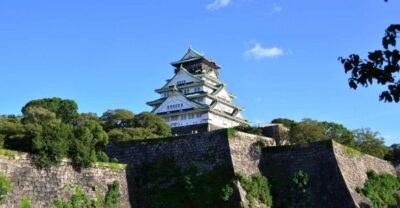
Main Sights and Hidden Spots Guided Walking Tour
Read our review →

Kuromon Market Food Walking Tour (6 stops, 6 tastes)
Read our review →
Browse the lists this tour appears in