
Review · BERLIN
Berlin: Sightseeing Walking Tour of the Top 20 Attractions
Berlin’s story is too large for one museum visit, but this three-hour walking tour gives you a sharp first look at the city’s defining places. You move from the government district and Brandenburg Gate through Nazi and Cold War sites, then finish among the grand buildings of Museum Island. The route is ambitious, covering about 6 kilometers, but it gives you a useful map of Berlin before you explore on your own.
I like two things in particular. First, the guide connects grand monuments with human stories, including Berlin’s division and the fall of the Wall. Second, the route includes more than the usual central highlights, with Checkpoint Charlie, the Topography of Terror, Potsdamer Platz, and longer stretches of Berlin’s historic center. The main consideration is simple: six kilometers in three hours can be tiring, especially in rain, cold, or summer heat.
What makes this Berlin walk worthwhile
- A route from the Reichstag to Friedrichsbrücke: You cross much of central Berlin on foot, ending beside Museum Island.
- Nazi and Cold War history included: Checkpoint Charlie, the Topography of Terror, the Holocaust Memorial, and Berlin Wall sites add weight beyond postcard views.
- Local humor and personal stories: Guides such as Carlos and Carlo are praised for warm delivery, strong English, and firsthand knowledge of Berlin’s changes.
- Plenty of photo opportunities: The schedule allows stops at major landmarks, and one private outing gave two people time to photograph each site.
- Small-group or private format: The guide can adapt the conversation to your interests and questions.
- Useful first-day orientation: You finish with a clearer sense of where Berlin’s central neighborhoods and major museums sit.
Starting beside the German Chancellery
The meeting point is in front of the main entrance to the Paul-Löbe-Haus, at Konrad-Adenauer-Straße 1, opposite the Federal Chancellery. This is a practical place to begin because you are immediately in Berlin’s government district, rather than spending the first part of the tour walking from a tourist meeting area.
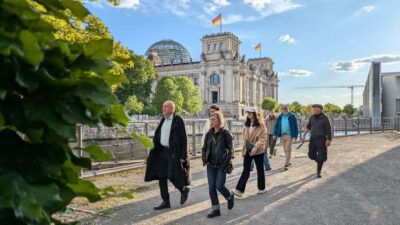
Your guide starts with the German Chancellery and the Paul-Löbe-Haus, then takes you toward the Reichstag. This opening gives you a look at modern German government before the tour moves into older royal Berlin and the city’s darker twentieth-century chapters.
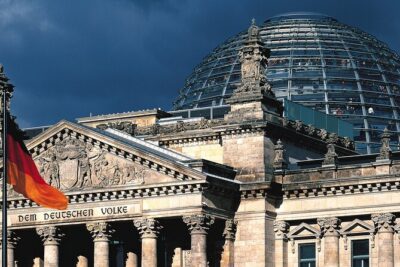
The Reichstag is one of Berlin’s most recognizable buildings, with its historic shell and modern parliamentary role. You should expect an exterior visit and guided commentary rather than a full parliamentary tour. The building makes a strong first stop because it introduces the city’s repeated pattern of destruction, change, and rebuilding.
From here, the route heads toward Brandenburg Gate. This is the classic Berlin image, but its importance goes beyond architecture. The gate has witnessed Prussian power, Nazi spectacle, Cold War division, and German reunification. A good guide can turn what looks like a single monument into a quick lesson in how Berlin’s political meaning has changed.
More City Highlights Walking Tours in Germany
- Berlin Historical Highlights Walking Tour
★ 4.9 · 657 reviews - Berlin: Walking Tour of the Top 10 Sightseeing Attractions
★ 4.7 · 150 reviews - Berlin : Must-see attractions Walking Tour
★ 4.8 · 83 reviews
Brandenburg Gate and the Holocaust Memorial
Brandenburg Gate is one of the places where the tour’s fast pace pays off. You get the landmark early, while the guide can still place the rest of the route in context. Ask about the gate’s role during the divided-city years, since this is where Berlin’s history shifts from imperial grandeur to twentieth-century conflict.
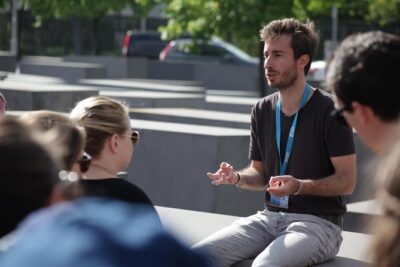
A short walk brings you to the Memorial to the Murdered Jews of Europe, usually called the Holocaust Memorial. The concrete blocks create a stark, uneasy space in the middle of central Berlin. You are given guided explanation and free time here, which matters. This is not a stop to rush through while taking a single photograph.
The memorial calls for a quieter pace than the earlier government district. I appreciate that the schedule allows you to experience the site rather than only hear a speech beside it. Still, the tour has many stops, so your free time will be limited compared with visiting independently.
Potsdamer Platz and the changing city
Potsdamer Platz shows a different Berlin. Once cut through by the Wall and left divided during the Cold War, it became a symbol of reunified Berlin’s new commercial center. The contrast with Brandenburg Gate and the Holocaust Memorial is useful: here, the guide can explain how an area shaped by war and division became a modern urban district.
This section also helps you understand the city’s scale. Berlin’s central sights are not all clustered around one small square. The walk links them through streets where the past is often mixed with ordinary offices, shops, traffic, and new construction.
You will want comfortable shoes from the start. The tour covers roughly 6 kilometers, and the ground is not always the same underfoot. Bring water, especially for the 2:00 PM departure in warm weather. The tour runs in all weather, so a rain jacket or suitable coat is sensible.
Checkpoint Charlie and the Topography of Terror
Checkpoint Charlie is one of Berlin’s most famous Cold War sites. The former crossing point has strong symbolic value, but the present-day setting can feel busy and commercial. That is precisely why a guide helps here. You can separate the original history of the crossing from the modern photo opportunity.
The route then continues to Martin-Gropius-Bau and the Topography of Terror. The memorial and documentation center occupy the former grounds of the Gestapo headquarters. This is one of the tour’s most important additions because it places Nazi persecution directly into the city center, rather than treating the period as a distant chapter.
The Topography of Terror can be a demanding stop. You may hear difficult facts, and the surrounding area does not soften them. The benefit is that the tour does not present Berlin only as a city of palaces and grand avenues. It asks you to look at the evidence of dictatorship and understand how close these events remain to the modern streets around you.
The route includes key Berlin Wall history and longer sections of the Wall than a basic central highlights walk. The exact amount of remaining Wall material you see depends on the guide’s route and timing, but the Cold War section gives the tour more substance than a quick stop at a reconstructed guardhouse.
More City Highlights Walking Tours in Berlin:
- Ho Chi Minh City Street Food Tour & Sightseeing By Motorbike
★ 5.0 · 9,413 reviews - Historic Charleston Guided Sightseeing Walking Tour
★ 5.0 · 6,216 reviews - Dublin Highlights and Hidden Gems Guided Walking Tour
★ 5.0 · 6,020 reviews - Vienna: Guided Walking Tour of City Center Highlights
★ 4.7 · 4,989 reviews
Gendarmenmarkt and Bebelplatz
Gendarmenmarkt changes the mood again. The square is known for its elegant architecture and the French and German cathedrals, with the Konzerthaus between them. It is one of central Berlin’s finest urban spaces and a welcome visual pause after the harder history around Checkpoint Charlie and the Topography of Terror.
Your guide also takes you to Bebelplatz, a square with a painful connection to the Nazi book burning of 1933. A memorial set into the pavement is easy to miss if you walk through quickly. This is exactly the kind of detail that turns a sightseeing route into a more thoughtful city walk.
Bebelplatz is not simply another attractive square. It shows how Berlin’s history can be found in small markers beneath your feet, not just in large monuments. I would give your full attention here, even if the tour’s overall schedule remains brisk.
The route continues along Unter den Linden, Berlin’s grand historic boulevard. This connects the former royal center to Museum Island and helps explain the city’s Prussian past. You see how political power, university life, museums, churches, and public squares were arranged along one important axis.
The New City Palace, Lustgarten, and Berlin Cathedral
The New City Palace is among the major sights included on the route. Its reconstructed exterior brings the former royal center back into Berlin’s view, while its present cultural use reflects the city’s habit of layering old and new identities.
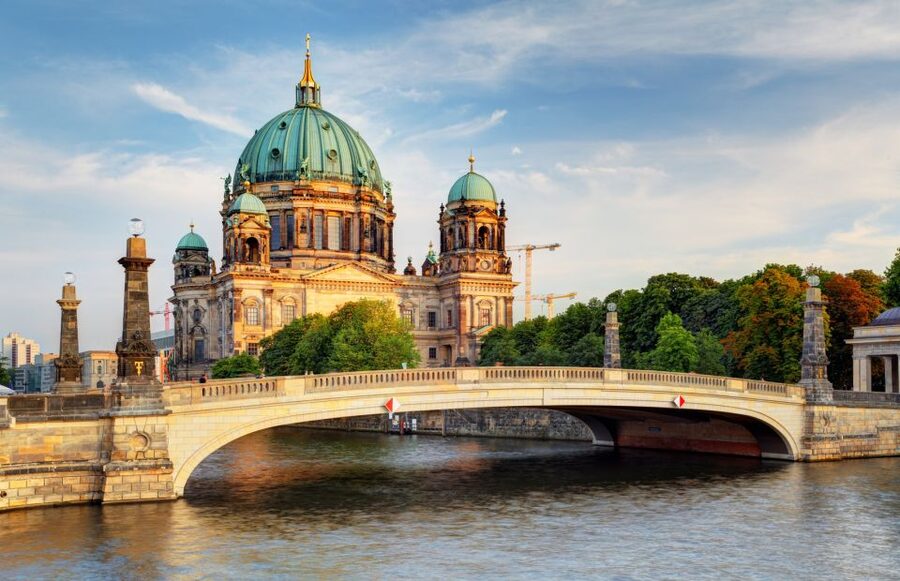
At Lustgarten, the setting opens around Berlin Cathedral, the Altes Museum area, and the broad space beside the Spree. This is one of the most photogenic parts of the walk. The grand buildings are close together, so you get a strong sense of Berlin as a museum and ceremonial city.
Berlin Cathedral is not only a striking facade. It helps anchor the story of Prussian Berlin and the development of Museum Island. You should expect a guided exterior visit rather than a full interior tour. If you want to see the cathedral inside, climb its dome, or spend time in the royal crypt, you would need a separate visit after the walk.
The advantage of seeing the cathedral with a guide is context. You learn why this part of Berlin matters, rather than simply collecting another photograph. The drawback is limited time. A three-hour route cannot give every building the attention it deserves.
Museum Island and the final bridge
Museum Island brings the walking tour to its natural climax. The complex includes major museum buildings such as the Alte Nationalgalerie, and the route gives you an overview of the island’s cultural importance without requiring admission to each museum.
You should not expect an extended gallery visit. The tour is about the city outside the museums, the placement of the buildings, and the story of Berlin’s cultural center. If you plan to visit the Pergamon Museum, Neues Museum, Bode Museum, or Alte Nationalgalerie, save another half-day or more for those interiors and check current opening information separately.
The walk finishes at Friedrichsbrücke. Ending here is useful because you are already near Museum Island and central Berlin’s riverfront. You can continue sightseeing, find a meal, or use the nearby city connections, although the tour description does not promise transport assistance at the finish.
The guides and the human side of the tour
The guide can make or break a history walk, and the strongest names associated with this experience are Carlos, Carlo, Antonella, and Max. Carlos is praised for warmth, strong English, personal stories, and a close connection to Berlin’s history. One group found that he extended the tour by about 30 minutes, while another appreciated that he stopped for a hot drink during a wet and windy day.
That extra time is a pleasant possibility, not something you should count on. You may have another appointment after the tour, so keep your schedule flexible if you hope for a longer conversation.
Carlo is also described as a native Berliner who brought personal experience to the story of the Wall’s fall and the city’s changes. Antonella and Max receive praise for friendly, warm guiding. The common strength is not a scripted list of dates. It is the guide’s ability to answer questions, add local observations, and use dry Berlin humor without losing sight of serious subjects.
The activity is available in English, Spanish, and German. Private and small-group options are offered, and the guide can adapt the discussion to your interests. A small group is especially useful at busy sites, where it is easier to hear and ask questions than in a large crowd.
What the $94 price means
At $94 per person, this is not Berlin’s cheapest walking tour. The value depends on how much structure and personal attention you want.
You are paying for a certified local guide, a full three-hour route, a small-group or private format, and a large sweep of central Berlin. A self-guided walk can cover many of the same streets for little money, but it will not give you live answers, local anecdotes, or a guide who can connect Checkpoint Charlie with Potsdamer Platz, Bebelplatz, and the government district.
The price makes more sense for a first visit, a short stay, or a family and small group that wants a clear overview quickly. It is less appealing if you prefer to spend 30 minutes inside each museum, move at a slow pace, or already know central Berlin well.
The tour offers free cancellation up to 24 hours before departure and reserve-now, pay-later booking. Those terms help if your plans are still shifting. The daily start times are 10:00 AM and 2:00 PM, so the morning option leaves your afternoon open for a museum, while the afternoon option works well after a relaxed morning.
Who should book this walk
I would choose this tour for a first-time Berlin visit, particularly if you want the city’s main political, royal, Nazi, and Cold War sites explained in one session. It also suits couples, families, older visitors who can manage the distance, and small groups that want to ask plenty of questions.
It is a good fit if you enjoy history but do not want a dry lecture. The mix of personal stories, humor, architecture, and difficult subjects keeps the walk varied.
I would hesitate if you have limited mobility, dislike walking in poor weather, or want extensive museum time. The tour is listed as wheelchair accessible, but the distance and three-hour duration still make it sensible to discuss your needs when booking. Also remember that accessible does not mean effortless: six kilometers is a substantial outing.
Practical tips for getting the most from the route
Wear comfortable walking shoes and bring water. A camera is worthwhile because the route includes the Reichstag, Brandenburg Gate, Gendarmenmarkt, Berlin Cathedral, Museum Island, and several broad city views.
Arrive at the Paul-Löbe-Haus meeting point with enough time to identify the main entrance. Look for the TourguideMe guide. Since the route runs in all weather, dress for the forecast and carry rain protection when needed.
I would book this early in your Berlin stay. The guide’s neighborhood tips about food, nightlife, and areas to explore can help shape the rest of your visit. Ask questions about places you plan to see later, and tell the guide if you care most about architecture, Nazi history, the Wall, politics, or local life.
Should you book the Berlin Top 20 walk?
Book it if you want a fast but serious introduction to Berlin, with the city’s famous sights tied to the events that shaped them. The strongest features are the broad route, the inclusion of Topography of Terror and Bebelplatz, and the personal style associated with guides such as Carlos and Carlo.
Skip it if you want a slow museum day or dislike covering long distances on foot. At $94, the value comes from the live guide, flexible discussion, and amount of ground covered, not from entry tickets or long interior visits. For the right pace and interests, it can turn your first three hours in Berlin into a clear, useful starting point.
FAQ
How long is the Berlin sightseeing walking tour?
The tour lasts three hours, or 180 minutes, and covers approximately 6 kilometers on foot.
Where does the tour begin?
It begins in front of the main entrance to the Paul-Löbe-Haus, opposite the Federal Chancellery, at Konrad-Adenauer-Straße 1 in Berlin.
Where does the tour finish?
The walk finishes at Friedrichsbrücke near Museum Island.
What time does the tour start?
Tours are scheduled daily at 10:00 AM and 2:00 PM. Availability should be checked for your chosen date.
Which languages are available?
The live tour guide is available in English, Spanish, and German.
Is the tour private or shared?
Private and small-group options are available.
Can I cancel the booking?
You can cancel up to 24 hours before the tour for a full refund. Reserve-now, pay-later booking is also available.
New routes in Berlin
- Small Group Walking Tour: “Wild Kreuzberg”★ 4.8 · 199 reviews
- Sachsenhausen Memorial: Walking Tour from Berlin★ 4.7 · 132 reviews
- Berlin: Prenzlauer Berg District Guided Walking Tour★ 4.9 · 316 reviews
- Berlin: 2.5-Hour Walking Tour through Kreuzberg 61★ 4.9 · 525 reviews
- From Berlin: Potsdam & Sanssouci half day Walking Tour★ 4.9 · 85 reviews
- Explore Berlin: Walking Tour of All The Iconic Sites★ 4.9 · 855 reviews
- East Berlin and the Wall: Walking Tour★ 4.9 · 407 reviews
- Cold War, Berlin Wall, Spies and the East Side Gallery★ 4.8 · 254 reviews
Berlin Walking Tours, compared.
Berlin City walk Government District and Places of Democracy
Read our review →
Berlin’s Best: 2 Hour Walking Tour Third Reich and the Cold War
Read our review →
Explore Berlin: See All The Iconic Sights & Some Hidden Gems
Read our review →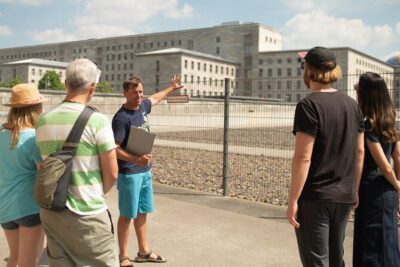
Third Reich Berlin: Hitler and WWII Walking Tour
Read our review →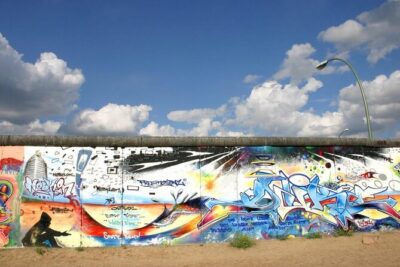
Berlin Center Food Tour with 8+ Authentic Local Tastings
Read our review →
Browse the lists this tour appears in