
Review · BERLIN
Berlin: Walking Tour of the Top 10 Sightseeing Attractions
Berlin’s story comes at you fast on this four-kilometer walk through the city center, from the modern government district to Museum Island. You’ll see the Reichstag, Brandenburg Gate, Holocaust Memorial, Gendarmenmarkt, Bebelplatz, Berlin Cathedral, and several other major sights without spending half a day on one museum.
I like the clear route and the guides’ lively approach. You get a useful first look at Berlin’s Prussian, Nazi, Cold War, and post-reunification story, plus time for photos. The main drawback is the pace: two hours is tight, so expect an overview rather than long visits inside individual attractions. The tour is outdoors in all weather, too.
- Brandenburg Gate at the center: Stand at Berlin’s best-known landmark and take in the embassies, Hotel Adlon, Victory Column, and Soviet War Memorial.
- A smart city orientation: Move from the Chancellery and Reichstag to Unter den Linden, Gendarmenmarkt, Bebelplatz, and Museum Island.
- History with personality: Guides use local humor, anecdotes, and clear explanations rather than giving you a dry list of dates.
- About 4 km on foot: Wear comfortable shoes and expect steady walking with stops for photos and commentary.
- Small-group and private options: The format can feel personal, with guides able to respond to questions.
- A useful first-day choice: The route gives you a map in your head before you return to explore museums and memorials at your own pace.
Starting beside the Chancellery at Paul-Löbe-Haus

The tour begins at the main entrance of the Paul-Löbe-Haus, at Konrad-Adenauer-Straße 1, directly opposite the Federal Chancellery. This places you in Berlin’s modern government district, not beside the older monuments most people picture first.
That is a good opening. Berlin is not just grand boulevards and old stone buildings. Its current political center has a clean, modern feel, and the starting point lets you see that side of the city before the walk turns toward older landmarks.
From here, you can look toward the Federal Chancellery, Berlin Central Station, and the Bell Tower in Tiergarten. The guide uses this first stretch to explain the area and set up Berlin’s modern political story.
You should arrive ready to walk, not expecting a bus tour with frequent sitting breaks. The route covers about 4 km, and the start and finish are in different places. That one-way design saves you from retracing your steps, but you should plan your onward journey from Friedrichsbrücke at the end.
The Reichstag and Berlin’s modern political heart

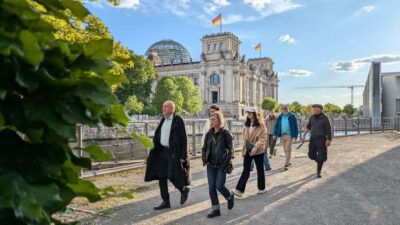
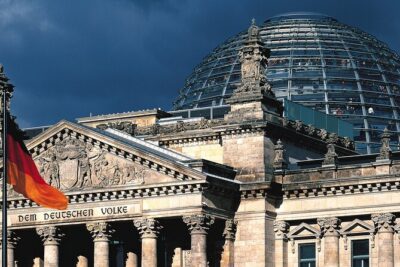
The route continues toward the Reichstag, home of the German Parliament. You’ll view the building from outside and hear about its place in Germany’s political story.
The Reichstag works well early in the tour because it connects the city’s past with its present. Berlin has seen empire, revolution, dictatorship, division, and reunification. The parliament building sits right in that chain of events.
Do not expect a full Reichstag visit or a trip to the glass dome. The experience described here is a guided walk and sightseeing stop, not an interior tour. If the dome is on your Berlin wish list, you’ll need to arrange that separately.
More City Highlights Walking Tours in Germany
- Berlin Historical Highlights Walking Tour
★ 4.9 · 657 reviews - Berlin: Sightseeing Walking Tour of the Top 20 Attractions
★ 4.5 · 196 reviews - Berlin : Must-see attractions Walking Tour
★ 4.8 · 83 reviews
Brandenburg Gate, Berlin’s great photo stop
Brandenburg Gate is the tour’s main visual moment. It was once tied to Prussian power, later became a symbol of a divided city, and now represents a united Germany. The guide gives you the context, while you get time to look around and take photos.
The setting helps tell the story. From the gate, you can see the American and French embassies, the Hotel Adlon, and, farther away, the Victory Column and Soviet War Memorial. Those sight lines show how many layers of Berlin’s political past sit within a short walk.
This is one of the strongest parts of the route for first-time visitors. You get the landmark itself, but also the surrounding geography. That matters because Berlin’s monuments make more sense when you know what lies beyond them.
Your guide should allow time to take in the view. Max, one of the guides, was specifically praised for answering questions and giving people time for photos and reflection. That is useful at Brandenburg Gate, where the surroundings can be as interesting as the monument.
The Holocaust Memorial and a serious change of tone
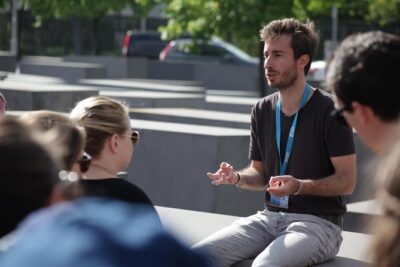
The next major stop is the Memorial to the Murdered Jews of Europe, commonly called the Holocaust Memorial. The block field creates a quieter, more serious section of the walk after the grand openness of Brandenburg Gate.
This stop needs attention and respect. The tour presents it as part of Berlin’s broader story, alongside the Nazi era, the Cold War, and the fall of the Wall. You will receive guided context, but the schedule does not allow for an extended visit to the underground information center.
That limitation is worth knowing before you book. A short stop can help you locate the memorial and understand its purpose, but it cannot replace dedicated time at the site. If this is a central interest for you, plan to return later.
Potsdamer Platz and Berlin’s sharpest contrast
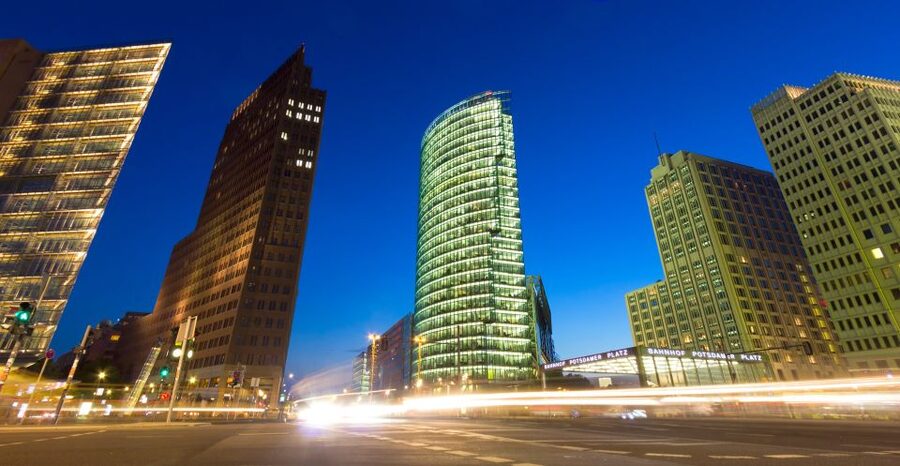
Potsdamer Platz adds another piece to the city’s modern story. Once divided by the Berlin Wall, the area is now known for contemporary development and wide urban spaces.
On this walk, you see the area as part of the route rather than as a separate architectural tour. The guide’s role is to connect the present-day setting with Berlin’s division and reunification. That quick contrast is useful: in a few minutes, you move from Nazi-era memory to Cold War geography and a rebuilt city.
The stop may feel brief if you want a detailed look at individual buildings. Still, it gives you a clear sense of how quickly Berlin changed after the Wall fell.
More City Highlights Walking Tours in Berlin:
- Ho Chi Minh City Street Food Tour & Sightseeing By Motorbike
★ 5.0 · 9,413 reviews - Historic Charleston Guided Sightseeing Walking Tour
★ 5.0 · 6,216 reviews - Dublin Highlights and Hidden Gems Guided Walking Tour
★ 5.0 · 6,020 reviews - Vienna: Guided Walking Tour of City Center Highlights
★ 4.7 · 4,989 reviews
Unter den Linden leads into older Berlin
From the Brandenburg Gate area, the walk follows Unter den Linden, Berlin’s famous boulevard. This is where the tour shifts from modern government and twentieth-century trauma toward Prussian power, royal planning, and the older center.
The boulevard links several of the tour’s most important stops. Walking it helps you understand the layout of central Berlin better than simply arriving at each sight by taxi or train.
Your guide brings the route alive with stories and local humor. That style matters here because Unter den Linden can otherwise feel like one long sequence of imposing buildings. The commentary gives the avenue a human scale and points out the people, decisions, and conflicts behind the stone facades.
Gendarmenmarkt and three major buildings
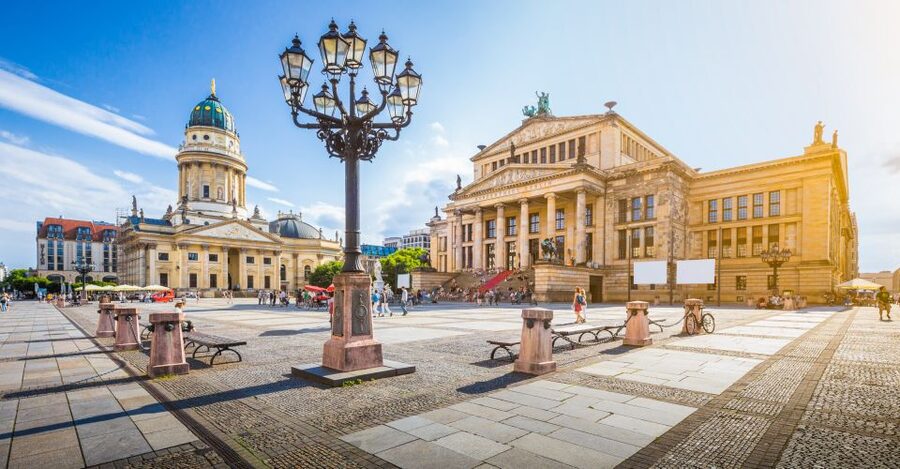
Gendarmenmarkt is one of Berlin’s most handsome squares, with the German Cathedral, French Cathedral, and Konzerthaus facing one another. It is a natural pause point and one of the tour’s best architectural scenes.
The square also shows Berlin’s habit of placing political, religious, and cultural buildings close together. You get a visual lesson in the city’s ambitions without needing a separate museum visit.
The tour focuses on guided sightseeing rather than interior access. Take a moment to photograph the three-part composition, but remember that a two-hour route cannot offer detailed commentary on every facade.
This stop is especially useful if you want a quick overview of central Berlin’s architecture. You see scale, symmetry, and the city’s old public face, then continue to places where the historical story becomes more pointed.
Bebelplatz and the memory of book burning
Bebelplatz is one of the most meaningful stops on the route. It is associated with the Nazi book burning of 1933, when works by Jewish, socialist, communist, and other writers were destroyed in a public spectacle.
The guide explains the event and the memorial at the square. The location is striking because the surrounding buildings are elegant and formal, yet the ground carries a warning about censorship and dictatorship.
You have some free time here, which is welcome. This is a place where you may want to pause rather than simply take a quick photograph. The underground memorial, visible through a glass panel, is easy to miss without guidance, so listen closely when the guide points out the details.
Bebelplatz is also a good example of why this tour works best as an introduction. You receive the essential context, then you can choose to return for a slower visit if the subject speaks to you.
Lustgarten, Berlin Cathedral, and Museum Island
The route continues to Lustgarten, the open space in front of Berlin Cathedral and near Museum Island. Here, the city’s royal, religious, cultural, and modern identities meet in one compact area.
Berlin Cathedral is an imposing landmark, with its large dome and formal riverfront setting. The tour includes a guided look from outside. It does not include an interior visit, so set aside separate time if you want to see the church inside.
Museum Island is one of Berlin’s key cultural districts, home to major museums and monumental buildings. The walk gives you a useful orientation to the area, helping you decide where to spend more time later.
For me, this is one of the most practical benefits of the route. A guide can show you how the cathedral, Lustgarten, Museum Island, and the nearby palace area fit together. Afterward, you can return with a better plan instead of wandering between buildings without knowing what you are seeing.
The New City Palace and the TV Tower view
The tour also passes the Berlin City Palace, rebuilt as the Humboldt Forum, with a view toward the TV Tower. This is a particularly good place to see the city’s old and new symbols in one frame.
The palace site connects to Berlin’s Prussian past, while the TV Tower points to the former East Berlin and the years of division. The pairing gives you a quick visual lesson in the city’s competing identities.
The route then heads toward Nikolaiviertel, described as the birthplace of Berlin dating back to 1237, before finishing at Friedrichsbrücke. The walk does not promise a full exploration of the quarter, but it places you close to one of the oldest parts of the city.
Because the finish comes near the river and Museum Island, you have several sensible options afterward: continue sightseeing, visit a museum, stop for food, or use nearby public transport. The tour’s end is more useful than finishing back at the starting point because you remain in the historic center.
What the two-hour format really gives you
Two hours is enough to connect the major sights, but not enough to explore them in depth. Think of this as a guided orientation with historical interpretation, not a substitute for museum visits or memorial tours.
The pace is likely to feel brisk. You will stop at each major location, hear the main story, and walk on. That works well if you have limited time, are in Berlin for a short stay, or want a clear first look before choosing what deserves a longer visit.
The route also covers a lot of ground without requiring transport. That is valuable in Berlin, where the main sights are spread across a broad central area. You finish with a stronger sense of how the government district, Brandenburg Gate, Unter den Linden, Gendarmenmarkt, Bebelplatz, and Museum Island relate to one another.
The tradeoff is depth. You will not have long, quiet periods at every memorial, and you will not enter every landmark. Bring a camera, but also bring water and shoes that can handle steady walking.
Guide style, languages, and group size
The tour is offered in English, Spanish, and German. Private and small-group formats are available, which is useful if you want more room for questions or prefer a less crowded experience.
The strongest praise has centered on the guides’ preparation, friendliness, and willingness to answer questions. One guide, Max, was singled out for making time for photographs and allowing the group to take in the sights. Another guide extended the tour beyond the planned time, giving the group extra explanation.
Those details suggest that the guide can shape the experience. A lively storyteller makes the long walk easier, while a guide who responds to questions can adjust the balance between dates, anecdotes, and practical city advice.
The advertised style includes Berliner humor. That can make difficult subjects easier to follow, but the serious memorial stops still require a respectful tone. Expect a mix of wit and weight, not a comedy walk.
Price, timing, and practical value
At $82 per person, this is not the cheapest way to see Berlin’s center. The price makes the most sense if you value a live guide, a small or private group, and a carefully planned route covering many major sights in two hours.
For a first visit, the value is strongest when your time is limited. You see a large section of central Berlin without arranging several separate stops, and you get historical links that are easy to miss when walking alone.
The tour runs daily at 10:00 AM and 2:00 PM. The morning departure leaves much of the day open for museums, while the afternoon option works well if you want a slower start. Check the current schedule when booking, since availability is required.
Free cancellation is available up to 24 hours before the tour, and you can reserve now and pay later. The walk runs in all weather, so bring water, comfortable shoes, and clothing suited to the forecast. It is wheelchair accessible, though you may want to confirm the exact route conditions for your needs before booking.
Who should book this Berlin walk?
I would recommend it to first-time visitors who want a strong overview, families who prefer stories to long museum sessions, and anyone with only a short stay in Berlin. It also suits people who like walking from one major sight to the next rather than using transport between isolated attractions.
It is a good match for history-minded visitors who want a guide to explain the Nazi era, Cold War, reunification, Prussian rule, and the city’s modern government district in one continuous story.
You may want something else if you prefer slow photography, extensive museum time, or detailed architectural study. The route is full, and two hours leaves little room for lingering at every stop.
Should you book this tour?
Book it if you want a fast, well-organized introduction to central Berlin with a live guide, local humor, and plenty of major landmarks. The route is broad, the historical range is impressive, and the stop at Brandenburg Gate, Bebelplatz, and Museum Island gives you a useful framework for the rest of your stay.
Skip it if you already know central Berlin well or want interior visits and long periods at memorials. For most first-time visitors, though, the walk offers a practical way to get your bearings, learn the city’s main stories, and decide where to return for a closer look.
FAQ
How long is the Berlin walking tour?
The tour lasts two hours, or 120 minutes, and covers approximately 4 km on foot.
Where does the tour begin?
It begins in front of the main entrance of Paul-Löbe-Haus at Konrad-Adenauer-Straße 1, opposite the Federal Chancellery.
Where does the tour finish?
The walk finishes at Friedrichsbrücke, near Berlin’s historic center and Museum Island.
What time does the tour start?
Tours are scheduled daily at 10:00 AM and 2:00 PM. Check availability for the date you want.
Which sights are included?
The route includes the German Chancellery, Reichstag, Brandenburg Gate, Holocaust Memorial, Potsdamer Platz, Gendarmenmarkt, Bebelplatz, Lustgarten, Berlin Cathedral, Museum Island, and the New City Palace area.
Is the tour available in languages other than English?
Yes. Live guides are available in English, Spanish, and German.
Is the tour wheelchair accessible?
Yes, the activity is listed as wheelchair accessible. It is still sensible to confirm route details for your specific mobility needs before booking.
New routes in Berlin
- Small Group Walking Tour: “Wild Kreuzberg”★ 4.8 · 199 reviews
- Sachsenhausen Memorial: Walking Tour from Berlin★ 4.7 · 132 reviews
- Berlin: Prenzlauer Berg District Guided Walking Tour★ 4.9 · 316 reviews
- Berlin: 2.5-Hour Walking Tour through Kreuzberg 61★ 4.9 · 525 reviews
- From Berlin: Potsdam & Sanssouci half day Walking Tour★ 4.9 · 85 reviews
- Explore Berlin: Walking Tour of All The Iconic Sites★ 4.9 · 855 reviews
- East Berlin and the Wall: Walking Tour★ 4.9 · 407 reviews
- Cold War, Berlin Wall, Spies and the East Side Gallery★ 4.8 · 254 reviews
Berlin Walking Tours, compared.
Berlin City walk Government District and Places of Democracy
Read our review →
Berlin’s Best: 2 Hour Walking Tour Third Reich and the Cold War
Read our review →
Explore Berlin: See All The Iconic Sights & Some Hidden Gems
Read our review →
Third Reich Berlin: Hitler and WWII Walking Tour
Read our review →
Berlin Center Food Tour with 8+ Authentic Local Tastings
Read our review →
Browse the lists this tour appears in