
Review · BELFAST
A History of Terror – Belfast City Centre Walking Tour
Belfast’s darkest modern history is told on the very streets where it happened. This tour connects ordinary shopping streets, police stations, bars, public art, and rebuilt nightlife areas with the bombings, political conflict, and personal loss that shaped Northern Ireland. Guides including James, Anne, Mylie, Róisín, and Rory are praised for making difficult material clear and personal.
I like the balanced treatment of both British and Irish viewpoints, and I like the use of headsets, which matters when a group reaches the full limit of 25 people. The main drawback is that this is more of a standing history lesson than a brisk sightseeing walk, and the subject can be sad and emotionally heavy.
Key points to know before booking
- The tour covers about 1.5 miles on flat city-center streets with no hills or steps.
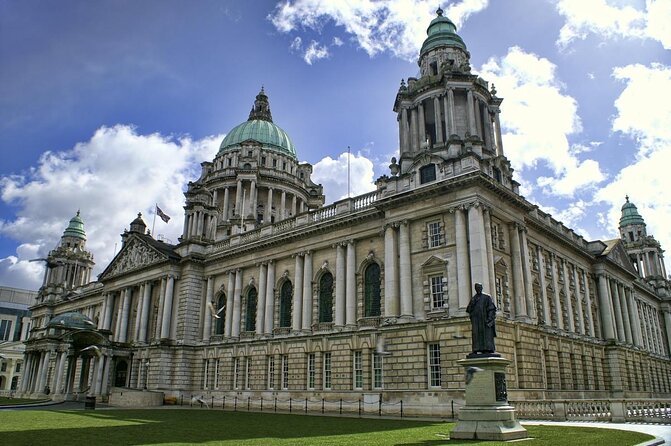
- City Hall and the Beacon of Hope frame the story, linking Belfast’s troubled past with its uncertain but hopeful future.
- The Cathedral Quarter adds a sharp contrast, showing today’s art, bars, and nightlife beside stories from the 1970s.
- Guides bring personal memories, with several guides describing what it was like to grow up during The Troubles.
- Headsets help in a group of up to 25, though one equipment failure has caused problems for at least one participant.
- The $36.06 price is fair if you want a serious, guided introduction to Belfast rather than a quick orientation walk.
Why this Belfast tour matters
A Belfast city tour can easily become a parade of attractive buildings and lively streets. This one asks you to look again at familiar places. A shopping street may also be the site of a bombing. A public sculpture may sit close to the setting of an event that helped push Northern Ireland into years of violence.
That contrast is the point. You are not being taken to a single museum and shown a fixed collection of objects. You move through the city and hear how politics, religion, policing, violence, and daily life collided in real places.
The tour focuses on The Troubles, the period of conflict that began in the late 1960s and continued for decades. It also explains the older relationship between Britain and Ireland, since the later conflict cannot be understood without that background.
I find this useful for a first visit to Belfast. You get a basic framework for the city’s divisions, then see how the peace process changed the center. The guide also discusses present political questions, including the possible effect of Brexit on borders. This keeps the tour from treating The Troubles as a closed chapter.
The tone is serious but not grim from start to finish. Guides use stories, facts, and personal memories, and the final stop turns toward peace and regeneration. Still, you should not book this expecting light sightseeing. The tour visits locations tied to explosions and deaths, and some parts are plainly difficult to hear.
More History Walking Tours in the UK
- Edinburgh: Old Town History and Tales Walking Tour
★ 4.8 · 2,361 reviews - Old Town Walking Tour History and Tales in Edinburgh
★ 5.0 · 2,168 reviews - Shadows of York: Ghost Walk and Horrible History.
★ 5.0 · 1,403 reviews
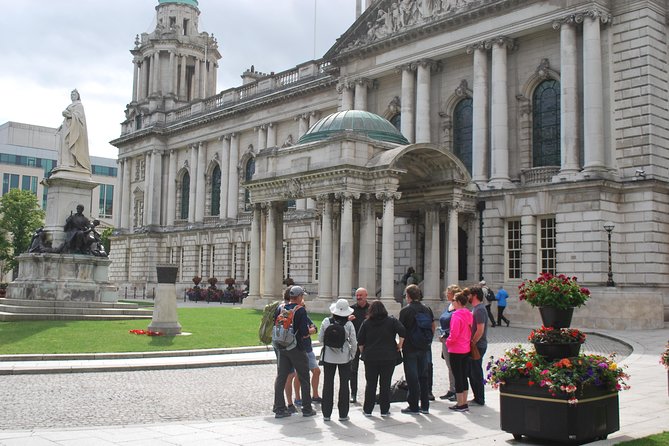
Beginning beside Belfast City Hall
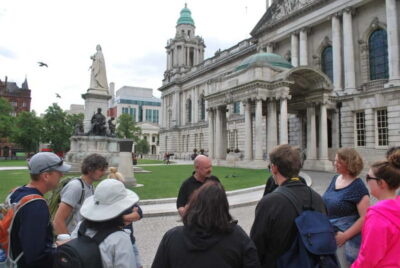
The 10:30 a.m. meeting point is in the grounds of Belfast City Hall at Donegall Square North. This is a practical place to begin because it is central, easy to reach by public transport, and close to the main streets used during the rest of the walk.
The opening section lasts about 20 minutes. Your guide sets out the long relationship between Britain and Ireland, then explains how and why The Troubles began in the late 1960s. That background is essential. Without it, later references to identity, religion, policing, and sovereignty can sound like a jumble of names and slogans.
This is also where the guide’s approach becomes clear. The strongest guides, including James, Anne, Mylie, and Róisín, are praised for combining a clear account of political events with memories of ordinary life. Several guides had direct experience of growing up during the conflict, which gives the discussion a human scale.
You begin standing outdoors, so weather matters from the first minute. Belfast can be wet and cool, even when the forecast looks promising. Wear comfortable shoes and bring a waterproof jacket. The route is flat, but there are few chances to sit during the longer explanations.
Donegall Place and the Ring of Steel
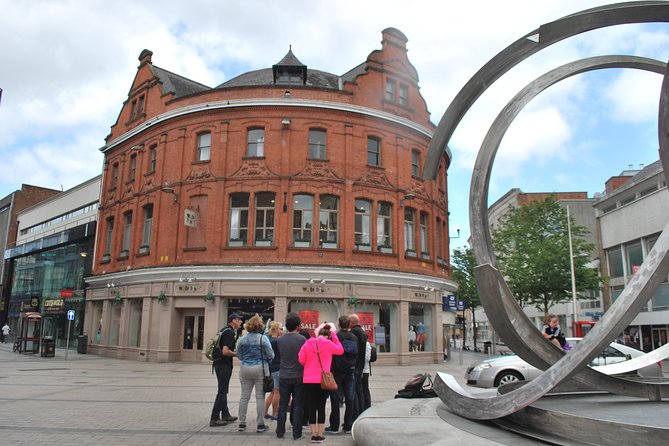
Donegall Place looks like a normal city shopping street today. The tour uses that everyday setting to explain a nightclub bombing in 1971, the tragic events that followed, and the introduction of the security measures known as the Ring of Steel.
This is a good early stop because it shows how violence altered daily routines. The conflict was not confined to distant neighborhoods or military checkpoints. It affected shopping, entertainment, travel, work, and the way people moved through the city center.
The stop lasts around 15 minutes. You will listen more than walk, and that pattern continues through much of the tour. If you prefer a fast-moving city walk with only brief commentary, this may feel slow. If you want the guide to explain cause and effect, the pauses are worthwhile.
The story can also be upsetting. The tour does not turn tragedy into spectacle, but the places are connected to real deaths and injuries. Pay attention to the guide’s tone and give yourself time afterward if the material affects you.
Castle Lane and the ordinary city at war
At Castle Lane, another pedestrian shopping area, the guide explains what daily life was like at the height of The Troubles. The location is especially effective because it is now a busy public space rather than an obvious memorial site.
You hear about an event that remains prominent in local memory and gain a sense of how quickly ordinary city life could be disrupted. The value here is not a long list of dates. It is the connection between a present-day street and the fear that once shaped how people used it.
This is one of the points where the headsets help. A group of up to 25 people can spread out while crossing streets or gathering near shops. You can hear the guide without needing to crowd directly around the speaker.
The equipment is not foolproof. One participant reported that the guide’s speaker stopped working halfway through the tour and that the guide did not have a backup. That seems to be an exception rather than the normal experience, but it is worth knowing. If you cannot hear, speak up early and move closer rather than quietly missing half the explanation.
Same streets, a different guide:
- Magical London: Harry Potter Guided Walking Tour
★ 4.7 · 22,044 reviews - Edinburgh: Harry Potter Magical Guided Walking Tour
★ 4.8 · 11,944 reviews - Edinburgh Castle: Guided Walking Tour with Entry Ticket
★ 4.7 · 11,699 reviews - Underground Vaults Walking Tour in Edinburgh Old Town
★ 4.5 · 8,506 reviews
The Spirit of Belfast and the turning point of 1971
The Spirit of Belfast is a piece of public art beside the city center, often called the Onion Rings because of its shape. The sculpture is intended to suggest resilience, but the tour uses its location to discuss events that began in a nearby bar in 1971.
This section explains how a local incident helped push Northern Ireland toward an escalating cycle of violence. The contrast is striking: a hopeful public artwork sits beside a story about how quickly fear and retaliation spread.
You spend roughly 15 minutes here. As with the other stops, the guide does the real work. There may not be much to see in the form of physical evidence, so the quality of the explanation matters more than the object itself.
This is also a useful place to notice the tour’s wider theme. Belfast has not erased its past. Instead, the city has placed new art, shops, and public spaces beside sites linked to conflict. The guide helps you read both layers at once.
The Cathedral Quarter after the violence
The walk continues into the Cathedral Quarter, now known for street art, bars, restaurants, and nightlife. The area has been regenerated, but the tour does not present it as a simple success story.
Here you hear about major events during The Troubles and the first steps toward peace. The guide then shows how much the district has changed since the 1970s. It is hard to miss the contrast between the lively lanes of today and the fear described in the stories.
This is one of the tour’s strongest sections for anyone trying to understand modern Belfast. You see how regeneration can change the use and feel of a place, while the older memories remain close beneath the surface.
Allow around 20 minutes. The Cathedral Quarter can be busy, and the group may need to pause in a suitable spot while the guide speaks. Again, expect standing and listening rather than a continuous walk.
The best guides avoid turning the district into a backdrop for dramatic storytelling. They explain the events carefully and give names and personal details where possible. That approach makes the history feel real without making it sensational.
Ann Street, policing, and the border question
Near the largest police station in Belfast, the guide explains how Northern Ireland was policed during The Troubles and how policing changed after the peace agreement. This section adds an important layer because security was not just a matter of soldiers and barricades. It affected trust, identity, and the relationship between local communities and official institutions.
You also discuss the possible impact of Brexit on the border. That brings the tour into the present and shows why old political questions still matter. The issue is not treated as an abstract debate. It is tied to the history of movement, identity, and the relationship between Northern Ireland, the Republic of Ireland, and Britain.
The stop lasts about 15 minutes. It is a useful point to ask questions, though the tour’s pace may limit how long the guide can explore every political detail. Think of this as a solid introduction, not a complete course in Northern Irish constitutional politics.
Ending beside the River Lagan
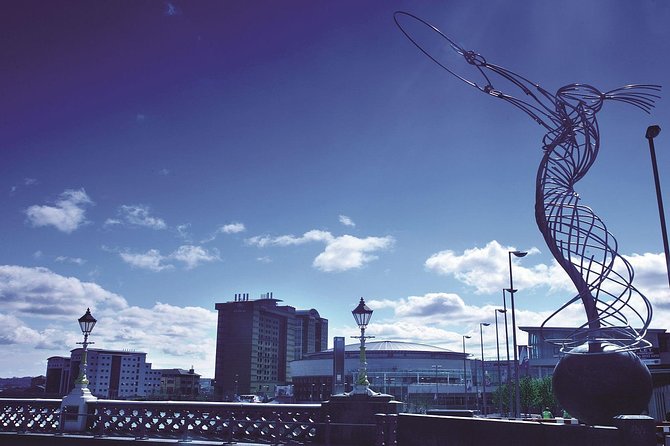
The final stop is at the Beacon of Hope on Oxford Street, beside the River Lagan. From here, the tour compares Belfast today with one of the darkest days in its past, then explains how the city reached its fragile peace.
The Beacon of Hope is a fitting ending because it represents resilience and renewal. The guide also discusses what the future may hold, which keeps the conclusion open rather than pretending that every issue has been settled.
The tour ends about five minutes on foot from City Hall. That makes the return simple if you have another appointment nearby. You can also use the waterfront setting as a quiet place to think over what you have heard.
The ending is more hopeful than celebratory. Belfast is presented as a city that has changed greatly but still carries political and personal tensions. I appreciate that restraint. A good history tour should leave you better informed, not falsely certain.
Guide quality and the value of personal stories
Guide quality is central to this experience. The strongest accounts describe James as funny, warm, and very well informed, while Anne is praised for combining detailed history with memories from her childhood during the conflict. Mylie is noted for a confident, engaging delivery and for presenting both sides of the story clearly.
Róisín brings personal experience and strong storytelling, and Rory is praised for his grasp of Irish history. The guides are not presented as interchangeable audio tracks. Their personalities and memories shape the experience.
That personal element is valuable, but it also means your experience can vary slightly depending on who leads the walk. The overall route and subjects remain the same, yet one guide may focus more on personal stories while another gives more political context.
The tour aims for a neutral presentation. That does not mean the subject becomes emotionless. You will hear about victims, fear, divided communities, and the cost of violence. A balanced guide gives you enough context to form your own view instead of telling you what conclusion to reach.
Price, timing, and physical demands
At $36.06 per person, the tour is reasonably priced for two and a half hours with a guide, headsets, and a carefully planned route through central Belfast. The real value comes from the explanation. Without it, several stops would look like ordinary streets or public art.
You cover about 1.5 miles, and the city center is completely flat. There are no hills or steps on the stated route, so the physical demand is modest. The catch is that you spend a fair amount of time standing while the guide speaks.
Wear comfortable footwear, even though the distance is short. Bring warm layers in winter and a waterproof jacket at any time of year. The tour operates in poor weather unless conditions lead to cancellation, so you should check the forecast and dress for rain.
The minimum age is 12. That seems sensible given the subject matter. Younger children may find the long explanations and difficult stories hard to follow, while teenagers with an interest in history and politics should gain a great deal from it.
The tour is offered in English and includes a mobile ticket. Service animals are allowed, and most people can take part. There is free cancellation up to 24 hours before the start time. A cancellation within 24 hours is not refunded, while a weather cancellation offers a different date or full refund.
Who should book this walking tour
I would choose this tour near the start of a Belfast visit. It gives you a useful frame for later visits to museums, political murals, neighborhoods, or other historical sites. You will understand more when you encounter references to The Troubles elsewhere.
It suits you if you want:
- A guided introduction to Belfast’s modern political history
- Personal stories alongside dates and events
- A balanced discussion of British and Irish viewpoints
- An easy route through the city center
- A serious tour that connects past events with current politics
I would hesitate if you want a relaxed sightseeing walk with little discussion of violence. I would also think twice if you have difficulty standing for long periods, since the 1.5-mile distance understates the amount of time spent listening outdoors.
Should you book A History of Terror?
Yes, if you want to understand Belfast rather than simply photograph it. The tour takes you from City Hall to the waterfront, using shopping streets, public art, the Cathedral Quarter, and a police station to explain how The Troubles affected daily life.
The $36.06 cost is fair, the route is flat, and the headsets are useful in a group of up to 25. Book it early in your stay, wear weatherproof clothing, and prepare for serious material. If you want the history of Belfast told with balance, human detail, and a clear link to the present, this is a strong choice.
FAQ
Where does the Belfast walking tour start?
It starts in the grounds of Belfast City Hall at Donegall Square North, Belfast BT1 5GS.
Where does the tour end?
It ends at the Beacon of Hope on Oxford Street, Belfast BT1 3NB. The end point is about a five-minute walk from City Hall.
What time does the tour start?
The stated start time is 10:30 a.m.
How long is the tour?
The tour lasts approximately two hours and 30 minutes.
How far do you walk?
The route covers about 1.5 miles.
Is the walking route difficult?
The city center is completely flat, with no hills or steps on the route. Comfortable footwear is still advised because you spend time walking and standing.
What language is the tour offered in?
The tour is offered in English.
Is there a minimum age?
Yes. The minimum age is 12.
Are headsets included?
Yes. Headsets are provided so you can hear the guide clearly.
What happens if the tour is canceled because of weather?
You will be offered a different date or a full refund if the experience is canceled because of poor weather. Dress for rain and cold because the tour normally takes place outdoors.
New routes in the UK
- Aberdeen City Centre Walking Tour (2pm)★ 5.0 · 217 reviews
- German London : The Ultimate Walking tour★ 4.8 · 400 reviews
- London: Medieval History Walking Tour from The Tower★ 4.9 · 318 reviews
- Oxford: Official University and City Walking Tour★ 4.7 · 618 reviews
- The Beatles London Walking Tour★ 4.2 · 147 reviews
- Stratford-Upon-Avon’s Town Walking Tour (10:30am & 2pm)★ 4.8 · 143 reviews
- Stratford-Upon-Avon: The Famous Walk Talk Show★ 4.9 · 342 reviews
- The Sinister Side of Shakespeare’s Stratford Walking Tour★ 4.8 · 547 reviews
Belfast Walking Tours, compared.
The Troubles Walls & Bridges Guided Walking Tour
Read our review →
Best of Belfast History, Culture & Art Walking Tour
Read our review →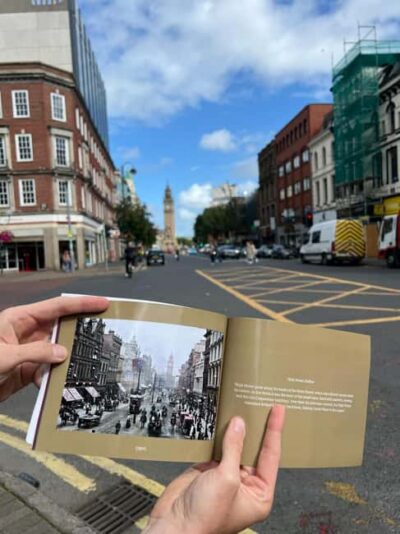
Belfast Walking Tour with a Local – History & Craic
Read our review →Browse the lists this tour appears in