
Review · BELFAST
Belfast: The Troubles Walls & Bridges Guided Walking Tour
The most useful way to understand Belfast’s Troubles is to walk through the places where division was built into daily life. This three-hour tour takes you from City Hall toward Divis and the Falls area, through security gates and along the Peace Walls, then back into the city center with a look at Belfast today.
I like the balanced account of both communities and the way guides such as Steve and Arthur add personal memories to the wider political story. I also like the small details hiding in plain sight, from a post box and 24-hour garage to fortified gates, murals, and the towering walls. The tradeoff is clear: this is a long, serious walk with no regular rest stops, limited facilities, and some upsetting detail.
Key points to know before you book
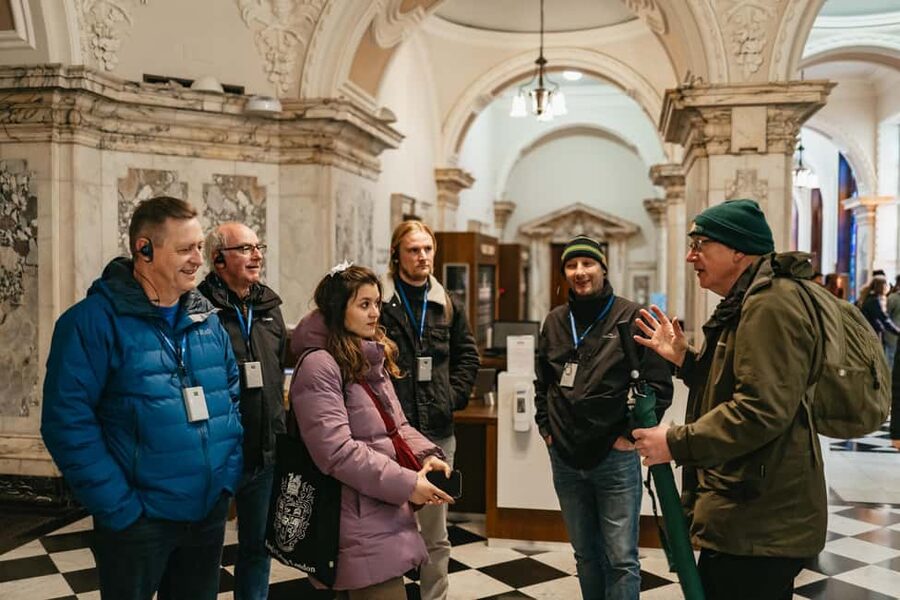
- A local view of The Troubles: Guides including Steve and Arthur connect dates and political events with first-hand memories of life in Belfast.
- A real neighborhood walk: You pass through Divis, the Falls area, the Shankill area, security gates, and the Peace Walls, not just central Belfast sights.
- Political murals change over time: The International Wall reflects local concerns and events around the world.
- A balanced route: The tour explains Irish nationalist and British unionist perspectives rather than presenting only one side.
- Plan for a serious physical walk: Expect three hours, roughly 8,500 steps, little shelter, and limited toilets.
- Best for adults and mature teenagers: Graphic stories and the subject matter make it unsuitable for children under 14.
Why this Belfast walking tour matters
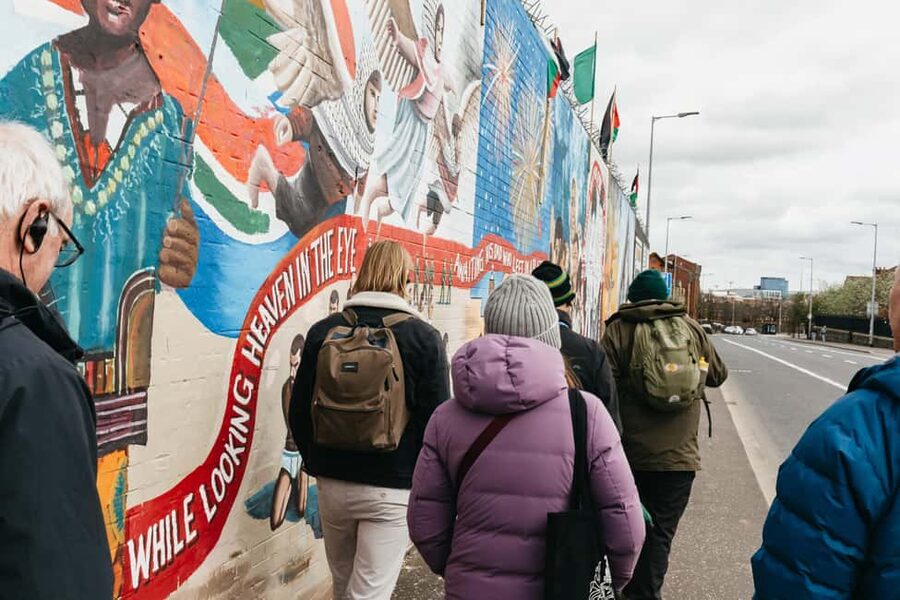
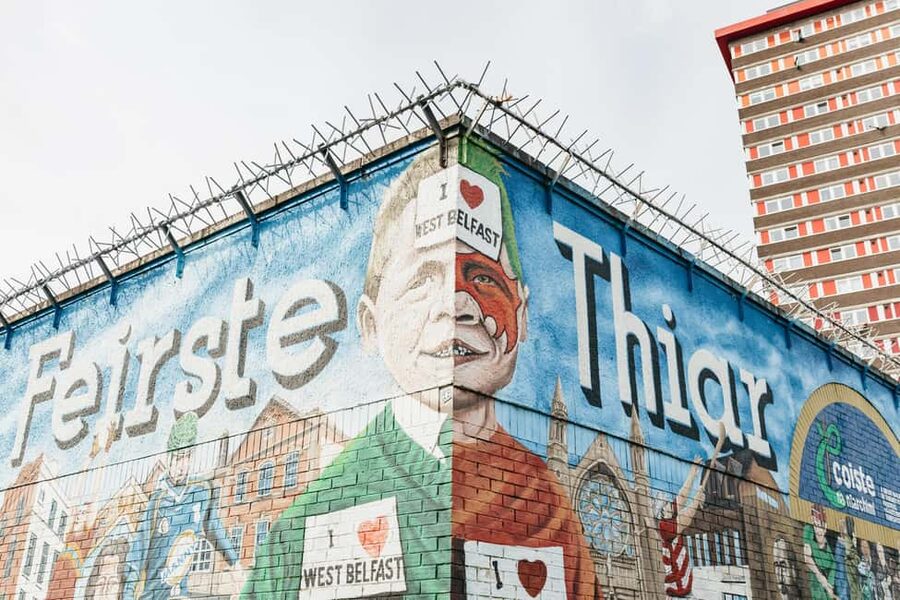
Belfast’s Peace Walls can look like a straightforward sightseeing stop. They are not. They are physical reminders of a division that still shapes neighborhoods, movement, identity, and memory.
This tour gives those walls a setting. You hear why they were built, how the conflict spread, and why many remain in place. You also hear about the less visible barriers: housing patterns, security arrangements, political power, economic hardship, and the habits people formed to stay safe.
That context is the main value of the experience. You are not simply taking photographs beside a famous wall. You are being asked to notice how an ordinary post box, a locked gate, a garage, or a mural can carry political meaning.
The tour also avoids ending in despair. The guide looks at musicians, boxers, historians, and other people who built links across the divide. The closing message is not that Belfast has solved everything. It is that ordinary people have created connections even when official structures were slow to change.
More Guided Walks in the UK:
- Magical London: Harry Potter Guided Walking Tour
★ 4.7 · 22,044 reviews - Edinburgh: Harry Potter Magical Guided Walking Tour
★ 4.8 · 11,944 reviews - Edinburgh Castle: Guided Walking Tour with Entry Ticket
★ 4.7 · 11,699 reviews
Starting at Belfast City Hall
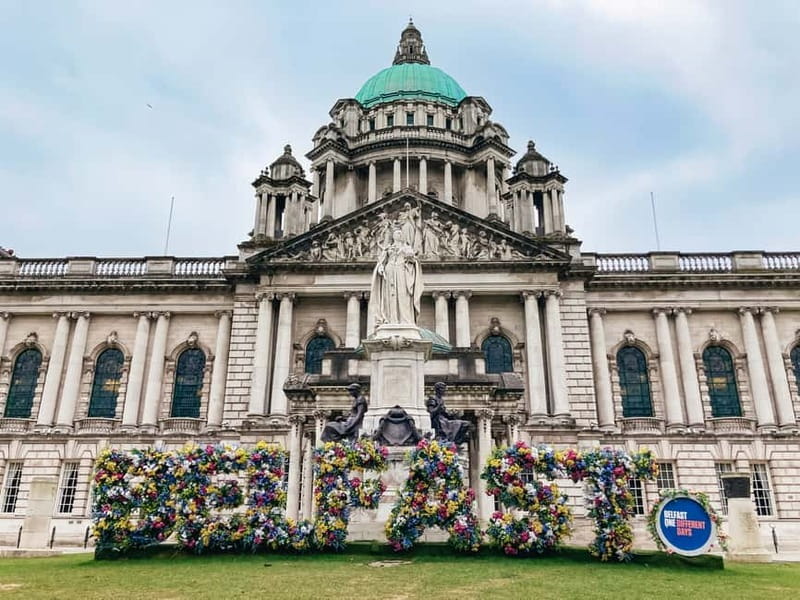
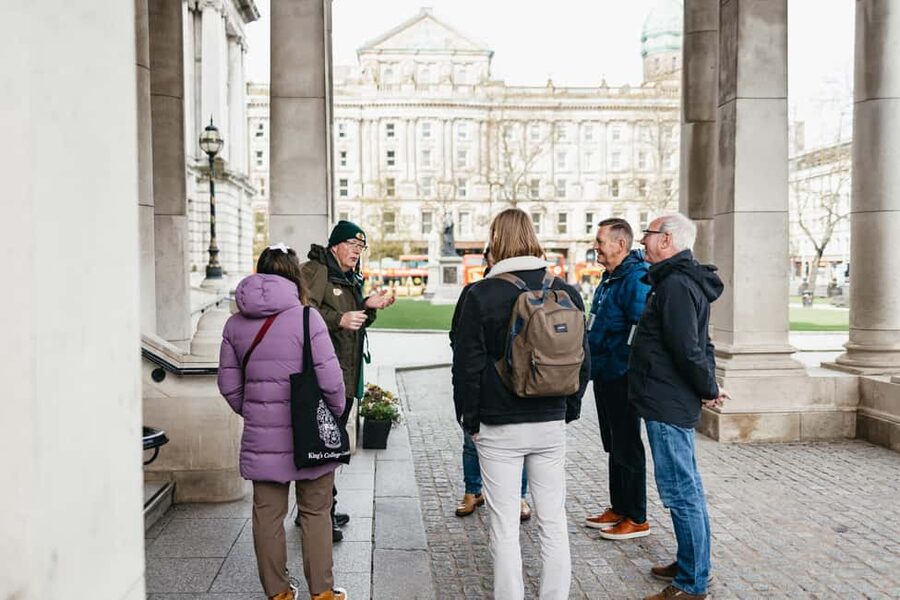
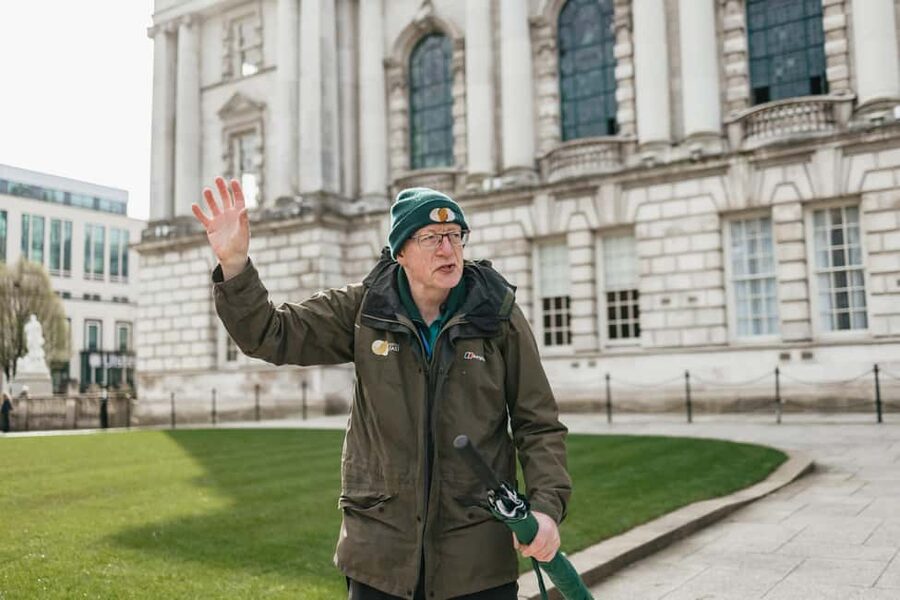
The meeting point is on the pavement outside the large railings of Belfast City Hall, beside a blue information table. Look for the guide near a small blue information board between two black ornamental lamp posts. Through the railings, you should see the statue of Queen Victoria.
The guide wears green and carries a large green and white golf umbrella. That detail matters because map apps may send you to Donegall Square West, where buses stop, or to the back of City Hall. The correct place is on the front side, across from the main shopping avenue and a Nationwide Building Society.
The opening section gives you a short safety briefing and sets the tone. This is not a standard city walk built around grand buildings and quick photographs. Belfast City Hall is a useful starting point because it places the later neighborhood story against the civic center of the city.
You begin with the broad political and social background before moving west. That helps you follow the later explanations instead of encountering a wall or mural without knowing why it exists.
Walking toward Divis and the Falls area
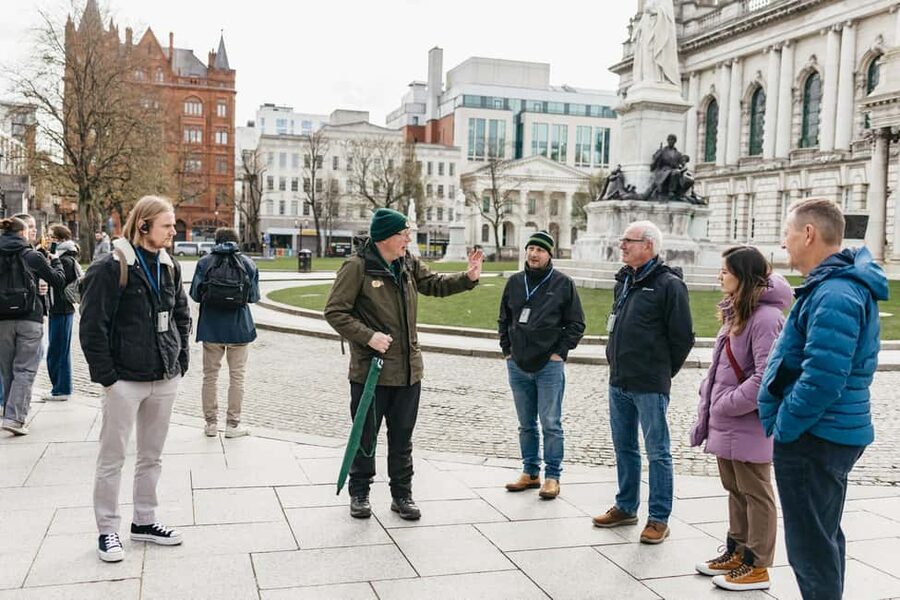
From City Hall, the route heads toward Divis and the Falls area, associated with the Irish nationalist and Catholic community. The walk takes about 25 minutes through Belfast, and the commentary continues as you go.
This is where the headsets are especially useful. Larger groups receive listening sets, allowing you to hear the guide while walking through traffic and city streets. The guide can keep talking rather than gathering everyone around a single quiet corner.
At Divis, the story turns to the period when the conflict erupted into mob violence, homes were set on fire, and communities became increasingly separated. The explanation is direct and human, not just a list of dates.
You then reach Divis Tower, where the first mural appears. Its message of Irish and local identity introduces one of the tour’s main themes: murals are not mere decoration. They can honor people, claim space, preserve memory, and express political views.
You should expect the guide to spend time explaining what you are seeing. If you prefer a quick mural tour with a camera stop every few minutes, this may feel slow. If you want to understand why the images are there, the pace works well.
Reading the International Wall
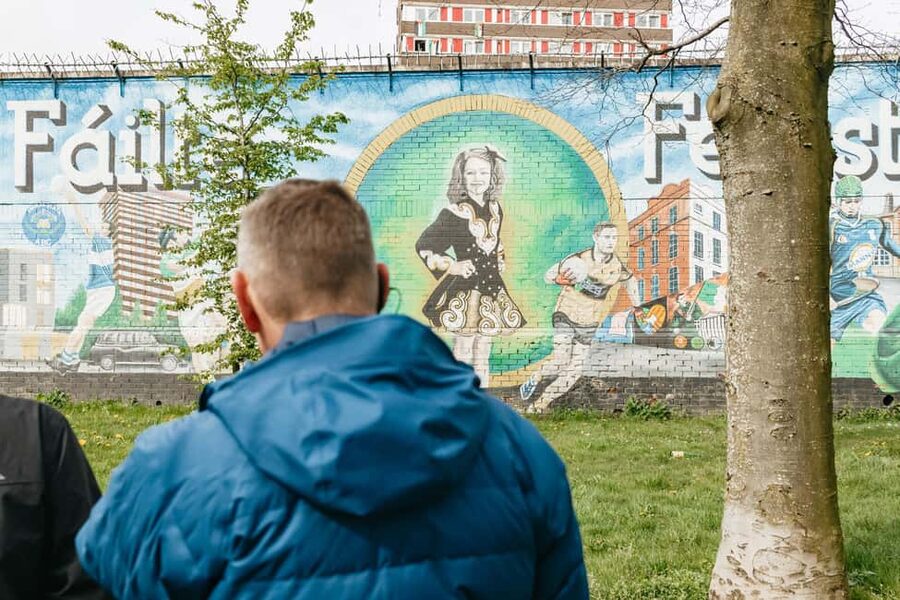
The route continues to the colorful International Wall, a long display of political murals near the Falls area. The murals change as local and world events change, so this part of Belfast is not a fixed museum exhibit.
That changing quality is important. It shows that political art remains part of public life rather than being frozen as a historic backdrop. The guide places the local messages in a wider setting, linking Belfast’s concerns with events beyond Northern Ireland.
You will hear personal stories alongside the public history. Guides Steve and Arthur are both praised for mixing humor, direct language, and lived experience with an effort to explain more than one point of view. Their styles may differ, but the aim is similar: help you see the people behind the slogans.
The subject can be painful. Some stories include graphic details and accounts of trauma. The tour is not suitable for children under 14, and adults should be ready for an unfiltered account rather than a polished heritage presentation.
More Walking Tours in the UK:
- Underground Vaults Walking Tour in Edinburgh Old Town
★ 4.5 · 8,506 reviews - London: The Original Jack the Ripper Walking Tour
★ 4.7 · 7,833 reviews - Oxford University Walking Tour With University Alumni Guide
★ 5.0 · 6,905 reviews - Edinburgh Castle: Guided Walking Tour with Entry Ticket
★ 5.0 · 5,540 reviews
Crossing through security gates
One of the most striking parts of the walk is the move toward the British Shankill area. The route does not visit Shankill Road itself, but it does pass through the Shankill area and heavily fortified security gates.
These gates function as a border between communities. Walking through them gives you a stronger sense of how division once affected basic movement than looking at a map or riding past in a taxi. The physical design tells its own story: control, caution, and the expectation that the gates may be closed.
The guide explains the political and cultural background of the British unionist and Protestant community, helping balance the earlier discussion of the Falls area. That balance is one of the tour’s strongest features. It does not pretend that every account is identical, but it does try to explain how both communities understood their position.
The route also draws attention to small, ordinary signs of separation. A garage, a post box, a gate, or a road can have a role in the story. These details make the conflict easier to grasp because they show how politics reached into daily routines.
Standing beside the Peace Walls
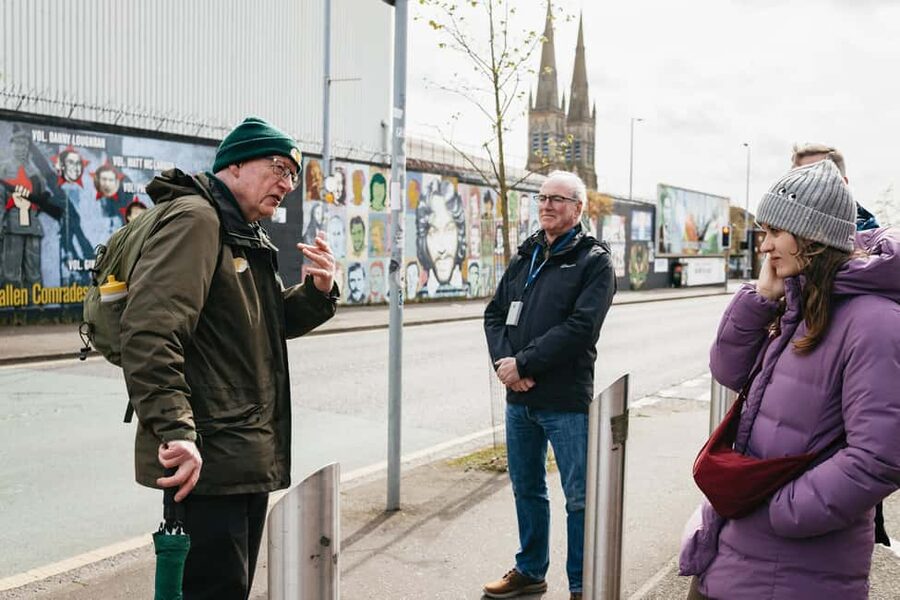
The Peace Walls are the central stop, with about 75 minutes for a visit, explanation, and photographs. You have time to look closely, listen, and take pictures rather than rushing straight back toward the center.
The walls are tall and imposing. They were created as security measures, yet their continued presence raises a difficult question: if they were meant to be temporary, why are they still standing?
The guide explains the reasons for their construction and the reasons they remain. You hear about safety, fear, memory, and the fact that political peace does not instantly erase local mistrust. This is where the tour moves beyond a simple account of religious difference and looks at social and economic barriers too.
You may find the walls visually powerful, but the point is not only the photograph. The greater value comes from hearing what it meant to live near them, pass through gates, or organize daily life around periods of unrest.
There is little shelter along the route, so weather can shape the experience. Bring proper rainwear or an umbrella, and do not assume you will be able to wait indoors. A leisure center near the walls can provide toilet access around two hours into the walk, but regular rest stops are not part of the route.
Returning through the gates and back to central Belfast
After the Peace Walls, the route returns through more security gates toward the Falls area. At one point, an Irish ballad forms part of the atmosphere as you look back at the gates and walls.
That moment brings the physical layout into focus. You see how close the neighborhoods are, yet how sharply they were separated. The walk is not designed as a comfortable, detached observation from a bus window. You are moving through streets that were never built as a tourist trail.
The group then heads back toward Belfast city center. This section covers the political and economic setting of the Peace Process and asks how Belfast has changed, as well as what remains unresolved.
The walk may last longer than the scheduled three hours. Allow at least 1.5 hours before your next activity. One guide has been described as running the tour for about three and a half hours, and the distance can reach roughly 8,500 steps.
Belfast today: art, hope, and a less simple ending
The final part changes pace. You hear about people who built bridges through music, sport, history, and community work. These stories matter because they keep Belfast from being reduced to walls, gunfire, and political labels.
The route finishes at a beautiful Victorian building that has been reused as an arts venue. It offers a useful image of contemporary Belfast: an old structure with a new public role, reflecting a city that is still working out how to live with its past.
The tour ends in a historic church in central Belfast. Its place in Irish history challenges simple divisions between British and Irish, Protestant and Catholic, or past and present. That is a fitting final stop because the whole tour questions easy categories.
You should leave with more than a list of events. The aim is to understand why the past still matters, how public spaces carry memory, and how progress can exist alongside unfinished work.
Guide style and the listening equipment
The guides are a major part of the experience. Steve is described as a lifelong Belfast resident with a strong command of local history. Arthur brings his own experience of growing up and working in the area, along with a more informal, humorous, and sometimes blunt delivery.
The guide assigned to your departure may be Steve, Arthur, or another member of the team. Do not expect a scripted speech delivered in a neutral museum voice. You will hear personal anecdotes, strong opinions about power and society, and clear attempts to explain competing viewpoints.
That approach works best if you are willing to listen carefully. Some visitors may find the language very direct. If you prefer a polished, strictly academic presentation, the personal style may feel rough around the edges. If you want human detail, it is a major strength.
Listening sets are supplied for larger groups. They help in noisy streets and let you stay connected if you need to step aside briefly. You still need to stay with the group and watch your footing, especially near traffic and uneven surfaces.
Is $32 good value?
At $32 per person, the price is fair for a three-hour guided walk led by someone with local experience. You are paying for sustained commentary, access to areas that make the history concrete, and the chance to ask questions along the way.
The value is strongest if you have limited time in Belfast and want more than the central landmarks. A short city visit, including a cruise stop, can make this a useful way to understand the city’s political past without arranging several separate visits.
The price does not include food or drinks, and there is no meal break. Bring water and use facilities before starting. Since the route is long and facilities are limited, the practical preparation matters as much as the ticket cost.
Compared with a taxi-based look at the murals, this walk gives you more time on foot and a stronger sense of distance between places. The drawback is comfort. You are exposed to the weather, you walk a substantial distance, and the topic demands concentration.
Who should take this tour?
I would recommend it to adults who want to understand Belfast beyond the Titanic Quarter, pubs, and central architecture. It suits history-minded visitors, people with an interest in peace processes, and anyone who wants local context before exploring Northern Ireland further.
It is also a good choice if you know little about The Troubles, though a small amount of background reading can help. The subject covers many decades and complex political positions, so you will get more from the walk if you arrive ready to ask questions.
I would not choose it for young children or anyone looking for a light sightseeing outing. The tour includes tragic events and graphic detail. It can be funny at times, but the humor sits beside grief, anger, and unresolved pain.
Wear comfortable shoes and weather-appropriate clothing. Leave plenty of time afterward. The tour can be moving and mentally demanding, so a quiet break after the walk may be welcome.
Should you book the Belfast Walls and Bridges tour?
Book it if you want a serious, local explanation of Belfast’s divided neighborhoods and the people affected by them. The strongest reasons are the walk through real community areas, the chance to see the Peace Walls up close, and the guides’ mix of historical detail, personal memory, humor, and hope.
Skip it if you want a short, gentle introduction to Belfast or if three hours on foot sounds too demanding. For everyone else, $32 buys a thoughtful look at a city where the past is still visible in gates, walls, murals, and ordinary streets.
FAQ
Where does the tour start?
It starts on the pavement outside the large railings of Belfast City Hall, beside a blue information table and blue information board. The guide is between two large ornamental lamp posts, across from the main shopping avenue.
Where does the tour finish?
The tour finishes in Belfast city center on Rosemary Street, at a historic church.
How long does the tour last?
The scheduled duration is three hours, but it may run longer. Allow at least 1.5 hours before your next activity.
Does the tour visit Shankill Road?
No. The route does not visit Shankill Road itself, but it does pass through the Shankill area and its security gates.
Is the tour suitable for children?
No. It is not suitable for children under 14 because the subject matter includes graphic detail and serious accounts of violence.
Are toilets available during the walk?
Facilities are limited, and there are no regular rest stops. Toilet access may be available at a leisure center near the Peace Walls about two hours into the tour.
What should I bring?
Bring comfortable shoes and clothing suited to the weather. An umbrella or rainproof layer is sensible because much of the route has little shelter.
New routes in the UK
- Aberdeen City Centre Walking Tour (2pm)★ 5.0 · 217 reviews
- German London : The Ultimate Walking tour★ 4.8 · 400 reviews
- London: Medieval History Walking Tour from The Tower★ 4.9 · 318 reviews
- Oxford: Official University and City Walking Tour★ 4.7 · 618 reviews
- The Beatles London Walking Tour★ 4.2 · 147 reviews
- Stratford-Upon-Avon’s Town Walking Tour (10:30am & 2pm)★ 4.8 · 143 reviews
- The Sinister Side of Shakespeare’s Stratford Walking Tour★ 4.8 · 547 reviews
- Stratford-Upon-Avon: The Famous Walk Talk Show★ 4.9 · 342 reviews
Belfast Walking Tours, compared.
A History of Terror – Belfast City Centre Walking Tour
Read our review →
Best of Belfast History, Culture & Art Walking Tour
Read our review →
Belfast Walking Tour with a Local – History & Craic
Read our review →Browse the lists this tour appears in