
Review · LONDON
London: Medieval History Walking Tour from The Tower
London’s medieval story unfolds best on foot, and this two-hour route along the Thames gives you a clear thread from the Tower of London to St Paul’s Cathedral. You’ll cross Tower Bridge, pass HMS Belfast, walk through Southwark, and follow Shakespeare’s footsteps to the Globe. Guide Mick Priestley brings old photographs and a sharp grasp of the city’s politics, religion, trade, and daily life.
I like the route’s excellent mix of famous sights and lesser-known places, especially Winchester Palace and the old riverside landmarks that many visitors miss. I also like the price: at $24, you get a lot of London in a short time. The main drawback is simple: this is a long outdoor walk with plenty of standing, and it runs in rain or shine.
Key points at a glance
- Start beside the Tower of London: Begin at Tower Hill, close to one of London’s most important medieval sites and the old eastern gateway to the city.
- Cross Tower Bridge on foot: Hear how the famous bridge was built while enjoying views along the Thames.
- Follow the medieval South Bank: See Borough Market, Southwark Cathedral, Winchester Palace, and the Golden Hinde.
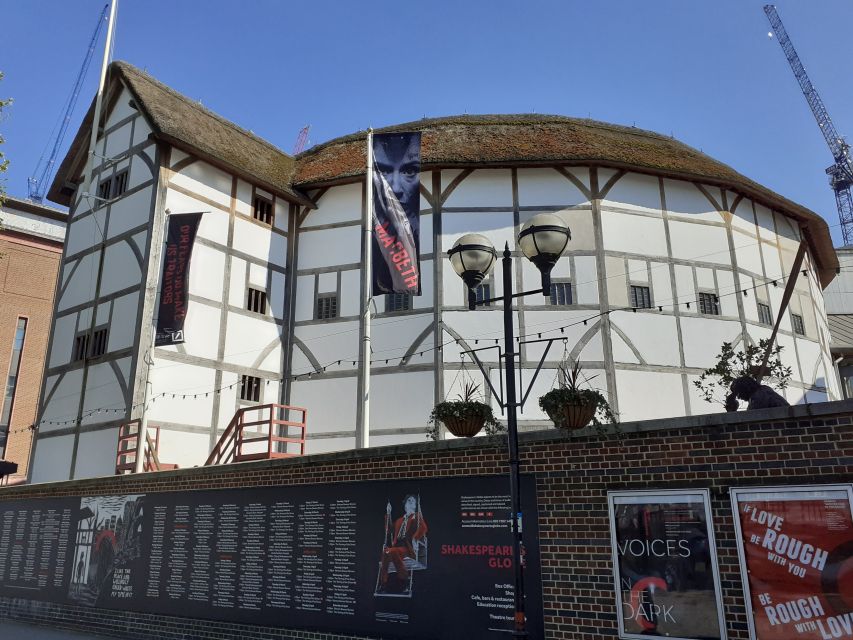
- Connect history with Shakespeare: Walk past the riverside Globe Theatre and learn why this part of London mattered to the playwright’s world.
- Finish beneath St Paul’s Cathedral: The route ends near one of London’s great landmarks, making it easy to continue sightseeing.
- Expect a guide-led history lesson: Mick Priestley is praised for detailed answers, old photographs, humor, and a pace that helps groups keep together.
From Tower Hill into London’s oldest story
The meeting point is outside the western exit of Tower Hill Underground Station, near Trinity Square, CitizenM Hotel, and the Tower Hill Tram burger van. Look for the guide holding a flagpole with a flag. That is a useful detail in a busy part of London, where several streets and entrances can look alike.
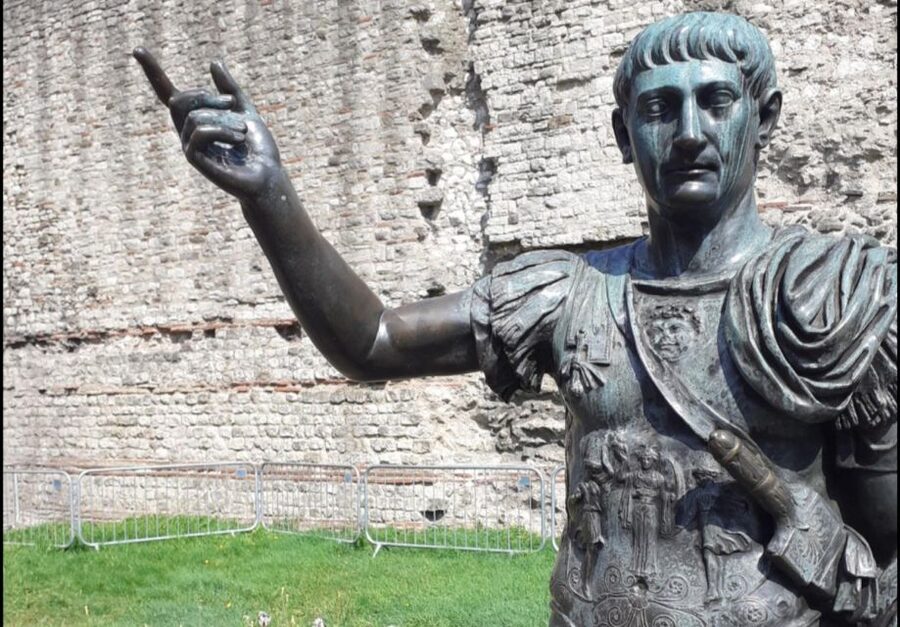
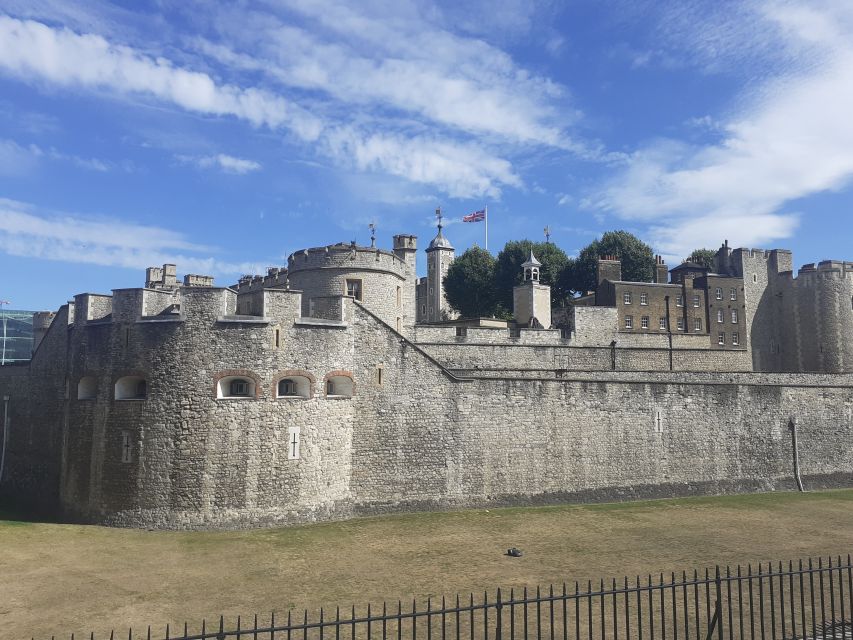
The tour begins with the Tower of London, whose story reaches back about 1,000 years. You do not go inside as part of this walk, so plan a separate visit if you want the Crown Jewels, the White Tower interiors, or the ravens. Here, the value is the setting and the wider explanation: the Tower was not just a prison or palace, but a powerful statement about control of London and the river.
I like starting here because it gives the rest of the walk a strong sense of place. You are not simply ticking off landmarks. You are tracing the relationship between royal power, the Thames, trade, religion, and ordinary London life.
The first section can be crowded, especially around Tower Hill and the bridge. Keep close to the guide and expect to pause rather than walk continuously. That is part of the tradeoff with an outdoor history tour in central London.
More History Walking Tours in London
- London: Historic Pubs of Central London Walking Tour
★ 4.9 · 1,065 reviews - London: Soho Music and Historic Pubs Walking Tour
★ 4.9 · 836 reviews - Royal Historic Pubs Walking Guided Tour in London
★ 5.0 · 803 reviews
Tower Bridge and the working Thames
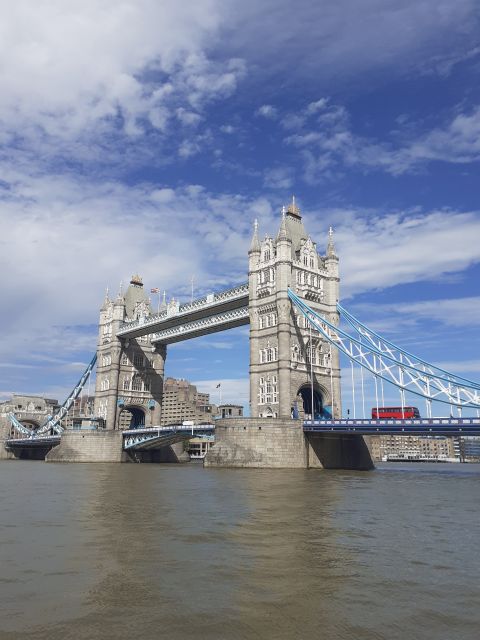
Crossing Tower Bridge is one of the clearest visual moments of the tour. The bridge is familiar from photographs, but walking across it helps you understand its practical purpose. You see the river below, the towers overhead, and the dense stretch of central London that grew around this crossing.
Your guide explains how the bridge was built, adding useful context to the Victorian engineering behind its decorative medieval look. You may want to pause for photographs, though the tour has a lot to cover and this is not a dedicated bridge photography session.
The Thames is more than scenery here. The river helped London become a major port, carried goods into the city, and shaped where communities formed. As you move south, the route shows how the riverbank changed from a defensive and commercial edge into a public promenade lined with cultural sights.
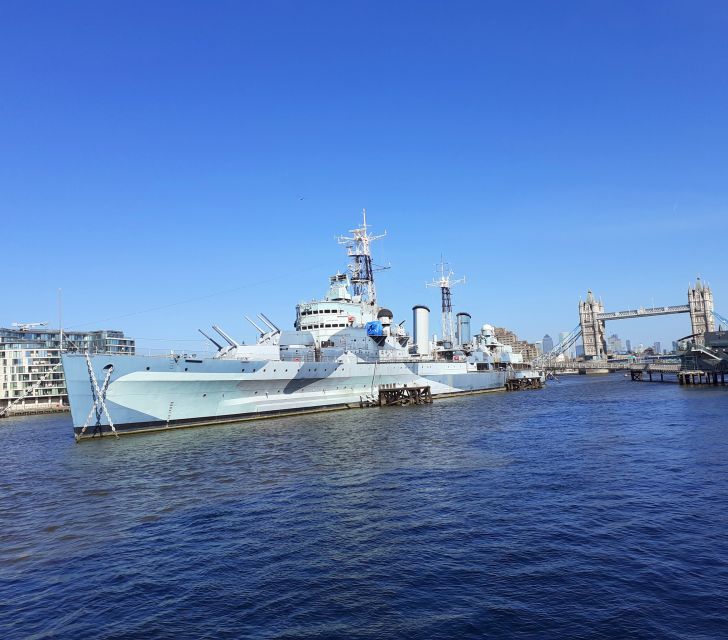
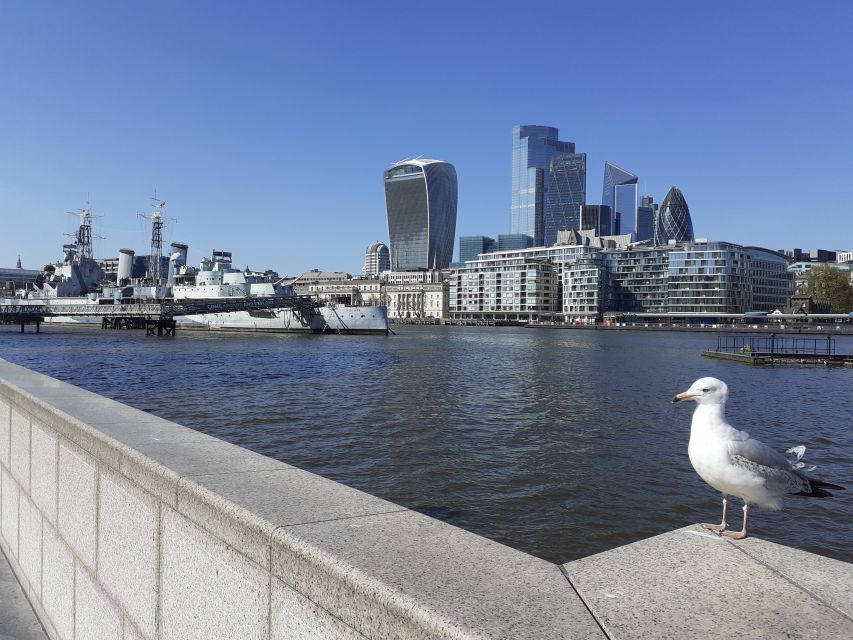
The walk then reaches HMS Belfast, the Second World War cruiser that took part in the D-Day landings. The ship is another place you pass rather than enter. If naval history interests you, note its position and return later for a separate visit. Even from outside, it adds a modern military chapter to a tour mainly focused on older London.
London Bridge, Borough Market, and Southwark
At London Bridge, the guide shifts attention from the structure you see today to the importance of the crossing itself. This has long been one of London’s key links between the City and the southern bank of the Thames.
The route continues toward Borough Market, one of the area’s best-known food markets. The market is worth seeing in its own right, but the historical point is more important on this walk. This part of Southwark was once outside the City of London’s formal control and developed its own mix of inns, entertainments, religious foundations, and trade.
You can return to Borough Market after the tour for food, but during the walk you may have limited time to browse. That is a practical consideration. The route is designed to explain the district, not to give you a full market visit.
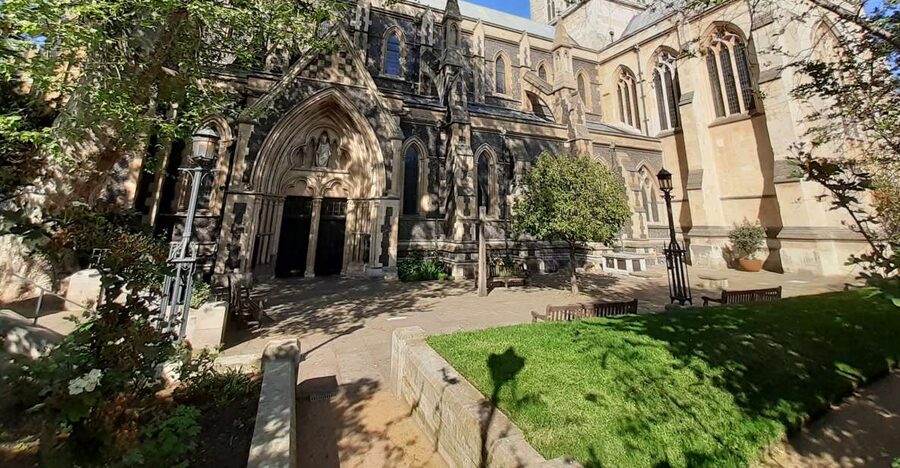
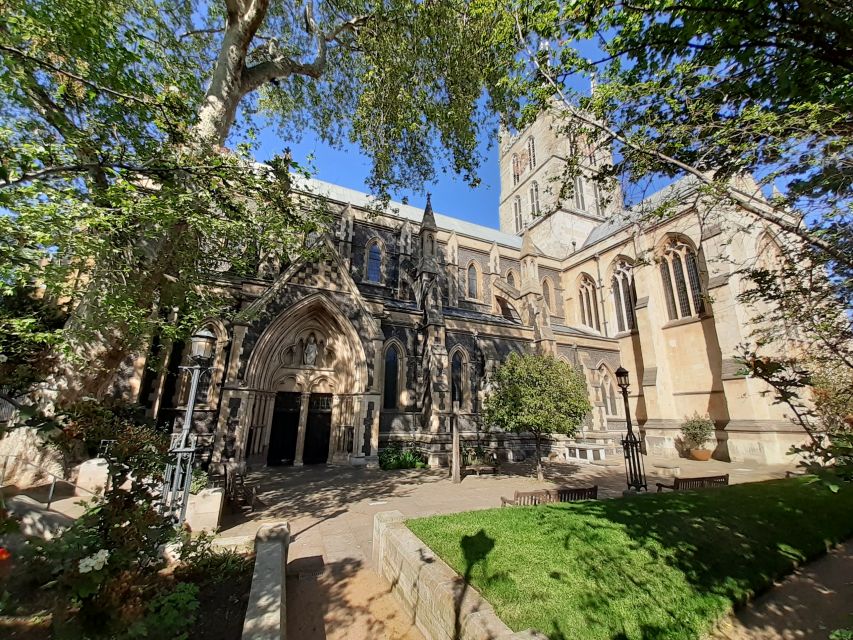
Nearby Southwark Cathedral brings another side of medieval London into view. The cathedral dates back to the 15th century in its present form, with religious roots reaching further into the past. It helps show how churches shaped the southern riverbank, from worship and charity to education and local power.
I especially like this part of the route because it moves beyond kings and famous writers. You get a sense of the institutions that served people living and working in the district. The walk becomes a lesson in how a city functions, not only a parade of grand buildings.
The Golden Hinde and Winchester Palace
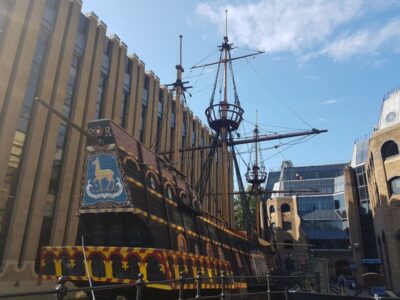
The Golden Hinde is a full-size replica of the ship associated with Sir Francis Drake. The original voyage belongs to the Elizabethan period rather than the medieval one, but it fits the story of the Thames as a place of exploration, commerce, conflict, and spectacle.
The ship is a good visual pause. It also breaks up the stonework and church interiors with something very different. You will see the vessel from outside on this tour, so ship enthusiasts may want to schedule extra time for a separate visit if available.
Then comes Winchester Palace, a 12th-century ruin that is easy to overlook beside the modern streets of Southwark. This is one of the route’s most rewarding stops because its remains are not as obvious as the Tower, Globe, or cathedral.
The palace was connected with the bishops of Winchester, who held major influence in medieval England. What remains today gives you a rare glimpse of the scale and status of the religious and political figures who operated along the South Bank.
This is also where a strong guide matters. A ruin can look like a few old walls if nobody explains its former use and place in the district. Mick Priestley often carries a portfolio of historic images, including pictures of buildings during construction and portraits of people linked to the story. Those visual aids help you imagine what is no longer there.
More History Walking Tours in the UK
- Private Group: Historical Pub Walking Tour of London
★ 5.0 · 660 reviews - London: Royal Historic Pubs Walking Tour
★ 5.0 · 536 reviews - London: Witches and History Bankside Walking Tour
★ 4.8 · 223 reviews - London: Historic London Pub Walking Tour
★ 4.8 · 94 reviews
Shakespeare’s Globe and the Elizabethan riverbank
The riverside Globe Theatre is one of the best-known stops. Shakespeare’s original Globe is gone, but the current theatre recalls the form and location of the playhouse associated with his work.
The point of the stop is not simply that Shakespeare lived and wrote here. The South Bank was a center of entertainment outside the City’s strict rules, with theatres, inns, and other amusements close to the river. That setting helps explain why the Globe developed in this particular part of London.
You pass the theatre rather than take a performance or interior tour. If you want to see a production or explore the theatre more fully, leave time on another day. The walking tour gives you the setting and the connections, which is useful before a later visit.
I like the way the route places Shakespeare among other people and institutions. The story is not isolated from the market, cathedral, palace, bridge, and river. It shows how the city’s cultural life grew from its geography.
The Millennium Bridge and the view to St Paul’s
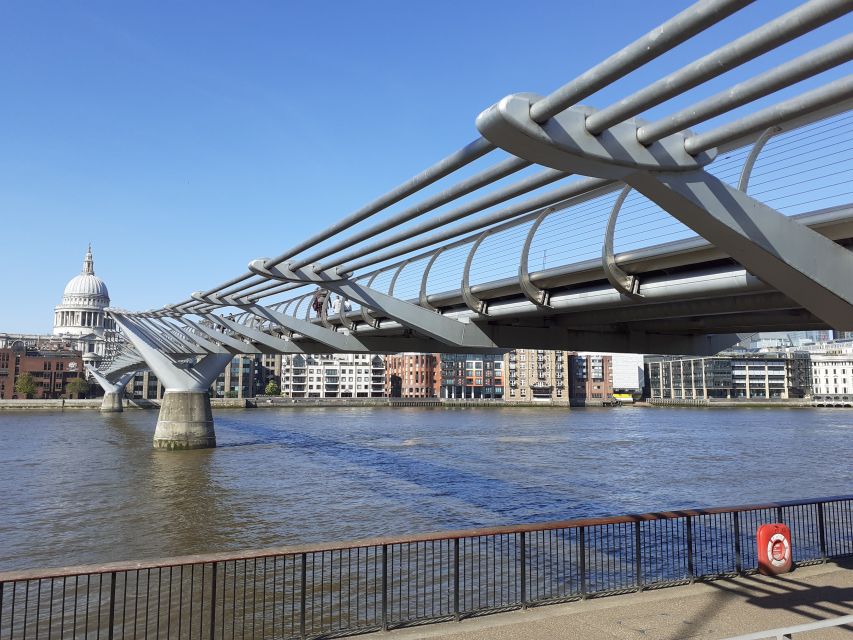
The walk returns to the Thames for the Millennium Bridge, a modern footbridge with a direct view toward St Paul’s Cathedral. This contrast between a sleek contemporary crossing and centuries-old landmarks makes the final section visually strong.
The bridge also gives you a good sense of London’s compact central core. From here, the city’s layers are easy to read: medieval churches and river crossings, Victorian engineering, postwar vessels, modern public spaces, and the great dome of St Paul’s.
The tour finishes near St Paul’s Cathedral, in the EC4M 8AD area. Again, entry is not included, so treat the ending as a useful handoff to your next activity. You can visit St Paul’s separately, continue through the City, or use nearby transport to reach another part of London.
Ending here is practical. The route takes you from the Tower to one of the city’s most recognizable landmarks, giving you a clear east-to-west orientation. It also makes the walk useful on your first day, when you want to understand how central London fits together.
How Mick Priestley handles the history
The strongest part of this experience is the guide. Mick Priestley is repeatedly praised for explaining more than surface facts and for answering questions in detail. He brings together politics, religion, military events, architecture, trade, and everyday life without making the walk feel like a lecture.
That matters because the route covers a lot. In two hours, you pass the Tower, Tower Bridge, HMS Belfast, London Bridge, Borough Market, Southwark Cathedral, the Golden Hinde, Winchester Palace, the Globe, the Millennium Bridge, and St Paul’s. A guide who simply recited dates would leave you with a blur of names.
Instead, the tour works best as a connected story. You learn why the river mattered, why Southwark developed differently from the City, and how power moved through this part of London. Mick is also described as funny, personable, and willing to take questions, which makes a difference when the subject matter gets dense.
Some feedback uses the names Mike or Michael, but the guide associated with the experience is Mick Priestley. He has also been praised for carrying visual material from historic archives and for taking photographs of participants. Do not count on a personal photo session, but it is a welcome extra when available.
Pace, walking conditions, and accessibility
The advertised duration is two hours, but the walk covers a considerable distance. Several people found the pace manageable, and the guide is said to adjust speed so the group can stay together. Still, you should wear comfortable shoes and be ready to walk or stand for most of the session.
The tour runs in all weather. London rain can turn a pleasant riverside walk into a tiring one, so bring weather-appropriate clothing rather than trusting a forecast that says the morning looks fine. On hot days, the open riverfront offers little shelter, so water and sun protection are sensible choices.
The experience is listed as wheelchair accessible. Conditions can still vary along a historic riverside route, especially in crowded areas and around older sites, so if you have specific mobility needs, confirm the practical details before booking.
Children can take part, and the guide has been praised for keeping a family at a suitable pace. The material is historical and sometimes touches on war, punishment, religion, and political conflict. Older children and curious teenagers are likely to get more from it than very young children.
Is $24 a fair price?
At $24 per person, this is good value if you want a guided orientation to central London. You see a long list of major sights and several less obvious sites, while an expert guide supplies the connections that plaques and audio commentary often miss.
The value is strongest for first-time visitors, repeat visitors who want more context, and anyone interested in medieval England. You also get a useful route for planning later visits. For example, you can return to the Tower, Borough Market, the Globe, or St Paul’s after learning which places deserve more of your time.
The price does not include entry to the Tower of London, HMS Belfast, the Globe, or St Paul’s Cathedral. That keeps the cost low, but it means you should budget separately if you want to go inside those sights.
A bus tour may involve less walking, but it cannot give you the same close-up look at Winchester Palace, Southwark Cathedral, or the riverside paths. If you can comfortably walk for two hours, I think this route gives you more historical detail for the money.
Who should book this walk?
I would choose this tour if you want history with a strong sense of place, rather than a quick photo stop at each famous landmark. It is also a smart first activity in London because it links several districts and ends near St Paul’s.
It suits solo visitors, couples, families with older children, and repeat visitors who feel they have already seen the main landmarks. The guide’s question-and-answer style makes it especially useful if you like to ask about unusual details.
I would think twice if you dislike walking, need frequent indoor breaks, or want to enter every attraction listed. This is an outdoor route, not a collection of museum visits. Crowds, rain, and city noise are part of the experience.
Should you book the Medieval History Walking Tour?
Book it if you want to understand how London grew around the Thames and you enjoy a guide who can move beyond dates and labels. The combination of the Tower, Tower Bridge, medieval Southwark, Shakespeare’s Globe, and St Paul’s gives you a strong two-hour introduction for $24.
The best reason to go is the guide’s depth and flexibility. Mick Priestley appears comfortable with detailed questions, old photographs, and the small historical clues that make familiar streets more interesting. Just wear good shoes, dress for the forecast, and leave time after the tour to explore one or two of the sights properly.
FAQ
How long does the walking tour last?
The tour lasts two hours. It may run slightly over, depending on the guide and the pace of the group.
Where does the tour start?
It starts outside the western exit of Tower Hill Underground Station, near Trinity Square, CitizenM Hotel, and the Tower Hill Tram burger van.
How will I recognize the guide?
The guide will be holding a flagpole with a flag flying from it.
Where does the tour finish?
The tour finishes near St Paul’s Cathedral, in the EC4M 8AD area.
Is the Tower of London included inside the tour?
The route passes the Tower of London and includes guided sightseeing there, but entry inside the Tower is not listed as included.
Does the tour enter HMS Belfast?
No. The route passes HMS Belfast and provides guided sightseeing outside. Entry is not included.
Does the tour include entry to St Paul’s Cathedral?
No. The walk finishes near St Paul’s Cathedral, but cathedral admission is not included.
What language is the tour conducted in?
The tour is conducted in English, with a live English-speaking guide.
Is the tour wheelchair accessible?
The activity is listed as wheelchair accessible.
What should I bring?
Bring comfortable shoes and clothing suited to the weather. The tour operates in all weather, including rain.
New routes in London
- German London : The Ultimate Walking tour★ 4.8 · 400 reviews
- The Beatles London Walking Tour★ 4.2 · 147 reviews
- London: Sherlock Holmes-Themed Walking Tour★ 4.7 · 756 reviews
- Secret Old London Walking Tour★ 4.8 · 154 reviews
- Secrets of London Walking Tour★ 4.7 · 562 reviews
- London: Notting Hill Walking Tour★ 4.5 · 254 reviews
- London: Old City Walking Tour★ 4.8 · 135 reviews
- London: Westminster Walking Tour & The Tower of London Entry★ 4.6 · 131 reviews
London Walking Tours, compared.
Magical London: Harry Potter Guided Walking Tour
Read our review →
Tour for Muggles The Ultimate Harry Potter Walking Tour in London
Read our review →
Harry Potter Movies Walking Tour (Kids Go Free)
Read our review →
London Bridge & Borough Market Food Tour with 7 Authentic Dishes
Read our review →
Changing of the Guard Guided Walking Tour in London
Read our review →
The Great British Rock and Roll Music Walking Tour
Read our review →Browse the lists this tour appears in