
Review · BELFAST
Belfast: A History of Terror Walking Tour
Belfast’s past is not tucked away in a museum. It sits beneath your feet on Donegall Square, beside busy streets, and at places where bombs once changed ordinary lives. This 2.5-hour History of Terror walk uses the city centre as its classroom, linking 800 years of political and social division to The Troubles and the peace process.
I like two things right away: the route is short and flat, yet packed with meaning, and the guides explain the conflict through daily life rather than dates alone. James, Mylie, Anne, Steve, Jim, Chris, and other local guides bring different personal viewpoints, while the supplied headsets make every word easy to catch. The one consideration is that this is serious material, with stories of violence, loss, and fear. It suits mature visitors and children aged 12 and over, not families seeking light sightseeing.
Key points to know before you go
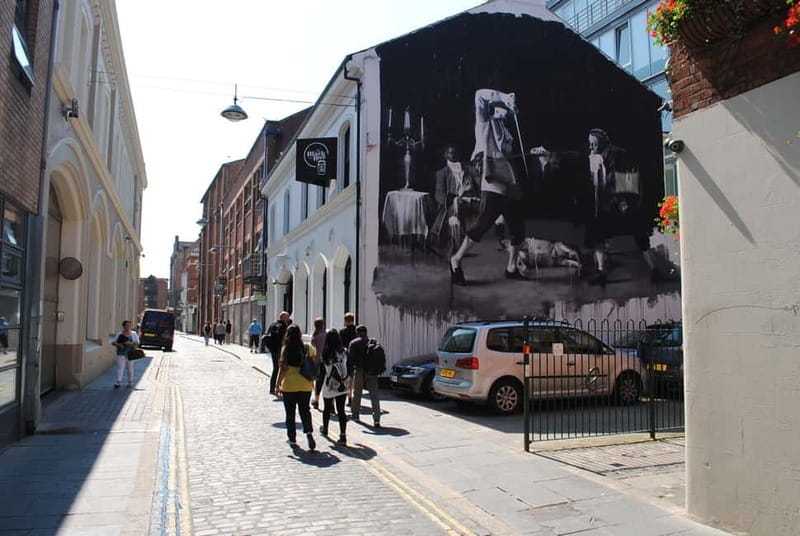
- The 1.5-mile route stays in central Belfast: You cover no hills or steps, making the walk manageable even in wet weather.
- The tour links long history to The Troubles: You learn why Belfast became a centre of conflict, rather than hearing isolated stories with no context.
- Local guides add personal insight: Guides including James, Mylie, Anne, Chris, and Steve have described growing up in Belfast during the unrest.
- The route includes real city-centre locations: Expect bombing sites, former security cordons, memorial points, and Belfast City Hall.
- The tone is careful and balanced: Political, religious, and social divisions are explained without turning the walk into a partisan speech.
- The final message is about peace and unfinished work: The Forgotten Troubles Memorial brings attention to lives lost and problems that remain.
Starting at Belfast City Hall
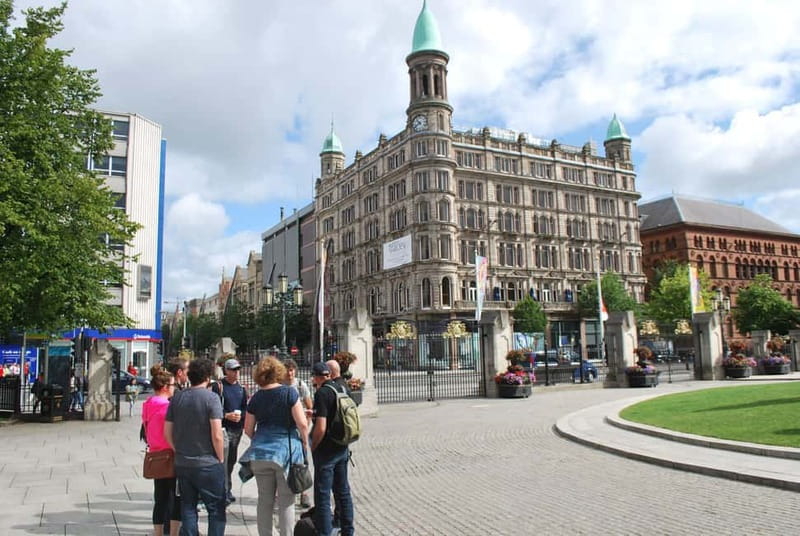
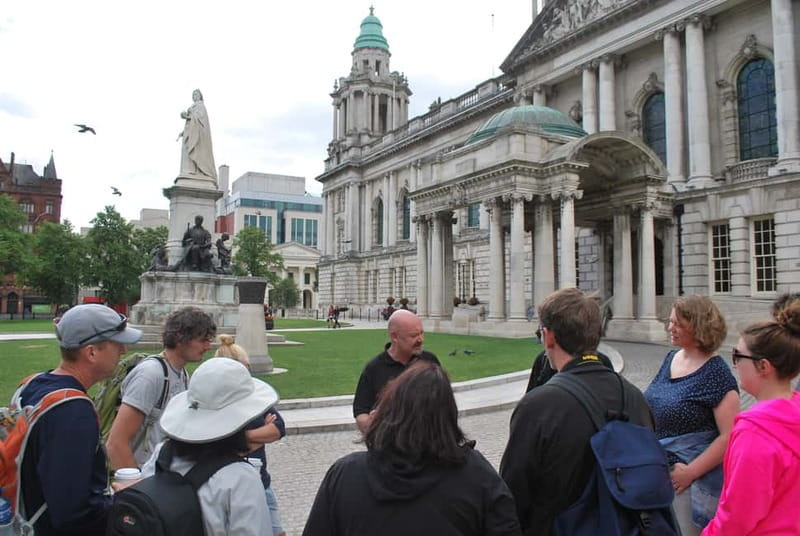
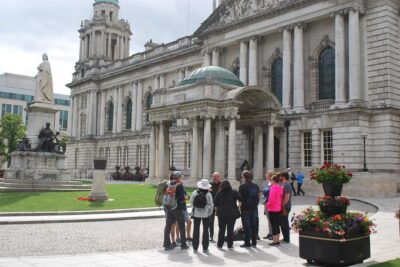
Meet at the front gates of Belfast City Hall on Donegall Square North. Look for a guide wearing a black DC Tours jacket or T-shirt with the company logo on the left side. Arrive 10 minutes early, since the opening explanation sets up the whole walk.
City Hall is a useful starting point. It places you in the heart of modern Belfast before the tour moves backward through the forces that shaped it. You begin to see that The Troubles did not appear out of nowhere in the late 1960s. The guide lays out the long story of Ireland’s division, political control, religious identity, and competing ideas about Northern Ireland’s future.
This opening matters because the conflict can be confusing if you only hear about individual attacks. The tour gives you the basic framework first, then returns to human stories and specific places. Guides such as James and Steve have been praised for making a large amount of history clear without turning the introduction into a university lecture.
More History Walking Tours in the UK
- A History of Terror – Belfast City Centre Walking Tour
★ 5.0 · 2,883 reviews - Edinburgh: Old Town History and Tales Walking Tour
★ 4.8 · 2,361 reviews - Old Town Walking Tour History and Tales in Edinburgh
★ 5.0 · 2,168 reviews
How 800 years led to The Troubles
The walk’s first major strength is its sense of cause and effect. You are not simply told that Belfast was divided between communities. You learn how those divisions formed, hardened, and passed into the twentieth century.
The guide explains the competing political aims, the place of religion in public identity, and the pressures that shaped Northern Irish society. You also hear about the effect of British rule, Irish nationalism, unionism, and the changing political situation that led to unrest in the 1960s.
That background is especially useful if you arrive knowing only the broadest outline of The Troubles. You may understand that there was conflict between Catholics and Protestants, but that description alone is not enough. The tour shows why that shorthand misses the political, social, and historical details.
I appreciate that the guide’s task is not to tell you which side to support. Instead, you are given enough information to understand why different groups saw the same events in sharply different ways. The aim is explanation, not a courtroom verdict.
Walking past places where violence happened
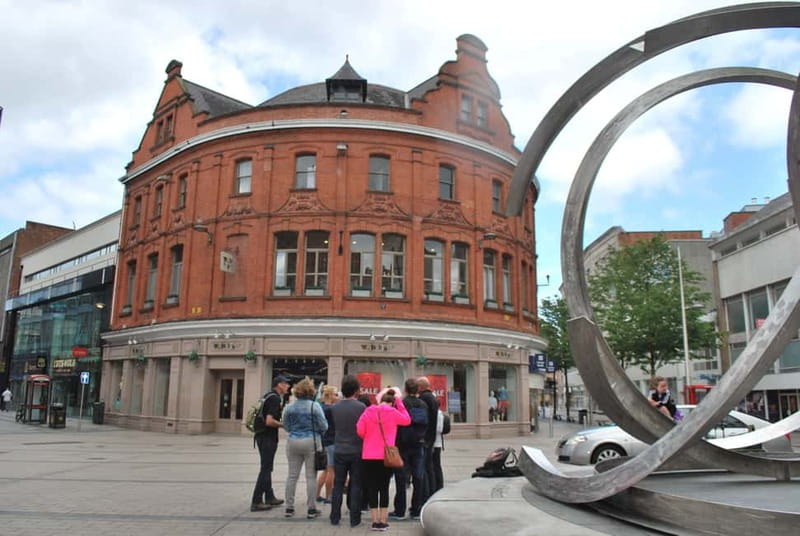
The route then turns the city centre into a record of the conflict. You stop at locations linked to major bombings and attacks, along with former security cordon points that once changed how people moved through Belfast.
These stops are not grand monuments. Often, they are ordinary streets and public spaces. That is precisely why they work. A café, shopfront, crossing, or square can look completely normal today, while the guide explains what happened there during the worst years of the conflict.
You hear how political violence affected civilians, businesses, workers, and people simply trying to get home. The focus is not only on the people who carried out attacks or the institutions involved. It is also on the wider population that had to live with sudden danger and long periods of tension.
The route covers the role of the British Army, the police, and paramilitary groups. It also explains how security measures affected everyday movement. A former cordon is more than a physical barrier in this telling. It becomes a way to understand surveillance, restricted access, fear, and the gradual loss of normal city life.
Because you move from place to place, the information has a natural rhythm. The guide explains an event, gives its setting, then leads you to the next point. The distance is modest, but the amount of material is substantial. The tour covers roughly 1.5 miles, so you will spend more time listening and thinking than racing between sights.
Personal stories and everyday life during The Troubles
The strongest part of the experience is its attention to ordinary people. Guides who grew up in Belfast during the conflict can explain not only what happened, but what it felt like to live with uncertainty as part of daily routine.
James has been described as combining political and historical study with memories of growing up in Belfast. Anne and Chris have also drawn on personal experience when explaining the period. Mylie is known for bringing local stories into the walk with care and feeling. These details give the tour a human centre.
Personal experience does not automatically make a history lesson fair, so it is important that the tour keeps more than one viewpoint in view. The guides are expected to discuss different political positions and the suffering of people across the communities. That balance helps you listen to personal stories without treating one person’s experience as the whole story.
The tone can be emotional. Some accounts may leave you quiet for a while. Yet the guides also use gentle humour at suitable moments. That does not make light of the violence. It reflects the way people often cope with difficult memories and keeps the two and a half hours from becoming an unbroken list of tragedies.
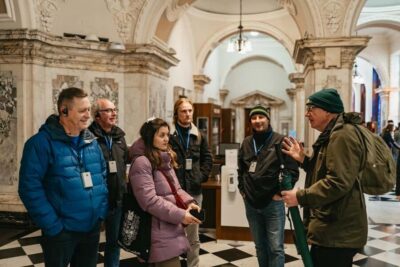
The headsets are a small but useful feature. Belfast traffic, weather, and city noise can make a walking tour hard to follow, especially for anyone with hearing difficulty. The audio equipment lets you stay with the group while hearing the guide clearly at each stop.
Same streets, a different guide:
- Magical London: Harry Potter Guided Walking Tour
★ 4.7 · 22,044 reviews - Edinburgh: Harry Potter Magical Guided Walking Tour
★ 4.8 · 11,944 reviews - Edinburgh Castle: Guided Walking Tour with Entry Ticket
★ 4.7 · 11,699 reviews - Underground Vaults Walking Tour in Edinburgh Old Town
★ 4.5 · 8,506 reviews
The road from violence to peace
The tour does not end with the darkest years. It follows the movement toward peace and explains how Belfast began to change after the peace process.
You hear about the shift from open conflict toward negotiation, reduced violence, and a different public life. The guide also discusses regeneration in the city centre. Streets that once carried fear now hold shops, offices, restaurants, and ordinary city traffic.
This is not presented as a tidy happy ending. Belfast has made progress, but peace does not erase memory or remove every division. The tour asks you to consider what reconciliation means in a city where the past remains close and political identities still matter.
That final section gives the walk its hopeful quality. You are not left with the idea that Belfast is defined only by bombs and barricades. Instead, you see a city trying to live with its history while building a less violent future.
The Forgotten Troubles Memorial
The Forgotten Troubles Memorial provides a quieter point for reflection. It brings attention to the people affected by the conflict and to the danger that some stories can disappear as the city changes.
This stop is valuable because the tour has already explained events, places, and political ideas. At the memorial, the emphasis shifts back to human cost. You are encouraged to think about loss, memory, and the people who still carry the effects of The Troubles.
It also adds an important note of caution. Peace is not only a political agreement or a change in the appearance of city streets. It involves how communities remember, how victims are acknowledged, and how younger generations understand what happened.
Is $35 good value for 2.5 hours?
At $35 per person, this is not the cheapest way to spend a morning in Belfast. But the comparison should be with a short guided history lesson combined with a city walk, not with a basic orientation stroll.
You receive 2.5 hours with a local guide, a carefully planned route, audio headsets, and access to context that would be hard to assemble from plaques or independent wandering. The guide connects long history, political change, specific attacks, security measures, personal memories, and the peace process.
The value is strongest if you are starting from limited knowledge. You leave with a framework that can make the rest of Belfast easier to understand. If you later visit other sites linked to the city’s past, you will have a clearer sense of why they matter.
It may feel less worthwhile if you have already studied The Troubles in detail or want a tour focused on architecture, food, or popular attractions. This experience is deliberately concentrated on conflict, memory, and peace.
Weather, walking pace, and accessibility
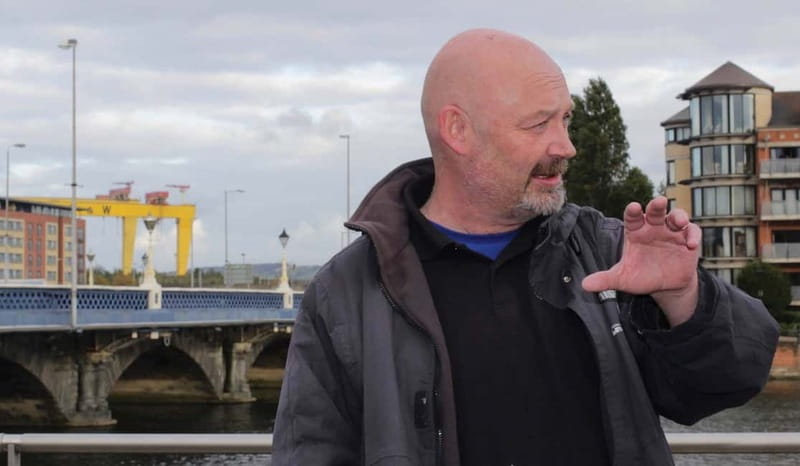
Belfast weather can change quickly, and the tour runs in rain as well as fair weather. Bring a waterproof jacket, and wear warm layers in winter. Comfortable shoes are sensible, although the route is flat and contains no hills or steps.
The walk covers only 1.5 miles, so it is not physically demanding for most people. The steady pace allows time for explanation at each location. The activity is wheelchair accessible, which is helped by the flat city-centre route.
English is the only tour language, and you need a good standard of English to follow the historical detail. The headsets help with sound, but they do not simplify the subject itself. If you find political history difficult to follow in English, this may not be the best choice.
Children under 12 are not accepted. That rule makes sense given the subject matter. Teenagers aged 12 and over who have an interest in history may get a lot from it, but parents should expect discussions of violence and death.
Who will get the most from this walk?
I would choose this tour early in a Belfast visit if I wanted a better understanding of the city. It gives you useful context before you visit museums, murals, memorials, or areas outside the centre.
It suits:
- Adults interested in modern Irish and British history
- Teenagers aged 12 and over who can handle serious subject matter
- People who want local perspective rather than a simple list of dates
- Visitors who prefer a balanced account of political conflict
- Anyone curious about how a post-conflict city functions today
It is less suited to young children, visitors seeking a cheerful sightseeing tour, or anyone uncomfortable hearing detailed accounts of violence and loss. The walk is thoughtful and at times moving, but it is not designed as entertainment alone.
Booking details worth keeping in mind
The meeting point is the front gates of Belfast City Hall, Donegall Square North. Arrive 10 minutes before the start and look for the DC Tours logo.
The duration is 2.5 hours, and start times vary, so check availability when booking. You can cancel up to 24 hours in advance for a full refund, and the reserve-now, pay-later option gives you some flexibility if your Belfast plans are still changing.
The tour is led live in English. Guides named in the experience include James, Eugene, Mylie, Anne, Rory, Chris, Jim, Steve, Paul, Finn, and Roisin. The exact guide depends on the departure, but the shared strength is local interpretation and a clear effort to treat the subject with care.
Should you book Belfast’s History of Terror walk?
Book it if you want to understand Belfast beyond its handsome buildings and current city life. The route is short, the subject is serious, and the guides take care to explain competing viewpoints without flattening the story into simple heroes and villains.
I especially recommend it for first-time visitors who know little about The Troubles. The combination of real city-centre locations, local memories, clear historical context, and the Forgotten Troubles Memorial gives you a strong foundation for seeing Belfast with more understanding.
Skip it if you want a relaxed general sightseeing walk or if two and a half hours of conflict history would make your day feel heavy. For the right audience, though, $35 buys something more useful than a collection of facts: it gives you a clearer way to read the city.
FAQ
How long is the Belfast History of Terror walking tour?
The tour lasts 2.5 hours.
How far do you walk?
The route is about 1.5 miles through Belfast city centre. The city-centre route is flat and has no hills or steps.
Where does the tour meet?
Meet at the front gates of Belfast City Hall on Donegall Square North in Belfast.
What language is the tour in?
The tour is conducted in English only. You need a good standard of English to follow the information fully.
Is the tour suitable for children?
Children under 12 are not permitted. The tour deals with violence, death, political conflict, and the human impact of The Troubles.
Is the tour wheelchair accessible?
Yes, the activity is wheelchair accessible.
What should I bring?
Wear comfortable shoes and clothing suited to the weather. A waterproof jacket is recommended for rain, and warm clothing is advised during winter.
New routes in the UK
- Aberdeen City Centre Walking Tour (2pm)★ 5.0 · 217 reviews
- German London : The Ultimate Walking tour★ 4.8 · 400 reviews
- London: Medieval History Walking Tour from The Tower★ 4.9 · 318 reviews
- Oxford: Official University and City Walking Tour★ 4.7 · 618 reviews
- The Beatles London Walking Tour★ 4.2 · 147 reviews
- Stratford-Upon-Avon’s Town Walking Tour (10:30am & 2pm)★ 4.8 · 143 reviews
- The Sinister Side of Shakespeare’s Stratford Walking Tour★ 4.8 · 547 reviews
- Stratford-Upon-Avon: The Famous Walk Talk Show★ 4.9 · 342 reviews
Belfast Walking Tours, compared.
A History of Terror – Belfast City Centre Walking Tour
Read our review →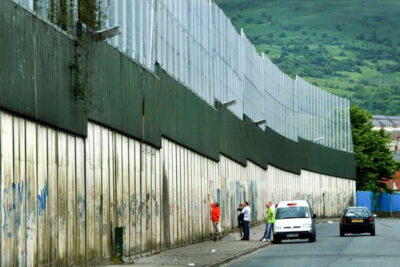
The Troubles Walls & Bridges Guided Walking Tour
Read our review →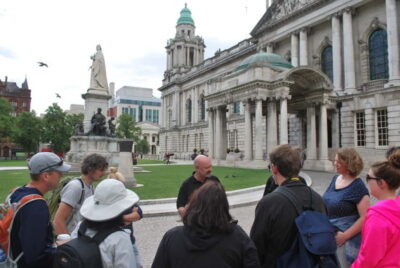
Best of Belfast History, Culture & Art Walking Tour
Read our review →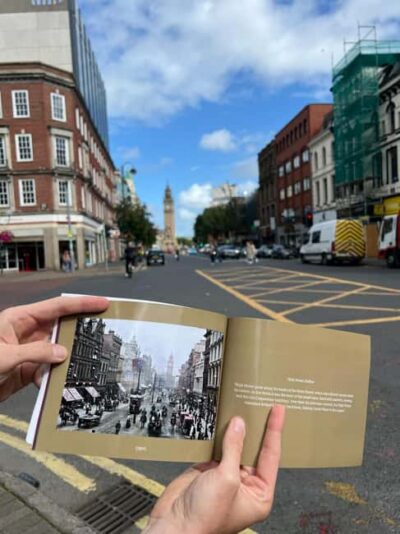
Belfast Walking Tour with a Local – History & Craic
Read our review →Browse the lists this tour appears in