
Review · BARCELONA
Gothic Quarter Donation-Based Walking Tour in English
Barcelona’s old center is not a museum behind glass. It is a working maze of lanes, squares, churches, government buildings, cafés, and stone walls from different centuries. This donation-based walking tour gives you a clear route through that maze, beginning in Plaça Reial and ending near Santa Maria del Mar in El Born.
I like the strong historical range, from Roman Barcelona at Plaça Nova to the medieval royal court at Plaça del Rei. I also like the generous time for photos and the guide’s willingness to suggest places for the rest of your trip. The main caution is the pace: two and a half hours on foot can feel long in humid weather.
Key points to know before you go
- Roman walls to Civil War scars: The route links major periods of Barcelona’s past instead of treating the Gothic Quarter as one single medieval story.
- A useful first-day orientation: Start at 11:00 and finish in El Born, a good base for finding lunch or planning more sightseeing.
- Small enough for conversation: The maximum group size is 20, so you should have a better chance to hear the guide and ask questions.
- Mostly exterior sightseeing: The listed stops focus on squares, façades, streets, walls, and public spaces, with free admission at each stop.
- Very low listed price: At $3.62 per person, the value rests mainly in the guide’s storytelling, route planning, and local suggestions.
- Come ready to walk: The tour lasts about 2 hours and 30 minutes, and one review found it fast-paced in humid conditions.
Why this route works for seeing old Barcelona
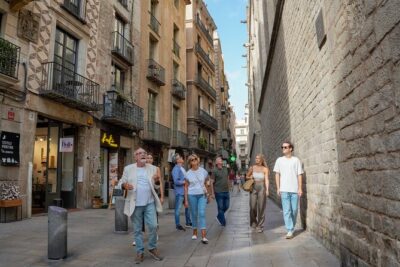
The Gothic Quarter can be confusing at first. Its streets twist around old churches and government buildings, and the most interesting details are often above eye level or tucked into a small square. A guide helps you connect the pieces.
This route is well shaped. It begins in a famous square just off La Rambla, moves through the older heart of the Gothic Quarter, then crosses toward El Born. You see lively public spaces, quiet corners, political centers, religious buildings, Roman remains, and reminders of the Spanish Civil War.
I especially like that the stops are not all variations on the same Gothic façade. Plaça Reial gives you an elegant 19th-century square with palm trees and cafés. The Jewish Quarter narrows the focus to medieval community life. Plaça de Sant Jaume brings you into present-day Catalan politics. Plaça Sant Felip Neri adds a darker, more personal layer.
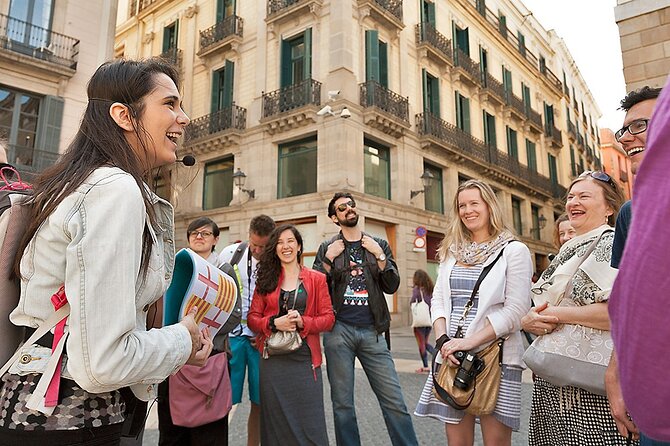
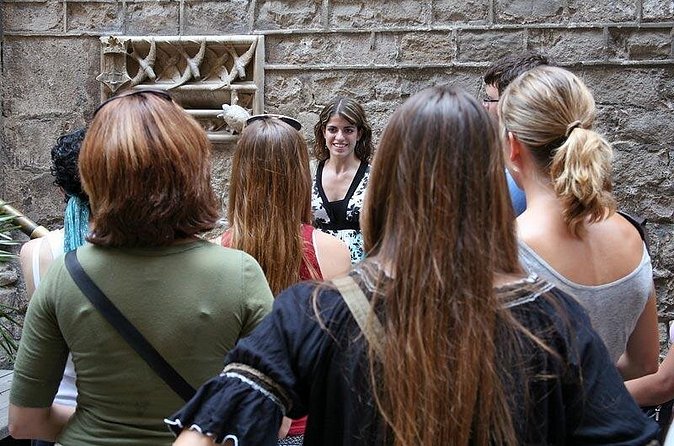
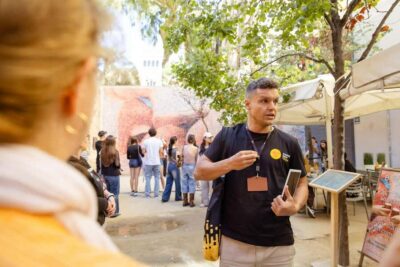
The tour is also social by design. With an English-speaking local guide and a maximum of 20 people, you can meet others while getting practical advice for the rest of your visit. The guide is happy to recommend places beyond the route, which is useful if this is your first morning in Barcelona.
More Free Walking Tours in Barcelona:
- Paris City Center Free Walking Tour (Tip-Based)
★ 5.0 · 1,340 reviews - Budapest Historical Sightseeing – Free Walking Tour
★ 5.0 · 1,302 reviews - Discover Helsinki – Tip-based Tour by RED UMBRELLA – 2026
★ 5.0 · 368 reviews
Starting at Plaça Reial at 11:00
Your meeting point is Plaça Reial, or Royal Square, just off La Rambla. It is an easy place to recognize, with neoclassical buildings, palm trees, cafés, and the Font de les Tres Gràcies fountain at its center.
Look for the unusual lampposts associated with Antoni Gaudí. They add a small architectural surprise to a square that otherwise feels formal and symmetrical. By day, the square is a pleasant place to begin; later, it becomes a nightlife and music spot.
The 15-minute stop is enough to get oriented without spending too much of the morning here. I would arrive a little early so you can locate the guide and use the nearby square as your first photo stop.
Starting here also gives the tour a useful contrast. Plaça Reial feels open and polished, while the next sections lead into tighter medieval lanes. That shift helps you understand how old Barcelona developed in layers rather than according to a neat modern street plan.
Plaça del Pi and the old Jewish Quarter
Plaça del Pi is a calmer square dominated by Santa Maria del Pi church. Its historic setting, cafés, and artisan stalls give it a more local feel than the broad tourist thoroughfare nearby. A regular art market adds another reason to pause.
The stop lasts about 15 minutes. You should have time to photograph the church façade and absorb the square without turning this into a long church visit. The route information describes the exterior, so do not assume that admission inside the church is included.
From here, the walk enters El Call, Barcelona’s former Jewish Quarter. The narrow streets are the point. They preserve the sense of a compact medieval district, though you should pay attention to the guide because the lanes can look similar from one turn to the next.
The Medieval Synagogue and Call Interpretation Centre help explain the area’s past. These references give the tour more substance than simply calling the streets old. You learn how a Jewish community once lived in this part of the city and how that story fits into Barcelona’s wider development.
The 15-minute timing is brief, so this is an introduction rather than a full study of El Call. If this part of Barcelona matters most to you, note the location and return later with more time.
Plaça de Sant Jaume, the city’s political center
The 20-minute stop at Plaça de Sant Jaume shifts the story from neighborhood life to public power. Barcelona’s City Hall and the Palau de la Generalitat face each other across the square, making it one of the city’s key civic spaces.
The location has served as a center of authority since Roman times. Today, it remains a setting for cultural events and public celebrations. That continuity is useful: the square is not only an attractive historic site, but also a place where Barcelona’s political life still takes place.
I like this stop because it shows how old architecture remains part of daily civic life. You are not looking at abandoned ruins. You are seeing historic buildings used for government, with the square acting as a stage for the city.
Because the stop lasts 20 minutes, the guide has room to explain the buildings and the square’s role without rushing through it. It is also a good point to ask broader questions about Barcelona’s past or request suggestions for the rest of your stay.
More Walking Tours in Barcelona:
- Barcelona Tapas and Wine Experience Small-Group Walking Tour
★ 5.0 · 5,804 reviews - Barcelona: Tapas Walking Tour with Food, Wine, and History
★ 4.8 · 4,261 reviews - Barcelona: Food Walking Tour with Tapas and Wine
★ 4.9 · 2,180 reviews - Barcelona Tapas Walking Tour: Food, Wine & History
★ 4.5 · 1,928 reviews
Barcelona Cathedral and Plaça Sant Felip Neri
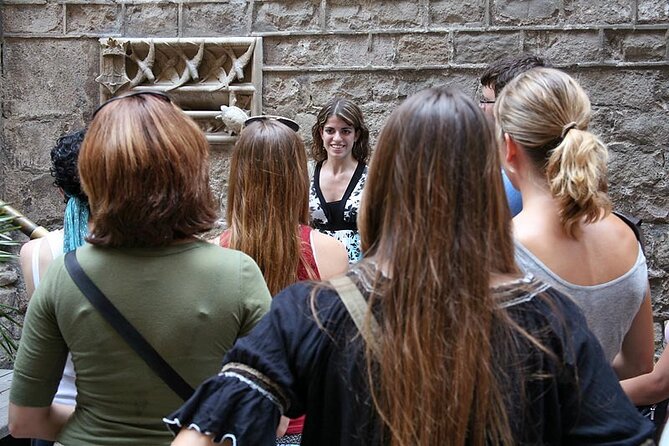
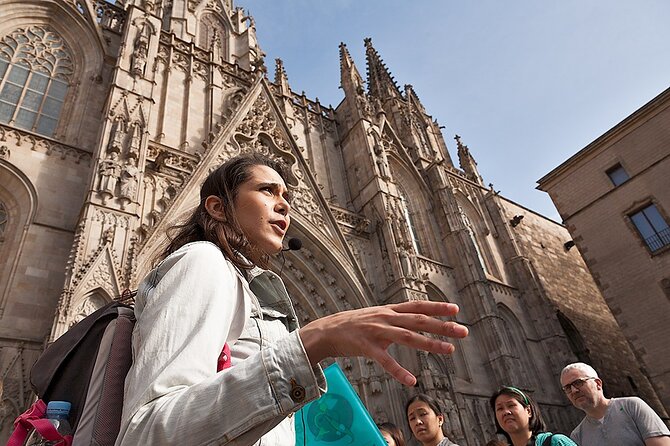
The façade of Barcelona Cathedral is one of the route’s grandest sights. Its carved stonework, tall spires, and large central arch present the Gothic Quarter at its most formal.
The scheduled stop is 15 minutes. That works well for seeing the exterior and taking photographs, but it is not enough for a detailed visit inside. If you want to explore the cathedral beyond the façade, you will need to arrange that separately.
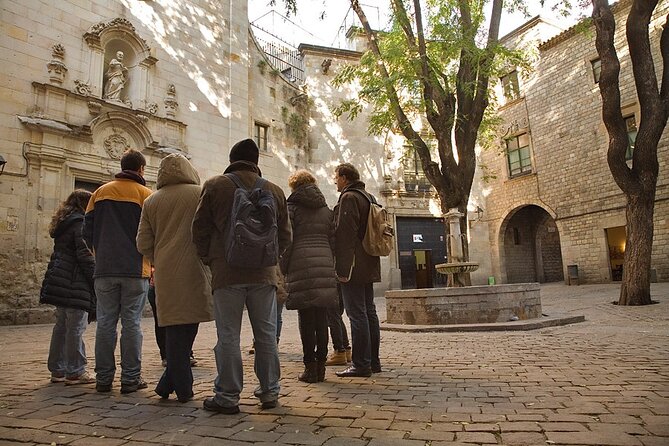
The route then moves to Plaça Sant Felip Neri, one of the most affecting places in the old quarter. The square is quiet, with a Baroque church and fountain, but the church façade carries visible shrapnel scars from the Spanish Civil War.
This is where the tour’s tone changes. The damaged wall connects Barcelona’s older architecture with a much more recent and painful period. I appreciate the inclusion of this stop because it prevents the Gothic Quarter from becoming a pretty collection of stone buildings with no modern context.
You have 15 minutes here. Use it quietly. The square is smaller and more reflective than the open spaces earlier in the tour, and the scars on the façade deserve more than a quick photograph.
Plaça Nova and the Roman beginning of Barcelona
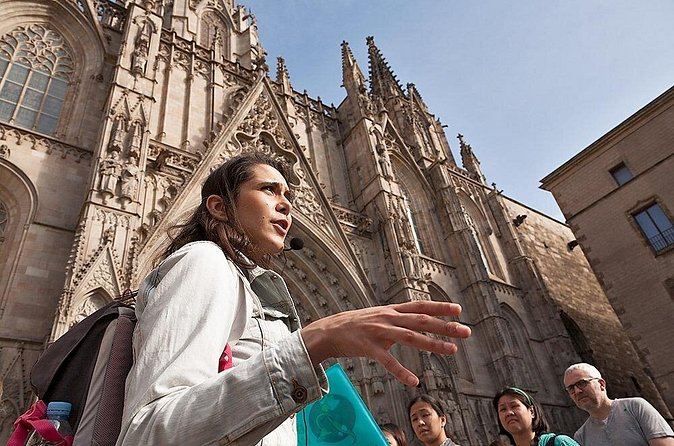
At Plaça Nova, the route reaches the gateway to Roman Barcelona. Remnants of the ancient city wall and two large defense towers remain near the cathedral, giving you a direct look at the city before the medieval streets took shape.
This stop lasts 15 minutes, which is enough to examine the wall remains and understand their position in the modern city. The old stones sit beside present-day streets, so the contrast is immediate.
I find this kind of stop especially useful on a walking tour. You can see how the city expanded beyond its original defenses, rather than hearing only a date or a name. Plaça Nova also helps place the cathedral and nearby Gothic Quarter buildings within a much older urban story.
The route has now moved through several periods: Roman defenses, medieval religious buildings, Jewish community life, royal power, and the Civil War. That chronological range is the tour’s strongest feature.
Plaça del Rei and Barcelona’s medieval court
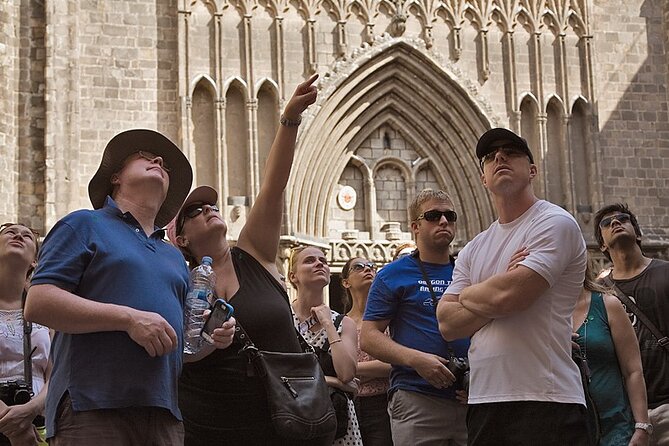
Plaça del Rei brings you into the royal center of medieval Barcelona. The square is surrounded by striking historic buildings, including the Grand Royal Palace and the Watchtower of King Martí.
The 20-minute stop gives the guide time to explain the square’s royal role and point out architectural details. The setting is enclosed and imposing, with stone buildings that make it easy to picture the area as a center of authority.
This is one of the better places on the route for understanding why Barcelona’s old center feels so dramatic. The square is not simply a scenic pocket. It reflects the city’s place in the medieval Crown of Aragon and its former political importance.
As with the cathedral, the experience described here centers on the exterior setting. You should treat the stop as a guided introduction, not as a ticketed museum visit. If you want to go inside nearby historic sites, ask the guide for current advice.
Finishing at Santa Maria del Mar in El Born
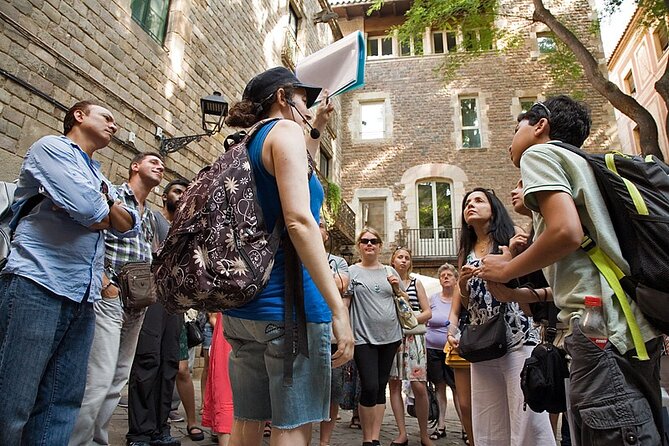
The final major stop is the Basilica de Santa Maria del Mar, in the El Born district. Its 14th-century façade is a fine example of Catalan Gothic design, with an elegant rose window, tall arches, and twin towers.
The 20-minute visit gives you time to take in the church from outside and notice how different it feels from the cathedral. Santa Maria del Mar has a strong connection to the medieval character of the district, while its setting in El Born makes the end of the walk feel more open and social.
The tour finishes at Plaça del Fossar de les Moreres, nearby. You end in a central part of Barcelona with restaurants, which is convenient for lunch after a long morning on foot.
That ending is practical. You do not have to retrace your steps to La Rambla, and you can continue exploring El Born after the guide leaves. You might also use the guide’s recommendations to choose where to eat or what to see next.
How much value do you get for $3.62?
At the listed price of $3.62 per person, this is unusually inexpensive for a 2.5-hour guided walk. The value is not in included admissions, since the stops are listed as free. It comes from having a planned route, an English-speaking local guide, historical context, and the chance to ask for local recommendations.
That distinction matters. If you want cathedral interiors, museum tickets, or a long stop at each site, this is not that kind of experience. If you want a broad orientation to Barcelona’s oldest center, the price is easy to justify.
The tour is recommended by 99 percent of its published audience and carries a 4.9 rating from 72 reviews. The strongest praise centers on clear historical information, a well-chosen set of stops, and an interactive guide who keeps the group involved.
There is one practical tradeoff. The walk can feel fast and long in humid weather. Two and a half hours is a serious stretch on stone streets, especially because the route has nine stops and keeps moving between them.
Who should book this Gothic Quarter walk?
I would choose this tour if you enjoy history but want it explained in plain language while you walk. It is especially useful early in a Barcelona visit, when you need a map in your head and a better sense of how the Gothic Quarter connects with El Born.
It also suits solo visitors and people who enjoy meeting others. The group can include up to 20 people, large enough for a social atmosphere but limited enough for the guide to interact with the group.
You may want a shorter activity if you dislike long walks, struggle in humid weather, or prefer spending a full hour inside one church or museum. Families and visitors with limited stamina should also consider the duration before booking, since most participants can take part but the route remains a lengthy walking experience.
Confirmation is provided at booking. Service animals are allowed, and the meeting point is near public transportation. Free cancellation is available up to 24 hours before the 11:00 start time, but changes or cancellations inside that window are not accepted.
Should you book it?
Book this walk if you want a low-cost, history-focused introduction to Barcelona’s oldest center, with a route that moves from Roman walls to medieval courts and then into El Born.
Skip it if you want extensive interior visits or a slow, relaxed stroll. The best way to enjoy it is to wear comfortable shoes, allow the full two and a half hours, and treat the guide’s suggestions as a starting point for the rest of your trip.
FAQ
Where does the Gothic Quarter walking tour start?
The tour starts at Plaça Reial in Barcelona’s Ciutat Vella at 11:00 am.
Where does the tour end?
It ends at Plaça del Fossar de les Moreres in El Born, a central area with restaurants.
How long does the walking tour last?
The tour lasts approximately 2 hours and 30 minutes.
What language is the tour offered in?
The tour is offered in English and includes a professional English-speaking local guide.
What is the maximum group size?
The tour allows a maximum of 20 participants.
Can I cancel the booking for a refund?
Yes. You can cancel up to 24 hours before the experience start time for a full refund. Cancellations or changes made less than 24 hours before the start are not accepted and are not refunded.
New routes in Barcelona
- Barcelona Historical Walking Tour: Gothic Quarter and El Born★ 5.0 · 217 reviews
- Private Tailored Barcelona Walking Tour★ 5.0 · 80 reviews
- The Spanish Civil War & Franco Barcelona Walking Tour★ 5.0 · 539 reviews
- Jewish Walking Tour Barcelona by Expert Jewish Guide 2h★ 5.0 · 297 reviews
- Barcelona Dark History Night Walking Tour With Drinks★ 5.0 · 153 reviews
- Ramblas, Old Town, Gothic and Gaudi Architecture Walking Tour★ 5.0 · 723 reviews
- Barcelona Gems, 10+ Sights Immersive Walking Tour★ 5.0 · 209 reviews
- Barcelona: Guided Food Walking Tour with Tapas and Wine★ 5.0 · 848 reviews
Barcelona Walking Tours, compared.
Barcelona Tapas and Wine Experience Small-Group Walking Tour
Read our review →
Tapas Walking Tour with Food, Wine, and History
Read our review →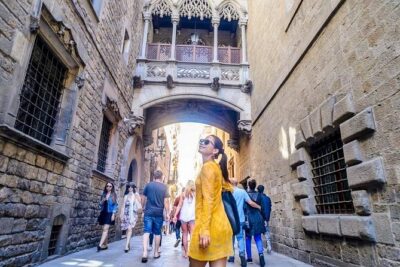
Barcelona Helicopter, Sailboat & Old Town Private Walking Tour
Read our review →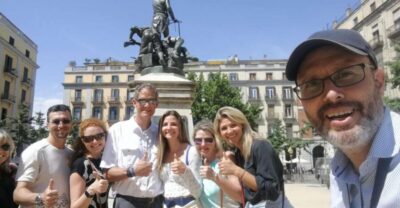

Helicopter Flight, Boat Ride, and Walking Tour
Read our review →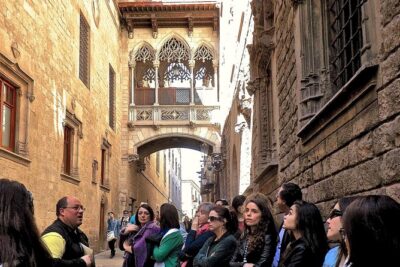
Barcelona Old Town & Gothic Quarter Small Group Tour
Read our review →
Barcelona Food Tour: Tapas, Paella, Sangria & 8+ Local Tastings
Read our review →Browse the lists this tour appears in