
Review · BARCELONA
Ramblas, Old Town, Gothic and Gaudi Architecture Walking Tour
Barcelona’s best introduction may be the walk from Roman ruins to Gaudí’s wildest façades. This tour crosses the old city, follows Las Ramblas, then moves into the grand Eixample to explain how Barcelona changed from a medieval walled town into a modernist showpiece. I like that it connects both sides of the city instead of treating them as separate sights.
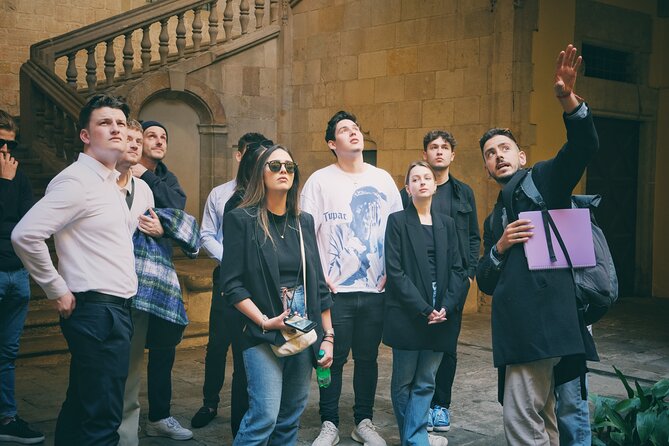
I also like the small maximum of 15 people and the guide-led storytelling. Guides including Yannis, Filipa, Christian, Henrietta, and Anna have been praised for humor, local insight, patient pacing, and good answers to questions. The catch is simple: this is a walking tour with plenty of pavement, one short metro ride, and no interior visits to the Gaudí buildings.
Key points at a glance
- Two Barcelonas in one walk: See the medieval Gothic Quarter and the polished Eixample in a single outing.
- Roman ruins and medieval streets: The first half gives you context for Barcelona’s oldest center.
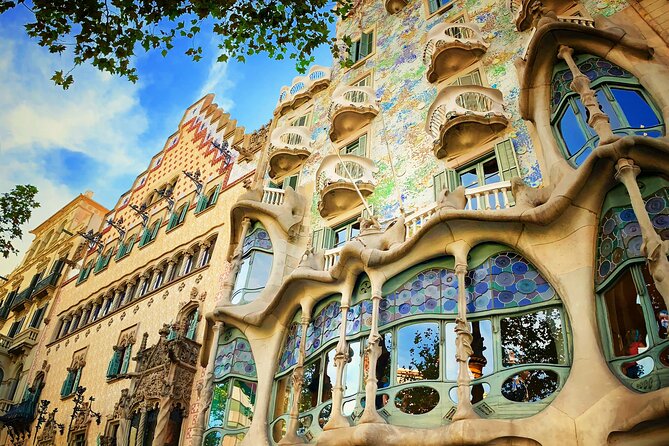
- Gaudí from the outside: Casa Batlló and Casa Milà are explained through their façades, but admission is not included.
- A genuinely small group: The tour is limited to 15 people, making it easier to hear and ask questions.
- Useful first-day orientation: The route helps you understand where the old center, Las Ramblas, and Passeig de Gracia fit together.
- Budget extras to plan for: Bring a metro ticket or buy one from the guide, and expect a €1 headset rental.
Why this route works so well for a first day

This experience is built around contrast. You begin at Plaça de Catalunya, where Barcelona’s old center meets the newer city, then enter the Gothic Quarter. Later, you finish near Casa Batlló and Casa Milà on Passeig de Gracia, surrounded by the grand avenues and apartment blocks of the Eixample.
That change in setting gives the history a clear shape. You can see how narrow medieval lanes, Roman remains, and church courtyards belong to one older Barcelona, while wide avenues and ornate private homes belong to the city’s 19th-century expansion.
I especially like this kind of route when I have just arrived. You get a useful mental map without spending a full day inside museums or monuments. Several guides also offer suggestions for restaurants, bars, and things to do after the walk, which makes the tour more useful than a simple march past famous façades.
The time is tight, though. Two hours and 15 minutes is enough for an overview, not a slow architectural study. You will stop often, but some stops are brief. If you want to enter Barcelona Cathedral, Casa Batlló, or La Pedrera, plan those visits separately.
More Old Town Walking Tours in Spain
- Barcelona Helicopter, Sailboat & Old Town Private Walking Tour
★ 5.0 · 1,395 reviews - Barcelona: Old Town and Gothic Quarter Walking Tour
★ 4.8 · 1,393 reviews - Barcelona Old Town & Gothic Quarter Small Group Tour
★ 5.0 · 1,308 reviews
Gothic Quarter: Roman stones and medieval lanes
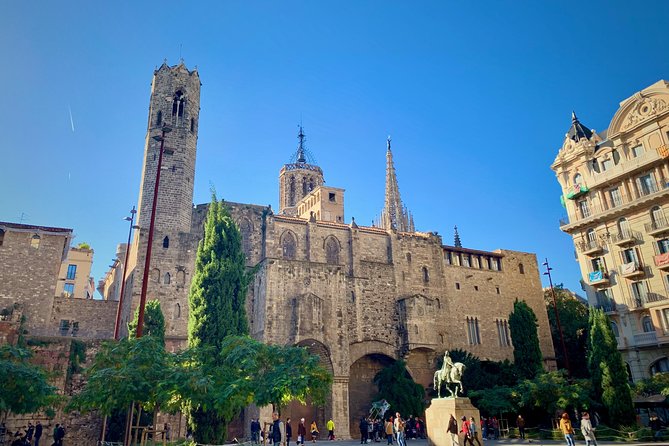
The tour spends about 30 minutes in the Gothic Quarter, the oldest section of the city. This is the strongest part of the route for history lovers because the streets still show several layers of Barcelona’s past.
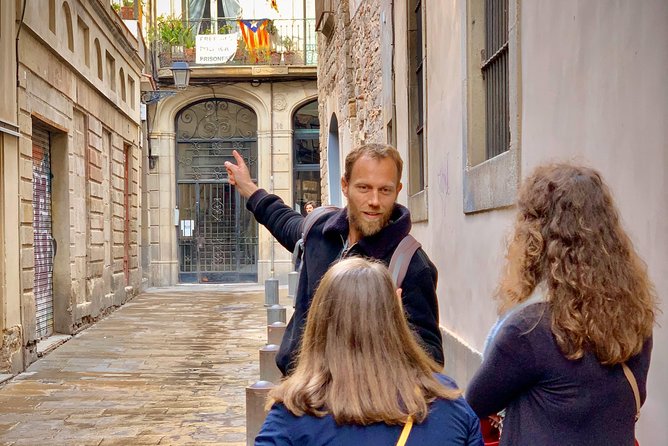
Expect narrow lanes, small courtyards, squares, medieval churches, and Roman remains. The guide’s job here is to make sense of what you are seeing. Without context, the quarter can feel like a maze of attractive stone buildings. With a good explanation, the lanes become evidence of a city that grew in cramped stages over many centuries.
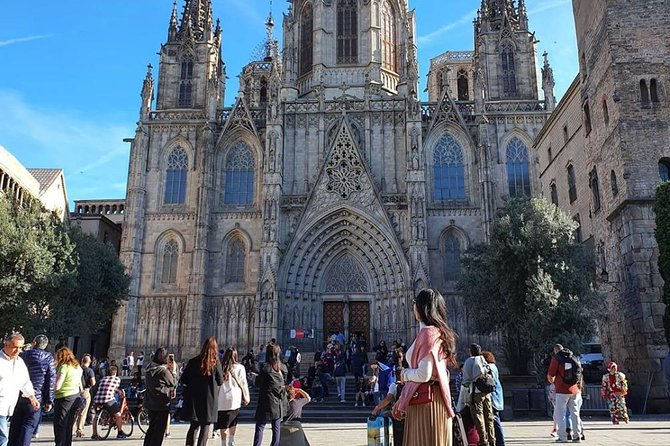
The Barcelona Cathedral is part of this section. You will see its medieval Gothic form and hear about its place at the center of the old town, but the entrance ticket is not included. The stop listed for the cathedral itself is only about three minutes, so treat this as an introduction rather than a full visit.
That distinction matters. If cathedral interiors are high on your list, you will want to return on your own when you have more time. The tour gives you the setting and the story, then keeps moving.
Plaça Sant Felip Neri and the quieter old town
Plaça Sant Felip Neri is one of the more atmospheric stops. It is a small square tucked into the Old Town, away from the open flow of Las Ramblas. The tour allows about five minutes here, enough to pause, look around, and hear why this place matters.
This is the sort of stop that helps the tour feel less predictable. You are not only being led to Barcelona’s biggest sights. You are also being shown a quieter corner where the scale changes from grand boulevard to enclosed neighborhood square.
The stop is free, but the walking surface and tight streets are worth noting. Comfortable shoes are essential. One person specifically noted that there is a lot of walking, even though the pace can be adjusted for breaks. The route has also worked for families with strollers, though you should still expect city streets and a full two-plus hours on foot.
Las Ramblas and Plaça Reial
Las Ramblas receives only about two minutes on the planned route. That may sound brief, but it is sensible. This famous street is more useful as a connecting spine than as a place for a long lecture.
You will pass the markets, bars, and restaurants that make the avenue one of Barcelona’s best-known public spaces. The quick stop lets the guide explain where you are and how Las Ramblas links the old center with the waterfront area, without allowing one crowded thoroughfare to take over the entire experience.
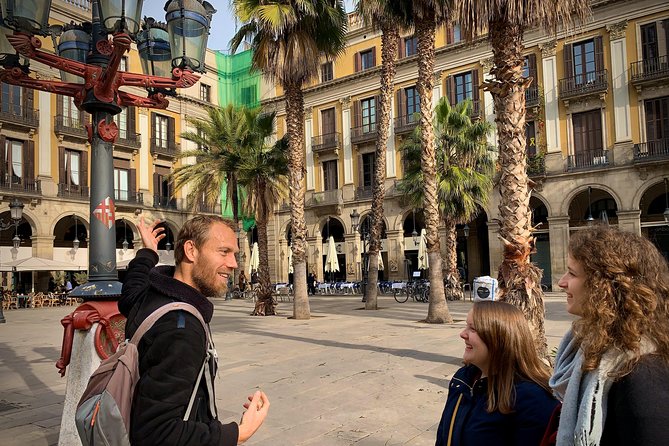
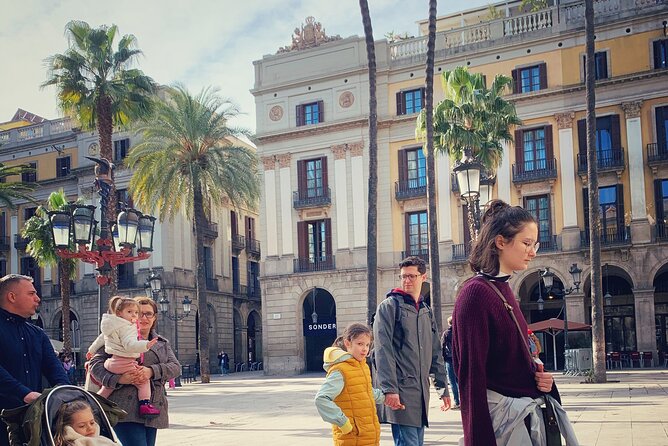
Plaça Reial gets about five minutes. Its arcaded edges, palm trees, restaurants, and nightlife give you a different view of the Old Town. The square is broad and theatrical after the Gothic Quarter’s narrow lanes, so the contrast is easy to feel.
I would not book this tour solely for Las Ramblas or Plaça Reial. Neither receives enough time for a deep look. Their value is in the route: they connect the historical core and help you see how Barcelona shifts from medieval streets to open civic spaces.
More Old Town Walking Tours in Barcelona:
- Barcelona 1.5h Private Old Town, Gothic & Ramblas Walking Tour
★ 5.0 · 318 reviews - Barcelona: Ramblas, Old Town & Gaudí Houses Walking Tour
★ 4.9 · 239 reviews - Barcelona: Old Town Private Walking Tour of Past and Present
★ 5.0 · 160 reviews - Underground Vaults Walking Tour in Edinburgh Old Town
★ 4.5 · 8,506 reviews
The short metro ride between old and new Barcelona
The route includes a short metro ride. Public transport is not included, so bring your own ticket or buy one from the guide. A useful practical detail is that elevators are available for the metro portion, which can help families with strollers.
This small transfer is important because it prevents the tour from becoming an exhausting cross-city walk. You get a taste of how Barcelona’s transit system links its historic center with the Eixample, then continue on foot among the modernist buildings.
The radio headset is another extra. Rental costs €1 per person, paid at the start to an outside provider. In a group of up to 15, the headset can make it easier to follow the guide near traffic or in busy public spaces. Bring a little cash, though credit cards have also been accepted for these small costs.
Casa Batlló: Gaudí’s dragon-like façade
Casa Batlló is one of the tour’s main architecture stops. The building is often described through its fairy-tale appearance, curved forms, bone-like details, and dragon associations. You will hear how Gaudí turned a private home into something that feels closer to a storybook creature than an ordinary apartment building.
The tour does not go inside. That keeps the price low and the pace moving, but it also means the façade is the full experience here. If you want the interior rooms, light wells, roof terrace, and exhibition details, you need a separate admission ticket and another visit.
The exterior explanation still has real value. A guide can point out details that are easy to miss when you are standing across the street taking photographs. You also learn how Casa Batlló fits into the larger modernist competition along Passeig de Gracia.
Casa Milà and the mountain house
La Pedrera, also called Casa Milà, receives about five minutes. This was Gaudí’s large private home for the Milà family, and its stone surface gives it the nickname the mountain house.
Again, the tour stays outside. Five minutes is enough to understand the basic design idea and hear why the building is so unusual, but not enough for a full architectural inspection. The building rewards a longer visit, especially if you want to see the roof structures and interior spaces.
I see this as a useful preview. The guide helps you decide which Gaudí sites deserve your admission money. Since Casa Batlló and Casa Milà can both take a significant part of your day if visited inside, an exterior overview helps you choose rather than blindly booking every attraction.
Passeig de Gracia: Barcelona’s modernist showcase
The longest part of the walk is about 45 minutes on Passeig de Gracia. This is where the tour shifts from isolated buildings to an entire urban setting.
Passeig de Gracia is Barcelona’s grandest shopping and residential avenue, lined with modernist homes, decorative tiles, ornate street lamps, and polished façades. The street itself explains how wealthy families used architecture to display status during the city’s growth.
The guide can point out details beyond Gaudí. That matters because Barcelona’s modernist style was not created by one architect alone. A street-level walk makes it easier to compare buildings, balconies, materials, and decorative choices in one stretch.
This is also the portion most likely to appeal to architecture students, design fans, and anyone who likes looking closely at buildings. You are not just checking off Casa Batlló. You are learning to read the whole avenue.
Casa Amatller and the rivalry of the great façades
Casa Amatller sits beside Casa Batlló and adds another architect’s voice to the same famous block. It was designed in the modernist style by Puig i Cadafalch, giving you a direct comparison between neighboring buildings.
The stop lasts about five minutes, but its location does much of the work. Stand in front of Casa Amatller and Casa Batlló, and you can immediately see that Barcelona’s modernism was full of competing ideas. One building does not erase the other. Together they show how private homes became public statements.
The tour ends on Carrer del Consell de Cent, near Casa Batlló and Casa Milà. That is a useful finish because you are already in the Eixample, close to some of the city’s major modernist sights and restaurants.
Guide quality and the small-group advantage
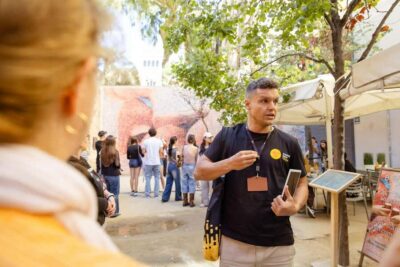
The guides are central to this experience. Yannis is praised for making Catalan and Barcelona history funny and memorable. Filipa has been especially effective with children, using stories and surprises while keeping a safe pace. Christian brings a local perspective as a Barcelona native, while Henrietta is noted for a calm rhythm and useful recommendations.
Other named guides include Anna, Loic, Evan, Tyler, Hanna, Melanie, Cristina, and Creasy. The strongest pattern is not a single personality but a shared ability to explain history in an engaging way, answer questions, and adjust to the group.
The group limit of 15 is important. A large walking group can turn an old-city route into a frustrating exercise in keeping up. A smaller group gives you a better chance of hearing the explanation, asking about a building, or pausing when someone needs a break.
The tour is offered in English. It is designed for most participants, and service animals are allowed. Still, I would not treat it as an easy stroll. Wear supportive shoes, expect stops on city streets, and plan for the short metro transfer.
Is $35.37 good value?
At $35.37 per person, this is a reasonable price for a guided orientation covering two very different parts of Barcelona. You are paying for a professional guide, the Old Town walk, and the exterior architecture route, not monument admission.
The value is strongest if you are new to Barcelona and want context quickly. You cover Roman remains, medieval streets, a Gothic cathedral, major public squares, Las Ramblas, and several modernist buildings in just over two hours. A guide also saves you from spending your first day trying to understand the city map on your own.
The value is weaker if you want long visits inside famous buildings. Cathedral entry, Casa Batlló entry, and Casa Milà entry are separate. Add the €1 headset and the metro ticket, and the final cost is slightly above the headline price.
Group discounts may help if you are booking for several people. The mobile ticket is convenient, and free cancellation is available up to 24 hours before the start time. Poor weather or failure to reach the minimum number can lead to a new date or full refund.
Who should book it?
I would choose this tour for a first or second day in Barcelona, especially if you want history and architecture explained in plain language. Families can benefit from the engaging pace, and solo visitors are included in a mixed small group rather than left to figure out the route alone.
It also suits anyone deciding which Gaudí buildings deserve an interior visit. You get an outside look at Casa Batlló and Casa Milà, then can return later with a better sense of what you want to see.
I would skip it if your priority is entering monuments, spending an hour at every stop, or avoiding a full walking route. In that case, book individual admissions and explore at your own pace.
Final call: book it for context, not entry tickets
This is a strong-value Barcelona orientation that joins the Gothic Quarter and Gaudí’s Eixample in one carefully chosen route. The best parts are the old-town stories, the small group, the long look at Passeig de Gracia, and guides who can make architecture feel human.
Book it early in your stay if you want a useful city framework and practical suggestions for the days ahead. Just bring good shoes, budget for the headset and metro ride, and remember that the famous buildings are viewed from the street. With a 4.9 rating from 723 reviews and 99 percent recommending it, the tour has a strong record, but its success still depends on what you want: an intelligent introduction, not a series of interior admissions.
FAQ
How long does the walking tour last?
The tour lasts approximately 2 hours and 15 minutes.
Is the tour offered in English?
Yes. The tour is offered in English.
Are entrance tickets to the monuments included?
No. Tickets for the Barcelona Cathedral, Casa Batlló, Casa Milà, and other monuments are not included.
Is the metro ride included?
No. The short public transport ride is not included. Bring your own ticket or get one from the guide.
How large is the tour group?
The maximum group size is 15 people.
What happens if the weather is poor?
The experience requires good weather. If it is canceled because of poor weather, you will be offered another date or a full refund.
New routes in Barcelona
- Barcelona Historical Walking Tour: Gothic Quarter and El Born★ 5.0 · 217 reviews
- Gothic Quarter Donation-Based Walking Tour in English★ 5.0 · 72 reviews
- Private Tailored Barcelona Walking Tour★ 5.0 · 80 reviews
- The Spanish Civil War & Franco Barcelona Walking Tour★ 5.0 · 539 reviews
- Jewish Walking Tour Barcelona by Expert Jewish Guide 2h★ 5.0 · 297 reviews
- Barcelona Dark History Night Walking Tour With Drinks★ 5.0 · 153 reviews
- Barcelona Gems, 10+ Sights Immersive Walking Tour★ 5.0 · 209 reviews
- Barcelona: Guided Food Walking Tour with Tapas and Wine★ 5.0 · 848 reviews
Barcelona Walking Tours, compared.
Barcelona Tapas and Wine Experience Small-Group Walking Tour
Read our review →
Tapas Walking Tour with Food, Wine, and History
Read our review →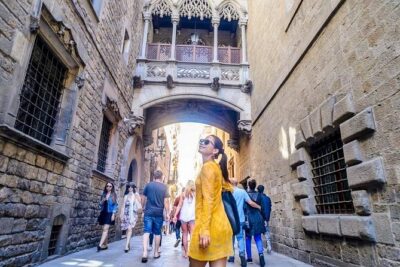
Barcelona Helicopter, Sailboat & Old Town Private Walking Tour
Read our review →

Helicopter Flight, Boat Ride, and Walking Tour
Read our review →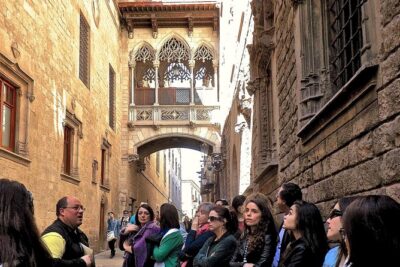
Barcelona Old Town & Gothic Quarter Small Group Tour
Read our review →
Barcelona Food Tour: Tapas, Paella, Sangria & 8+ Local Tastings
Read our review →Browse the lists this tour appears in