
Review · GERMANY
Frankfurt on Foot Daily Walking Tour in English
Frankfurt’s story is best understood on foot, and this three-hour English tour gives you a useful first look at both its medieval center and its difficult 20th-century past. You move from the Römer and rebuilt Altstadt to Jewish memorials, the Main River, and the food stalls of Kleinmarkthalle.
I like the strong mix of major sights and quieter history, especially the Stolpersteine and Jewish Holocaust Memorial Wall. I also like the practical pace: a restroom break, a snack stop, photo pauses, and guides such as Justin, Jennifer, Phillip, Anne, and Hannes who explain the city in clear, lively English. The main consideration is distance. You may walk about 7 kilometers, and the cobblestones can be slippery in rain, so good shoes matter.
Key points at a glance
- Frankfurt in one morning: Cover the Römer, rebuilt old town, Main River, churches, memorials, and market hall in about three hours.
- History with some weight: The tour addresses Nazi book burning, the Holocaust, wartime destruction, and Frankfurt’s rebuilding rather than showing only postcard sights.
- Useful breaks: You get a restroom stop and time for a snack, though the market pause may feel short if you want to sit and eat.
- English only: Every tour is conducted in English, with guides including Justin, Jennifer, Phillip, Anne, and Hannes.
- Easy but lengthy walking: The route is described as easy and wheelchair and stroller friendly, but expect roughly 7 kilometers on city streets.
- Good first-day value: At $35 per person, it is a sensible way to get your bearings before choosing which museums and sights deserve more time.
Why this walking tour makes sense in Frankfurt
Frankfurt can seem simple at first glance. You see the modern towers, walk toward the river, take a few pictures at the Römer, and assume you have the city figured out.
That misses much of the point. Frankfurt’s center brings together a medieval trading town, an imperial election city, a major Jewish community, wartime destruction, postwar reconstruction, and a modern business hub. The value of this tour is that it connects those pieces while you walk between them.
The route does not use buses or other transport. That keeps the experience local and practical. You see how close the old town is to the Main River, how the memorials fit into ordinary streets, and how the rebuilt Altstadt relates to surviving buildings.
I would book it early in a Frankfurt visit. After three hours, you will have a better sense of where to return, which museums line the river, and where to eat or shop. Several guides also give tips for continuing your day, which is useful if Frankfurt is only one stop on a longer German trip.
More Walking Tours in Germany:
- Discover Berlin Half-Day Walking Tour
★ 5.0 · 9,624 reviews - Berlin City walk Government District and Places of Democracy
★ 4.7 · 8,467 reviews - Berlin: Third Reich & Cold War Guided Walking Tour
★ 4.9 · 8,378 reviews
Meeting at Römerberg
The tour begins at 10:00 at Braubach Strasse 41, directly across from the Tourist Information office on Römerberg and in front of the Binding Schirn Pub. Look for a guide holding a Frankfurt on Foot Walking Tours sign.
Römerberg is a sensible starting point because it puts you right in the city’s historic core. It is also an easy place to find if you are arriving from nearby hotels or the main station area, although you should allow time to reach the square.
Your guide sets the tone here. The strongest guides on this route, including Justin, Jennifer, Phillip, Anne, and Hannes, are praised for speaking clearly, keeping a steady pace, and making room for questions. That matters in a group tour. A guide can know every date in Frankfurt’s past, but you need to hear the explanation and follow the thread.
The Römer and the rebuilt Altstadt
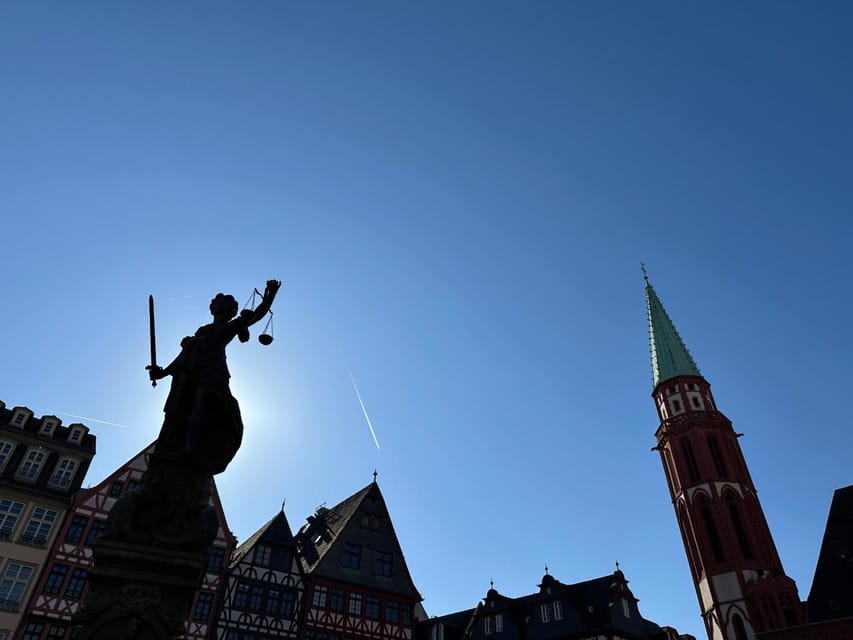
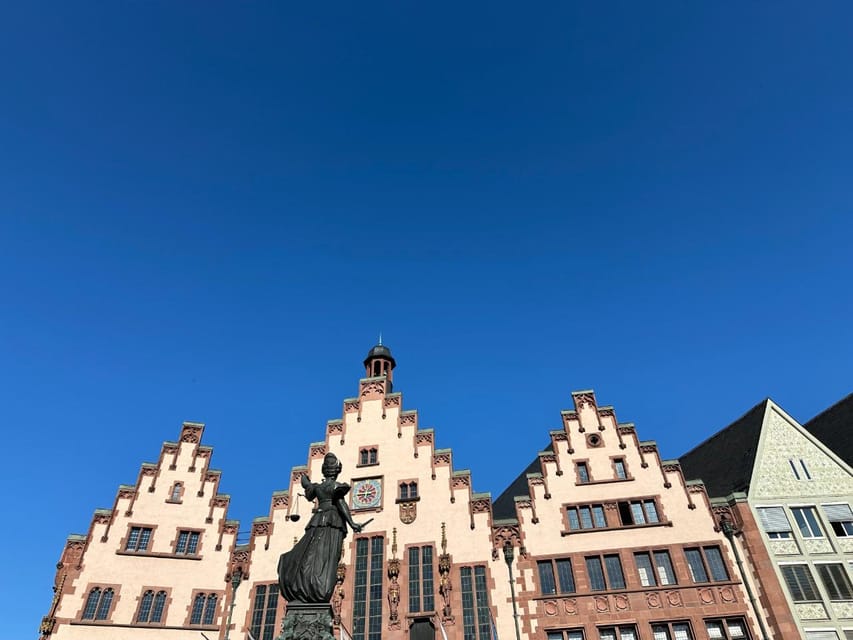
The Römer is Frankfurt’s city hall and has served that role since 1405. Its stepped facade is one of the city’s most recognizable sights, and the surrounding Römerplatz gives you the classic old-town view.
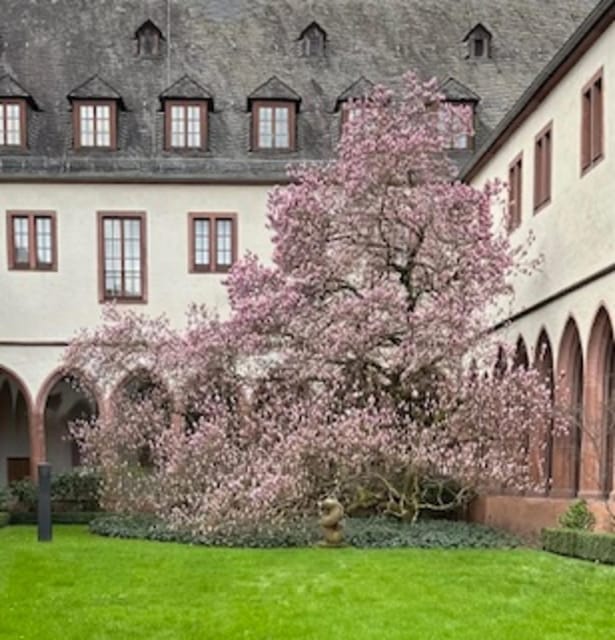
This is also where the tour starts separating appearance from reality. Much of Frankfurt’s old center was destroyed during World War II. The Altstadt you see today includes careful reconstruction, not an untouched medieval quarter.
That rebuilding story is one of the tour’s strongest subjects. You learn how and why the New Altstadt was recreated, and how the city chose to bring back historic-looking streets and buildings after the war. I appreciate this approach because it helps you read Frankfurt honestly. The rebuilt streets are attractive, but the city does not pretend that every old facade survived.
The House Wertheim adds a useful contrast. It is the inner city’s only original half-timbered house left at the end of World War II. Seeing it after discussing the reconstruction gives the building more meaning than a quick photograph would.
Churches, coronations, and a medieval wall painting
The route includes the exterior of Alt Nikolai Church, a Gothic church built in 1290. On Sundays, the tour sees the church from outside only, so do not expect a full interior visit at that time.
You also see St. Bartholomew Cathedral, usually called the Kaiserdom. This Imperial Church was used for the elections and coronations of Holy Roman Emperors for centuries. Its importance is political as well as religious, and it helps explain why Frankfurt mattered far beyond the size of its old center.
On Sundays and religious holidays, the cathedral is viewed from outside only. That is a small but important planning point. If entering churches is a priority for you, check the day of your tour and plan separate visits where needed.
Another unusual stop is the Karmeliter Cloister, home to the Jörge Ratgeb wall paintings. Created in the early 1500s, they are described as the largest religious wall paintings north of the Alps. The cloister is not included on some holidays, so this is another part of the route that can vary by date.
These stops give the tour some variety. You are not simply moving from one facade to the next. You are looking at city government, imperial power, religious art, and the physical remains of medieval Frankfurt.
Same streets, a different guide:
- Munich: Third Reich & WWII Walking Tour
★ 4.6 · 6,181 reviews - Berlin: Discover Berlin Walking Tour
★ 4.9 · 5,998 reviews - Berlin’s Best: 2 Hour Walking Tour Third Reich and the Cold War
★ 5.0 · 5,486 reviews - Berlin: Hidden Backyards Guided Walking Tour
★ 4.8 · 5,360 reviews
The Book Burning Memorial and Frankfurt’s difficult past
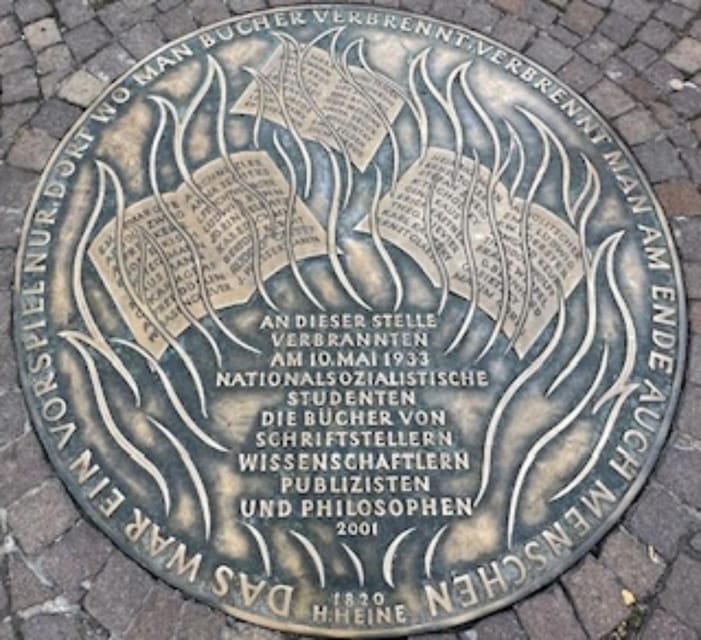
Frankfurt’s story cannot be told only through churches and pretty squares. The tour visits the Book Burning Memorial, marking the site of the Nazi book burning.
From there, the route turns toward the city’s Jewish history. You see Stolpersteine, or stumbling stones, set into the pavement to remember victims of the Nazi regime. These small memorials are easy to miss when walking alone. With a guide, you learn to notice them and understand why they are placed where they are.
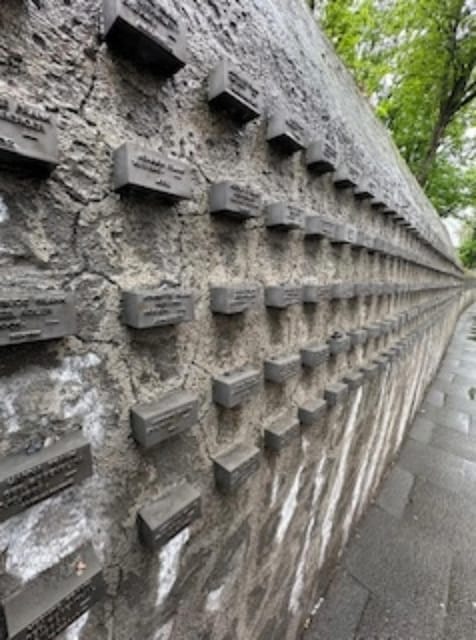
The Jewish Holocaust Memorial Wall is more personal in scale and purpose. It honors approximately 12,000 Jewish citizens of Frankfurt who were killed in the Shoah. The names of Anne, Margot, and Edith Frank are included on the wall.
I consider this section essential, not an optional add-on to the sightseeing. The tour does not avoid the city’s dark past, and that gives the rest of Frankfurt’s story needed context. You see how a normal street can hold a memorial, a former neighborhood, or a reminder of people who were removed from city life.
The Medieval Jewish Cemetery is viewed from outside. It is one of Germany’s oldest and largest Jewish cemeteries. Nearby, the Jewish Ghetto Wall recalls part of the city defenses from 1180 and its later role in enclosing the medieval Jewish ghetto.
The route covers painful subjects in a walking-tour setting, so the quality of explanation matters. The guides praised most highly, including Justin and Phillip, are valued for making difficult history clear without turning the entire morning into a lecture. The result is serious, but still approachable.
Crossing the Main at Eisener Steg
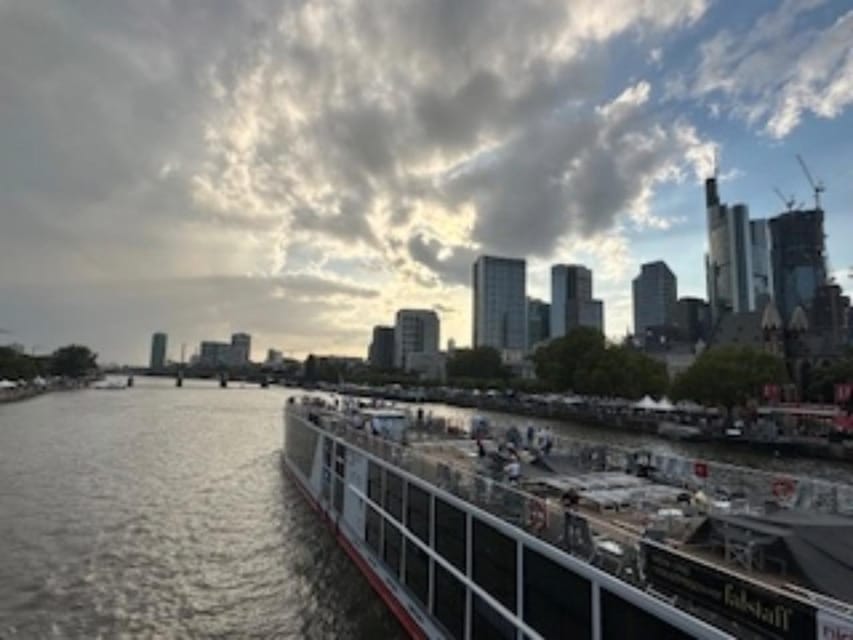
Eisener Steg is a pedestrian bridge across the Main River. It provides a fine view back toward Frankfurt’s skyline and along the riverbanks, where many museums are located.
This is one of the tour’s best photo stops. After the close streets of the Altstadt, the bridge opens the view and lets you see the contrast between old Frankfurt and the modern high-rise center.
The bridge also gives you a geographic reset. You understand the river’s role in shaping the city and see why Frankfurt can feel like several different places packed together. The stop is not just a quick picture opportunity. It helps connect the historic center with the museum district and the broader city.
Because the tour is on foot, you experience the change in scale directly. No vehicle whisks you from one district to another. You walk out of the old lanes, cross the river, and see Frankfurt spread around you.
A pause at Kleinmarkthalle
Kleinmarkthalle is a favorite stop for good reason. This indoor produce hall is filled with fruit, vegetables, chocolate, pastries, cheese, bread, meat, fish, and foods from around the world.
The market is not open on Sundays and holidays, so the route changes on those dates. When it is operating, the stop adds a welcome local-food break to a morning filled with monuments and memorials.
Snacks and drinks are not included in the $35 price, so bring a little spending money if you want to buy something. The stop is designed for a short break rather than a long meal. If you want to sit and take your time, the allotted pause may feel brief.
That is a fair trade for a three-hour overview. You get a chance to look at Frankfurt’s food culture without losing the morning. I would use the stop to buy a small snack, then return later for a longer visit if the market catches your interest.
Pace, distance, and comfort
The tour is described as an easy walk, but easy does not mean short. Children 12 and under are welcome and free, yet they should be comfortable walking about 7 kilometers.
The route includes restroom breaks, photo stops, and a snack pause. Several guides are praised for keeping the pace relaxed and for spending about the right amount of time at each place. One guide also received credit for making the walk feel manageable without rushing.
Still, wear comfortable shoes. Cobblestones can become slippery in wet weather, and you should bring an umbrella if rain is likely. Frankfurt on Foot runs every day, rain or shine, so the weather does not automatically cancel your plans.
The tour is wheelchair and stroller friendly. That is useful, though the information does not promise that every surface will be equally smooth. Anyone using a wheelchair or stroller should still be prepared for historic streets and cobblestones.
The guides make the difference
The tour has several guides, so your experience will depend partly on who leads your group. Justin is often praised for linking Frankfurt’s past to the modern city and for answering questions in clear, easy-to-follow English.
Jennifer is described as warm, lively, and well paced. Phillip brings strong enthusiasm for Frankfurt and German history, while Anne is praised for personal stories, humor, and making the city feel approachable. Hannes is noted for clear explanations and a friendly manner.
One useful detail is that the guides do not all have the same style. Some are more energetic, some more focused on dates and context, and some add more personal stories. That variety can be a strength, though it means the exact tone is not fully predictable.
The overall customer score is 4.9 from 323 ratings, which points to a consistently strong experience. I would still keep expectations sensible. A three-hour group walk cannot cover every museum, enter every church, or provide a detailed study of Frankfurt’s architecture.
What the $35 price really buys you
At $35 per person, this is not the cheapest way to spend a morning, but it is a reasonable price for a live, English-language introduction with an experienced guide.
The main value is not admission tickets. The listed stops are free, and no transportation is used. You are paying for the route, the explanations, the historical connections, the photo stops, and the time saved finding the important places yourself.
The tour is especially good value if Frankfurt is new to you or if you have only one day. You can use the morning to learn the city, then choose your own museums, food stops, and viewpoints afterward.
It is less useful if you already know Frankfurt well and want long interior visits. Even then, a local resident could still find new material in the Jewish quarter, the rebuilding story, or the cloister paintings. One local participant who had lived in Frankfurt for years found the tour useful for exactly that reason.
Booking is flexible. You can reserve and pay later, and cancellation is free up to 24 hours before the tour for a full refund. The tour is offered in English only.
Who should book this tour?
I recommend it for first-time visitors, couples, families with children who can handle a long walk, and anyone who wants history explained rather than simply photographed.
It also works well for English-speaking friends visiting Frankfurt, since the route combines major sights with practical suggestions for the rest of the day. The morning schedule leaves time afterward for museums along the Main or a return to Kleinmarkthalle.
I would think twice if you dislike group walks, need long meal breaks, or want to spend most of your time inside churches and museums. The tour is an overview, not a substitute for dedicated visits to the cathedral, cloister, or museum collections.
Should you book Frankfurt on Foot?
Book it if you want a clear introduction to Frankfurt’s old center, rebuilding, Jewish history, and riverfront in one well-organized morning. The combination of the Römer, Eisener Steg, memorials, medieval remains, and Kleinmarkthalle gives you more than a standard photo walk.
At $35, the tour offers solid value, especially when you use the guide’s advice to plan the rest of your stay. Wear good shoes, allow for about 7 kilometers, and do not expect a leisurely market lunch.
For most first visits, I would book this near the beginning of the trip. It gives you the city’s basic map, its major stories, and several places worth returning to on your own.
FAQ
How long is the Frankfurt on Foot tour?
The tour lasts three hours. One customer account described a slightly longer experience, so allow some flexibility in your schedule.
What time does the tour start?
The stated start time is 10:00.
Where does the tour meet?
The meeting point is on Römerberg, directly across from the Tourist Information office and in front of the Binding Schirn Pub. The guide carries a Frankfurt on Foot Walking Tours sign.
Is the tour offered in English?
Yes. The tour is conducted in English only.
How much does the tour cost?
The price is $35 per person.
Are children allowed to join?
Yes. Children 12 and under are welcome and free, but they should be comfortable walking about 7 kilometers.
Is the tour wheelchair and stroller friendly?
Yes. The tour is listed as wheelchair and stroller friendly.
Is food included?
No. Snacks and drinks are optional purchases. The route includes a break, and Kleinmarkthalle is visited when it is open.
Does the tour enter every church and historic building?
No. Alt Nikolai Church and St. Bartholomew are viewed from outside on Sundays, and the cathedral is also exterior-only on religious holidays. The Jörge Ratgeb wall paintings are not visited on some holidays.
What should I bring?
Wear comfortable shoes. An umbrella is useful in rainy weather, since the tour operates every day and includes outdoor walking.
Can I cancel the booking?
You can cancel up to 24 hours in advance for a full refund. You can also reserve now and pay later.
New routes in Germany
- Munich: Walking Tour Old Town and Viktualienmarkt★ 4.7 · 839 reviews
- Stuttgart: Guided Ghost Walking Tour★ 4.5 · 867 reviews
- Stuttgart: Private Guided Circular City Walk★ 4.7 · 129 reviews
- Stuttgart: Old Town Highlights Guided Walking Tour★ 4.2 · 101 reviews
- Stuttgart: City Highlights – Guided Walking Tour★ 4.7 · 189 reviews
- Hamburg: Private Tour Red Light District Walking Tour★ 4.7 · 227 reviews
- Small Group Walking Tour: “Wild Kreuzberg”★ 4.8 · 199 reviews
- Sachsenhausen Memorial: Walking Tour from Berlin★ 4.7 · 132 reviews
Germany Walking Tours, compared.
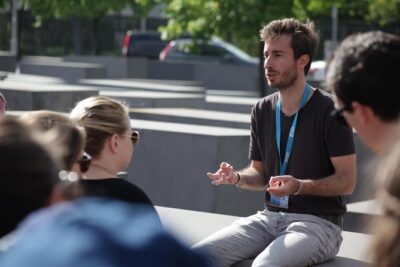
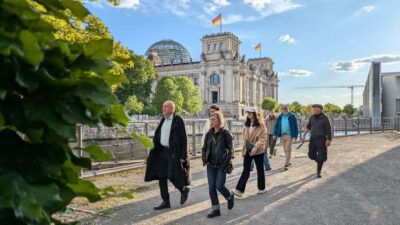
Berlin City walk Government District and Places of Democracy
Read our review →
Berlin’s Best: 2 Hour Walking Tour Third Reich and the Cold War
Read our review →
Explore Berlin: See All The Iconic Sights & Some Hidden Gems
Read our review →
Third Reich Berlin: Hitler and WWII Walking Tour
Read our review →
Browse the lists this tour appears in