
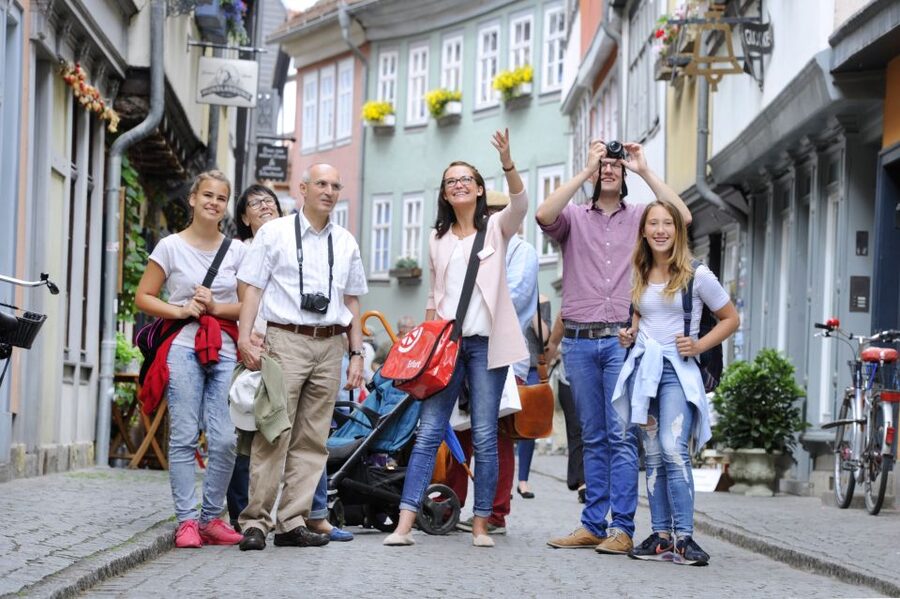
Review · GERMANY
Erfurt: Old Town Guided Walking Tour
Erfurt’s Old Town is the sort of place that rewards walking slowly, and this two-hour tour gives you a useful path through its medieval lanes, churches, bridges, and grand townhouses. I like the focus on Krämerbrücke, the famous Merchants’ Bridge, and the outside of the Cathedral of St. Mary, home to the 500-year-old Gloriosa bell.
I also like that the tour brings together very different sides of Erfurt: wealthy patrician homes, humble half-timbered buildings, Gothic Revival civic architecture, and the University District. The main consideration is language: the live guide speaks German, so you’ll get the most from this walk if you understand German or are comfortable following a visual tour with limited explanation.
Key points at a glance
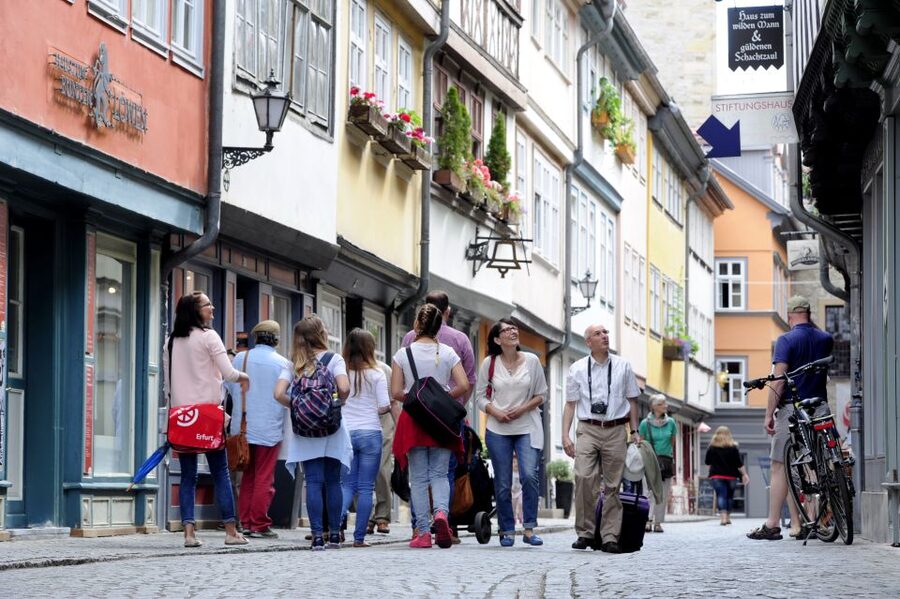
- Two hours through a 1,270-year-old city: A compact introduction to Erfurt’s historic center.
- Krämerbrücke is a major highlight: See one of the Old Town’s signature sights on foot.
- The Gloriosa bell adds a memorable detail: Learn about the Cathedral of St. Mary’s famous 500-year-old bell.
- Architecture changes from street to street: Expect patrician townhouses, half-timbered buildings, churches, and the 19th-century Town Hall.
- German-speaking guides bring the stories: Guides including Nick and Frau Messerschmidt have led lively, humorous walks.
- Practical in any season: The tour runs rain or shine, and you can cancel up to 24 hours ahead for a full refund.
Starting behind the Tourist Information
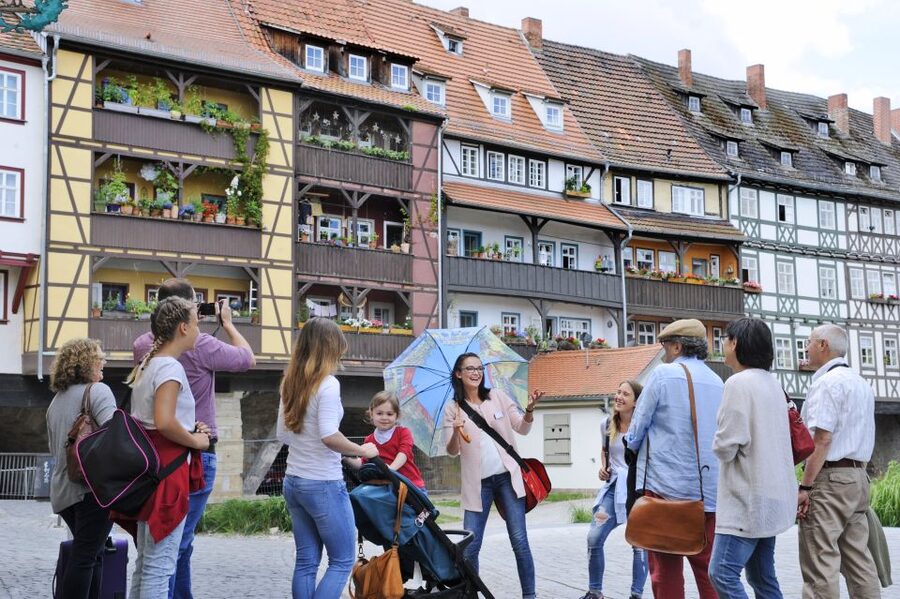
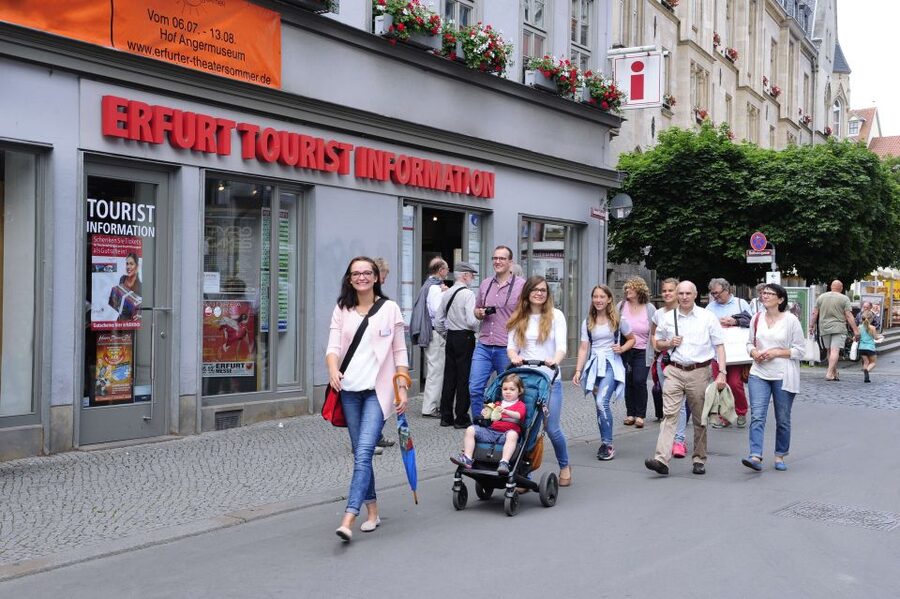
The meeting point is easy to locate once you know where to look. Go behind the Erfurt Tourist Information at Benediktsplatz 1 and find the Denkmal Eulenspiegel monument. That sculpture is the official starting point for the walk.
This detail matters because the meeting point is not simply the front door of the tourist office. Give yourself a few minutes to find the monument, especially if you are arriving in Erfurt for the first time. The tour begins in the center of the Old Town, so there is no hotel pickup and no need to arrange extra transport.
Your guide leads the group on foot for two hours. The route passes through the old quarter rather than rushing from one isolated sight to another. That format suits Erfurt well. The city’s character comes from the way its streets, bridges, churches, and houses fit together.
The experience has a 4.7 rating from 1,617 reviews, with recent comments praising guides such as Nick and Frau Messerschmidt for making the walk interesting, informative, humorous, and engaging. Those are useful qualities on a city tour, since a row of old buildings becomes much easier to understand when someone explains who built them and how the city worked.
More Old Town Walking Tours in Germany
- Nuremberg: Old Town Guided Walking Tour
★ 4.6 · 2,416 reviews - Munich: Old Town & Viktualienmarkt City Walk in German
★ 4.7 · 2,304 reviews - Heidelberg: Walking Tour of the Old Town
★ 4.6 · 1,742 reviews
Erfurt’s long story in a short walk
Erfurt is described as a 1,270-year-old city, and the tour uses the Old Town as its main history book. You will not get a full account of every period in two hours, but you will see enough layers to understand why the center feels so distinctive.
The route brings together religious buildings, commercial streets, civic architecture, and private homes. That mix helps you read the city as more than a collection of attractive façades. Churches point to Erfurt’s religious importance, bridges and commercial streets reflect trade, and large townhouses hint at the wealth of successful merchants and patrician families.
I appreciate this kind of city walk because it gives you a framework for exploring on your own afterward. Instead of simply photographing a half-timbered building, you can begin to notice how it differs from a grand patrician townhouse or a later public building.
The walk is also a good first activity in Erfurt. After two hours, you should have a better sense of the Old Town’s layout and a clearer idea of which streets and sights deserve a closer look. Since the route is guided in German, the visual side of the tour remains accessible even if your language skills are modest, but the stories will be most useful to German speakers.
The Cathedral of St. Mary and the Gloriosa bell
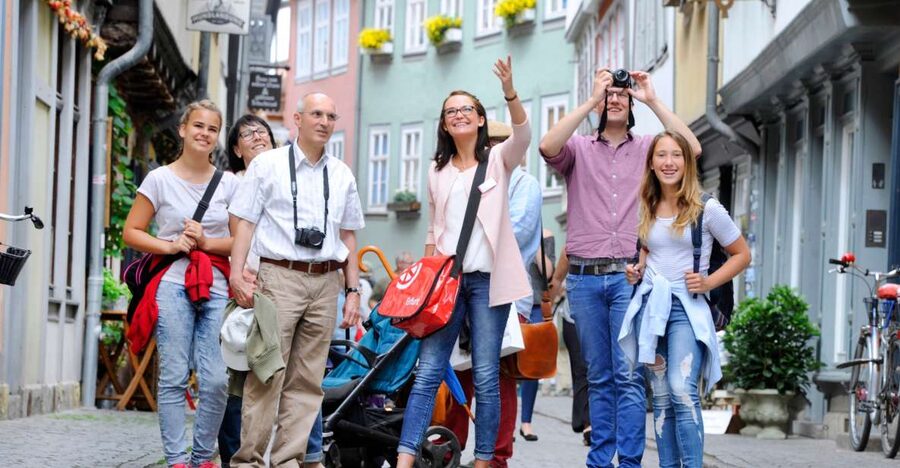
One of the important stops is the outside of the Cathedral of St. Mary. The tour does not promise an interior visit, so plan on seeing the cathedral as part of the outdoor walking route rather than as a cathedral admission tour.
The key detail here is the Gloriosa bell, said to be 500 years old and famous for the beauty of its tone. A bell may sound like a small detail on paper, but it gives the cathedral a human connection. You are not just looking at stone and architectural decoration. You are hearing about an object that has marked time in Erfurt for centuries.
The Cathedral of St. Mary also helps balance the tour’s secular sights. Later, you will see the Town Hall and former merchant homes, but the cathedral points to another source of power in the Old Town: the church. The contrast makes the route more useful than a simple list of pretty buildings.
Because the tour is only two hours, expect an outside explanation rather than a lengthy cathedral visit. That is a benefit if you want a broad introduction to Erfurt. If your main aim is church interiors, religious art, or bell towers, you may want to make separate plans.
Walking across the Krämerbrücke
The Merchants’ Bridge, known as the Krämerbrücke, is one of the defining sights on the route. Its name reflects Erfurt’s trading past, and the bridge is best understood as part of the Old Town’s working street system, not just a photo stop.
The tour gives you a chance to see how a bridge can also function as a street lined with buildings. That is one of the most appealing details of Erfurt’s historic center. The bridge connects movement, commerce, and architecture in a single place.
I would pay attention to the change in atmosphere as you approach and cross it. A guided explanation helps you see why this is more than another old crossing. The Merchants’ Bridge gives the tour a clear center point and a memorable visual image to carry with you after the walk.
Do not expect a long stop devoted only to the bridge. The tour continues through other parts of the Old Town, so the value comes from seeing the Krämerbrücke in relation to the surrounding streets, churches, houses, and commercial past.
Same streets, a different guide:
- Discover Berlin Half-Day Walking Tour
★ 5.0 · 9,624 reviews - Berlin City walk Government District and Places of Democracy
★ 4.7 · 8,467 reviews - Berlin: Third Reich & Cold War Guided Walking Tour
★ 4.9 · 8,378 reviews - Munich: Third Reich & WWII Walking Tour
★ 4.6 · 6,181 reviews
Patrician townhouses and half-timbered streets
The route leads through quaint alleys lined with wealthy patrician townhouses. These buildings help show how prosperous families expressed their position through architecture. You will also see half-timbered buildings, which provide a sharper contrast in scale, materials, and appearance.
This is where the walking format really pays off. From a vehicle, you might notice only a general old-town look. On foot, you can pause close to the façades and follow the details that give each street its personality.
The tour presents the Old Town as a picture-book of German history, but the useful part is the variety. One building may suggest merchant wealth, another local craft and domestic life, and another the power of the church or city government. The guide’s stories help connect these visual clues to the people who lived and worked here.
The word quaint can sometimes hide the fact that old buildings were practical places with ordinary problems. Here, the mix of grand townhouses and simpler half-timbered structures gives you a more grounded view. Erfurt’s past was not built from monuments alone. It also survives in narrow streets and everyday homes.
The 19th-century Town Hall and Gothic Revival details
The tour also passes the 19th-century Town Hall, an important change of mood after the medieval streets and older homes. Its Gothic Revival architecture shows how later generations looked back to the Middle Ages while creating a civic building for their own time.
That contrast is worth noting. Erfurt is not preserved in one single period. Its Old Town includes genuinely old structures alongside later buildings designed to fit an older visual language. If you only look for medieval architecture, you can miss how the city continued to reshape itself.
The Town Hall gives the route a public and political focus. After seeing homes connected with wealthy families, you encounter a building made to represent the city itself. It is a helpful stop for understanding how Erfurt’s identity was presented in the 19th century.
Again, the emphasis is on seeing the building from outside as part of the walking route. The tour’s strength is breadth: it brings several architectural periods into one continuous experience instead of spending the full two hours in one interior.
The University District and Erfurt’s changing identity
The University District is another part of the Old Town route. Its inclusion keeps the tour from treating Erfurt as a frozen medieval display. A university area points to education, young people, and the continuing life of the city.
The tour does not provide a separate university visit or an academic program, so think of this as a neighborhood stop within the larger walk. Its value is context. You see how historic streets remain connected to modern city life rather than existing only for sightseeing.
I like that the route includes this change of emphasis. After bridges, churches, old homes, and civic buildings, the University District broadens the picture. Erfurt becomes a living city with a long past, not merely an open-air museum.
Stories make the buildings easier to read
The strongest part of a walking tour is usually not the number of sights but the quality of the explanations. This experience promises numerous stories and tales about Erfurt, and the recent feedback points to guides who tell them with humor as well as information.
Nick has led a tour described as interesting, while Frau Messerschmidt was singled out as a particularly good guide. You cannot choose a specific guide in advance from the information provided, but those names give you a sense of the tone to expect: personal storytelling rather than a silent procession from one landmark to the next.
The guide’s role is especially important because the route includes many buildings that can look similar at first glance. Stories give each street a reason to matter. They also help you remember Erfurt after the tour, which is more useful than collecting a long list of dates.
Since the tour is in German, language remains the main limitation. If you understand German, the humor and local tales should add a great deal. If you do not, you may still enjoy the architecture and route, but this is not the best choice if you need detailed explanations in English.
Is $15 a good value for two hours?
At $15 per person, this is a modestly priced introduction to Erfurt. You are paying for a two-hour guided walk through several of the city’s key areas, including the Krämerbrücke, Cathedral of St. Mary, University District, patrician streets, and Town Hall.
The value depends mainly on how much you want interpretation. You can walk through the Old Town for free, but you will not automatically know why the Gloriosa bell matters, how the bridge fits Erfurt’s commercial past, or what the contrast between patrician and half-timbered buildings tells you about the city.
The price also works well for a first morning or afternoon activity. It is short enough to fit around other plans, yet long enough to give you a solid orientation. The tour includes the guide, but not hotel pickup or drop-off. Since it begins in the central Old Town, that is a minor issue rather than a serious drawback.
Booking is flexible. You can reserve now and pay later, and cancellation is free up to 24 hours before the start time. Check the available start times when booking, since the exact schedule is not fixed here.
Who should take this Erfurt walking tour?
I would recommend it most strongly to first-time visitors who want a clear introduction to Erfurt without committing to a full-day program. It also suits anyone who enjoys architecture, local stories, and short city walks with a defined route.
Families and older visitors may appreciate the two-hour length, though the tour still takes place on foot through historic streets. The experience is wheelchair accessible, which makes it more practical for many people, but weather and street conditions can still affect comfort.
German speakers are the best match because the live guide speaks German. Architecture fans can still gain something from the route without fluent German, but the storytelling is a central part of the experience, not an optional extra.
Bring weather-appropriate clothing. The tour runs rain or shine, and there is no promise of indoor shelter along the way. Comfortable clothing and a willingness to walk through changing weather will make the experience much more pleasant.
Should you book it?
Book this tour if you want a reasonably priced, two-hour introduction to Erfurt’s Old Town, especially if you speak German and enjoy stories about buildings rather than sightseeing on your own. The combination of Krämerbrücke, Cathedral of St. Mary, patrician homes, half-timbered streets, Town Hall, and the University District gives you a well-rounded first look.
Skip it if you need an English-speaking guide, want extensive interior visits, or prefer to explore entirely at your own pace. For everyone else, it is a practical way to get oriented, notice details you might otherwise pass by, and begin your Erfurt visit with a stronger sense of how the city fits together.
FAQ
How long does the Erfurt Old Town tour last?
The guided walking tour lasts two hours.
What language is the tour conducted in?
The live tour guide speaks German.
Where does the tour meet?
Meet at the Denkmal Eulenspiegel monument behind the Erfurt Tourist Information at Benediktsplatz 1.
What sights are included on the route?
The route includes the Krämerbrücke, the Cathedral of St. Mary, the 19th-century Town Hall, the University District, patrician townhouses, half-timbered buildings, and several churches.
Does the tour include entry inside the cathedral?
The experience includes admiring the outside of the Cathedral of St. Mary. An interior visit is not specified.
Is the tour wheelchair accessible?
Yes, the tour is listed as wheelchair accessible.
Does the tour run in bad weather?
Yes. The tour takes place rain or shine, so bring weather-appropriate clothing.
Can I cancel the booking?
Yes. You can cancel up to 24 hours in advance for a full refund. You can also reserve now and pay later.
New routes in Germany
- Munich: Walking Tour Old Town and Viktualienmarkt★ 4.7 · 839 reviews
- Stuttgart: Private Guided Circular City Walk★ 4.7 · 129 reviews
- Stuttgart: Old Town Highlights Guided Walking Tour★ 4.2 · 101 reviews
- Stuttgart: Guided Ghost Walking Tour★ 4.5 · 867 reviews
- Stuttgart: City Highlights – Guided Walking Tour★ 4.7 · 189 reviews
- Hamburg: Private Tour Red Light District Walking Tour★ 4.7 · 227 reviews
- Small Group Walking Tour: “Wild Kreuzberg”★ 4.8 · 199 reviews
- Sachsenhausen Memorial: Walking Tour from Berlin★ 4.7 · 132 reviews
Germany Walking Tours, compared.

Berlin City walk Government District and Places of Democracy
Read our review →

Berlin’s Best: 2 Hour Walking Tour Third Reich and the Cold War
Read our review →
Explore Berlin: See All The Iconic Sights & Some Hidden Gems
Read our review →
Third Reich Berlin: Hitler and WWII Walking Tour
Read our review →
Browse the lists this tour appears in