
Review · SPLIT
Split: Walking tour of Split with a ‘Magister’ of History
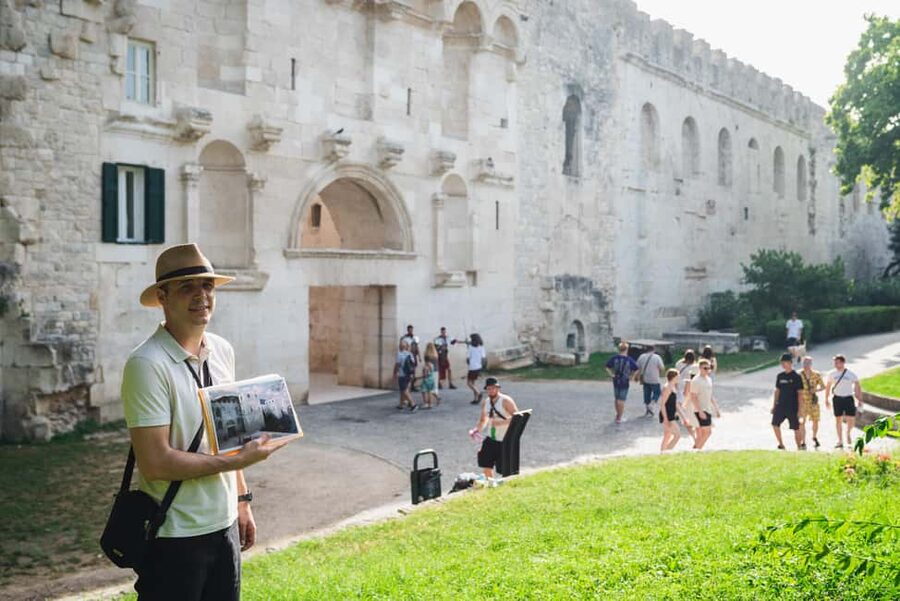
Diocletian’s Palace is not a fenced-off ruin. It is Split’s living town center, with homes, shops, lanes, cafés, and centuries of new buildings pressed into the old Roman walls. This tour makes sense of that jumbled beauty with Toni Šare, a Split-born historian and former teacher who uses 3D images to show what the palace looked like before time rebuilt it.
I like the way the tour moves from Roman Split through medieval and Venetian chapters into the modern city. I also like the open question-and-answer style, plus Toni’s care with shade and quieter corners. The main consideration is that you will not enter paid museums or monuments, and the stone lanes are not suitable for wheelchair users.
Key points at a glance
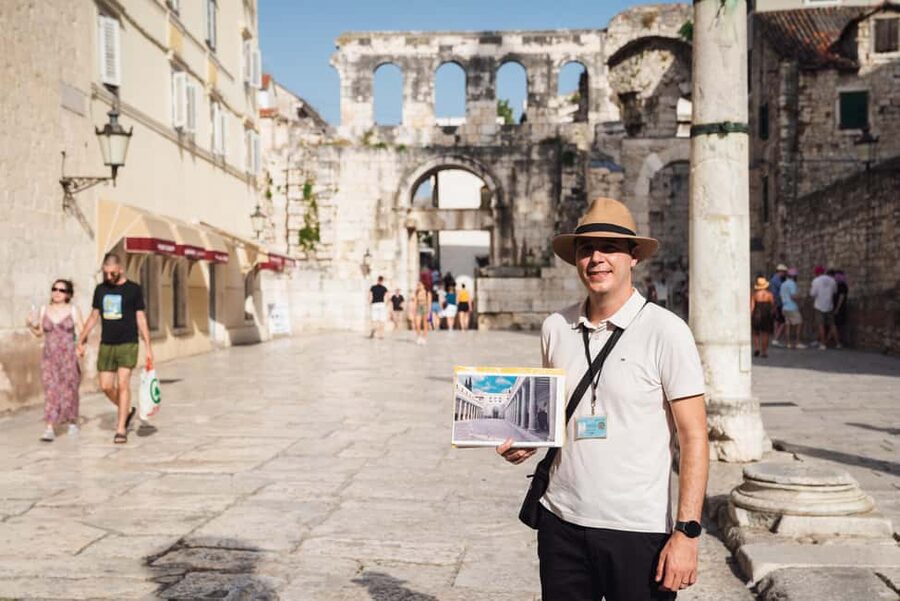
- A local guide with a teacher’s gift: Toni Šare has a master’s degree in history and has lived his entire life in Split.
- 3D images make ruins readable: Printed reconstructions help you picture the palace as a working Roman complex, not just a collection of walls.
- The route covers several eras: You move from Diocletian’s Roman residence to medieval homes, Venetian traces, and modern Split.
- Questions are part of the design: The tour encourages conversation instead of forcing you to listen to a fixed script.
- A useful first tour in Split: The route ends at the Golden Gate, leaving you well placed to keep exploring the old center.
- Good value at $33: For 110 minutes with a specialist guide, the price is reasonable, though admission to paid sites is not included.
Why this tour helps you understand Split
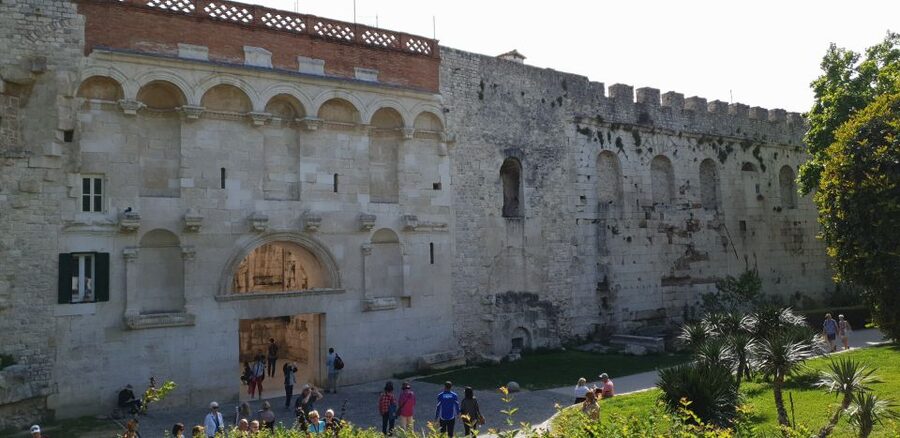
Split can be confusing at first. The old town is not laid out like a tidy archaeological park. Roman columns may support later houses, laundry hangs above ancient stone, and a narrow lane can lead from a modern café to a structure built for an emperor.
That is exactly why a history-focused walking tour works well here. Toni does not treat Diocletian’s Palace as a single frozen monument. He explains how the Roman complex became the center of the later city, then shows how each period left something behind.
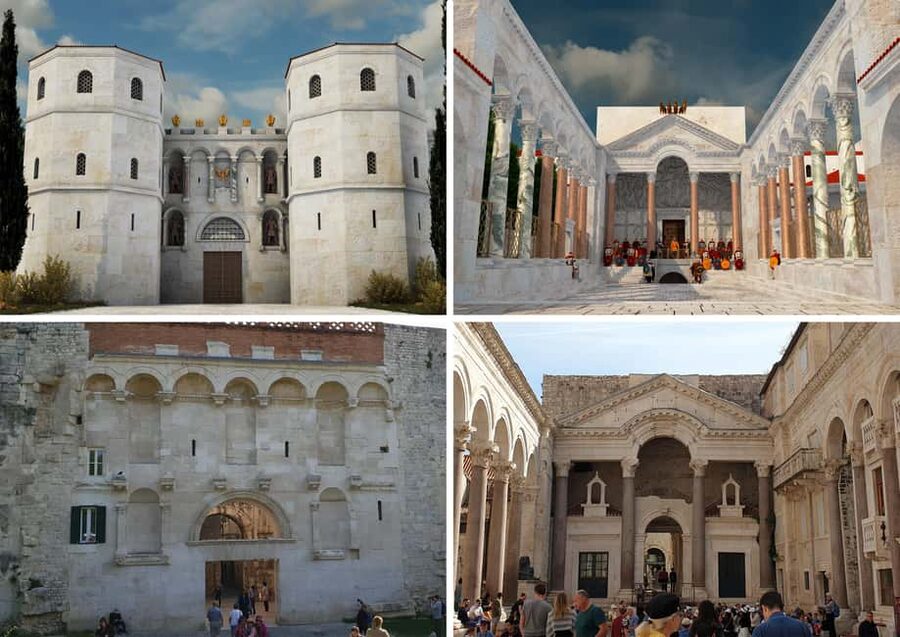
I especially like the use of visual material. A ruined wall can be hard to read, even when you are standing beside it. Toni’s 3D reconstructions give you a practical before-and-after view, helping you connect the surviving fragments with the original design.
The tour also goes beyond Roman dates and architectural labels. You can ask about medieval Split, Venetian influence, Croatian history, and more recent events. Several parts of the experience are built around discussion, so this suits you if you prefer a guide who can respond to your interests rather than recite a short memorized speech.
The pace matters too. The walk lasts 110 minutes, long enough to build a clear picture without turning into an all-day history class. Toni has been praised for keeping a steady pace, finding shade when possible, and avoiding the worst crowd pressure when the route allows.
More History Walking Tours in Croatia
- Walking Tour of Split with a ‘Magister’ of History
★ 5.0 · 1,122 reviews - Split Walking Tour with Professor of History
★ 5.0 · 926 reviews - Split: History and Heritage Walking Tour
★ 4.9 · 650 reviews
Meeting Toni at the Bronze Gate
The meeting point is at the Bronze Gate, also called the Brass Gate, on the southern side of Diocletian’s Palace. The address is Obala Hrvatskog narodnog preporoda 22.
The simplest way to find it is to locate the Riva promenade first. From the seafront, walk toward the palace and look for the southern entrance. This is a practical meeting point because you begin beside the water and enter the old core immediately.
Try to arrive with a bottle of water. The tour takes place rain or shine, and much of the route runs over stone paving in an old urban area. Comfortable shoes are sensible, though the tour information does not list a specific footwear requirement.
If you can choose a starting time, an early slot is worth considering in warmer months. Split’s old center can feel much busier later in the morning, and an earlier walk may give you a calmer start. You will also have the rest of the day to revisit the places that catch your interest.
Entering through the Bronze Gate and Cellars
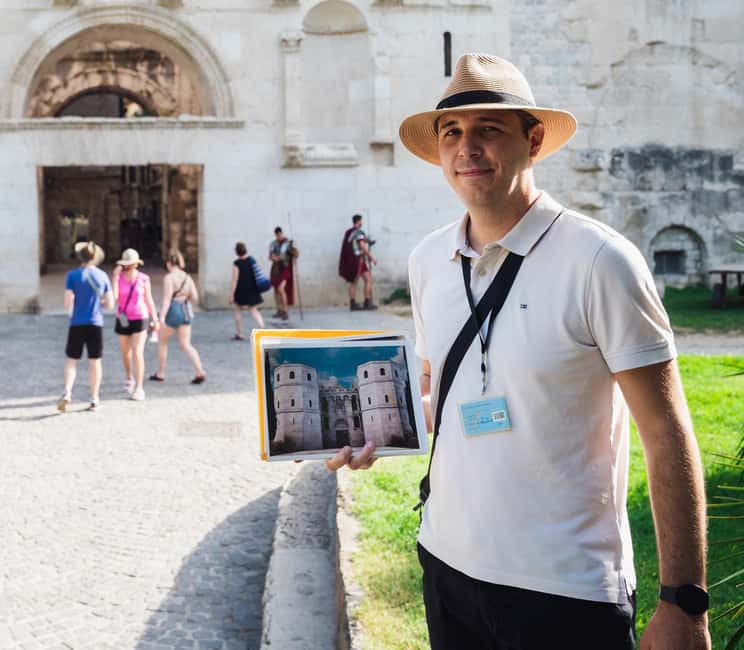
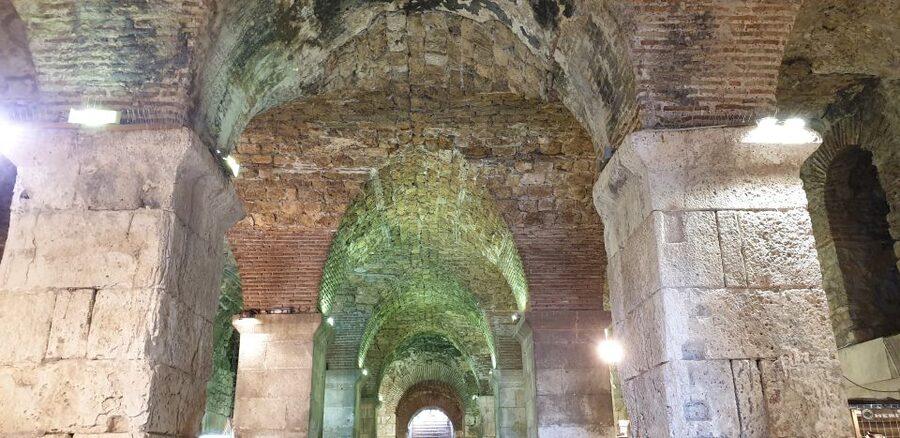
The first few minutes set up the geography of the palace. From the Bronze Gate, you pass into the palace complex and briefly pause around Diocletian’s Cellars.
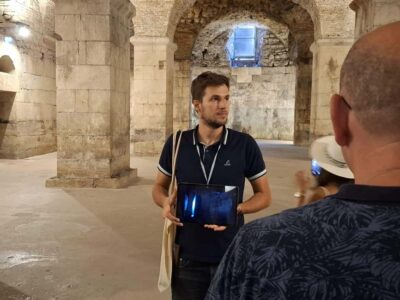
The cellars are important because they show the relationship between the lower and upper parts of the palace. They are also one of the places where Toni’s visual reconstructions can do real work. Instead of seeing only dark stone chambers and masonry, you get help picturing how the original structure functioned.
You do not need to buy admission to enter Diocletian’s Palace itself. That is one reason this tour offers good value: the central setting is part of Split’s public old town, rather than a separate ticketed attraction.
The cellar stop is brief, about 10 minutes as part of the overall route. Do not expect a long underground visit or a museum-style presentation. Think of it as an orientation stop that prepares you for the open spaces above.
Peristyle, the palace’s great Roman stage
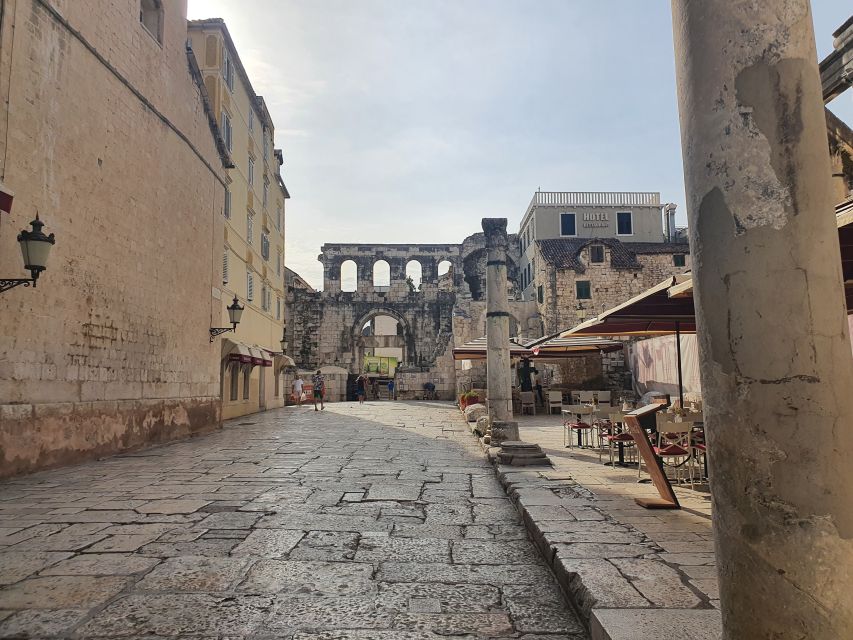
The Peristyle is the main visual payoff. This preserved square is where the Roman structure becomes easiest to understand as a grand imperial residence rather than a maze of old streets.
Toni covers the key buildings around the square, including Diocletian’s Mausoleum, the Temple of Jupiter, and the Vestibul. The route gives you time to look, listen, and ask questions instead of rushing through a list of names.
The 3D images are especially useful here. You can compare the present stonework with a reconstruction of the palace in its Roman form. The exercise also shows how much of the current impression comes from later changes, not only from the original plan.
Expect this to be one of the more crowded parts of the walk. The Peristyle is a central point in Split’s old town, and it can be busy later in the day. Toni’s habit of seeking quieter spots and shade can make the experience easier, but he cannot remove the crowds entirely.
The square also rewards close attention. Look for the contrast between monumental Roman forms and the later life built around them. The strength of the tour is not just naming each structure, but explaining how the whole area kept functioning as the city changed.
More History Walking Tours in Split:
- Split: Local History and Culture 90-Minute Walking Tour
★ 5.0 · 194 reviews - History and Hauntings of Salem Guided Walking Tour
★ 5.0 · 14,564 reviews - Lisbon: History, Stories and Lifestyle Walking Tour
★ 4.8 · 10,902 reviews - Boston: Freedom Trail History Small Group Walking Tour
★ 5.0 · 6,450 reviews
The Vestibul and Triklinij
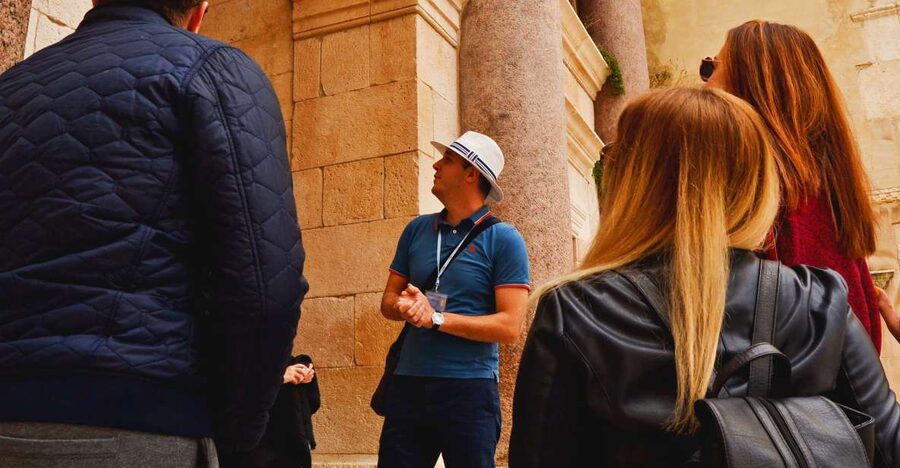
The Vestibul is a short but memorable stop. It formed part of the route into the emperor’s private section, and its shape helps you understand how visitors would have moved through the palace.
This is a good place to ask questions about the difference between public and private spaces. Toni’s teaching background is useful here because he can connect a physical feature with the way the building was used, rather than leaving you with an isolated architectural term.
The tour then continues to Triklinij, another stop in the palace’s former private residential area. You will spend only about five minutes there, so expect an explanation and a quick look rather than a long examination of every surviving detail.
That brevity is part of the tradeoff. The tour covers a lot of ground and several centuries in under two hours. If you want a specialist study of one room or one monument, you may find the pace broad rather than deeply focused. If you want a clear framework for the whole old center, the balance works well.
Saint Domnius and Jupiter’s Temple
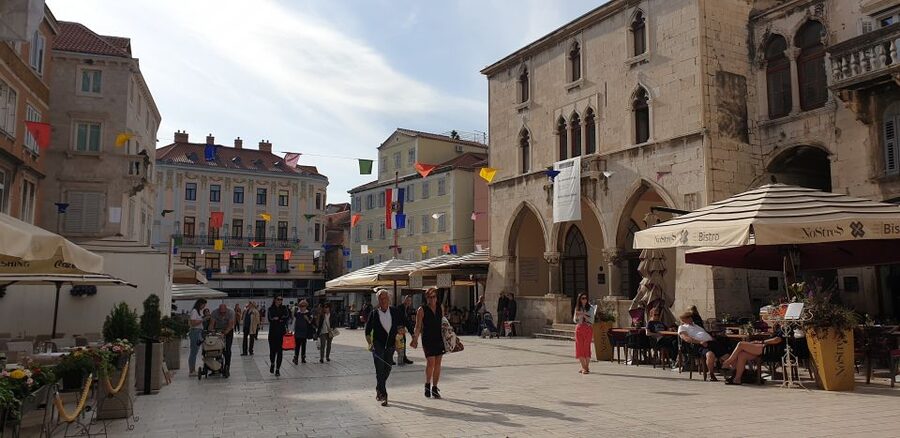
The route passes by the Cathedral of Saint Domnius and the Temple of Jupiter. These stops help show how the palace’s religious spaces changed in meaning over time.
You will not enter paid sites or museums on this experience. The Cathedral and Temple of Jupiter are therefore treated from the outside, with Toni explaining their role and place in the palace complex.
That limitation is worth knowing before you book. If entering the cathedral or other ticketed interiors is your main goal, you will need to arrange separate admission. If your priority is context, orientation, and a strong walk through the old town, the exterior explanations may be enough.
The Roman, medieval, and later religious layers are easier to grasp when seen together. Toni’s approach gives you a way to connect the buildings with the city’s changing identity, instead of treating each one as a separate attraction.
Silver Gate, Bishop Gregory, and the route north
The walk continues toward the Silver Gate and then the northern side of the palace. The Silver Gate stop is short, about three minutes, but it helps complete your sense of the palace entrances and defensive walls.
Near the North Wall, you can see the statue of Bishop Gregory of Nin. The route then carries on toward Piazza Square and the Golden Gate, where medieval and Venetian traces become more visible.
This section is valuable because it shifts the focus away from the most famous Roman spaces. Split is not only an imperial residence. It is also a medieval town and a later city shaped by Venetian influence, local customs, and modern life.
Toni’s local connection matters here. He was born and raised in Split, and the tour brings in local sayings, shops, and the way historic events still affect the city today. You are not simply looking at old stones. You are being shown how a working city grew around them.
Finishing at the Golden Gate
The tour ends at the Golden Gate, the large northern entrance to Diocletian’s Palace. This makes a practical finish because you remain in the old center rather than being taken away from the places you came to see.
The route is also easy to continue on your own. You can keep walking through the palace quarter, return to a square that interested you, or stop for food and a drink. Since the tour does not include refreshments, plan to handle those separately.
Ending at the Golden Gate gives the walk a clear shape. You begin at the seafront, enter through the southern side, pass through the central Roman spaces, and finish at the northern edge. Along the way, the palace changes from emperor’s residence to medieval neighborhood and modern city center.
What Toni’s teaching style adds
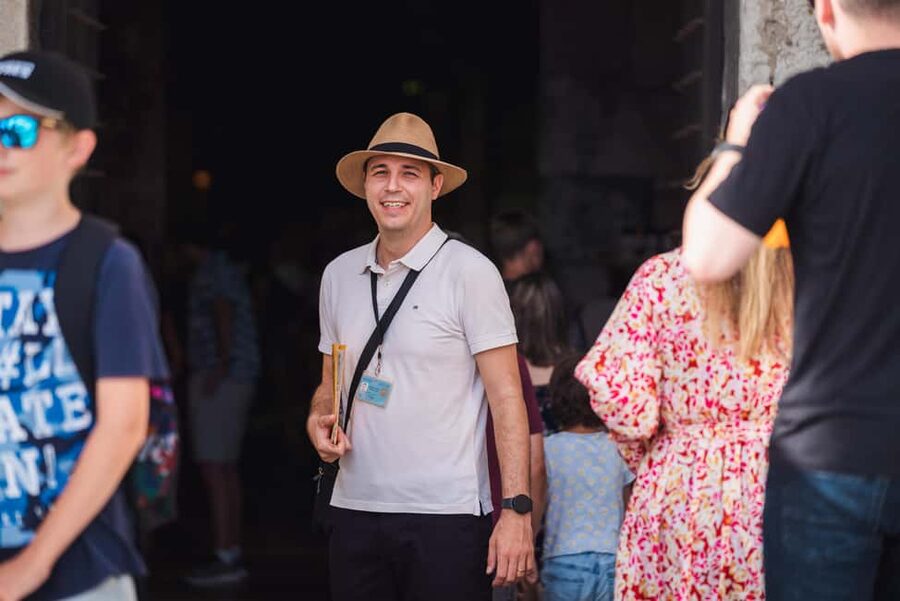
A master’s degree in history is useful, but the former-teacher experience may matter even more during a walking tour. Toni’s explanations are designed to keep a group involved, with questions encouraged throughout.
The tone is educational without needing to feel formal. He can explain the broad timeline, then pause for a specific question about a building, Croatia’s past, or more recent history. That flexibility is a strong reason to choose this tour over a basic sightseeing circuit.
Toni also appears careful about accuracy. You may appreciate that he can distinguish between what is firmly known and what is only a likely reconstruction. The 3D images are not a substitute for evidence, but they give you a useful visual aid while leaving room for uncertainty.
His personal connection to Split adds another layer. The tour includes the city as it is now, not just the Roman period. You get a sense of how historic events shaped modern Split and why the old center remains part of everyday life.
Price, length, and who gets the most value
At $33 per person, this is not the cheapest way to walk around Split. You can wander through much of the old center without paying anything, and Diocletian’s Palace itself does not require general admission.
The value comes from interpretation. For 110 minutes, you get a specialist guide, a planned route, discussion, and custom 3D reconstructions. If you arrive in Split knowing little about the palace, the tour can save you from spending the day looking at impressive but confusing remains.
I would especially recommend it for:
- First-time visitors who want a strong introduction to Split.
- People who enjoy history, architecture, and local context.
- Families with older children who respond well to visual explanations.
- Visitors who want to understand the city before exploring alone.
- Cruise or short-stay visitors with only a few hours in the old center.
You may want a different option if you mainly want interior access to the cathedral, museums, or other paid monuments. You should also think twice if uneven stone streets or a full 110-minute walk are difficult for you. The tour is not suitable for wheelchair users, and the information states that it is not suitable for people over 95.
Free cancellation up to 24 hours before the start and reserve-now, pay-later booking add flexibility. The more important practical choice is timing: an early start can help with heat and crowds, especially in summer.
Should you book this Split walking tour?
Book it if you want to understand why Split feels like a city built inside an ancient palace. Toni’s local background, teaching experience, questions, and 3D reconstructions give the walk more substance than a quick circuit of famous spots.
The strongest reason to go is the way the tour connects eras. You begin with Roman imperial design, move through the palace’s medieval transformation, see Venetian and later traces, and finish with modern Split. That story makes the old town easier to read for the rest of your visit.
Skip it only if your main aim is entering ticketed monuments or spending your time without a guide. For everyone else, $33 is a fair price for a focused introduction, especially if you take an early time slot and bring water.
FAQ
Where does the tour start?
It starts at the Bronze Gate, also called the Brass Gate, at Obala Hrvatskog narodnog preporoda 22. The gate is the southern seaside entrance from the Riva promenade into Diocletian’s Palace.
Where does the tour finish?
The tour finishes at the Golden Gate of Diocletian’s Palace.
How long does the tour last?
The walking tour lasts 110 minutes.
What language is the tour in?
The live tour is conducted in English.
Who leads the tour?
The guide is Toni Šare, a Split-born local historian with a master’s degree in history and experience as a teacher.
Are 3D reconstructions included?
Yes. Toni uses 3D reconstructions of important sites to show how parts of Diocletian’s Palace may have looked in the past.
Are admission tickets included?
No. The tour does not enter paid sites or museums. Entering Diocletian’s Palace itself does not require admission.
Is the tour suitable for wheelchair users?
No. The activity is not suitable for wheelchair users. It is also listed as unsuitable for people over 95.
New routes in Split
- Split: Local History and Culture 90-Minute Walking Tour★ 5.0 · 194 reviews
- Split: Food Tasting Walking Tour★ 4.9 · 102 reviews
- Split: Diocletian Palace & Old Town Guided Walking Tour★ 4.7 · 882 reviews
- Split: 1.5-Hour Walking Tour and Diocletian’s Palace★ 4.7 · 256 reviews
- From Split: Krka Waterfalls Cruise & Trogir Walking Tour★ 4.7 · 681 reviews
- Split: History and Heritage Walking Tour★ 4.9 · 650 reviews
- Diocletian’s Palace and Old Town SMALL GROUP Walking Tour★ 5.0 · 502 reviews
- Split: City Walking Tour w/ Game of Thrones Locations★ 4.9 · 318 reviews
Split Walking Tours, compared.
Walking Tour of Split and Diocletian’s Palace
Read our review →
Krka Waterfalls tour with Trogir Walking tour and Krka panoramic boat cruise
Read our review →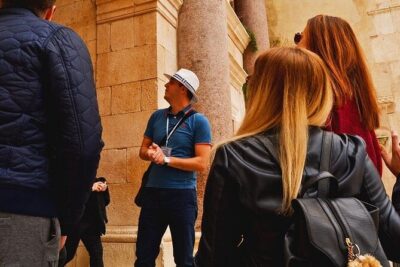
Walking Tour of Split with a ‘Magister’ of History
Read our review →
Local History and Culture 90-Minute Walking Tour
Read our review →
Browse the lists this tour appears in