Review · BOSTON
Boston: Freedom Trail History Small Group Walking Tour
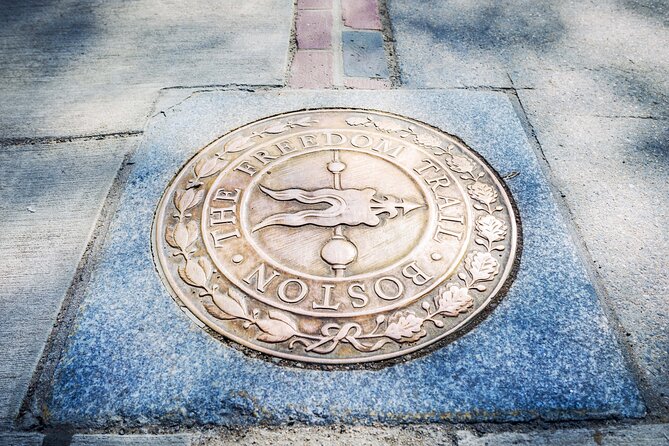
Boston’s Freedom Trail is more than a line of red bricks. It is a compact walk through the argument that became the American Revolution, from Boston Common and Puritan burial grounds to the Boston Massacre Site, Faneuil Hall, and Paul Revere’s North End home. I like that this tour puts the story in chronological order, so each stop builds on the last.
I also like the small group of no more than 16 people and the chance to ask questions as you go. Guides such as Jon, Maura, Mark, Alejandro, and Maz have been praised for clear storytelling and strong command of Boston history. The tradeoff is simple: you walk and stand for about two and a half hours, and you see historic interiors from the outside rather than touring them.
Key points to know before booking
- The full official route: You see all 16 official Freedom Trail landmarks, from Boston Common to Copp’s Hill Terrace.
- A focused time period: The guide concentrates on the years from 1760 to 1775, when tensions with Britain reached a breaking point.
- Small-group format: The maximum group size is 16, making questions and conversation easier than on a large coach tour.
- A downtown-to-North End walk: The route connects Boston Common, the historic center, Faneuil Hall, and the North End on foot.
- No interior admissions: Museum and church entry fees are not included, and the tour does not visit Charlestown.
- Plan for weather: The walk requires good weather, and winter conditions can be cold and windy. Warm layers matter.
Why this Freedom Trail walk works
At $35.10 per person, this is a sensible way to get oriented in Boston if you want more than a quick look at the red trail markers. You are paying for two and a half hours with a historian, a carefully ordered route, and explanations that connect places that can otherwise feel like separate stops.
I especially like the focus on 1760 to 1775. Boston’s revolutionary story is often reduced to a handful of famous names, but the walk shows how political conflict grew through meetings, protests, military tension, and public tragedy. The guide can explain not just what happened at a site, but why that location mattered to Boston’s residents.
The price does not include admission inside museums or churches. That keeps the walking tour affordable, but you should budget extra if you want to enter Old South Meeting House, Old North Church, King’s Chapel, or other sites later. The tour operator notes discounted admission at some of those locations with its Hub Town Tour ticket, so ask about current terms if interior visits matter to you.
More History Walking Tours in Boston
- Boston: Freedom Trail History Small Group Walking Tour
★ 4.9 · 1,590 reviews - Boston Pizza Lovers Food and History Walking Food Tour
★ 4.5 · 1,082 reviews - Boston History Tour: Scenic Walk Through Time & Landmarks
★ 5.0 · 627 reviews
Starting at the Boston Foundation Monument
Meet inside Boston Common at the Boston Foundation Monument, near the park’s northern boundary and opposite 50 Beacon Street. The monument features a bronze relief of two men shaking hands, marking the arrival of the Puritans in 1630 in what became Boston.
This is a useful starting point because the tour does not begin with the Revolution alone. It first gives you the colonial setting that shaped Boston’s politics, religion, and public life. Your guide checks in the group here, then leads you into Boston Common.
The meeting point is near public transportation, but the directions still deserve attention. Boston Common is large, and the monument is on the northern side of the park. Arrive early enough to locate it without rushing.
Boston Common and the city’s public beginnings
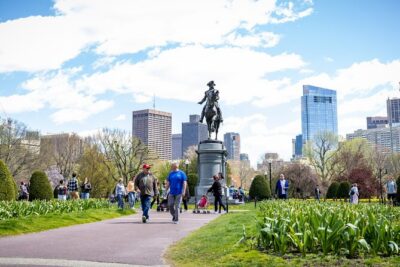
Boston Common is described as the oldest public land in the Americas. In 1634, it served as Boston’s communal grazing pasture, a practical reminder that this was once a small colonial settlement rather than a modern city center.
The stop lasts about 20 minutes. You will hear how common land functioned in early Boston and how the park fits into the city’s growth. It is also a good place to settle into the walking pace before the route becomes denser and more crowded with historic buildings.
The itinerary also points out the Massachusetts State Capitol and its nickname, the Hub of the Solar System. The building dates to 1798 and helps place Boston’s civic power near the Common. The guide connects the city’s colonial politics with the institutions that followed.
Another nearby church is described as active and as the tallest building in 19th-century Boston, dating to 1809. You will not be touring every interior, but these buildings add useful context to the streetscape.
Granary Burying Ground and the people behind the Revolution
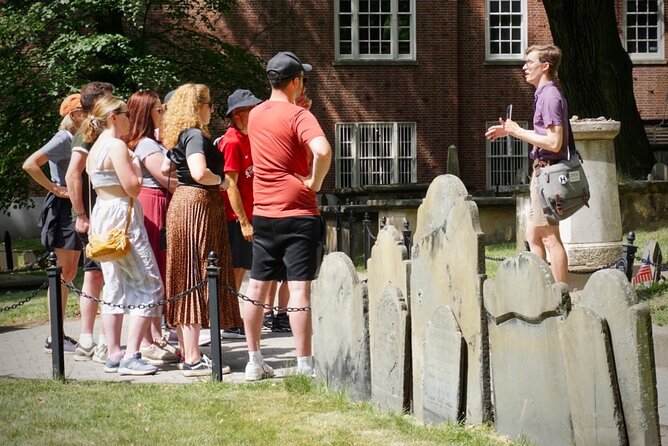
Granary Burying Ground is Boston’s third-oldest burying ground, established in 1660. The tour allows about 20 minutes here, giving you time to look at the markers and hear about people connected with Revolutionary Boston.
This is one of the most meaningful stops because it puts names and lives behind the political story. The guide can discuss Boston’s leaders and the people who shaped the movement, rather than presenting the Revolution as an abstract sequence of dates.
Nearby landmarks include King’s Chapel, the first Church of England in Puritan Boston, founded in 1686 and rebuilt in 1754. You also pass Boston’s oldest burying ground, dating to 1630. These places show the religious divisions and changing population of early Boston.
The practical limit is that you generally remain outside. If you want to study the burial grounds closely or enter the churches, plan a return visit. The walking tour gives you the setting and the story, but not a full museum-style visit.
More History Walking Tours in the USA
- Boston: 2-Hour Historic Walking Tour
★ 4.7 · 88 reviews - History and Hauntings of Salem Guided Walking Tour
★ 5.0 · 14,564 reviews - Historic Charleston Guided Sightseeing Walking Tour
★ 5.0 · 6,216 reviews - Savannah History and Haunts Candlelit Ghost Walking Tour
★ 5.0 · 3,235 reviews
Boston Latin School and Benjamin Franklin
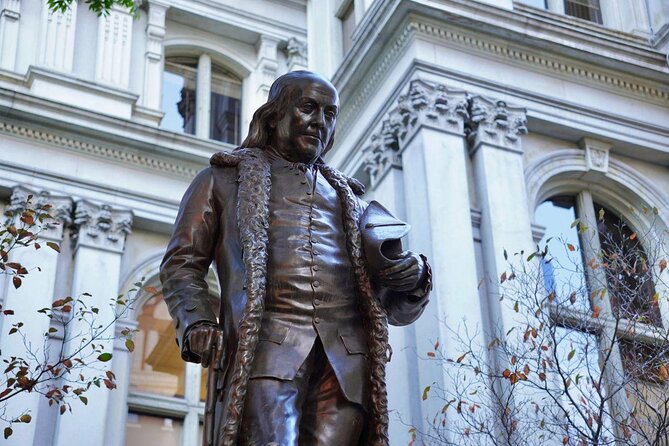
The Statue of Benjamin Franklin marks the site of Boston Latin School, founded in 1635 and identified as the oldest public school in the Americas. The stop lasts about 10 minutes.
This is a good example of how the Freedom Trail reaches beyond battles and protests. Education was part of Boston’s civic life long before independence, and Franklin’s connection gives the stop a strong human link. A guide who enjoys quoting historical figures can make this short stop more memorable than a quick photo would be.
The route also passes the center of Boston politics for more than a century, a former publishing house of Ticknor & Fields, and a Congregationalist meeting house dating to 1729. That meeting house is tied to the origin of the Boston Tea Party in 1773.
These are the kinds of details that make a guided walk worthwhile. You can follow the trail on your own, but it is easy to miss why a meeting house, publishing office, school site, or civic building mattered.
The Boston Massacre Site and the turn toward revolt
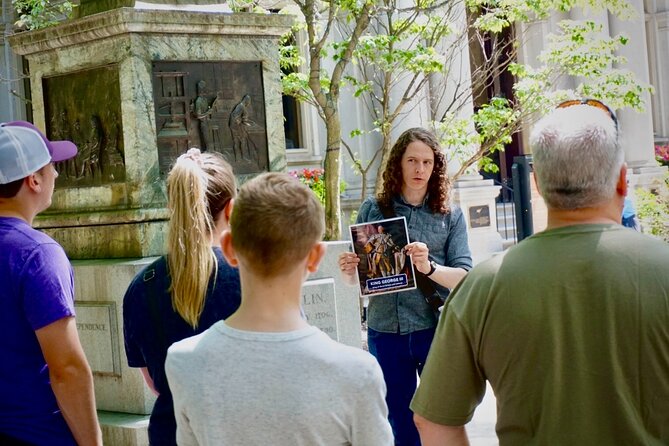
The Boston Massacre Site receives about 20 minutes. Here, British soldiers killed five Bostonians in 1770, an event that sharpened the conflict between local residents and British authority.
This is one of the route’s strongest teaching moments because the event had political force far beyond the number of people killed. Your guide can explain how public memory, political messaging, and military presence combined to raise tensions.
The route also includes Boston’s colonial capitol, the oldest public building in Boston, dating to 1713. You pass a renowned political leader associated with Boston’s Sons of Liberty, then continue toward Faneuil Hall.
I would pay close attention here if you are interested in how revolutions gain support. The tour’s best guides do not treat each stop as an isolated fact. They show how public meetings, printed arguments, and street conflict fed into one another.
Faneuil Hall and the Cradle of Liberty
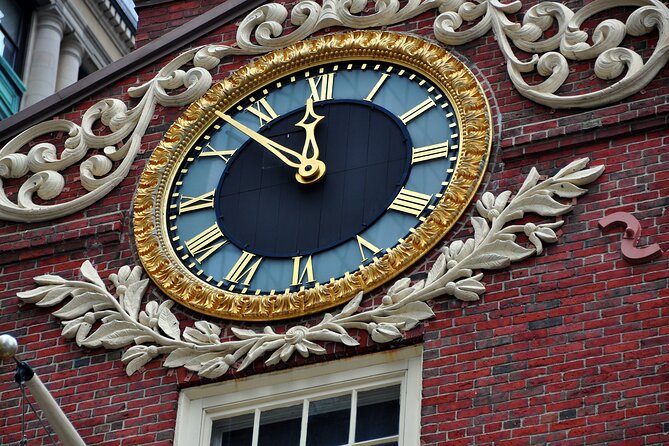
Faneuil Hall dates to 1742 and hosted Boston’s town meetings. It is known as the Cradle of Liberty, a name that captures its role as a place where political ideas were presented and challenged in public.
The stop lasts about 10 minutes. That is enough for an explanation and an exterior look, but not a full interior visit. The surrounding Faneuil Hall Marketplace is also a practical point in the route, with food and shopping nearby if you want a break before continuing.
The tour passes the oldest restaurant in the United States, located in a historic building dating to 1704. This is another reminder that Boston’s historic center is still part of a living city. You are not walking through a preserved set. Restaurants, shops, offices, and daily city life surround the landmarks.
North Square and Paul Revere’s neighborhood
North Square Park sits in the heart of Boston’s North End and dates to 1634. The tour allows about 20 minutes here, making it one of the longer stops.
The North End is where the route begins to feel more intimate. Streets tighten, buildings sit close together, and the story shifts toward the neighborhood connected with Paul Revere and the Midnight Ride. You are still close to busy city streets, but the scale changes from broad civic spaces to older residential lanes.
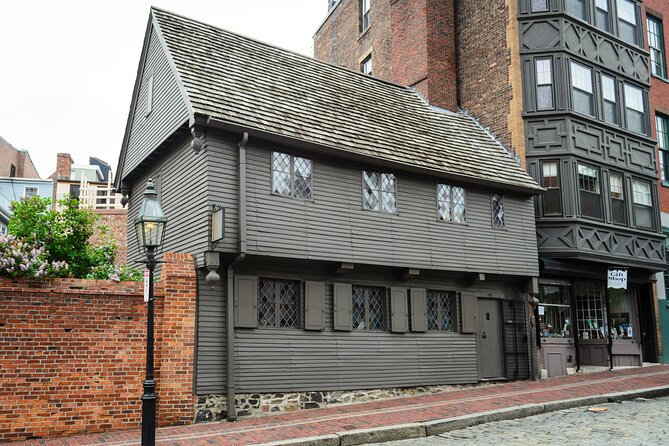
Paul Revere’s House dates to 1680 and is identified as the oldest structure in Downtown Boston. It is one of the most recognizable stops on the walk, but it is important to know that admission inside is not included.
The house is valuable even from the outside because it helps correct the idea that the Midnight Ride happened in a distant rural setting. Revere lived in a dense urban neighborhood. The guide can place his actions within Boston’s streets, churches, meeting places, and political networks.
The Paul Revere Statue and Old North Church
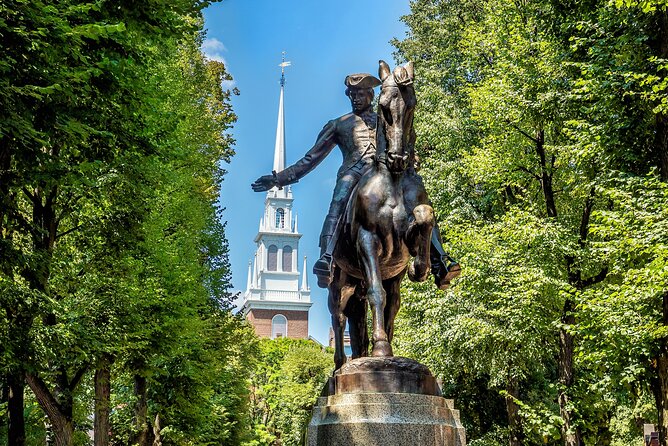
The Paul Revere Statue sits in a pedestrian-only space honoring the famous 1775 ride. The tour allows about 20 minutes here.
This is a natural place to pull the earlier story together. By now, you have seen the political buildings, burial grounds, meeting houses, and sites of conflict that shaped Boston before the ride. The statue becomes more meaningful when you understand the network around Revere rather than treating him as a lone hero.
The route also passes Boston’s oldest church, which held the signal lanterns during Paul Revere’s ride. You will also see Boston’s second-oldest burying ground, dating to 1659.
The guide’s storytelling matters most at this point. Several guides, including Jon, Maura, Mark, Alejandro, Maz, and Nick, have been praised for making the history clear, interactive, and lively. Individual guides vary, but the small group gives you a better chance to ask about details that interest you.
If you want to see the inside of Old North Church, make a separate plan. The walk does not include church or museum admission. The tour operator indicates that Old North Church and Old South Meeting House may offer discounted admission with its Hub Town Tour ticket, with King’s Chapel expected to join that arrangement soon. Check the current details before relying on the discount.
Finishing at Copp’s Hill Terrace
The tour ends at Copp’s Hill Terrace on Commercial Street after about 20 minutes at the final area. The terrace overlooks the Charles River and offers views toward the USS Constitution and Bunker Hill Monument.
This ending is useful because it brings the route to the North End while leaving you near Hanover Street. After the walk, you can reach Italian restaurants, pastry shops, pizza, and other local food spots within a short distance.
The tour does not continue into Charlestown. You may see the USS Constitution and Bunker Hill Monument from across the water, but a visit to those sites is not part of this experience. If you want the full Charlestown portion of the Freedom Trail, schedule it separately.
The ending also gives you a chance to keep exploring rather than returning to the starting point. That is convenient, but it means you should think about your next stop before booking. If your hotel is near Boston Common, you will need public transportation, a taxi, or another walk back.
What the guides do best
The strongest part of this experience is the guide’s storytelling. The people leading these walks include historians and educators, and the best examples from the tour team include Jon, Maura, Mark, Alejandro, Maz, Nick, Miles, Amelia, Kiera, Cal, Cyrus, and Meaghan.
You should not expect every guide to deliver the same personality or exact wording. You can expect a focus on the Revolutionary period, historical quotes, questions along the way, and a route that moves from early Boston toward the crisis of 1775.
The tour has also shown flexibility in difficult weather. Guides have used covered or indoor spaces for short warm-up breaks when possible. That helps, but it does not turn a winter walking tour into an indoor activity. Several experiences took place in freezing or windy conditions, and visitors who enjoyed the walk still needed serious layers.
Walking conditions, access, and family fit
The tour is wheelchair and stroller accessible, and service animals are allowed. Still, the route requires a moderate level of physical fitness, with extended periods of standing and walking. If standing for long stretches is difficult, this may not be the right choice even though the route is listed as accessible.
Families can do well here if children enjoy history and walking. The 2.5-hour length is a lot for younger children, but an 11-year-old and a 14-year-old were able to handle the walking and cold with their family. Your results will depend on weather, attention span, and interest in colonial history.
I would book this early in your Boston stay. It gives you a useful map of downtown and the North End, helps you choose which interiors to revisit, and puts many major landmarks into one connected story. Since the tour is often booked 22 days ahead, popular dates may fill before your trip.
The cancellation policy is practical: cancel at least 24 hours before the start for a full refund. If poor weather or an insufficient number of participants cancels the tour, you are offered another date or a full refund. The tour has a maximum of 16 people, which is small enough for questions without making the walk feel private or expensive.
Who should book it?
You should book this tour if you are visiting Boston for the first time, enjoy American history, or want a clear explanation of the Freedom Trail rather than a self-guided walk with plaques. The $35.10 price is good value for a 2.5-hour guided route covering all 16 official landmarks.
I would also recommend it as a first-day activity. You will get your bearings, see the main historic center, and finish in the North End, where you can continue with food or a second visit to a site that caught your attention.
You may want another plan if you dislike cold, extended walking, or outdoor history talks. You should also choose a different activity if your main goal is to tour church interiors, enter museums, or visit Charlestown. For those limits, the tour is still a useful overview, but it will not replace separate admissions.
FAQ
How long is the Freedom Trail walking tour?
The tour lasts approximately 2 hours and 30 minutes.
Where does the tour start?
It starts at the Boston Foundation Monument inside Boston Common, near the northern boundary of the park and opposite 50 Beacon Street, Boston, MA 02108.
Where does the tour end?
The tour ends at Copp’s Hill Terrace, 520 Commercial Street, Boston, MA 02109, in the North End.
How many people can join the tour?
The tour has a maximum of 16 participants.
Are museum and church admissions included?
No. Admission inside museums and historic churches is not included in the tour price.
Is the tour wheelchair and stroller accessible?
Yes, the experience is listed as wheelchair and stroller accessible, and service animals are allowed. You should still be comfortable walking and standing for extended periods.
Should I book this Boston tour?
Book it if you want a focused, story-led introduction to Revolutionary Boston and do not mind walking outdoors. The small group, full 16-landmark route, and strong emphasis on 1760 to 1775 make it a good first look at the city. Skip it only if you need an indoor activity or want included admission to historic buildings.
More Small-Group Walking Tours in Boston
- Amsterdam Anne Frank: Small-Group Walking Tour & Local Guide
★ 4.8 · 12,789 reviews - Barcelona Tapas and Wine Experience Small-Group Walking Tour
★ 5.0 · 5,804 reviews - Reykjavík Small group Walking Tour – by CityWalk
★ 5.0 · 5,076 reviews - Best of Lisbon Small-Group Guided Walking Tour
★ 5.0 · 4,869 reviews
More Small-Group Walking Tours in the USA
- The Full Revolutionary Story Epic Small Group Boston Walking Tour
★ 5.0 · 2,356 reviews - Boston: Full Revolution Story Epic Small Group Walking Tour
★ 4.9 · 132 reviews - New Orleans Food Walking Tour of the French Quarter with Small-Group Option
★ 5.0 · 6,118 reviews - Hidden Alleyways and Historic Sites Small-Group Walking Tour
★ 5.0 · 2,335 reviews
New routes in Boston
- Cambridge, Massachusetts: MIT and Harvard Walking Tour★ 4.7 · 486 reviews
- Boston: Full Revolution Story Epic Small Group Walking Tour★ 4.9 · 132 reviews
- Boston: Salem by Boat – Witch Trials & Walking Tour★ 4.3 · 263 reviews
- Boston: 2-Hour Historic Walking Tour★ 4.7 · 88 reviews
- Boston: North End Pizza Walking Tour with 3 Slices & Cannoli★ 4.8 · 162 reviews
- Boston: Freedom Trail Guided Walking Tour in French★ 4.9 · 106 reviews
- Self Guided Classic Freedom Trail Location Aware (GPS) Walking Audio Tour★ 4.5 · 258 reviews
- Boston History Tour: Scenic Walk Through Time & Landmarks★ 5.0 · 627 reviews
Boston Walking Tours, compared.
Harvard University Campus Guided Walking Tour
Read our review →
Boston Freedom Trail Walking Tour with Costumed Guide
Read our review →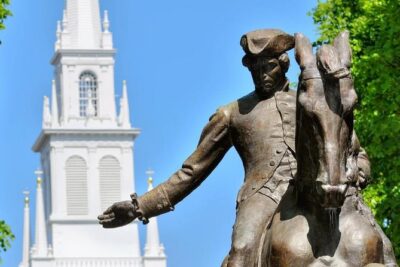
The Full Revolutionary Story Epic Small Group Boston Walking Tour
Read our review →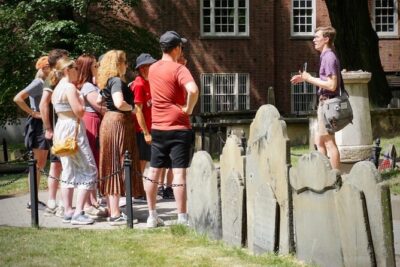
Freedom Trail History Small Group Walking Tour
Read our review →
Boston North End Food Tour of 6+ Tastings, Cannoli, Lobster Roll
Read our review →

Boston Pizza Lovers Food and History Walking Food Tour
Read our review →