
Review · DRESDEN
Dresden: City & Semperoper Guided Walking Tour
Dresden’s great attraction is how much of its royal center fits into one walk. This 170-minute tour links Dresden Castle, Frauenkirche, the Procession of Princes, the Zwinger, and the Semperoper, so you get the city’s main Baroque sights in one well-packed outing.
I like the clear route and the chance to see inside both Frauenkirche and the Semperoper, not just photograph their facades. I also like the practical value: at $35 per person, the price includes guided visits to the castle, Zwinger, cathedral, Frauenkirche, and opera house. The main consideration is that the tour is conducted in German, and the pace may be demanding if walking or standing is difficult.
Key points to know before booking

- The route covers Dresden’s royal center: You walk from Dresden Castle through the city’s best-known historic sights.
- The Semperoper is a major part of the experience: A separate guided visit takes you through the Saxon State Opera’s elegant interior.
- Frauenkirche is visited during opening hours: Interior access depends on the church being open.
- Augustus II the Strong gives the walk its theme: His court and building projects explain much of Dresden’s Baroque character.
- The price includes guided sightseeing but not museums: You see the city’s landmarks, while museum admission costs extra.
- German is the tour language: This matters if you need detailed explanations in another language.
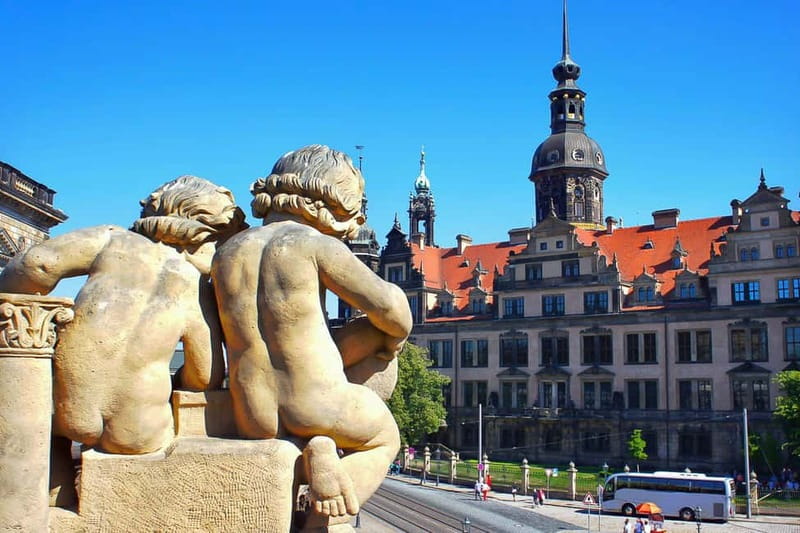
Dresden Castle is the right place to begin
The meeting point is on Schlossstraße, at the corner by Dresden Castle, beside the sign for Der historische Stadtrundgang durch Elbflorenz. Arrive with enough time to find the exact corner. The castle sits in the heart of the old city, so this is an easy place to begin if you are already exploring central Dresden.
Dresden Castle was the home of Saxon rulers, and it gives the tour its royal starting point. From here, the guide places the city’s grand buildings in the story of Augustus II the Strong, the elector of Saxony and king of Poland whose ambitions helped shape Dresden’s Baroque center.
The castle visit is guided, but museum tickets are not included. That distinction matters. You can learn about the building and see its historic setting as part of the walking route, but this tour is not a substitute for a separate visit to the castle museums.
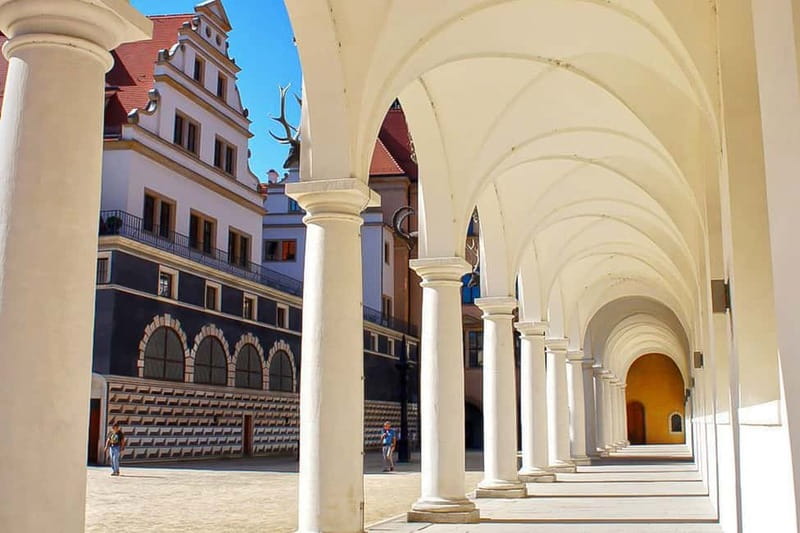
The route also reaches the Stables Courtyard, one of the castle’s notable spaces. You’ll hear about the court life that took place here and see the Taschenbergpalais nearby. The tour gives you the broad picture rather than unlimited time for every room, so I would save detailed museum browsing for another day.
More Guided Walks in Germany:
- Berlin: Third Reich & Cold War Guided Walking Tour
★ 4.9 · 8,378 reviews - Berlin: Hidden Backyards Guided Walking Tour
★ 4.8 · 5,360 reviews - Bamberg: Guided Walking Tour
★ 4.6 · 3,202 reviews
Frauenkirche shows Dresden’s painful recovery
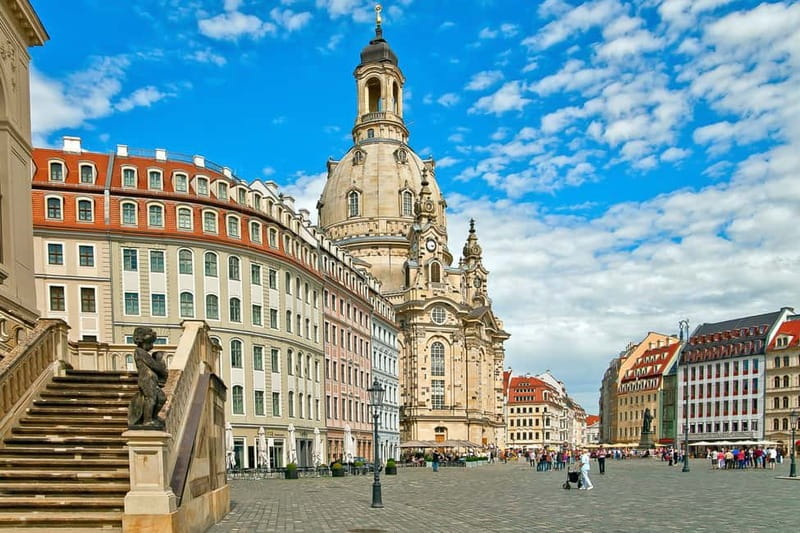
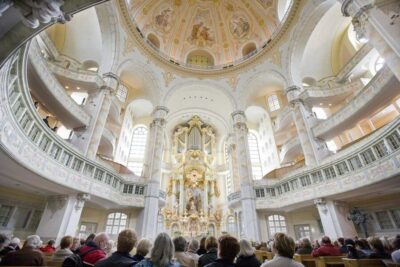
From the castle, the walk continues to Frauenkirche, Dresden’s Church of Our Lady. Its great stone dome is one of the city’s defining sights, but the building carries more weight than its graceful exterior suggests.
You first see the church from the square, where the restored Baroque design is easy to appreciate. The guide explains its place in Dresden’s story before taking you inside, provided the church is open at the time of the visit. Opening hours can change, so you should treat interior access as part of the planned route, not as a guarantee at every hour of the day.
Inside, the church has a very different effect from the broad open space outside. The restored interior helps you understand the scale of the original building and the effort required to bring it back after wartime destruction. That contrast between loss and restoration is one of the most meaningful parts of a Dresden visit.
This is also a point where the German-language format matters. The church’s story has several layers, and a guide can connect the architecture, the city, and the rebuilding effort more clearly than a quick stop with a camera.
The Procession of Princes turns history into a street scene
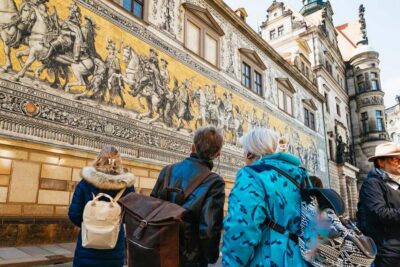
A short walk brings you to the Procession of Princes, the long wall mural made from porcelain tiles. It presents Saxon rulers in a procession, making this one of Dresden’s easiest historic sights to understand at a glance.
The mural is especially useful on a walking tour because you do not need to enter a museum to see it. You can stand in front of the figures and follow the sequence while the guide explains the role of Saxon rulers and the place of Augustus II the Strong in that story.
I like this stop because it breaks up the monumental churches and palaces with something more graphic and immediate. You are looking at a public artwork, but it also works as a visual timeline of the ruling dynasty.
Allow yourself a moment to take in the full length of the wall. It is easy to focus on one section and miss the scale of the entire procession. The guide’s explanation should help you notice details that would be easy to pass without context.
The Zwinger is the Baroque showpiece
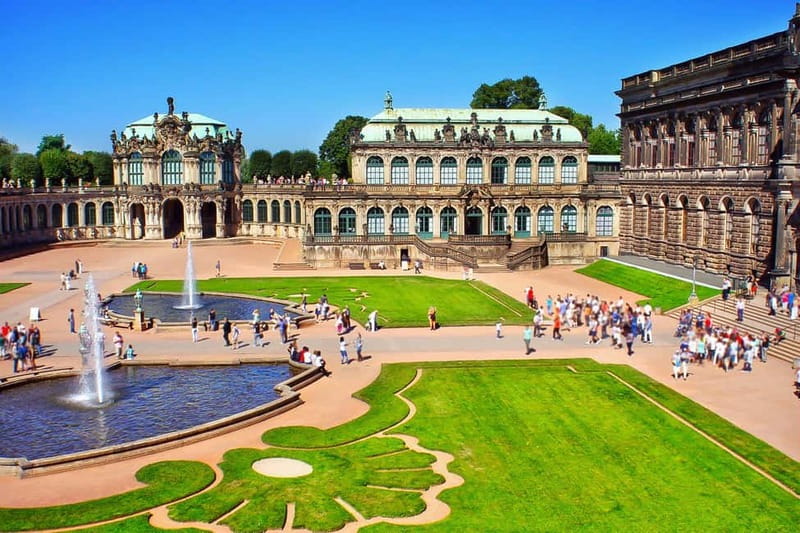
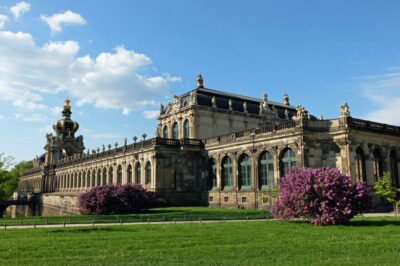
The walk then reaches the Zwinger, one of Dresden’s most ornate Baroque complexes. Its courtyards, pavilions, sculptures, and formal garden areas were built for court life and display rather than ordinary daily use.
The guided visit helps you understand how the Zwinger functioned as a royal setting. You’ll hear stories connected with Augustus II the Strong and see how the architecture was designed to impress guests arriving at the Saxon court.
The Zwinger is also a good place to slow down visually. After the darker weight of Frauenkirche and the historical procession mural, the pale stone, decorative details, and open courtyards offer a lighter change of mood. I would pay attention to the balance between the buildings and the garden spaces, rather than rushing straight through for a few photographs.
The tour includes a guided visit to the Zwinger, but museum admission is separate. If you want to see the collections housed there, plan extra time and budget beyond the $35 tour price. This arrangement works well for visitors who want an introduction first and can decide later which museum deserves a longer visit.
More Walking Tours in Germany:
- Discover Berlin Half-Day Walking Tour
★ 5.0 · 9,624 reviews - Berlin City walk Government District and Places of Democracy
★ 4.7 · 8,467 reviews - Munich: Third Reich & WWII Walking Tour
★ 4.6 · 6,181 reviews - Berlin: Discover Berlin Walking Tour
★ 4.9 · 5,998 reviews
The cathedral completes Theater Square
The walk ends at Theater Square, where the cathedral adds another major building to Dresden’s central group. Its formal exterior helps complete the picture of the former court district, with the castle, opera house, and other royal buildings close by.
The cathedral visit is included. Dogs are not allowed inside, so leave pets elsewhere before joining the tour. The cathedral is also one of the places where the route may involve standing while the guide explains the building, which is worth keeping in mind if you need frequent rest.
This part of Dresden feels carefully arranged. Within a short distance, you have the royal residence, the cathedral, the opera house, and the Zwinger. The tour’s main strength is showing you that these sights are not isolated monuments. They form a connected center created around the Saxon court.
The Semperoper gives the tour its grand finale
The Semperoper is the major indoor finale. It is the Saxon State Opera and former court opera, and the guided visit takes you through its impressive rooms while explaining the history of music and the building.
This is more than a quick look at the facade. You receive a ticket for a guided Semperoper tour, which means the interior is a central part of what you are paying for. The elegant rooms give you a sense of how the opera house served both art and court ceremony.
I see this as one of the strongest reasons to choose the full experience instead of taking only a city walk. Dresden’s old center can be admired outdoors in a couple of hours, but the Semperoper adds an interior visit with its own subject and atmosphere.
The opera house has strict practical rules. Buggies are not allowed inside, though you may leave one in the foyer. Infants must be carried, and dogs are not allowed. These rules can make the final section awkward for families with very young children, so plan ahead.
The tour is in German. If you understand German well, you’ll get the full value from the explanations. If not, you can still appreciate the rooms and architecture, but much of the historical detail will be harder to follow.
What $35 covers, and what it does not

At $35 per person, the tour offers good value if you want one organized introduction to central Dresden. The price covers a live guide, the guided castle and Zwinger visits, Frauenkirche, the cathedral, and entry to a guided tour of the Semperoper.
The value comes from the combination. You are not paying only for a stroll past famous buildings, and you are not paying only for an opera-house visit. The route connects several sights that would otherwise require separate planning.
Museum tickets are not included. That keeps the starting price reasonable, but you should not expect admission to every collection inside Dresden Castle or the Zwinger. If those museums are your priority, use this tour as an orientation and add separate visits.
The booking terms also make the experience relatively low-risk. You can cancel up to 24 hours before the start for a full refund, and you can reserve now and pay later. Starting times vary, so check availability for your date before arranging other activities around it.
The total duration is 170 minutes, or just under three hours. That is long enough to cover the main sights but short enough to fit into a day of sightseeing. You should still wear comfortable shoes and expect a steady walking pace through the historic center.
Who will get the most from this walk

I would recommend this tour to a first-time Dresden visitor who wants the city’s central sights explained in one continuous route. It is particularly useful if you have limited time and want both outdoor landmarks and the Semperoper interior.
It also suits anyone interested in the connection between royal power, architecture, and music. Augustus II the Strong is not just a name attached to one palace. His court helps explain why Dresden has such a concentrated collection of Baroque buildings, ceremonial spaces, and cultural institutions.
The tour is less suitable if you want a relaxed, highly specialized visit to one building. The itinerary covers a lot, so no single stop receives the same attention as it would on a dedicated castle, church, or opera-house tour.
The walking format also deserves an honest warning. The activity information describes the tour as wheelchair accessible, but it also lists people with mobility impairments as not suitable. I would clarify the current route and access arrangements before booking if you use a wheelchair or have difficulty walking, standing, or managing historic interiors.
Families should note the restrictions at the Semperoper and the ban on dogs inside the opera house, cathedral, and Frauenkirche. Buggies must stay out of the opera house, and infants must be carried there.
A practical way to plan your Dresden day
If you book this tour early in your stay, use it to get your bearings in the historic center. Afterward, you can return to the building or museum that caught your attention instead of guessing which places deserve your limited time.
I would avoid scheduling another fixed activity immediately afterward. The route is tightly packed, and the Semperoper portion may finish at a time that depends on the walking section and the opera-house entry. Give yourself a little breathing room.
Bring only what you need. You will be walking between major sights, and the Semperoper has rules about buggies and dogs. Check Frauenkirche opening hours when choosing a start time, since the church interior is available during opening hours rather than at all times.
The German-only format is the biggest booking question. A German-speaking guide can provide a lively, detailed account, but you need enough German to follow the explanations. If you do not, the tour still provides access and visual context, but the spoken history will not be as useful.
Should you book the Dresden Castle and Semperoper tour?
Book it if you want a brisk, well-organized introduction to Dresden’s royal center and you understand German. The strongest combination is the city route plus the Semperoper interior, with Frauenkirche, the Zwinger, castle, cathedral, and Procession of Princes filling out the story.
Skip it if you need an English-language tour, want extensive museum time, or prefer a slow pace with long stops at each monument. For most first visits, though, the $35 price is sensible because it joins Dresden’s main sights and includes a guided Semperoper visit that would otherwise require separate planning.
FAQ
How long does the Dresden city and Semperoper tour last?
The tour lasts 170 minutes, which is just under three hours.
What language is the guided tour in?
The live tour guide speaks German. The available activity information does not list another tour language.
Where is the meeting point?
Meet in Dresden on Schlossstraße, at the corner by Dresden Castle. Look for the sign reading Der historische Stadtrundgang durch Elbflorenz.
Is the Semperoper visit included?
Yes. The price includes a ticket for a guided tour of the Semperoper.
Does the price include museum admission?
No. Tickets for museums are not included.
Can I visit Frauenkirche during the tour?
Yes, Frauenkirche is included during its opening hours. Interior access depends on the church being open at the time of your visit.
Are buggies allowed inside the Semperoper?
No. You may leave a buggy in the foyer, and infants must be carried inside.
Are dogs allowed on the tour?
Dogs are not allowed inside the Semperoper, cathedral, or Frauenkirche. Pets are also listed as not allowed for the activity.
Can I cancel the booking?
Yes. You can cancel up to 24 hours in advance for a full refund. You can also reserve now and pay later.
New routes in Germany
- Munich: Walking Tour Old Town and Viktualienmarkt★ 4.7 · 839 reviews
- Stuttgart: Guided Ghost Walking Tour★ 4.5 · 867 reviews
- Stuttgart: Private Guided Circular City Walk★ 4.7 · 129 reviews
- Stuttgart: Old Town Highlights Guided Walking Tour★ 4.2 · 101 reviews
- Stuttgart: City Highlights – Guided Walking Tour★ 4.7 · 189 reviews
- Hamburg: Private Tour Red Light District Walking Tour★ 4.7 · 227 reviews
- Small Group Walking Tour: “Wild Kreuzberg”★ 4.8 · 199 reviews
- Sachsenhausen Memorial: Walking Tour from Berlin★ 4.7 · 132 reviews
Dresden Walking Tours, compared.

Walking Tour with a Night Watchman including a Meal
Read our review →
Guided Walking Tour and Chocolate Museum Ticket
Read our review →

Neustadt District Street Art Guided Walking Tour
Read our review →
Browse the lists this tour appears in