
Review · VIENNA
Vienna Historic Center Small Group Walking Tour
Vienna’s old center is compact, but its grand buildings can blur together without context. This 2.5-hour walk gives you the story behind the imperial palace, Ringstrasse, churches, squares, and coffeehouse culture, ending at St. Stephen’s Cathedral. It is a fast, useful orientation for a first visit.
I like the small cap of 15 people, which makes it easier to ask questions, and I like the audio devices, especially around busy streets. Guides including Dace, Giselle, Gabriela, Beatrice, and Annelie are praised for humor, clear storytelling, and good local advice about food and sightseeing.
The main catch is simple: this is mostly an outdoor look at Vienna, not a ticketed museum tour. You will walk a lot, possibly close to 14,000 steps, and most sights are viewed from outside. Comfortable shoes and weather-ready clothing matter.
Key points to know before booking
- Maria-Theresien-Platz to St. Stephen’s Cathedral: The route crosses Vienna’s main imperial and civic sights in one continuous walk.
- Small group of up to 15: You get a better chance to hear the guide and ask questions than on a large city tour.
- Strong historical focus: Expect stories about the Habsburgs, Hitler’s annexation speech, Freud, Lise Meitner, Beethoven, and Vienna’s coffeehouse life.
- No museum admissions: The tour explains buildings and may visit some churches or occasional indoor sites, but regular museum entry is not included.
- Useful on your first day: The route helps you choose where to return later, including museums, palace interiors, cafés, and restaurants.
- Good but active value: At $72.56 per person, the price makes the most sense if you want a guide-led overview rather than independent sightseeing.
Why this walk works well on a first day
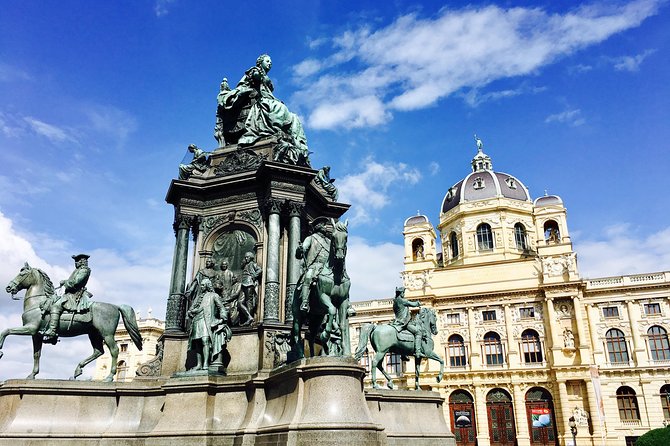
The tour begins at Maria-Theresien-Platz, a broad square between the Ringstrasse and the MuseumsQuartier. Two matching 19th-century museum buildings face each other across the square: the Natural History Museum and the Art History Museum. The large monument to Maria Theresa anchors the middle.
This is a smart starting point because Vienna’s story is visible in one glance. The square links imperial ambition, public museums, and the grand boulevard that replaced the city’s old defenses. Your guide sets up that story before the walk moves into the historic center.
You then pass the Ringstrasse and the Kunsthistorisches Museum. The route does not take you inside the museum, so you should not book this expecting a gallery visit. Instead, you get the building’s role in Vienna’s royal art collection and a useful explanation of how the Ringstrasse reshaped the city in the second half of the 19th century.
The Ringstrasse is not just a road. It is a showcase of different architectural styles, including Classical, Gothic, Renaissance, and Baroque. Along the wider circuit are the Town Hall, Parliament, Burgtheater, University of Vienna, and State Opera. This walk samples that grand civic world without trying to cover the entire boulevard.
More History Walking Tours in Austria
- Vienna: World War II Historical Walking Tour
★ 4.8 · 1,772 reviews - Historical Hitler Walking Tour of Vienna
★ 5.0 · 887 reviews - Vienna: Essential History Walking Tour
★ 4.9 · 633 reviews
From Burgtor into the Habsburg center
The Burgtor is a short stop, but its position helps you understand the change from Vienna’s old fortifications to the imperial palace complex. The neoclassical gate was built after the Napoleonic Wars and leads toward the Hofburg and Heroes Square.
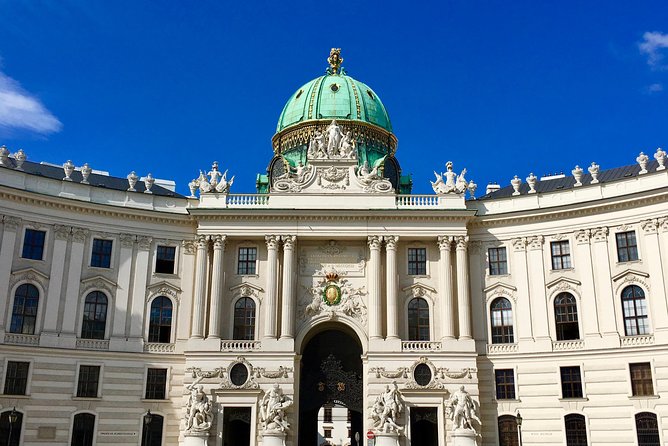
The Hofburg receives more time than most stops, and rightly so. This was the Habsburgs’ former palace and the center of political power in Vienna. You will see courtyards, façades, and parts of the New Castle while hearing about emperors, empresses, court routines, and the palace’s continuing role in Austrian public life.
The Hofburg is also a place where Vienna’s imperial story turns darker. From the balcony of the New Castle, Adolf Hitler proclaimed Austria’s annexation into Nazi Germany. A good guide can connect the palace’s long royal past with the political events that followed, rather than presenting the complex as a collection of pretty façades.
Heroes Square, or Heldenplatz, opens the palace area into a broad green space. The old bastion was removed after the Napoleonic Wars, creating the setting you see today. Nearby are the Austrian National Library and the Winter Riding School, associated with the Lipizzan horses. The tour does not promise a riding performance, so treat these as places to note for a separate visit.
The route also points out the apartment connected with the Habsburg empress Elisabeth, often called Sisi. This gives the palace section a more personal angle. Her life is often wrapped in romantic legend, but the guide can help separate the public image from the complicated person behind it.
Churches, government buildings, and city life
St. Michael’s Church dates to 1220 and provides one of the route’s older religious landmarks. It is a brief stop, but the church adds a different mood after the formal palace courtyards. Depending on the day and conditions, the tour may include some church interiors or other indoor locations, but you should not count on a full interior program.
The route then moves past the office of Austria’s Federal Chancellor and toward Rathaus, Vienna’s neo-Gothic City Hall. Rathaus is still the seat of Vienna’s government and also serves as a major event venue. Its tall Gothic design is a sharp contrast to the classical forms around the Ringstrasse.
Burgtheater follows. It is one of Europe’s major theaters, and its location opposite Rathaus helps show how the Ringstrasse was designed to place government, culture, and public ceremony side by side. You will see the exterior and hear its place in Vienna’s theatrical life, but a stage visit is not part of the tour.
Volksgarten offers a welcome change of pace. The park includes the Theseus Temple, a small replica of the Hephaisteion in Athens, originally built to display a sculpture by Antonio Canova. The park also recalls Vienna’s café and music traditions, including performances by Johann Strauss at the former Cortisches coffeehouse.
These short green spaces and open squares matter because the tour is not only a march from one famous façade to another. They give you a few calmer pauses and show how Vienna’s public spaces were designed for walking, ceremony, music, and conversation.
Freud, Beethoven, and Vienna’s intellectual side
The Beethoven Pasqualatihaus is linked to one of Ludwig van Beethoven’s former residences. It sits on the ramp of the old city fortifications, giving the stop both a musical connection and a reminder of how the medieval city once fit within its defenses.
At the University of Vienna, the guide connects the city’s academic life with figures such as Sigmund Freud and Lise Meitner. Meitner was a Jewish physicist whose work helped change modern science, and her story adds an important 20th-century perspective to a tour often dominated by emperors and palaces.
This section is one of the best reasons to take a guided walk instead of simply following a map. You can photograph a building on your own, but a guide can connect a university courtyard with Vienna’s role in psychology, science, music, and public debate.
Freyung is one of the oldest squares in central Vienna. It feels more intimate than the large imperial spaces and gives the route a sense of older city life. The Palais Ferstel is nearby, a grand building that once housed the Austro-Hungarian National Bank and Stock Exchange.
The tour also gestures toward Vienna’s famous coffeehouse tradition. Some coffeehouses became meeting places for writers, composers, architects, painters, psychoanalysts, and political thinkers. You may receive a café recommendation or personal suggestion from the guide, and one guide-led coffee stop has been particularly appreciated, but a café visit is not guaranteed as part of every departure.
More Old Town Walking Tours in Vienna:
- Underground Vaults Walking Tour in Edinburgh Old Town
★ 4.5 · 8,506 reviews - Prague: 3-Hour Walking Tour of Old Town & Prague Castle
★ 4.7 · 5,696 reviews - Dubrovnik: Old Town Walking Tour
★ 4.8 · 5,174 reviews - Split: Old Town and Diocletian Palace Walking Tour
★ 4.9 · 4,727 reviews
Graben, Kohlmarkt, and the final cathedral view
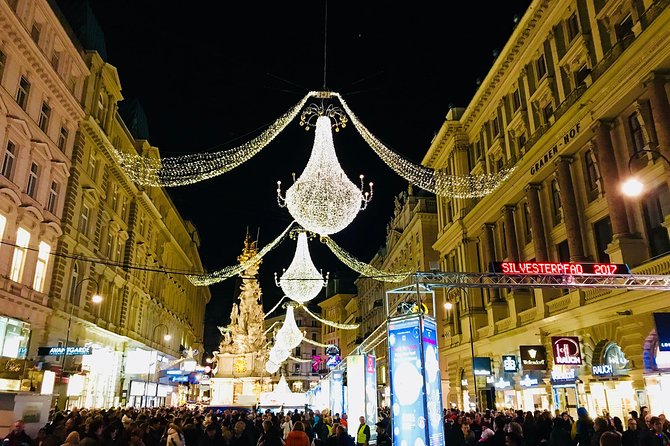
The walk continues along Kohlmarkt and Graben, two of central Vienna’s most elegant pedestrian streets. These are good places to notice the city’s polished commercial side, from historic façades to shops and cafés. They can be busy, so stay close to the group and use the supplied audio device to keep hearing the guide.
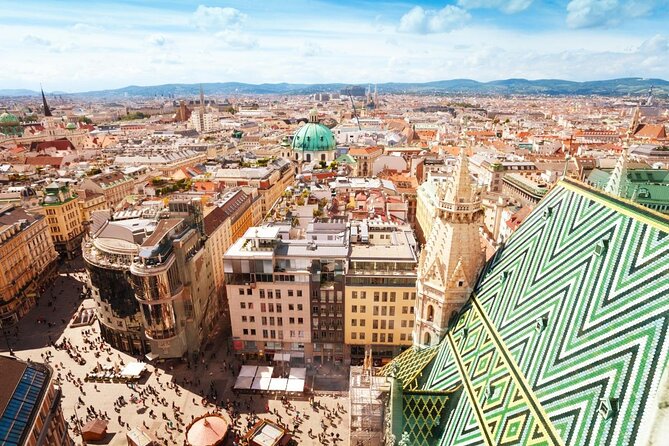
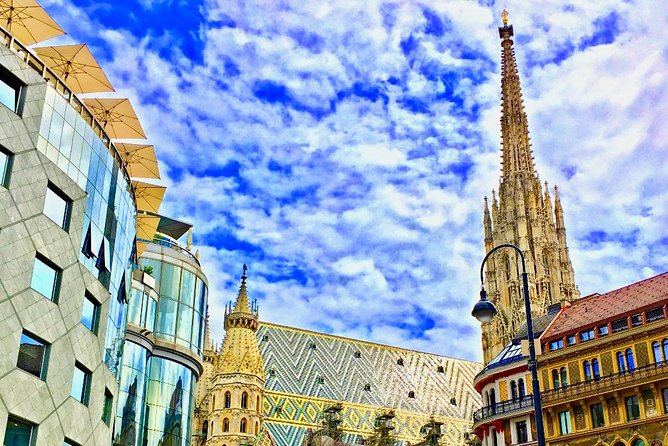
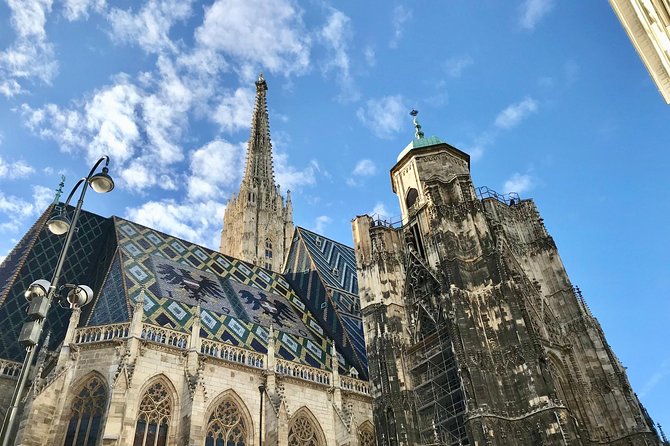
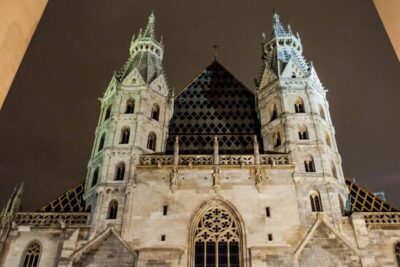
Stephansplatz is the final major square and the heart of the old center. St. Stephen’s Cathedral rises at its center, with its patterned roof and tall tower making it one of Vienna’s clearest symbols. The tour ends here, which is convenient because you can continue independently in several directions.
The cathedral is treated as the final landmark rather than a full guided interior visit. You can explore further on your own from Stephansplatz, and this is a good point to return to the cathedral, walk the surrounding lanes, or continue toward more central sights. The ending also makes the tour practical for a first day: you finish in the middle of the city rather than at an out-of-the-way meeting point.
What the guide adds to the walk
The strongest part of this experience is the guide’s delivery. Dace is praised for dry humor, personal observations, and clear explanations. Giselle is noted for her energy, history lessons, and practical suggestions. Gabriela is described as warm and attentive, with a knack for finding places to pause and warm up on cold days.
Beatrice and Annelie are also praised for lively presentations and strong subject knowledge. Since the guide can vary, you should not book expecting one specific person unless your confirmation says so. Still, the repeated pattern is clear: the tour depends heavily on having a guide who can turn a sequence of buildings into a connected story.
The audio devices are a real help. Vienna’s center has traffic, crowds, and wide open spaces, so hearing every sentence without standing shoulder to shoulder with the guide is valuable. The 15-person limit also keeps the group manageable and leaves room for questions.
The pace is fairly brisk. One account described about 14,000 steps over two hours, so do not confuse this with a gentle stroll. The official guidance calls for moderate physical fitness and does not recommend the activity for people with walking disorders.
Price, timing, and overall value
At $72.56 per person, this is not the cheapest way to see Vienna’s center. You can walk past most of these buildings for free, and many independent visitors will prefer to use a guidebook or audio app.
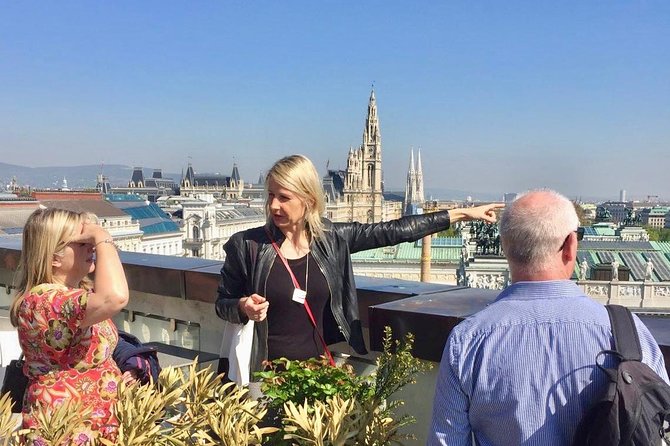
The price becomes easier to justify if you value context, route planning, and questions answered on the spot. You are paying for a certified local guide, a carefully arranged route, audio equipment, and recommendations for cafés, restaurants, food, and local customs. The small group matters too, especially when the guide is showing images on a tablet or pointing out details that are easy to miss.
The value is weaker if you expect admission to the Hofburg, museums, or cathedral. Entry tickets are not included, and the main experience is external viewing. One useful way to plan is to take this walk early, then return later to the interiors that interest you most.
Several start times are offered, which helps fit the walk around train arrivals, museum bookings, or an evening concert. Since the experience is weather dependent, pack for Vienna’s conditions. Free cancellation is available until 24 hours before the start time, while bad weather or an unmet minimum group size can lead to a new date or a full refund.
Who should book this Vienna walk
I would choose this tour if you are visiting Vienna for the first time, have only a short stay, or want the city’s main sights explained before setting off on your own. It is also useful for history fans who want links between the Habsburg court, Nazi-era Austria, music, science, and café culture.
It suits solo visitors and couples particularly well because the small group makes it easier to ask for restaurant ideas or help planning the rest of your day. Families with older children may also find the changing subjects easier to follow than a single palace tour.
I would think twice if your priority is entering museums, spending time inside the Hofburg, or moving at a slow pace. This is a teaching-focused walking tour, not an interactive attraction and not a full interior tour of Vienna’s monuments.
Should you book it?
Book it if you want a strong orientation to central Vienna and are happy to trade entry tickets for stories, route planning, and local advice. The guides’ humor, clear explanations, and personal recommendations add value that a map cannot provide.
Skip it if you mainly want interiors or if 2.5 hours of steady walking sounds tiring. For most first-time visitors who can manage the distance, the tour offers a sensible introduction, especially when scheduled near the beginning of your stay.
FAQ
Where does the Vienna Historic Center Walking Tour begin?
It begins at Maria-Theresien-Platz in central Vienna, Austria.
Where does the tour end?
The tour ends at Stephansplatz, beside St. Stephen’s Cathedral in Vienna’s 1st district.
How long does the tour last?
The walk lasts approximately 2 hours and 30 minutes.
How many people are in the group?
The group is limited to a maximum of 15 participants.
What language is the tour offered in?
The tour is offered in English.
Does the tour enter Vienna’s museums?
No. Museum entry is not included, and the tour does not visit the inside of any museum. Some churches and occasional indoor places may be visited depending on the weekday and conditions.
Is St. Stephen’s Cathedral included inside?
The route ends at St. Stephen’s Cathedral, but the supplied information does not promise a guided interior visit or admission.
Is the tour physically demanding?
You should have moderate physical fitness. The activity involves substantial walking and is not recommended for people with walking disorders.
Can I cancel for a refund?
Yes. You can cancel at least 24 hours before the start time for a full refund. Cancellations or changes made less than 24 hours before the start time are not accepted for a refund.
More Small-Group Walking Tours in Vienna
- Vienna: Small Group Guided Walking Tour of City Highlights
★ 5.0 · 540 reviews - Amsterdam Anne Frank: Small-Group Walking Tour & Local Guide
★ 4.8 · 12,789 reviews - New Orleans Food Walking Tour of the French Quarter with Small-Group Option
★ 5.0 · 6,118 reviews - Barcelona Tapas and Wine Experience Small-Group Walking Tour
★ 5.0 · 5,804 reviews
More History Walking Tours in Vienna
- History and Hauntings of Salem Guided Walking Tour
★ 5.0 · 14,564 reviews - Lisbon: History, Stories and Lifestyle Walking Tour
★ 4.8 · 10,902 reviews - Boston: Freedom Trail History Small Group Walking Tour
★ 5.0 · 6,450 reviews - Historic Charleston Guided Sightseeing Walking Tour
★ 5.0 · 6,216 reviews
New routes in Vienna
- The unknown Vienna City- a guided walking tour in 3 hours★ 4.7 · 137 reviews
- Hungry in Vienna? A Food Lover’s Coffee & Market Walk★ 4.9 · 276 reviews
- 3-Hour Walking Tour of Vienna Central Cemetery★ 4.7 · 71 reviews
- Vienna: City Center Guided Walking Tour★ 4.8 · 99 reviews
- Private Hidden Vienna Walk — Stories Behind Quiet Corners★ 5.0 · 137 reviews
- Vienna Private Walking Tour with a Local★ 4.5 · 131 reviews
- Vienna: Essential History Walking Tour★ 4.9 · 633 reviews
- Historical Hitler Walking Tour of Vienna★ 5.0 · 887 reviews
Vienna Walking Tours, compared.
Guided Walking Tour of City Center Highlights
Read our review →
Ghosts and Legends Guided Nighttime Walking Tour
Read our review →
Vienna for Food Lovers: Cafés, Markets & Austrian Cuisine
Read our review →Browse the lists this tour appears in