
Review · VIENNA
Historical Hitler Walking Tour of Vienna
Vienna’s grand center carries a darker story beneath its polished stone. This walking tour connects Hitler’s early years in the city with the Nazi takeover of Austria, wartime destruction, the persecution of Jewish residents, and the long effort to face that past.
I like the way the route combines major sights with less familiar memorials, and I like that the guides keep the focus on Vienna and Austria rather than giving you a generic Second World War lecture. The walk also ends near Schwedenplatz, a useful spot for dinner or the U-Bahn.
The main drawback is simple: two and a half hours outdoors can feel long in cold, wind, or rain. Some people also expect a tour devoted only to Hitler and may find the wider political and social history broader than the title suggests.
Key points to know before you book
- Hitler’s Vienna is placed in context: You look at his early life, the art academy that rejected him, and the political climate he encountered in the city.
- The route covers six major stops: The State Opera, Memorial Against War and Fascism, Academy of Fine Arts, Heldenplatz, Judenplatz, Morzinplatz, and the Stadttempel area.
- The Jewish history is central: You pause at the memorial for more than 65,000 Austrian Jews murdered by the Nazis and learn why Vienna’s main synagogue is concealed behind an apartment building.
- The walk is about 2.5 hours: Expect steady city walking, outdoor explanations, and a moderate fitness requirement.
- Guides add visual help: Dieter, Wolfgang, Stephan, Charles, and others have used maps, photographs, and tablet images to explain places that look very different today.
- The price is reasonable for a small-group history walk: At $32.65 per person, the fee pays for a licensed guide and focused interpretation, not entry tickets or refreshments.
Why this is more than a Hitler biography
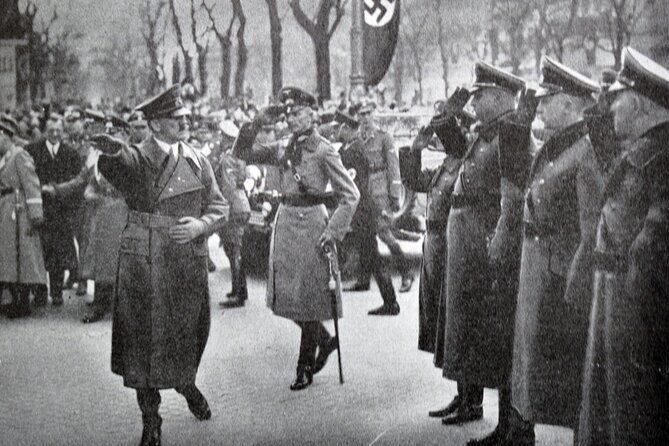
The title may suggest a narrow trail of personal landmarks. The actual experience is broader and more useful. You follow Hitler’s connection to Vienna, but the real subject is how a city with a brilliant cultural life became part of the Nazi system, how antisemitism grew, and how Austria remembered, ignored, or confronted what happened.
That distinction matters. One person who wants only Hitler’s private life may find the route misnamed. If you want to understand the setting that shaped his ideas, and the way Vienna responded to the Anschluss in 1938, the wider approach works well.
The tour is inspired by the historical study Hitler’s Vienna by Austrian historian Brigitte Hamann. You hear about Hitler’s early days, his failed attempt to enter the Academy of Fine Arts, and the important 1938 speech at Heldenplatz. But you also examine artists, Jewish residents, political power, architecture, war damage, and the city’s responsibility.
I would choose this walk if you want history explained at the places where it happened. It is less suitable if you are looking for a quick sightseeing loop or a tour built around grand interiors.
More History Walking Tours in Austria
- Vienna: World War II Historical Walking Tour
★ 4.8 · 1,772 reviews - Vienna Historic Center Small Group Walking Tour
★ 5.0 · 1,746 reviews - Vienna: Essential History Walking Tour
★ 4.9 · 633 reviews
Starting outside the Albertina and entering Vienna’s cultural world
The meeting point is at Albertinaplatz, outside the Albertina Museum. The walk begins at 2:30 pm and heads toward the Vienna State Opera, an easy way to move from today’s elegant city into the subject’s difficult past.
The State Opera opened on May 25, 1869, with Mozart’s Don Giovanni, in the presence of Emperor Franz Joseph and Empress Elisabeth. That detail sets up the larger story: Vienna was a major center for music, theater, and art long before National Socialism changed daily life.
After the Anschluss of Austria in 1938, Hitler visited the opera house on June 19 and October 27. The cultural world around it was damaged by the departure, persecution, and murder of artists and employees. Some works were banned from performance.
You spend about ten minutes here, but the stop is not just a photo opportunity. The guide explains how political control reached into the arts, which gives you a sharper sense of what the Nazi takeover meant beyond military events and official speeches.
Remembering war at Albertinaplatz
Next comes the Memorial Against War and Fascism, created by Austrian sculptor Alfred Hrdlicka. It has been at Albertinaplatz since 1988 and is dedicated to victims of war and fascism.
This is one of the route’s useful choices because it brings the subject into modern Vienna. You are not only looking back at the 1930s and 1940s. You are also seeing how Austria later chose to mark that period in public space.
The guide uses the memorial to discuss the darkest era in Austrian history and the human cost of political violence. The stop lasts about ten minutes. You do not enter a museum, so the value comes from the explanation and from looking closely at the memorial itself.
The broader setting also helps explain the scale of wartime destruction. More than 100,000 bombs fell on Vienna during the Second World War. Much of the city center has been repaired or rebuilt, so a guide’s historical explanation helps you notice damage and change that are not obvious at street level.
The art academy and Hitler’s early years
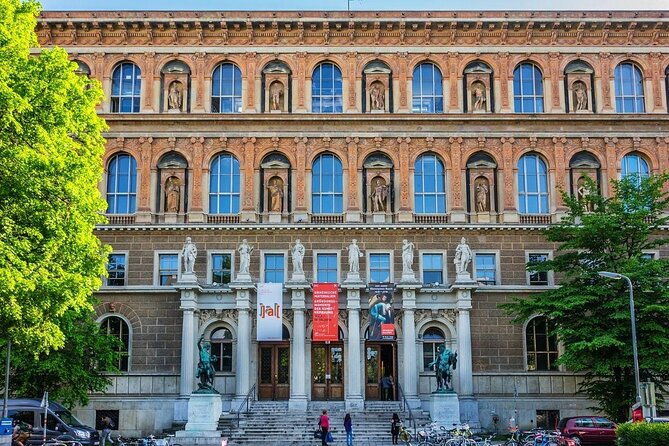
At the Academy of Fine Arts, you learn about the school that did not accept Hitler as a student. This stop is brief, but it is one of the most direct connections to his personal story.
The academy is not presented as a magic explanation for everything that followed. That would be too simple. Instead, the guide places the rejection within Hitler’s early years in Vienna and explains the political and social ideas circulating around him.
This is where guides often bring extra material. Stephan, for example, has used images and maps on a tablet to show how places looked in the past. That sort of visual aid can help because the modern building and street scene do not automatically reveal the story.
If your main interest is Hitler’s biography, this is one of the stops you will probably value most. If you prefer military history, it may feel like a short detour before the tour returns to Austria’s political experience.
More History Walking Tours in Vienna:
- History and Hauntings of Salem Guided Walking Tour
★ 5.0 · 14,564 reviews - Lisbon: History, Stories and Lifestyle Walking Tour
★ 4.8 · 10,902 reviews - Boston: Freedom Trail History Small Group Walking Tour
★ 5.0 · 6,450 reviews - Historic Charleston Guided Sightseeing Walking Tour
★ 5.0 · 6,216 reviews
Heldenplatz and the March 15, 1938 speech
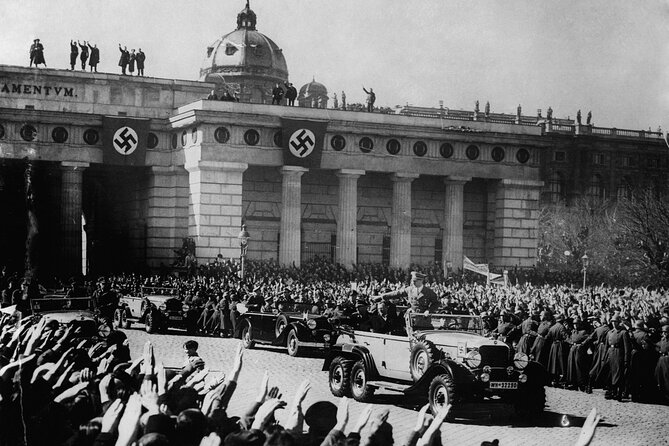
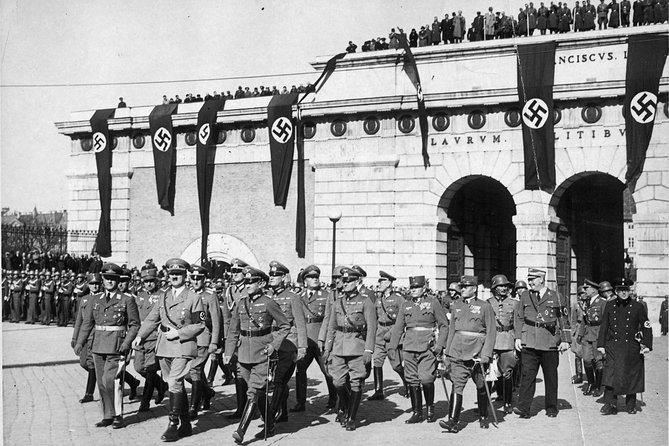
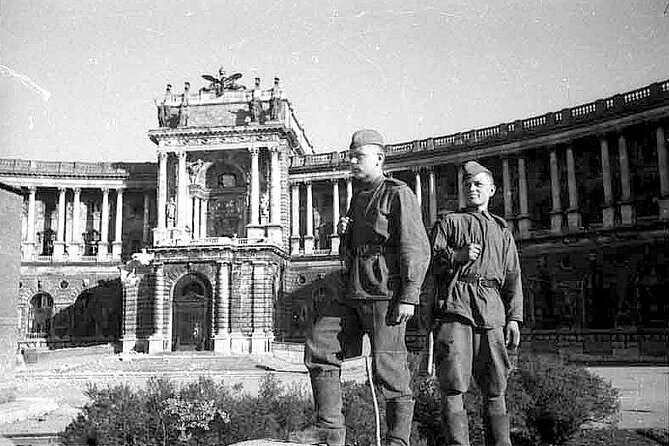
Heldenplatz is one of the most powerful places on the route. On March 15, 1938, Hitler spoke from the balcony of the Neue Hofburg after Germany’s annexation of Austria.
The speech became a symbol of the National Socialist seizure of power and the broad public approval associated with it. It also became a source of trauma for Austria’s Second Republic. The guide helps you picture the crowd, the setting, and the political message being delivered from this imposing imperial square.
This stop shows why location matters. A speech that might seem like a paragraph in a history book gains force when you stand in the same open space and see the imperial buildings around it.
You will likely spend about ten minutes here, though the guide may use more time for questions. Listen for the distinction between Nazi coercion, public enthusiasm, and later Austrian memory. The history is not comfortable, and a serious guide should not make it comfortable.
Judenplatz and the murder of Vienna’s Jewish population
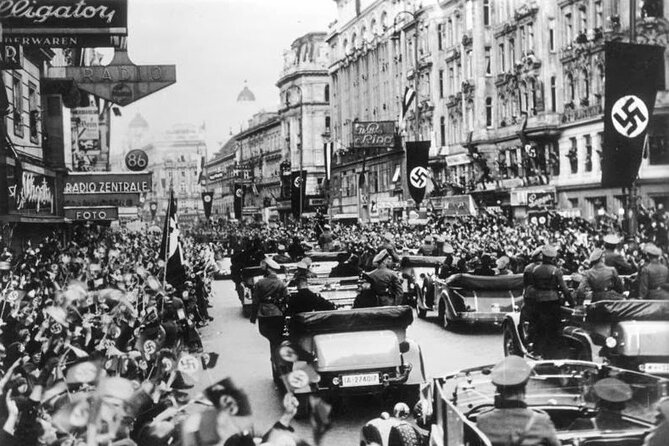
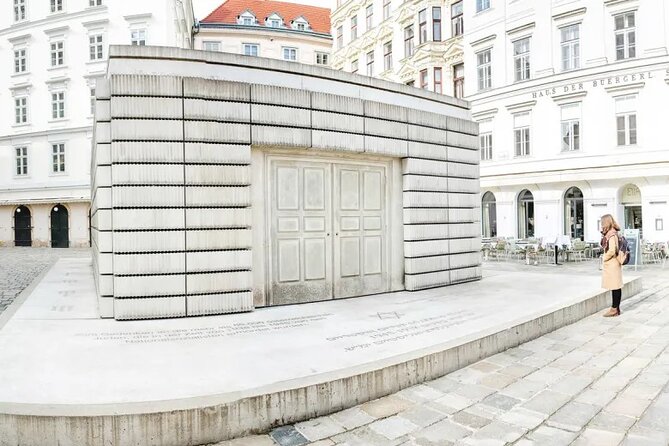
The route then crosses the historic center to Judenplatz and the Memorial for the Austrian Jewish Victims of the Shoah. The memorial honors more than 65,000 Austrian Jews murdered by the National Socialists between 1938 and 1945.
This is the emotional center of the walk. The memorial’s severe design gives the guide a place to discuss deportation, murder, persecution, and the destruction of Vienna’s Jewish community. You should expect the tone to become quieter here.
The tour also places this tragedy within the city’s longer Jewish history. Guides have discussed the large numbers of Jewish people who took their own lives rather than face deportation to the camps. That detail is difficult, but it shows the terror created before many victims were even transported.
I appreciate that the route does not treat Jewish history as a footnote to Hitler’s biography. The memorial gets its own time and attention. You are asked to remember the people who lived in Vienna, not only the politicians who shaped its fate.
Morzinplatz and the former Gestapo headquarters
At Morzinplatz, the guide explains the history of the former Hotel Metropole. Once a luxury hotel, it became one of the most brutal Gestapo headquarters in the Third Reich.
The present memorial marks a site whose original function can be hard to imagine. That contrast is precisely why the stop is valuable. The building’s former status as a luxury hotel makes the transformation even more chilling.
This part of the walk shifts from public speeches and cultural institutions to intimidation, interrogation, and state terror. It also reinforces the point that Nazi power was not confined to battlefields. It operated in ordinary-looking urban spaces, close to homes, shops, and public streets.
Again, the stop lasts about ten minutes. The guide’s storytelling does most of the work, since you are not touring a preserved interior.
The concealed Stadttempel Synagogue
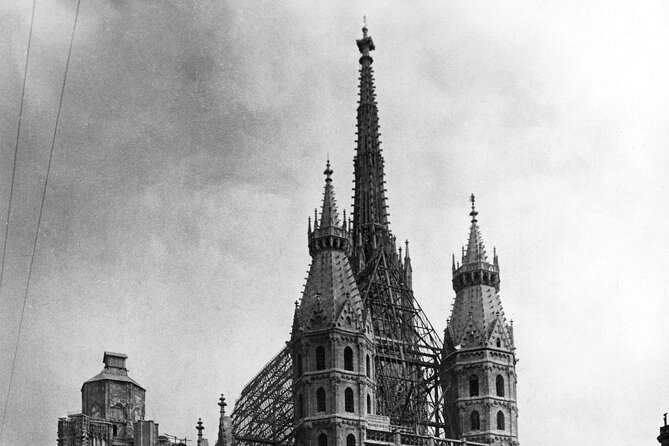
Near the end, you reach the Seitenstettentempel, Vienna’s main synagogue, in the area covered by the Jewish Vienna information point. The synagogue is concealed behind a five-story apartment building and cannot be seen directly from the street.
The reason goes back to regulations requiring non-Catholic places of worship to remain hidden from public view. The synagogue’s position is a physical reminder of the restrictions placed on Jewish religious life long before the Nazi period.
Above the entrance gate is the inscription, Come to his gates with thanksgiving, to his courts with praise. The guide explains the building’s unusual arrangement and why the synagogue was designed behind the street-facing tenement.
This is a small architectural detail with a large historical reach. You learn how prejudice can appear in building rules, street plans, and ordinary city design. The tour ends a short walk away at Schwedenplatz, where you can catch U1 or U4 trains or stop at one of the many nearby restaurants.
What the guide adds to the walk
The licensed guides are the heart of this experience. Dieter has been praised for a relaxed pace, clear English, and careful attention to the group. Wolfgang is known for philosophical discussion and for linking Vienna’s past with its present. Stephan has used an iPad with photographs and maps, while Charles has brought a teacher’s sense of structure to the subject.
Guide assignments can change, so you should not book on the assumption that one particular person will lead your walk. Still, the range of strong guide feedback points to the tour’s main strength: the human explanation between stops.
A good guide also manages the practical side. The group may include up to 25 people, and one past problem involved people being left behind at the busy meeting point. Arrive early, identify the guide clearly, and make sure you are with the group before it moves away from Albertinaplatz.
Some guides have made indoor pauses to help people warm up. That is useful in winter, but you should still dress for the weather. Bring water, sunblock, and a raincoat or umbrella. Comfortable shoes matter more than dressy clothes.
Is $32.65 good value?
At $32.65 per person, I consider this a fair price for a two-and-a-half-hour guided walk in central Vienna. You are paying for a licensed guide who connects several difficult sites into one clear story.
The tour does not include food, drinks, hotel pickup, or entry tickets. That is not a serious weakness here because the main stops are viewed from public streets and squares. The value comes from interpretation, not admissions.
A self-guided route would cost less, of course. But you would need to research the State Opera, Hrdlicka’s memorial, the art academy, Heldenplatz, Judenplatz, Morzinplatz, and the synagogue before setting out. You would also lose the links between those places.
For a history-minded visitor, the price is especially sensible. For someone mainly interested in Vienna’s imperial palaces, classical music, or coffeehouses, another tour may offer better use of your time.
Who should take this walk?
You should book it if you like political history, memorials, twentieth-century Europe, or tours that ask difficult questions. It also suits visitors who want to understand Austria’s role in National Socialism rather than hear a story focused only on Germany.
The walk requires moderate physical fitness. The pace is generally manageable, but you will be outside for about 2.5 hours and should expect regular walking through the city center.
Families with older teenagers may find the subject worthwhile, though the material is serious. The tour is offered in English, and service animals are allowed. It is near public transportation at both ends.
You may want a different experience if you dislike long historical explanations, want a purely architectural tour, or expect every minute to concern Hitler personally. This is a history walk about Hitler’s Vienna, not a complete Second World War tour.
Booking, weather, and cancellation details
Confirmation arrives when you book. Free cancellation is available up to 24 hours before the start time, with a full refund. Changes or cancellations inside that 24-hour window are not accepted for a refund.
The experience requires suitable weather and a minimum number of participants. If poor weather or low enrollment cancels the walk, you can choose another date or experience, or receive a full refund.
I would keep the afternoon flexible if the forecast is uncertain. Vienna’s weather can shift quickly, and an umbrella or raincoat is worth carrying even when the sky looks calm at 2:30 pm.
Should you book the Historical Hitler Walking Tour of Vienna?
Book it if you want serious history tied to real places. The best parts are the links between Hitler’s early life, Vienna’s cultural world, the 1938 takeover, the Gestapo, and the destruction of the Jewish community.
Do not book it expecting a fast list of Hitler landmarks. The tour spends real time on Austria’s wider political and social story, and that is its strength. It gives you a more honest picture of Vienna than a narrow biography would.
At $32.65, with a maximum group size of 25 and a well-regarded group of guides, this is a solid choice for history buffs. Wear good shoes, dress for the forecast, arrive early at Albertinaplatz, and be ready to spend two and a half hours thinking about a part of Vienna that its grand facades cannot explain.
FAQ
Where does the Historical Hitler Walking Tour of Vienna begin?
The tour begins outside the Albertina Museum at Albertinaplatz, 1010 Vienna.
Where does the tour end?
The walk ends a few minutes from Schwedenplatz. U1 and U4 trains serve the area, and nearby restaurants make it convenient for dinner.
What time does the tour start?
The scheduled start time is 2:30 pm.
How long does the walking tour last?
The tour lasts approximately 2 hours and 30 minutes.
Is the tour offered in English?
Yes. The experience is offered in English and includes a licensed guide.
How many people can join the tour?
The maximum group size is 25 people.
What should I bring?
Wear comfortable shoes and clothes. Bring water, sunblock, and a raincoat or umbrella because Vienna’s weather can change.
Can I cancel for a full refund?
Yes. You can cancel at least 24 hours before the start time for a full refund. Cancellations or changes made less than 24 hours before the start time are not refunded.
New routes in Vienna
- The unknown Vienna City- a guided walking tour in 3 hours★ 4.7 · 137 reviews
- Hungry in Vienna? A Food Lover’s Coffee & Market Walk★ 4.9 · 276 reviews
- 3-Hour Walking Tour of Vienna Central Cemetery★ 4.7 · 71 reviews
- Vienna: City Center Guided Walking Tour★ 4.8 · 99 reviews
- Vienna Private Walking Tour with a Local★ 4.5 · 131 reviews
- Private Hidden Vienna Walk — Stories Behind Quiet Corners★ 5.0 · 137 reviews
- Vienna: Essential History Walking Tour★ 4.9 · 633 reviews
- Vienna: Small Group Guided Walking Tour of City Highlights★ 5.0 · 540 reviews
Vienna Walking Tours, compared.
Guided Walking Tour of City Center Highlights
Read our review →
Vienna Historic Center Small Group Walking Tour
Read our review →
Ghosts and Legends Guided Nighttime Walking Tour
Read our review →Browse the lists this tour appears in