

Review · UK
Fascinating Walking Tours Of Roman Chester With An Authentic Roman Soldier
Chester’s Roman past is not locked away in a museum. It appears beneath a cafe, along the city wall, and in the open sweep of Britain’s largest Roman amphitheater. This 90-minute walk brings those remains together with a guide dressed as a Roman soldier, often known by names such as Julius, Marcus, Gaius, or Tiberius.
I like the way the tour connects stones to ordinary life, including soldier pay, ranks, clothing, hygiene, and living quarters. I also like the guide-led format, since you can stop to ask questions rather than simply read signs. The main thing to consider is the weather: this is an outdoor walk, and the route includes uneven historic areas and a cellar visit that may not suit every participant.
Key points to know before you book

- Britain’s largest Roman amphitheater: See where public spectacles took place and learn what the surviving archaeology can, and cannot, tell us.
- Roman fortress walls: Walk beside original masonry, with some sections rising more than 5 meters high.
- A working Roman soldier-guide: Guides including Marcus, Julius, Gaius, and Tiberius use uniforms, stories, humour, and questions to bring the route to life.
- Roman Gardens evidence: Examine original pila stones and a reconstructed hypocaust, the underfloor heating system used in Roman baths.
- A surprising cellar stop: Ancient columns and remains appear beneath a modern cafe, one of the tour’s most memorable details.
- Small, affordable group: The tour lasts about 90 minutes, costs $16.64 per person, and accepts a maximum of 15 people.
Why Roman Chester works best on foot
Chester is a good city for a short Roman tour because its ancient remains sit within the modern centre. You do not spend the afternoon traveling between distant sites. Instead, the route lets you compare Roman stonework with shops, cafes, roads, and city streets.
That contrast is the point. A Roman wall may form the base of a later structure. A column can survive in a cafe basement. The amphitheater may look like a simple open space until your guide explains what happened there and how archaeologists pieced its story together.
Your meeting point is outside Chester Town Hall on Northgate Street. From there, the group follows the guide through central Chester. The maximum group size is 15, a useful limit for a walking tour where you need to hear explanations and see objects up close.
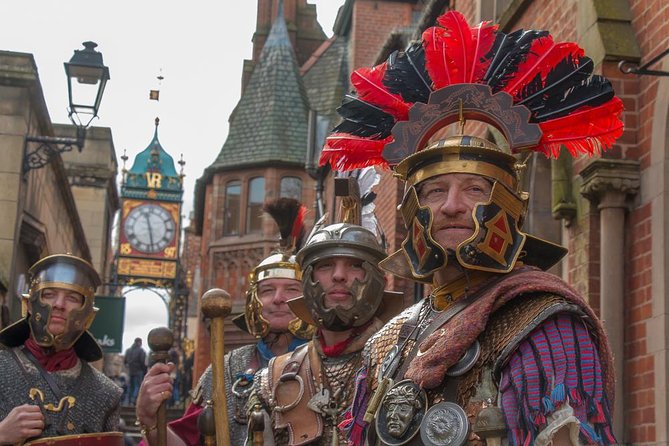
The guides are the heart of the experience. They wear Roman-style military clothing and often use a Roman name for the walk. Marcus is praised for his custom-made legionary kit and for letting participants handle reproduction and real artefacts. Julius is described as a lively historian who keeps children involved. Gaius, Tiberius, Faustus, Hippolyta, and others bring their own approach, so the mood may vary slightly from one departure to another.
You should expect a performance element, but not a theatrical show that replaces facts. The best parts combine humour with solid explanation. Guides discuss daily life, soldier ranks, wages, military duties, personal hygiene, and sleeping arrangements. One guide also addressed the presence of women connected with the Roman military world, including women from areas now known as Ukraine and Russia. These details help you picture people rather than only ruins.
More Walking Tours in the UK:
- Magical London: Harry Potter Guided Walking Tour
★ 4.7 · 22,044 reviews - Edinburgh: Harry Potter Magical Guided Walking Tour
★ 4.8 · 11,944 reviews - Edinburgh Castle: Guided Walking Tour with Entry Ticket
★ 4.7 · 11,699 reviews
The amphitheater: Rome’s public life in Chester
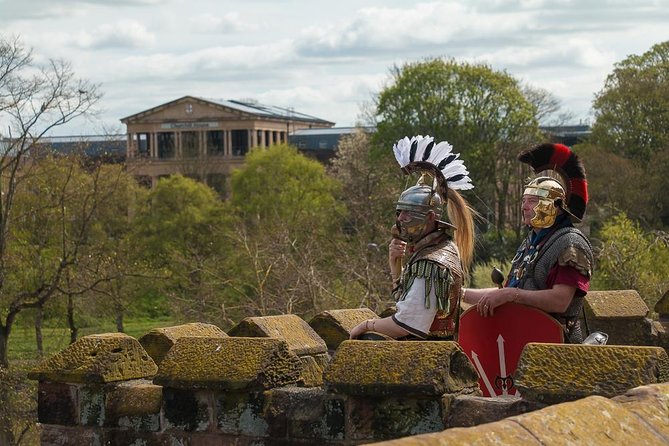
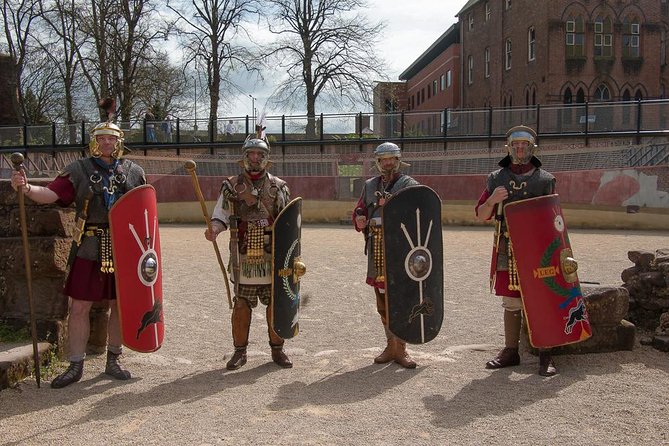
The Chester Roman Amphitheatre is the first major stop and receives about 15 minutes. It is described as Britain’s largest Roman amphitheater, a claim that gives the site real weight even when parts of the structure survive only as foundations and outlines.
Here, the guide focuses on the people who fought and died in the arena, using archaeology and the remaining stonework as the basis for the explanation. You will hear about the purpose of the building and the kinds of public events that shaped Roman life.
The open layout makes this an easy place to understand scale. You can see where a large crowd would have gathered, then consider how much of the original structure has disappeared. A good guide also helps you avoid a common mistake: assuming that every visible stone belongs to the same period. The point of a guided visit is to separate Roman remains from later changes.
This is an outdoor stop, so rain can affect how long you want to linger. There are no admission charges for the listed stops, but comfort depends on your shoes and the weather. If you want dramatic ruins on the scale of a fully rebuilt arena, keep your expectations measured. The value here lies in the setting, the evidence, and the explanation.
Walking the fortress walls and finding Roman stone
The next part of the route follows the foundations of the walls of Britain’s largest Roman fortress. Some original Roman wall sections still survive to more than 5 meters high. That height gives you a much stronger sense of the military base than a few scattered stones would provide.
I find this section especially useful because it shows how Roman Chester fitted into a defensive system. The guide can point out where later construction has reused or covered Roman material, helping you read the city as a series of layers.
This is also where a guide’s ability to answer questions matters. You can ask about construction, the role of the fortress, or the difference between original masonry and later repairs. The route is not just a march from one famous site to another. It is a lesson in how archaeology works in a living city.
The walk is generally suitable for most participants, and service animals are allowed. Still, old walls and historic streets can bring practical limits. One participant using an electric wheelchair was able to take part but missed one cellar section. That is useful context if step-free access is important to you. The information provided does not promise full accessibility, so contact the provider before booking if you need a precise route assessment.
Roman Gardens and the hypocaust system
At the Roman Gardens, the tour explains a reconstructed hypocaust system. A hypocaust heated a floor by circulating warm air beneath it. The display uses original pila stones, along with reconstructed sections and mosaic flooring found during excavations of Roman military baths.
This is one of the most valuable stops for anyone who wants to understand technology rather than just admire old stone. The guide explains how the pila stones supported the floor, how heat moved through the space, and why the finds were relocated here.
The Roman Gardens are also a good place to ask practical questions about Roman bathing. The walk does not simply tell you that the baths existed. It shows the physical parts that made the building work. You can see how a small piece of archaeology fits into a larger structure.
The tour also addresses the loss of Roman remains. Chester once had military baths described as larger and grander than those at Bath, but those baths were bulldozed for a shopping development after only a short period of basic archaeological investigation. That story adds an important note of caution. Chester’s Roman past is impressive, but not all of it was protected.
Same streets, a different guide:
- Underground Vaults Walking Tour in Edinburgh Old Town
★ 4.5 · 8,506 reviews - London: The Original Jack the Ripper Walking Tour
★ 4.7 · 7,833 reviews - Oxford University Walking Tour With University Alumni Guide
★ 5.0 · 6,905 reviews - Edinburgh Castle: Guided Walking Tour with Entry Ticket
★ 5.0 · 5,540 reviews
The cellar stop and Chester’s unexpected remains
One of the most unusual moments comes beneath a modern cafe, where Roman remains and Principia columns can be seen in a basement setting. The Principia was the headquarters building of a Roman fortress. Seeing its columns beneath a place used for coffee makes the city’s archaeology feel immediate.
This is the sort of stop you could easily miss on your own. There may be no grand exterior sign pointing you toward it. Your guide provides the access point and explains what you are looking at, which gives the stop much more meaning.
The cellar is also the clearest practical consideration on the walk. Access may not suit everyone, and one participant in an electric wheelchair missed this section. If you have mobility concerns, ask in advance. If you can enter, the stop is likely to be one of the tour’s most memorable because it places ancient remains inside a very modern setting.
What the guides add to the experience
The Roman costume is more than a photo opportunity. It gives the guide an easy way to discuss clothing, equipment, rank, and daily routine. Marcus, for example, has a custom-made legionary kit and uses artefacts to explain what a soldier carried and how the uniform worked.
You may handle reproduction objects and some real artefacts during the tour. That hands-on element helps children stay involved, but adults interested in ancient history should enjoy it too. A participant with a PhD in ancient history found enough fresh material to remain entertained, which suggests that the tour is not aimed only at beginners.
The strongest guides mix detail with humour. Puns, jokes, and what one might call good craic keep the pace moving. Julius is praised for his energy, Marcus for his enthusiasm, and Tiberius for engaging children while still explaining the evidence.
The guides also answer questions without making you feel foolish for asking. That matters in a subject filled with unfamiliar military terms and uncertain archaeological conclusions. If a guide is doing the job well, you should come away knowing not only what is known, but also how archaeologists know it.
Is the $16.64 price good value?
At $16.64 per person, this is a low-cost way to spend 90 minutes in central Chester. The listed sites do not charge separate admission, so you are paying mainly for the guide’s time, interpretation, costume, and access to less obvious remains.
The value is strongest if you are new to Chester or have limited time. You can cover the amphitheater, fortress walls, Roman Gardens, and the cellar remains in one focused outing. A self-guided walk may cost nothing, but it will not necessarily reveal the columns beneath the cafe or explain the hypocaust stones in the same way.
The price also works well for families, since most children can participate and the soldier format gives them something visual to follow. Adults who already know a great deal about Roman Britain should still find useful detail, though the overall approach remains lively and accessible rather than academic.
The group cap of 15 is another positive. Smaller groups make it easier to hear the guide and ask questions. The tour is usually booked about 14 days ahead, so booking early is sensible if your Chester visit has fixed dates.
Who should take this Roman Chester walk?
I would recommend it to first-time visitors, families, history fans, and anyone who wants an efficient introduction to Chester. It also suits local residents who have walked past Roman remains without knowing what they were seeing.
You should choose this tour if you enjoy stories about people and daily routines as much as large monuments. The material on pay, personal hygiene, military training, living quarters, ranks, and risks gives the walk a human focus.
It may be less suitable if you want a long archaeological visit with time for private photography at every site. Ninety minutes passes quickly, and the route has several stops. It is also not the best choice in poor weather unless you are prepared to walk outside in the rain. The experience requires good weather, and a cancellation caused by bad conditions is handled with a new date or full refund.
The tour is offered in English. It begins at Chester Town Hall and finishes at the Roman Amphitheatre area, with the guide directing you toward your next destination afterward. The supplied meeting information also lists 23 Little St John Street as the end location, so check your booking details carefully for the exact finishing point.
Should you book it?
Book this walk if you want Chester’s Roman remains explained by an engaging guide rather than viewed as isolated ruins. The amphitheater, high wall sections, hypocaust stones, and cafe cellar each offer something different, and the Roman soldier format gives the route a clear personality.
I would be especially keen to take it early in a Chester visit. It gives you a useful map of the Roman centre, points out details you can revisit later, and helps you understand why ordinary-looking streets contain major archaeological remains.
Skip it only if outdoor walking in uncertain weather is a problem, or if you need guaranteed step-free access throughout. For most people, the modest price and 90-minute length make this an easy addition to a Chester day.
FAQ
How long does the Roman Chester walking tour last?
The tour lasts approximately 1 hour and 30 minutes.
How much does the tour cost?
The listed price is $16.64 per person.
Where does the tour begin?
It begins at Chester Town Hall on Northgate Street, Chester CH1 2HJ, UK.
Where does the tour finish?
The tour terminates at the Roman Amphitheatre area, and the guide directs you to your next destination. The supplied information also lists 23 Little St John Street, Chester CH1 1RF, as the end location, so check the booking details.
What language is the tour offered in?
The tour is offered in English.
How many people can join the tour?
The maximum group size is 15 people.
Can I cancel for a full refund?
Yes. You can cancel at least 24 hours before the experience start time for a full refund. Cancellations or changes made less than 24 hours before the start time are not refunded or accepted. If poor weather causes the tour provider to cancel, you are offered another date or a full refund.
New routes in the UK
- Aberdeen City Centre Walking Tour (2pm)★ 5.0 · 217 reviews
- German London : The Ultimate Walking tour★ 4.8 · 400 reviews
- London: Medieval History Walking Tour from The Tower★ 4.9 · 318 reviews
- Oxford: Official University and City Walking Tour★ 4.7 · 618 reviews
- The Beatles London Walking Tour★ 4.2 · 147 reviews
- Stratford-Upon-Avon’s Town Walking Tour (10:30am & 2pm)★ 4.8 · 143 reviews
- Stratford-Upon-Avon: The Famous Walk Talk Show★ 4.9 · 342 reviews
- The Sinister Side of Shakespeare’s Stratford Walking Tour★ 4.8 · 547 reviews
UK Walking Tours, compared.

Magical London: Harry Potter Guided Walking Tour
Read our review →

Edinburgh Castle: Guided Walking Tour with Entry Ticket
Read our review →
Underground Vaults Walking Tour in Edinburgh Old Town
Read our review →

Oxford University Walking Tour With University Alumni Guide
Read our review →
Tour for Muggles The Ultimate Harry Potter Walking Tour in London
Read our review →
Edinburgh Darkside Walking Tour: Mysteries, Murder and Legends
Read our review →Browse the lists this tour appears in