
Review · PORTUGAL
Óbidos: Medieval Tales & Secrets Spots Guided Walking Tour
Óbidos saves one of its best tricks for the end, or perhaps the middle: a sip of sour-cherry ginjinha served in a little chocolate cup. This two-hour walk pairs that tasty local custom with the town’s old castle, churches, art, bookshops, and quieter lanes.
I like the way the tour gets beyond Óbidos’s postcard streets to places such as São Tiago Bookstore, set in a former church and royal chapel, and the old Moorish and Jewish quarters. I also like the human touch: guides including Ivo, JP, Bruno, Maria, and João Pedro have been praised for clear stories, photo help, restaurant suggestions, and patient answers.
The main drawback is the walking itself. Rough stone streets, slippery surfaces, steps, and the castle area make this a poor match for wheelchair users, people with mobility limits, or anyone recovering from surgery. Wear proper shoes and expect an active two hours.
Key points at a glance
- Ginjinha in chocolate: Taste Óbidos’s famous sour-cherry liqueur from an edible chocolate cup.
- A castle with Moorish roots: Explore a fortification described as 1,300 years old, with stories reaching back to Muslim rule.
- Josefa de Óbidos: See five original works by the celebrated 17th-century local painter.
- Two unusual bookshops: Visit Livraria do Mercado and São Tiago Bookstore, housed in distinctive historic spaces.
- The Town of the Queens: Learn how Catherine of Austria, Isabel of Aragon, and Leonor de Avis shaped Óbidos.
- Quiet corners: Your guide takes you away from the busiest lanes for better photographs and a calmer look at town life.
Why this walk makes sense in Óbidos
Óbidos is easy to admire and surprisingly easy to misunderstand. You can enter through the walls, photograph the white houses trimmed in blue and yellow, walk along the main street, and leave with a fine collection of pictures. But without context, the town can feel like a pretty medieval stage set.
This tour gives the buildings a human story. You hear why Portuguese queens cared about Óbidos, how religious institutions shaped the town, and how artists and merchants fitted into its past. The guide does not simply point at a church and give you a date. The strongest part of the experience is the connection between places, people, and power.
The tour is also useful early in a stay. Several people who took it appreciated getting their bearings before exploring on their own. You can use the guide’s suggestions later for restaurants, books, quieter streets, and details worth a second look.
It costs $41 per person for two hours, including a guide and the liqueur tasting. That is not the cheapest way to walk around Óbidos, since the town itself is free to enter. Still, the price can be fair if you want the castle and churches explained, prefer a local perspective, and value access to small corners you might pass without noticing.
More Hidden Gems Walking Tours in Portugal:
- Porto: Highlights & hidden gems Walk – max 10
★ 5.0 · 441 reviews - Lisbon by Night: Guided Walking Tour – The Unholy Secrets
★ 4.8 · 93 reviews - Dublin Highlights and Hidden Gems Guided Walking Tour
★ 5.0 · 6,020 reviews
Starting outside the walls at the tourist office
You meet in front of the Óbidos Tourist Office, near the main parking area outside the walls. This is a practical meeting point, especially if you arrive by car or bus, because you do not need to search for a meeting spot inside the narrow old town.
From there, the guide leads you into the walled center. The walk returns to the same tourist office at the end, so you are not left trying to find your way back after the final tasting.
The exact starting time depends on availability. English and Portuguese are offered, and the tour lasts two hours. That is long enough for a useful introduction without taking over an entire day, though the route is fairly full. If you like to stop for every photograph or read every sign, you may find the pace brisk.
Guides named in past bookings include Ivo, JP, Bruno, Maria, João Pedro, Jorge, and others. The strongest pattern is a warm, conversational style. Ivo in particular is often praised for turning facts into stories, while JP is noted for patience and a personal approach. Your guide may be someone else, but the experience is designed around live explanation rather than a fixed audio script.
Josefa de Óbidos and the town’s art
One of the tour’s most specific features is its focus on Josefa de Óbidos. You see five original paintings by this important 17th-century artist, who was born in Spain but made her career in Portugal and became closely associated with Óbidos.
The tour presents her as more than a local name on a church label. Josefa was a major Portuguese painter and the first Portuguese female artist to have work exhibited at the Louvre in Paris. That detail helps place her in a wider European story, rather than treating her art as a footnote.
You also visit the Museum of the Saint John the Baptist Church, where the art and religious setting work together. The specific appeal here is scale. Instead of rushing through a large museum, you get a focused look at works connected to the town and its churches.
The superb Renaissance pietà by Nicolau de Chanterene is another important stop. It gives the walk a different artistic note from Josefa’s paintings and helps you see Óbidos as a place of serious religious art, not just whitewashed lanes and souvenir shops.
If art is your main reason for booking, keep in mind that the tour is not a dedicated museum visit. The route covers history, architecture, neighborhoods, bookshops, and the castle as well. You receive context and selected works rather than a long, specialist lecture on painting.
Churches, chapels, and the old center
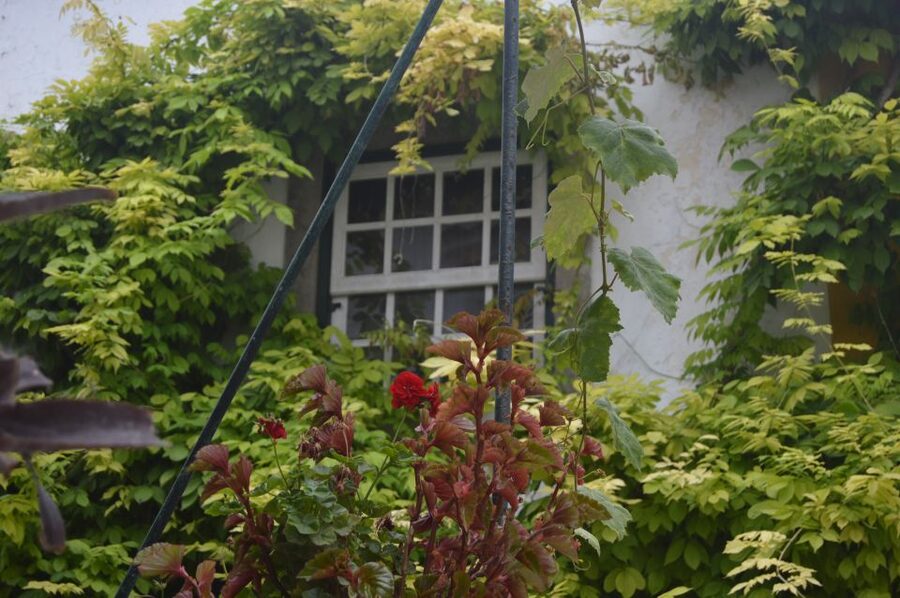
The route includes Saint Peter Church, Saint Martin Chapel, the Almshouse Church, and Saint Mary Church. Each adds another layer to the town’s story, and the variety keeps the walk from becoming a repeated procession of similar façades.
At Saint Mary Plaza, the guide helps connect the main square to the social and religious life of old Óbidos. The Almshouse Church brings in the charitable work linked with Queen Leonor of Avis. Her Holy House of Mercy became an early branch of a relief and hospital network that later spread across the Portuguese Empire.
Leonor is remembered as the Most Perfect Queen, and Óbidos was one of the places where her influence took visible form. The guide’s explanation gives meaning to the title and shows how royal patronage affected ordinary care, worship, and civic life.
You also hear about queens including Catherine of Austria and Isabel of Aragon, known as Queen Saint Isabel. Óbidos was closely connected to Portugal’s queens for centuries, which explains the nickname Town of the Queens. This is one of the tour’s strongest history lessons because it turns a broad royal story into something you can see in the streets and buildings around you.
Camões Mark and Casa da Música add another cultural stop. The route does not stay locked in the distant medieval past. It shows how the town’s public spaces and buildings have continued to serve cultural purposes.
More Guided Walks in Portugal:
- Best of Lisbon Small-Group Guided Walking Tour
★ 5.0 · 4,869 reviews - Experience Porto’s Charm: 3-Hour Guided Walking Tour
★ 5.0 · 2,432 reviews - Madeira: Enjoy a Guided Levada Walk in the Rabaçal Valley
★ 4.7 · 2,197 reviews - Porto: 3-Hour Guided City Highlights Walking Tour
★ 4.8 · 2,050 reviews
The Moorish and Jewish quarters
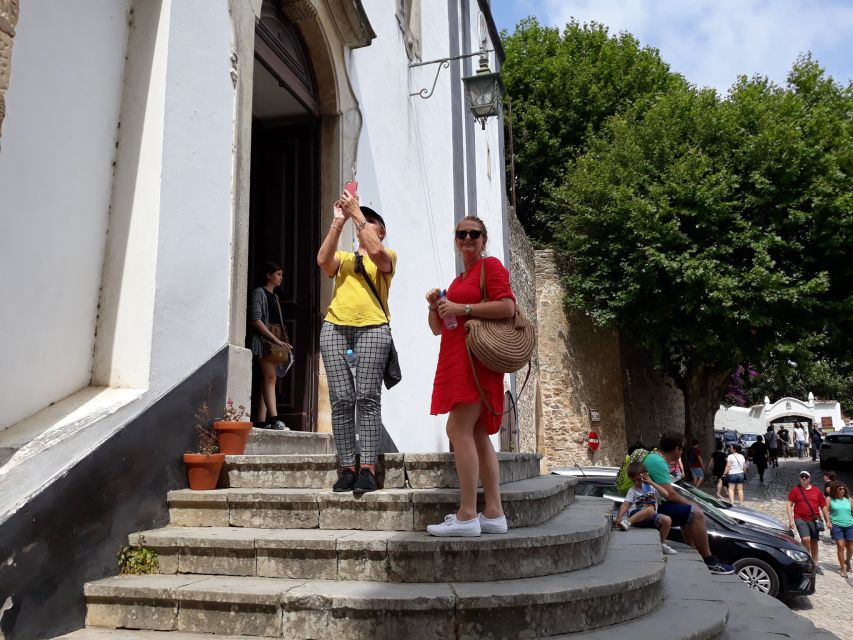
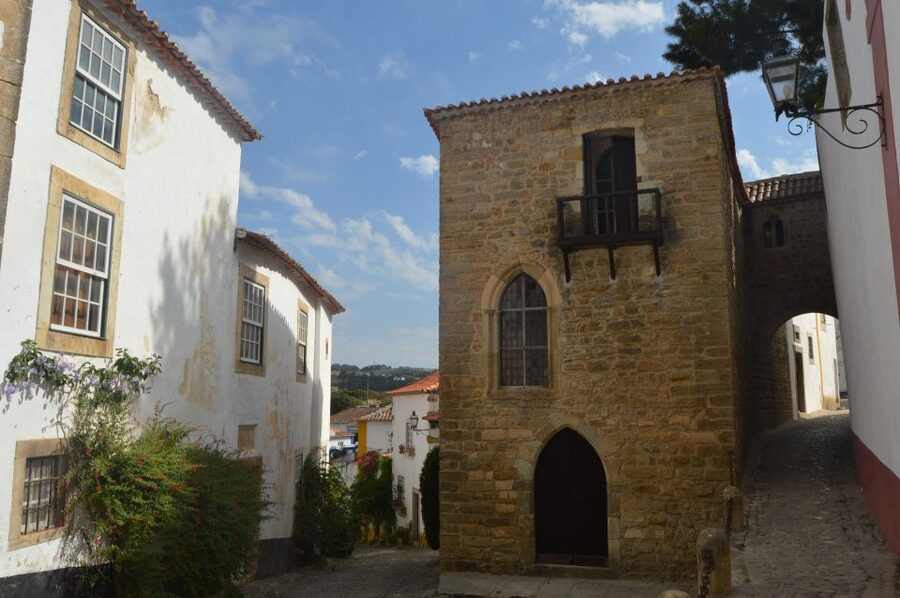
The old Moorish and Jewish neighborhoods are among the places where a guide adds real value. On your own, you might see narrow passages and irregular lanes without understanding why the town developed that way.
The guide explains the communities that once lived and worked here, along with the changing power of Christian, Muslim, and Jewish populations over time. The point is not simply to attach labels to streets. It is to help you picture Óbidos as a working town with different communities, trades, beliefs, and social divisions.
The lanes can be narrow and uneven. That is part of their charm, but it also affects comfort. Take your time on wet stone and watch your footing. One guide has been praised for helping people across slippery surfaces, but you should still bring shoes with good grip.
This section also tends to feel less crowded than the main route. If you want to take photographs without a stream of people behind you, listen closely when the guide suggests a side street or quiet viewpoint.
A castle with 1,300 years of stories
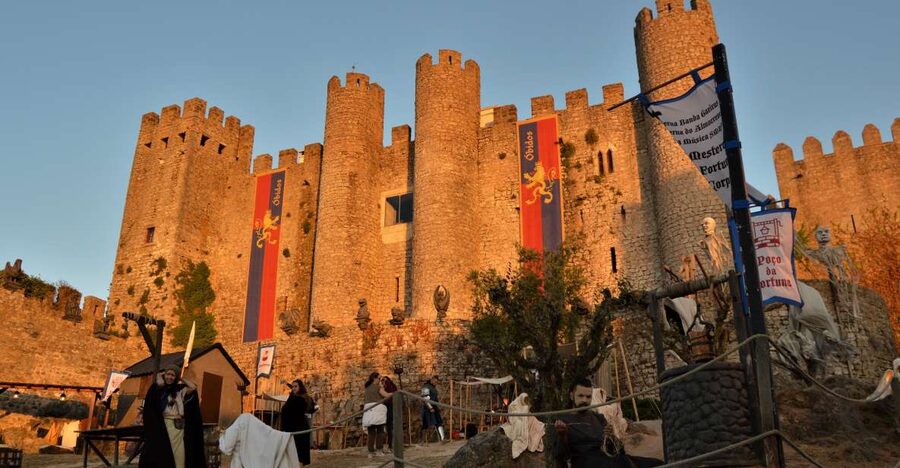
Óbidos Castle is the grand anchor of the walk. Its origins are described as Moorish and roughly 1,300 years old, though the structure you see reflects many periods of construction, repair, and change.
The castle matters because it explains Óbidos’s location and purpose. This was not simply a pretty settlement that happened to acquire walls. Its fortifications protected a strategic town and helped shape the streets inside.
The guided castle visit gives you more than a quick photograph at the gate. You learn about the Muslim period, the Christian reconquest, and the role of the castle in Portugal’s royal story. The guide’s job is especially useful here because walls can look impressive while leaving you unsure what you are actually seeing.
Do not expect a long archaeological visit with access to every part of the fortification. The castle is included within a larger walking route, so time is shared with churches, art, bookshops, and neighborhoods. If you want to explore every wall and corner at leisure, reserve extra time before or after the tour.
The castle area also brings the route’s biggest practical challenge. Surfaces are uneven, and some sections may be demanding for anyone with balance or mobility issues. Comfortable shoes are not a casual suggestion here.
Two bookshops that make the route unusual
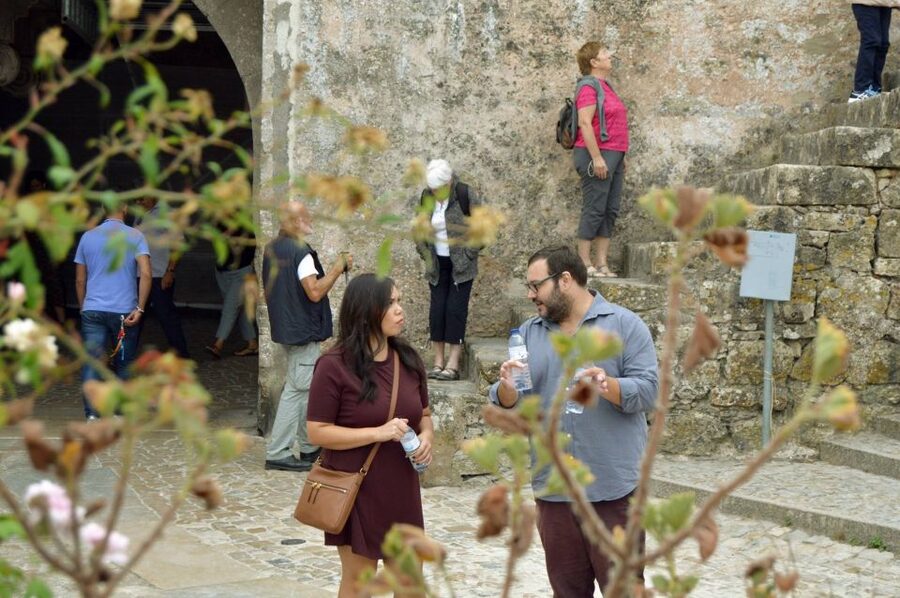
Óbidos is known for more than medieval walls. The walk visits two distinctive bookshops, each giving the town a modern cultural edge.
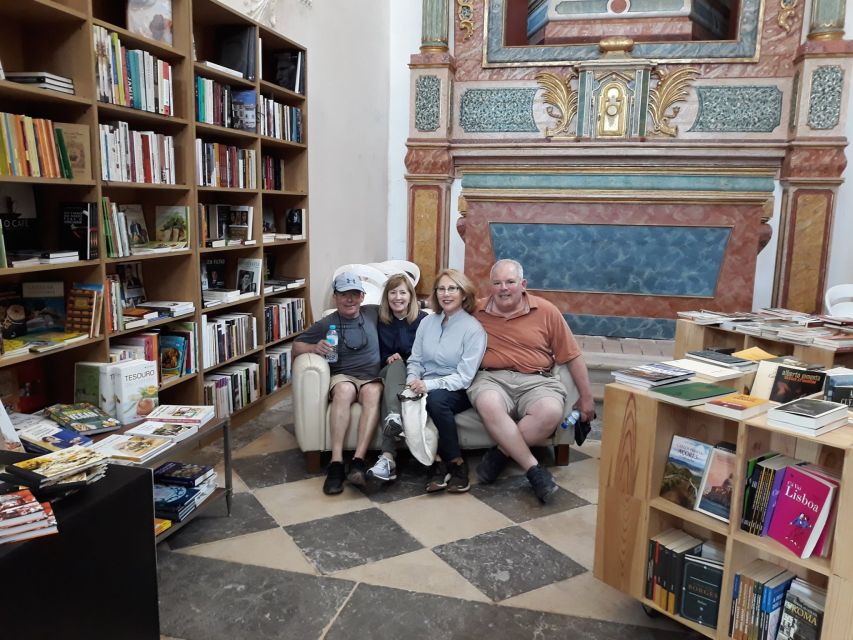
Livraria do Mercado, also called the Market Bookstore, combines books with organic products. It is a pleasant contrast to the stone churches and royal stories, and it shows how an old town can support present-day cultural life without abandoning its character.
São Tiago Bookstore is located in a former church and royal chapel. That setting is the real attraction. Browsing books in a former religious space is a memorable experience, even if you are not planning to buy anything.
These stops also provide a pause from the outdoor walking. If the day is hot, wet, or crowded, an indoor cultural stop gives the group a change of rhythm. Do not expect a long shopping period, though. The guide’s aim is to explain why these places matter and fit them into the route, not give you an hour to browse.
Out beyond the walls and into quieter views
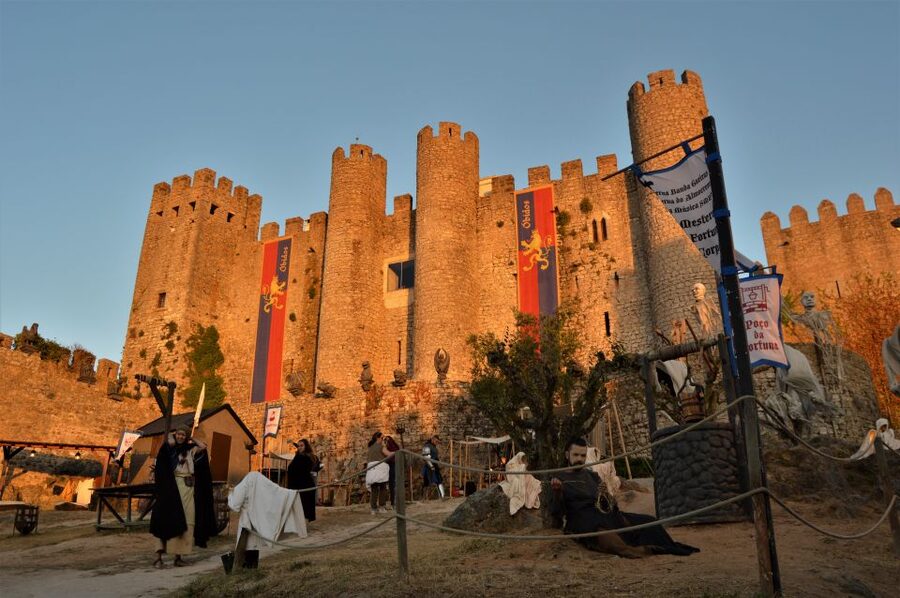
The walk includes a short route outside the walls. This helps you see Óbidos from a different angle and gives you photographs that are not limited to the familiar main street.
The quieter stops are a major reason to book with a guide instead of wandering alone. Several guides are praised for taking people away from the busiest lanes and finding places where the medieval atmosphere feels less packaged. That does not mean complete solitude, especially during busy periods, but it can make a noticeable difference.
Guides also tend to help with photographs. João Pedro, for example, has been praised for offering to take pictures at attractive stops. That small service matters if you are traveling as a couple or group and want a photograph with everyone in it.
The route’s photo appeal is obvious, but it is best to let the guide finish each explanation before stepping away for pictures. The walk has a lot packed into two hours, and repeated stops can make the final section feel rushed.
Ginjinha in a chocolate cup
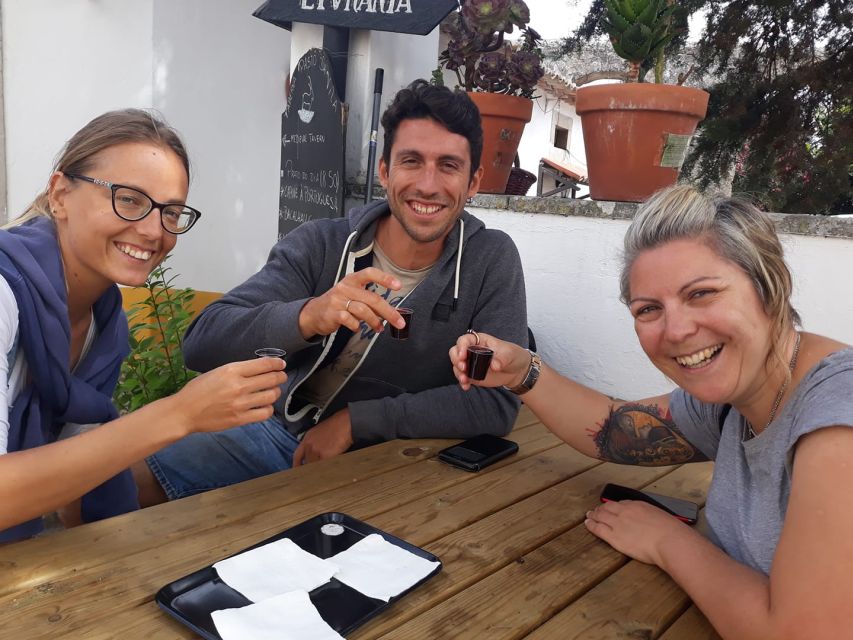
The tasting is simple, local, and well chosen. You receive Óbidos ginjinha, a sour-cherry liqueur, served in a small chocolate cup.
Ginjinha is strongly tied to Portuguese food culture, and the chocolate cup turns a standard tasting into a very Óbidos-style moment. You drink the liqueur, then eat the cup. It is a small serving, not a substitute for lunch, and food is not included beyond this tasting.
The timing of the tasting may vary within the walk, so treat it as part of the experience rather than a guaranteed final stop. If you do not drink alcohol, check before booking because the included tasting is specifically liqueur.
The tasting also helps break up the historical material. Two hours of churches, queens, fortifications, and paintings can feel dense. A sweet local sample gives the tour a lighter finish and a clear taste memory to take with you.
What the two hours feel like
This is an active, information-filled walk rather than a slow photo stroll. Guides are praised for explaining Portugal as well as Óbidos, answering side questions, and adjusting their pace when possible.
The best guides use stories instead of firing dates at you. Ivo is repeatedly described as entertaining and patient, while JP is praised for a conversational style and personal attention. Bruno is noted for enthusiasm about art, culture, and history. These details suggest a tour that works well for curious families and mixed-age groups, not only for specialist history fans.
The group size is not specified, so you should not book expecting a guaranteed private or semi-private walk. One small group had only four people, but that will not necessarily be the standard. Smaller groups allow more questions and easier photography, while larger groups may require you to stay close and save longer questions for natural pauses.
Weather can cancel the activity. That is sensible in a town where much of the experience happens outdoors, but it means you should keep some flexibility in your schedule. Cancellation up to 24 hours before the start is allowed for a full refund, and you can reserve now and pay later.
Who should book this Óbidos walk
I would choose this tour if you want a strong first look at Óbidos and care about the story behind the buildings. It suits:
- First-time visitors who want orientation before exploring alone
- History lovers interested in Muslim, Jewish, Christian, and royal Portugal
- Art fans who want to see Josefa de Óbidos and Nicolau de Chanterene
- Families who prefer stories and local tasting to a formal museum lecture
- Photographers looking for quieter lanes and useful picture stops
- Visitors with only a few hours in Óbidos
I would hesitate if you need a completely level route, use a wheelchair, are recovering from surgery, or dislike a full walking schedule. I would also skip it if your main goal is independent castle exploration with plenty of time at every stop.
Bring comfortable shoes, water, and a light layer for changing weather. If you want lunch afterward, the guide may be able to suggest a restaurant, but food is not included.
Should you book it?
Book this tour if you want Óbidos to feel like a living Portuguese town instead of a quick stop for castle photographs. The combination of royal stories, Josefa de Óbidos paintings, unusual bookshops, old neighborhoods, quieter photo spots, and ginjinha gives you a useful range in only two hours.
At $41, the value depends on how much you want explanation. The town costs nothing to wander, but finding five original Josefa paintings, the castle’s broader story, the queens’ connection, and the less obvious lanes on your own would take more planning and luck. For a first visit, I think the guide, context, and tasting justify the cost.
Book with realistic expectations: this is a brisk walking tour on old stone streets, not a relaxed café crawl or a fully accessible route. If your shoes are sound and your curiosity is strong, it is a smart way to get oriented and leave with a much clearer sense of why Óbidos matters.
FAQ
How long does the Óbidos walking tour last?
The tour lasts two hours, beginning and ending at the Óbidos Tourist Office.
Where does the tour meet?
You meet in front of the Óbidos Tourist Office, near the main parking area outside the town walls.
What languages are available?
The tour is offered in English and Portuguese.
Is the ginjinha tasting included?
Yes. The tour includes a tasting of Óbidos ginjinha served in a chocolate cup.
Is food included?
No. Food is not included, although the liqueur tasting is included.
Is the tour suitable for wheelchair users?
No. The activity is not suitable for wheelchair users, people with mobility impairments, or people with recent surgeries.
What should I bring?
Bring comfortable shoes. The route includes uneven and potentially slippery stone paths, and weather conditions can lead to cancellation.
New routes in Portugal
- Small Group Walking Tour of Belém★ 4.9 · 80 reviews
- Porto: Sunset Walking Tour with Port Wine and Views★ 4.6 · 95 reviews
- PORTO: Historical Walking Tour★ 4.8 · 92 reviews
- Porto: Highlights & hidden gems Walk – max 10★ 5.0 · 441 reviews
- Porto: City Center Walking Tour★ 4.6 · 227 reviews
- Porto: Harry Potter and City of Porto Guided Walking Tour★ 4.9 · 501 reviews
- Porto: Historical Center Walking Tour★ 4.8 · 898 reviews
- Porto: 3-Hour Walking City Tour & Lello Bookstore Visit★ 4.7 · 99 reviews
Portugal Walking Tours, compared.
Best of Lisbon Small-Group Guided Walking Tour
Read our review →

Porto Walking Tour, Lello Bookshop, River Cruise and Cable Car
Read our review →
Best of Lisbon Walking Tour: Rossio, Chiado & Alfama
Read our review →
Experience Porto’s Charm: 3-Hour Guided Walking Tour
Read our review →
Madeira: Enjoy a Guided Levada Walk in the Rabaçal Valley
Read our review →Browse the lists this tour appears in