
Review · DUBLIN
2-Hour Historical Walking Tour from Dublin
Dublin’s story comes into focus on this compact walk from Trinity College to Dublin Castle. In two hours, you move from the Viking foundations of the city through English rule, Protestant power, Catholic emancipation, the War of Independence, and the Irish Civil War. That is a lot of Ireland for $22.98.
I like the small maximum of 25 people, which makes it easier to hear the guide, and I like the way the route links famous sights to the political events that shaped them. Guides such as Jody, Eoin, John, and Colm bring different styles, but all are history postgraduates. The trade-off is clear: this is a serious history walk, not a light tour of Dublin’s pubs, food, or everyday culture. Some people may find the politics dense, and the walk can run beyond two hours.
Key points to know before booking
- The meeting point is the Henry Grattan Monument, opposite Trinity College’s front gate, not at the college gates themselves.
- The tour covers about 5,000 years of Dublin’s story, from early settlement and Viking Dublin to modern political events.
- The Book of Kells is discussed but not included, so you need a separate ticket if you want to see the manuscript.
- The route is central and walkable, with stops at Temple Bar, the Four Courts, Christ Church Cathedral, and Dublin Castle.
- A history postgraduate leads the group, and guides use stories, humor, and political context to explain the sights.
- The $22.98 price is good value if you want context for the city, but less so if you prefer a casual stroll with only brief facts.
Why this is a strong first tour in Dublin
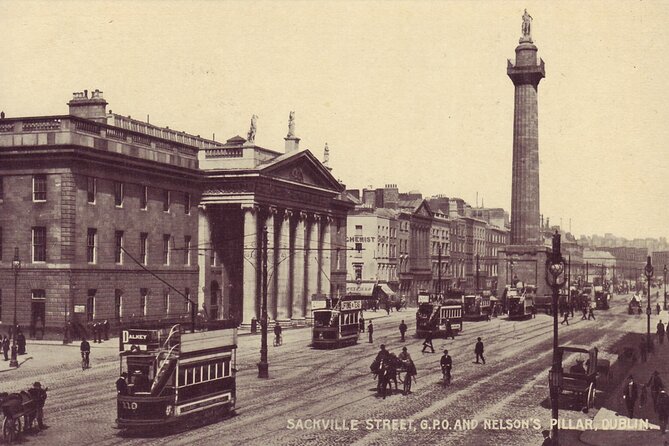
I would put this walk near the start of a Dublin visit. It gives you a useful framework for the buildings and streets you will see later, especially if Irish politics and religion are new to you. The tour explains why Dublin’s center looks and feels the way it does, rather than treating each stop as an isolated photo opportunity.
The guide may move quickly through centuries of material. One guide has been praised for summing up 5,000 years in five minutes before adding detail at each stop. That approach helps you keep the broad story in mind, but you will need to pay attention. This is not a tour where you can drift along and catch every fact by accident.
The subject matter includes Vikings, Norman expansion, British administration, Catholic emancipation, the 1916 period, the War of Independence, and the Civil War. Recent political developments may also appear, including Brexit. The result is a walk about Dublin, but also a short introduction to Ireland’s wider story.
More History Walking Tours in Dublin
- Dublin Historical Centre Food Tour with 8 Food Tastings & Drinks
★ 5.0 · 1,718 reviews - Historical 2-Hour Guided Walking Tour of Dublin
★ 4.7 · 865 reviews - Dublin’s Haunted History Walking Tour
★ 4.3 · 345 reviews
Meeting the guide opposite Trinity College
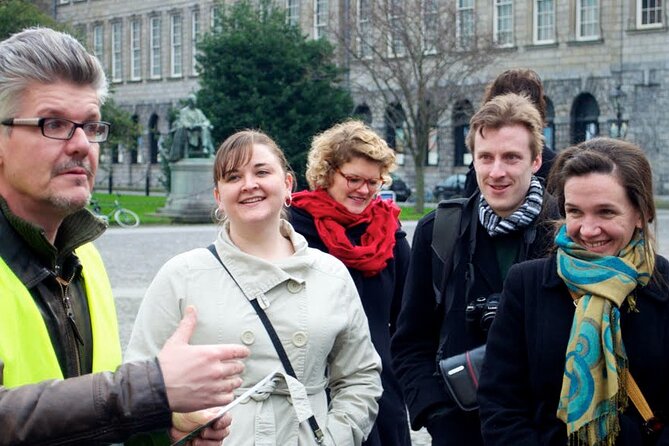
The start point is the Henry Grattan Monument at College Green, opposite Trinity College’s front gate. This detail matters. One person waited at the college gates and missed the guide, so check the exact point before setting off. Look for the monument rather than simply heading into the university entrance.
The group can include up to 25 people. That is larger than a private walk, but still manageable in a city center setting. The guide needs a clear voice, since traffic and street noise can be an issue, yet multiple participants have found the guides easy to hear.
The meeting area is near public transportation, and confirmation arrives when you book. Bring comfortable shoes and check the forecast. Dublin weather can turn a pleasant walk into a cold, wet one, and this experience continues in rain and wind. Service animals are allowed, and the operator recommends a moderate level of physical fitness.
Trinity College and the Book of Kells
The first stop is Trinity College, Ireland’s oldest university, founded in 1592. You enter the campus area and hear how the university fits into Dublin’s religious and political past.
The main object discussed here is the Book of Kells, an eighth-century manuscript containing the four Gospels in Latin. It is one of Ireland’s best-known treasures, but admission to see it is not part of this walk. That keeps the tour price low, but you should plan a separate visit if the manuscript is high on your list.
This opening stop works well because it gives the guide a place to explain the links between education, religion, colonial power, and national identity. Allow about 20 minutes. You will get context, not a full visit to the Book of Kells exhibition.
If you want both experiences, check your schedule carefully. The walking tour is planned as a two-hour activity, while the Book of Kells requires its own entry arrangements. Do not assume that the walking tour ticket gets you inside the exhibition.
Bank of Ireland and the old parliament
The group then heads to the Bank of Ireland, a grand building with a major political past. It was built in 1729 as Ireland’s colonial parliament, before the Act of Union abolished that parliament in 1800.
The guide uses the building to explain Protestant Ascendancy, the system in which political and economic power rested largely with Ireland’s Protestant ruling class. The architecture also gives you a clear example of 18th-century neoclassical design.
This is a short stop of around 10 minutes, but it adds an important layer to the Trinity College discussion. You are not only looking at an attractive Georgian building. You are seeing a place connected to who could govern Ireland, who could vote, and who held influence.
More History Walking Tours in Ireland
- Dublin: Macabre History Walking Tour
★ 4.9 · 95 reviews - Cork: Guided Historical Walking Tour
★ 4.7 · 310 reviews - Galway: Dark History Guided City Walking Tour
★ 4.8 · 236 reviews - Kilkenny: Historical and Hysterical Guided City Walking Tour
★ 5.0 · 126 reviews
Temple Bar beyond the nightlife
Temple Bar is now one of Dublin’s best-known areas, but the guide presents a less obvious part of its story. The narrow-street district was once marked for demolition. In the 1990s, it was repurposed as Dublin’s Cultural Quarter.
That change helps explain why Temple Bar feels different from the surrounding streets. The stop is brief, about 10 minutes, and does not focus on restaurant recommendations or pub hopping. Instead, it shows how urban planning and cultural policy changed the area’s role.
If you have already visited Temple Bar at night, this stop gives you another way to read it. You see a district shaped by decisions about demolition, preservation, and tourism. It also provides a break between the larger political subjects covered at the other locations.
Wood Quay and Viking Dublin
At Wood Quay Amphitheatre, the story reaches back to the Vikings. Extensive archaeological work in the 1980s uncovered evidence from the Viking city, founded around AD 840.
This is one of the most useful stops for understanding Dublin’s origins. The city was not simply created by later English rule or modern Irish independence. Its early growth also came from Viking settlement and trade.
The stop lasts about 10 minutes. Do not expect a museum visit or a large collection of visible ruins during the walk. The value is in the explanation of what was found and why Wood Quay matters. The guide connects a modern part of the city to the early settlement beneath it.
The Four Courts and the Irish Civil War
The Four Courts is one of the tour’s most politically important stops. It is Ireland’s legal headquarters and the place where the Civil War began in June 1922.
The conflict divided those who supported the Treaty of December 1921 and those who opposed it. That treaty ended the War of Independence from 1919 to 1921, but it also created a new dispute over the direction of the country. The guide explains how that argument became armed conflict.
You spend about 20 minutes here, which is longer than at several other stops. That extra time makes sense. The events are not easy to reduce to a simple good side and bad side, and the political details matter if you want to understand modern Ireland.
This is also where the tour’s serious tone becomes clearest. If you prefer a brief introduction to buildings, you may find the discussion too dense. If you want to know why Irish independence did not bring instant agreement, this is one of the most valuable parts of the walk.
Christ Church Cathedral and the Norman invasion
Christ Church Cathedral dates to 1030, making it Dublin’s oldest cathedral. It was rebuilt in stone during the 1170s by Strongbow, a key figure in the original English invasion of Ireland.
The stop lasts around 10 minutes and focuses on the cathedral’s place in the story of English involvement. You learn how a religious building can also mark a major shift in military and political power.
The tour ends at Christ Church Cathedral, which is practical if you want to continue exploring the area afterward. The cathedral itself is included as an exterior stop in the walking route, not as a separate admission visit. If you want to go inside, you will need to arrange that independently.
City Hall and Daniel O’Connell
At City Hall, the guide points out a statue of Daniel O’Connell, Dublin’s first Catholic Lord Mayor, elected in 1840. O’Connell led the successful campaign for Catholic Emancipation in 1829, which ended anti-Catholic laws. That achievement earned him the name The Liberator.
This stop puts a person at the center of the story. After hearing about institutions and conflicts, you get a clearer sense of how one political leader helped change the rights available to Catholics.
The stop takes roughly 10 minutes. The building also offers a useful setting for discussing Dublin’s civic government and the slow change from a Protestant-dominated system. The guide’s commentary is likely to be more valuable than the statue alone, since the political setting gives O’Connell his full importance.
Dublin Castle and the Dubh Linn
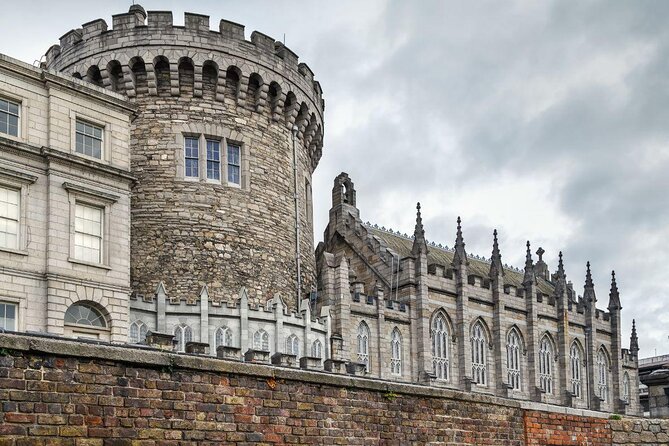
Dublin Castle is the final major stop. King John ordered its original construction in 1204, and it served as the center of British administration in Ireland until 1922.
The site also connects to the city’s name. The Dubh Linn, or Black Pool, was located here, giving Dublin its name. This is a small but memorable detail, and it ties the modern city back to the geography of its earliest settlement.
The castle is a fitting final stop because it brings several themes together: English rule, administration, national identity, and the transfer of power in 1922. You spend about 10 minutes here. The tour does not include admission to the castle interiors, so treat this as an outdoor history stop unless you arrange a separate visit.
The guides and the pace of the storytelling
The operator uses history postgraduate guides, and individual guide style matters on a subject this dense. Jody has been especially praised for combining detailed political explanation with humor and an animated delivery. Eoin is described as entertaining, clear, and easy to hear even in poor weather. John has led tours with a strong overview of how Dublin developed, while Colm has used songs and stories to connect history with culture.
You may get a guide with a different style, but the core approach remains academic and detailed. One guide is also a trained actor, which can add energy to the storytelling. The best guides on this route do not simply list dates. They connect people, buildings, religion, and political decisions.
The pace is brisk. Some walks last closer to two and a half hours, so do not schedule an immediate appointment afterward. The route is not described as difficult, but it is a full walking experience over two hours. Comfortable shoes are sensible, and warm or waterproof clothing can make a major difference.
Is $22.98 good value?
At $22.98 per person, this is an inexpensive way to get a structured introduction to central Dublin. The group format keeps the cost down, and the tour includes the guide’s expertise at every stop. You are paying for interpretation, not admission tickets.
The value is strongest if you plan to visit Trinity College, Temple Bar, Christ Church, or Dublin Castle on your own. The walk shows you why each place matters, so later visits become easier to understand. It also helps you decide which sites deserve more of your time.
The price is less compelling if you want entry to the Book of Kells or Dublin Castle. Those are not included, and you will need to pay separately for any interior visits. Even so, the low tour cost leaves room in your budget for those additions.
Who should book this Dublin walk?
I would recommend it to adults, older teenagers, and anyone who enjoys political or cultural history. It works particularly well for a first day in Dublin, when you want to get oriented and learn the basic story behind the city center.
It may not suit young children who need constant movement or simple stories. The guide covers religion, colonial rule, political division, and war, often with considerable detail. One participant found the political focus too dense, and that is a fair warning. The tour is meant to be historical first, entertaining second.
If you enjoy clear explanation, ask questions, and want more than a list of dates, you should get good value from it. If you mainly want a relaxed walk through attractive streets, choose a lighter city tour instead.
Should you book it?
Book this tour if you want Dublin’s buildings to make sense. The route is short, affordable, and packed with context, from the Book of Kells and Viking archaeology to Daniel O’Connell and the Four Courts. Take it early in your stay, wear comfortable clothes, and arrive at the Henry Grattan Monument rather than the Trinity College gates.
Skip it if you dislike political history or prefer a food, pub, music, or folklore walk. For the right audience, this is a strong introduction to Dublin and Ireland, with enough detail to shape the rest of your visit.
FAQ
How long does the historical walking tour last?
The tour is scheduled for approximately two hours. Some outings may run longer, so allow extra time after the tour.
Where does the tour begin?
It begins at the Henry Grattan Monument at College Green, opposite the front gate of Trinity College Dublin.
Where does the tour end?
The tour ends at Christ Church Cathedral on Christchurch Place, in the Wood Quay area of Dublin.
Is admission to the Book of Kells included?
No. The walk discusses the Book of Kells, but entry to see it is not included.
How many people can join the tour?
The maximum group size is 25 people.
What language is the tour offered in?
The tour is offered in English.
Who leads the tour?
The guides are history postgraduates. Named guides associated with the experience include Jody, Eoin, John, and Colm, though the specific guide can vary.
What level of fitness is needed?
A moderate level of physical fitness is recommended. You should also wear comfortable shoes for the two-hour city walk.
Are service animals allowed?
Yes. Service animals are allowed on the tour.
Can I cancel for a full refund?
Yes, if you cancel at least 24 hours before the experience start time. Cancellations made less than 24 hours in advance are not refunded, and changes within that period are not accepted.
More Two-Hour Walks in Dublin
- Berlin’s Best: 2 Hour Walking Tour Third Reich and the Cold War
★ 5.0 · 5,486 reviews - Budapest City Landmarks Walking Tour in 2 Hours
★ 5.0 · 2,048 reviews - Leipzig: 2-Hour Guided Walking Tour in German
★ 4.8 · 1,612 reviews - Lucca: 2-Hour City Center Walking Tour
★ 4.7 · 1,314 reviews
New routes in Dublin
- Dublin: North Quay Guided Ghost Walk★ 4.2 · 144 reviews
- Dublin: Mythology, Folklore and Legends Walking Tour★ 4.9 · 703 reviews
- Dublin: Traditional Pub Walking Tour★ 4.6 · 295 reviews
- Dublin: Traditional Pubs Walking Tour with Local Guide★ 4.9 · 112 reviews
- Dublin: Irish Music Walking Tour with Live Performance★ 4.8 · 137 reviews
- Dublin: Highlights and Hidden Corners Walking Tour★ 4.8 · 79 reviews
- Dublin: Macabre History Walking Tour★ 4.9 · 95 reviews
- Dublin: Delicious Walking Food Tour★ 4.9 · 137 reviews
Dublin Walking Tours, compared.
Dublin Highlights and Hidden Gems Guided Walking Tour
Read our review →
Dublin Historical Centre Food Tour with 8 Food Tastings & Drinks
Read our review →

90 Minute Dublin Walking tour and Sightseeing tips
Read our review →
Historical 2-Hour Guided Walking Tour of Dublin
Read our review →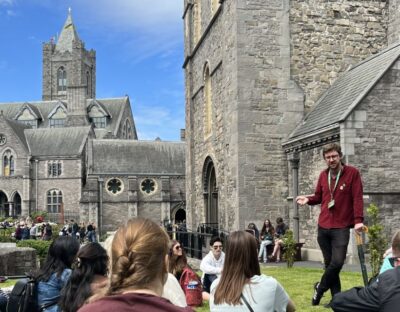
Dublin Highlights: 2.45-Hour Walking Tour in Italian
Read our review →
Browse the lists this tour appears in