
Review · VERONA
Verona Highlights Walking Tour in Small-group
Verona’s story unfolds quickly on this two-hour small-group walk, from a first-century Roman arch and amphitheater to medieval palaces, family feuds, and the modern legend of Juliet. The route covers the city center on foot, with stops at Castelvecchio, Piazza Bra, Piazza delle Erbe, the Scaliger tombs, and Juliet’s House.
I like two things right away: the route gives you a useful first look at Verona, and the guides add the details you would likely miss alone, such as Roman remains tucked inside a shop and the rebuilding of Scaligero Bridge after wartime destruction. The second strength is the easy access to local help. Guides including Frank, Isabella, Priscilla, and Maria have been praised for clear English, humor, and good food and sightseeing suggestions.
The main consideration is pace. You cover a lot of ground in 120 minutes, and some parts of the historic center are crowded or uneven. This is an overview rather than a long museum visit, and admission to the Arena and Juliet’s House is not included.
Key points to know before booking
- A compact route through Verona’s main sights: See the Arena, Castelvecchio, Juliet’s House, Piazza Bra, Piazza delle Erbe, Piazza dei Signori, and the Scaliger tombs.
- A maximum of 16 people: The group is small enough for questions and conversation, though the exact size can vary.
- Roman and medieval Verona in one walk: The tour links ancient gates, a Roman arch, the Arena, medieval ruling families, and Shakespeare’s famous setting.
- English-speaking local guides: Frank, Isabella, Priscilla, and Maria are among the guides praised for storytelling, humor, and clear explanations.
- A practical first-day activity: The start and finish at Piazza Bra make it easy to continue sightseeing, visit the Arena, or stop for lunch afterward.
- Tickets cost extra: The walk includes the guide, but admission to the Arena and Juliet’s House is not part of the $42.33 price.
Starting in Piazza Bra beside Verona’s Arena
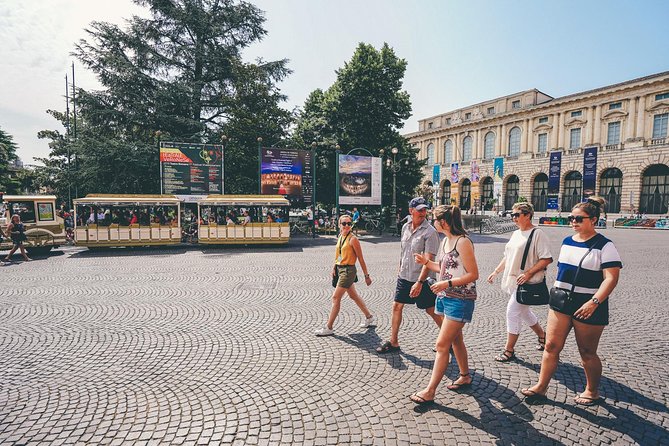
The tour begins and ends in Piazza Bra, Verona’s largest square. This is a smart meeting point because the Arena dominates the piazza, cafés line the edges, and several important streets lead into the old center.
Starting here gives you an immediate sense of Verona’s scale. The city is compact, and the major sights sit within a walkable historic core. You do not spend the first part of the tour on a bus or waiting for transfers. Instead, you begin on foot and get your bearings as the guide explains how Roman, medieval, and later Verona fit together.
Piazza Bra is also a useful place to continue your day. You can return to the Arena, find a café, or walk toward the shopping streets after the tour. Since the experience ends where it starts, you are not left on the far side of town trying to find your way back.
More City Highlights Walking Tours in Italy
- Florence: Highlights Walking Tour with Expert Guide
★ 4.6 · 4,662 reviews - Skip-the-Line Florence Highlights and David Walking Tour
★ 5.0 · 1,127 reviews - Venice: Walking Guided Tour of the City Must-See Sites
★ 4.7 · 1,095 reviews
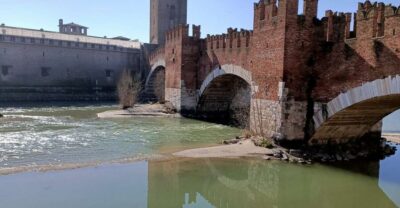
Castelvecchio and Scaligero Bridge: Verona’s medieval power
One of the early highlights is Castelvecchio, the medieval castle associated with Verona’s ruling Scaliger family. The tour views the castle from outside rather than taking you through its museum galleries, so you should plan a separate visit if you want to see the collection inside.
The nearby Scaligero Bridge is one of the most memorable pieces of medieval engineering in the city. It links the castle with the Adige’s left bank and was almost destroyed during bombing in 1945. The bridge was later rebuilt to closely match the original.
This is a good example of what the walking format does well. You see a major monument, hear why it matters, and keep moving without spending the entire morning indoors. The tradeoff is that the stop is introductory. If military architecture or the castle museum interests you, save time for a return visit.
Roman Verona at the Arch of Gavi and Porta Borsari

The route then connects modern streets with the Roman city. The Arch of Gavi is a first-century AD monument linked to the Gavia family, an important Roman family of Verona. It was originally located outside the city along the Via Postumia, was demolished under Napoleon in 1805, and was reconstructed in its present location in 1931.
You may also pass Porta Borsari, the marble-faced remains of an ancient Roman city gate. The surviving front gives you a sense of the former entrance, while the brickwork behind and missing upper sections show how much of the original structure has disappeared.
One especially useful detail is the chance to notice Roman remains in places that do not look ancient at first glance. A section of Roman wall and part of a Roman home can be seen inside a Benetton store. That kind of sight is easy to miss when you follow only the obvious monuments, and it helps you understand that Verona’s oldest layers are woven into the modern city.
The Arena: Verona’s great Roman showplace
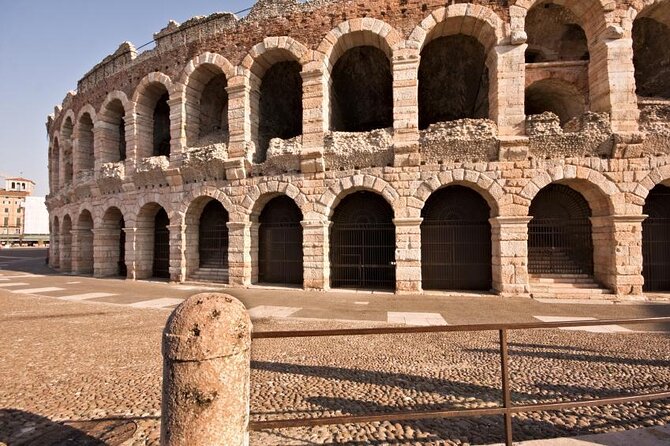
The Arena di Verona is the headline stop. Built in the first century AD, around the same broad period as Rome’s Colosseum, this amphitheater is remarkably well preserved. In Roman times, it could hold as many as 30,000 people.
The guide explains how the building has survived, what happened to its outer sections, and how it continues to function today. The Arena remains the setting for major concerts and the Verona Arena Festival, the city’s summer opera season. That continued use gives the monument a special character. It is not only a ruin to admire from behind a barrier. It is still part of Verona’s cultural life.
The scheduled stop is about 10 minutes, and admission is not included. That is enough time for an outside explanation and photographs, but not enough for a proper interior visit. If you want to walk through the seating areas or attend an opera performance, consider adding a separate Arena visit. One practical option is to ask about a combined experience or a follow-up Arena tour, since some guides, including Isabella and Frank, have led visitors through the building afterward.
At $42.33 per person, the price is reasonable for a two-hour guided orientation, especially if this is your first visit and you want historical context before exploring independently. It is less of a bargain if you expect the Arena ticket to be included. Check the admission details carefully before booking.
Same streets, a different guide:
- Venice: Doge’s Palace and St Mark’s Basilica Walking Tour
★ 4.4 · 6,291 reviews - Milan: Guided Walking Tour & Last Supper Visit with Ticket
★ 4.7 · 5,409 reviews - Naples: Street Food Walking Tour with Local Guide
★ 4.9 · 4,976 reviews - Venice: San Marco to Rialto Walk & Spritz Like a Local
★ 4.2 · 3,651 reviews
Juliet’s House and the limits of the Shakespeare connection
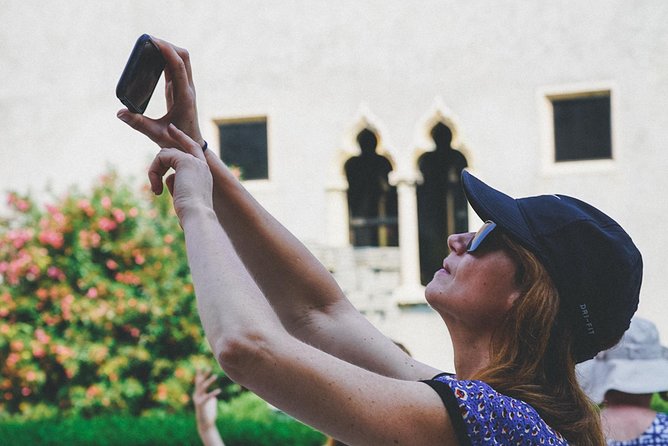
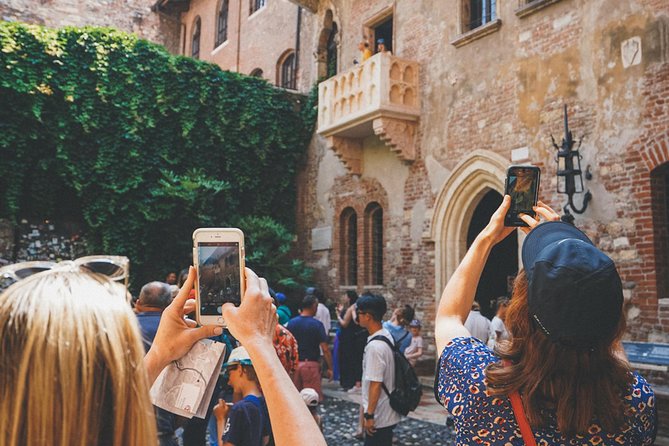
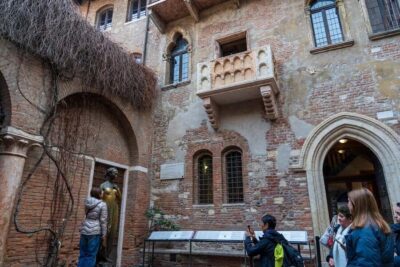
Casa di Giulietta, or Juliet’s House, is one of Verona’s most popular stops. You enter the courtyard associated with the Capuleti family and see the setting connected with Shakespeare’s Romeo and Juliet.
The guide can help separate Verona’s literary image from the city’s documented past. The courtyard is a powerful piece of tourism and storytelling, but Shakespeare’s tragedy is not a straightforward historical record. The famous balcony was created in the twentieth century, and the connection between the building and Juliet belongs largely to legend and literary tradition.
The standard route includes the courtyard, but admission is not included. The itinerary allows about five minutes here, so you should not expect a long visit or a quiet examination of every detail. Crowds can also make this stop feel brief.
From December 6, 2025, through January 6, 2026, access to Juliet’s Balcony requires a separately purchased ticket because of high visitor numbers. The tour company can explain how to buy that ticket, but it will not purchase it for you. If the balcony matters to you, confirm the current arrangement before the walk.
Romeo’s House and the city’s famous family feud
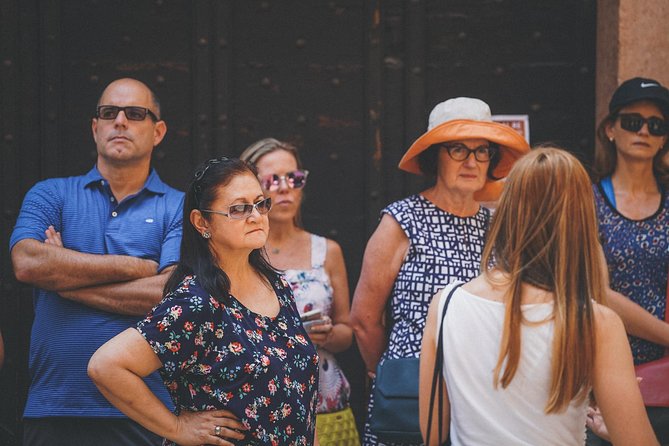
The route also passes Romeo’s House, a medieval palace associated by legend and literary tradition with the Montecchi family. The building is private and inhabited, so you see it from outside only.
That limitation is worth knowing in advance. This is a brief exterior stop, not an entry into a preserved literary house. Its value comes from hearing how Verona’s medieval family rivalries later became linked with the Romeo and Juliet story.
The stop works best when treated as part of the city’s broader narrative. Verona is not just an ancient Roman site or a Shakespeare destination. It is a medieval power center whose families, towers, churches, and political struggles shaped the streets you walk through.
Piazza delle Erbe and Piazza dei Signori
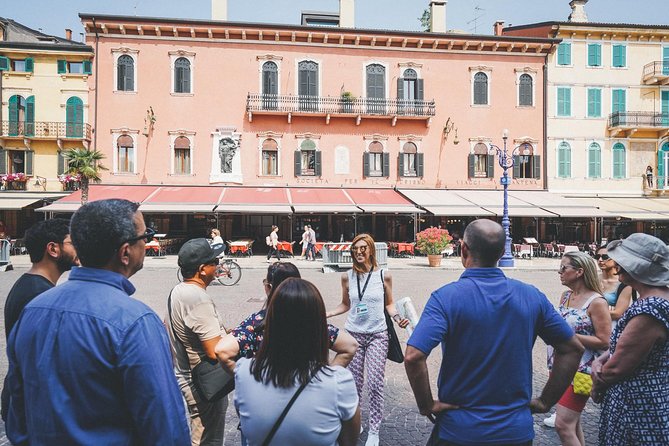
Piazza delle Erbe occupies the site of Verona’s Roman forum and remains one of the city’s central public spaces. The guide points out the fountain, monuments, façades, and traces of the different rulers who shaped the square.
This is one of the places where looking up pays off. Buildings around the piazza include elegant details and old frescoes, including fifteenth-century decoration. The square can be lively, and the short five-minute stop is mainly about orientation and explanation rather than sitting down for a long break.
A nearby turn leads to Piazza dei Signori, once the center of political power. Dante’s statue has dominated the square since 1865, giving it the nickname Piazza Dante. The square also includes impressive palaces and the entrance area for Torre dei Lamberti, whose viewpoint can be visited separately.
I like this part of the walk because it shows how Verona’s public life shifted from the Roman forum to medieval government and later civic spaces. You are not simply checking off plazas. You are seeing how the city’s center changed over time.
The Scaliger tombs and Verona’s medieval rulers
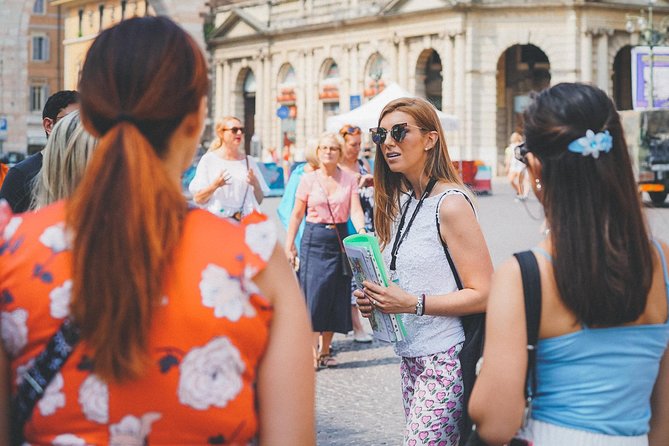
The Arche Scaligere are the outdoor tombs of the Scaliger family, Verona’s powerful medieval rulers. The Gothic monuments include the arches and sarcophagi of Cangrande I, Mastino II, and Cansignorio.
The stop lasts about five minutes, and admission is not included. Even from outside, the tombs are striking because they rise above the surrounding street in a highly decorated style. They are a reminder that the ruling family wanted its power displayed even after death.
This is another place where a guide adds value. Without context, the ornate structures can look like a small group of elaborate church decorations. With an explanation of the Scaliger family and Verona’s medieval politics, the stop becomes easier to place in the city’s story.
What the guides add to the experience
The tour depends heavily on the guide, and the strongest part of the experience appears to be the human connection. Frank is known for humor, historical detail, and practical suggestions for food and places to visit. Isabella has been praised for combining architecture, local culture, and jokes without making the tour feel like a lecture.
Priscilla brings a particularly local perspective and is fluent in English. She has also been attentive to older participants, which matters on a walking tour where the group may include people with different speeds and needs. Maria has led the route in rainy conditions while keeping the historical explanations engaging.
The guide style is not limited to dates and names. You may hear small details about how the city changed, why a monument was rebuilt, or where Roman remains survive in an unexpected place. You should also feel free to ask questions as you go. That is one of the main advantages of booking a small group instead of relying on a guidebook.
The group can include up to 16 people, with at least two required for the tour to operate. A small group does not guarantee a private experience, but it usually makes it easier to hear the guide and ask for help with the rest of your Verona plans.
Pace, walking conditions, and practical planning
The tour lasts about two hours and runs in rain or shine. You should wear comfortable shoes and be ready to walk through busy central streets. Some areas may not be easy for people with reduced mobility or other disabilities, so ask the operator for exact details before booking if accessibility is important to you.
There is no hotel pickup or drop-off. You meet at Piazza Bra and return there, which keeps the arrangement simple but means you must make your own way to the square. The location is near public transportation.
Minors must be accompanied by an adult, and service animals are allowed. The tour can be canceled if the minimum number of participants is not reached, in which case you are offered another date or experience, or a full refund. You can cancel for a full refund up to 24 hours before the start time. Late cancellations and changes are not accepted.
Who will get the most from this Verona walk
I would choose this tour for a first visit, a short stay, or a day when you want a clear introduction before exploring on your own. It is also a good fit if you enjoy history but prefer stories and conversation to a long formal lecture.
Families can benefit from the variety. Roman ruins, castles, medieval tombs, a famous love story, and a working opera arena give younger visitors several ways into the city. The walk is also useful for anyone arriving in Verona with limited time.
I would not choose it as your only activity if you want extended interior visits. The Arena and Juliet’s House are viewed in a short format, and the key stops are not included admission visits. Travelers with limited mobility should also check the route before paying.
Is the $42.33 price worthwhile?
For $42.33, you are paying for a local guide, a planned route, and two hours of context across a large number of major sights. You are not paying for entrance tickets, transport, or hotel service.
That makes the value strongest when you are new to Verona and want to avoid spending your first morning figuring out the city’s layout. The guide can point out details you might pass without noticing, explain the difference between history and legend, and suggest what deserves a separate visit.
The value is weaker if you already know Verona well or plan to see only the Arena from inside. In that case, buying an Arena ticket and walking independently may suit you better. For most first-time visitors, though, the compact route and small group make the price fair.
Should you book it?
Book this walk if you want a friendly, efficient introduction to Verona’s Roman and medieval center, especially if you have only a day or two. The best reason to choose it is not just the list of sights. It is the way the guide links them, from Roman gates and the Arena to Scaliger power and the modern Juliet tradition.
Go in expecting an overview, not a full museum tour. Wear comfortable shoes, budget extra time for the Arena and Juliet’s House if you want to enter, and confirm the balcony rules during the December 2025 to January 2026 period. With those limits clear, this is a practical first step into Verona.
FAQ
How long does the Verona Highlights Walking Tour last?
The tour lasts approximately two hours.
Where does the tour begin?
It begins in Piazza Bra, Verona, Italy.
Where does the tour end?
The tour ends in Piazza Bra, the same place where it begins.
What language is the tour offered in?
The tour is offered in English.
What sights are included on the walking route?
The route includes Castelvecchio, Scaligero Bridge, the Arch of Gavi, the Arena di Verona, Casa di Giulietta, Romeo’s House, Piazza Bra, the Scaliger tombs, Piazza delle Erbe, and Piazza dei Signori.
Are admission tickets included?
No. Admission to the Arena, Juliet’s House, and the Scaliger tombs is not included. Piazza Bra, Piazza delle Erbe, and Piazza dei Signori are listed as free stops.
Is hotel pickup included?
No. Hotel pickup and drop-off are not included.
How many people can join the tour?
The maximum group size is 16 people. The tour requires at least two participants to operate.
Does the tour operate in bad weather?
The tour runs rain or shine. In cases of severe weather or other unforeseen events, a full refund is not guaranteed, and each case is assessed by the company.
Can I cancel for a refund?
Yes. You can cancel at least 24 hours before the local start time for a full refund. Cancellations or changes made less than 24 hours before the start time are not accepted.
More Small-Group Walking Tours in Italy
- Uffizi & Accademia Timed Entry: Small Group Duomo Walking Tour
★ 4.5 · 3,630 reviews - Eat Like a Local: Venice 3-Hour Small-Group Food Tasting Tour
★ 5.0 · 3,137 reviews - Michelangelo’s David, Accademia & Uffizi Small Group Tour
★ 4.5 · 1,986 reviews - Florence: Uffizi & Accademia Small Group Walking Tour
★ 4.7 · 1,380 reviews
New routes in Italy
- Private St. Francis Basilica of Assisi and City Walking Tour★ 5.0 · 114 reviews
- Assisi Private Walking Tour including St. Francis Basilica★ 5.0 · 124 reviews
- Milan: City Highlights Walking Tour with The Last Supper★ 4.9 · 195 reviews
- Florence: Heart of Florence Guided Walking Tour★ 4.0 · 81 reviews
- Milan: Private or Shared Essential Walking Tour★ 4.7 · 84 reviews
- Taormina: Shared or Private Food & Wine Walking Tour★ 4.6 · 167 reviews
- Syracuse: Ortigia Private Walking Tour★ 4.8 · 181 reviews
- Syracuse: Ortigia and Neapolis Guided Walking Tour★ 4.7 · 205 reviews
Verona Walking Tours, compared.
Small Group Guided Walking Tour with Arena Tickets
Read our review →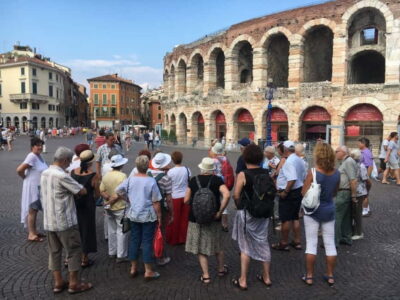
Discover Verona: City Highlights Guided Walking Tour
Read our review →
Browse the lists this tour appears in