
Review · ITALY
Syracuse: Highlights of Ortigia Guided Walking Tour
Ortigia’s best sights are packed into a small island, and this two-hour walking tour gives you a clear route through its Greek, Roman, medieval, and Baroque past. You’ll begin at the Temple of Apollo, cross Piazza Archimede, pause at the Fountain of Diana, and finish beside the sea at Arethusa Spring.
I like the modest $29 price and the way the tour links famous monuments with Greek myths, especially the story of Arethusa and Alpheus. I also like that guides such as Michael, Letizia, Giuseppe, and Vincenzo bring local knowledge and personal stories to the walk. The main drawback is that English and Italian may be spoken together, which can slow the pace, and the cathedral ticket costs extra.
Key points to know before you book
- Temple of Apollo starting point: Meet under the pomegranate tree near the roundabout where Corso Matteotti begins.
- Greek myths in the streets: The Fountain of Diana and Arethusa Spring connect Ortigia’s monuments to stories of Artemis, Arethusa, and Alpheus.
- Piazza Duomo centerpiece: You’ll see Syracuse Cathedral, built into the remains of an ancient Greek temple.
- Strong local guiding: Guides including Michael, Letizia, Giuseppe, Eva, and Vincenzo have been praised for clear explanations and friendly service.
- Bilingual pacing: A combined English and Italian tour may require each explanation to be repeated.
- Plan for the heat: Arrive ten minutes early, bring water, and expect mostly outdoor walking with limited shade in some places.
Why Ortigia works so well on foot
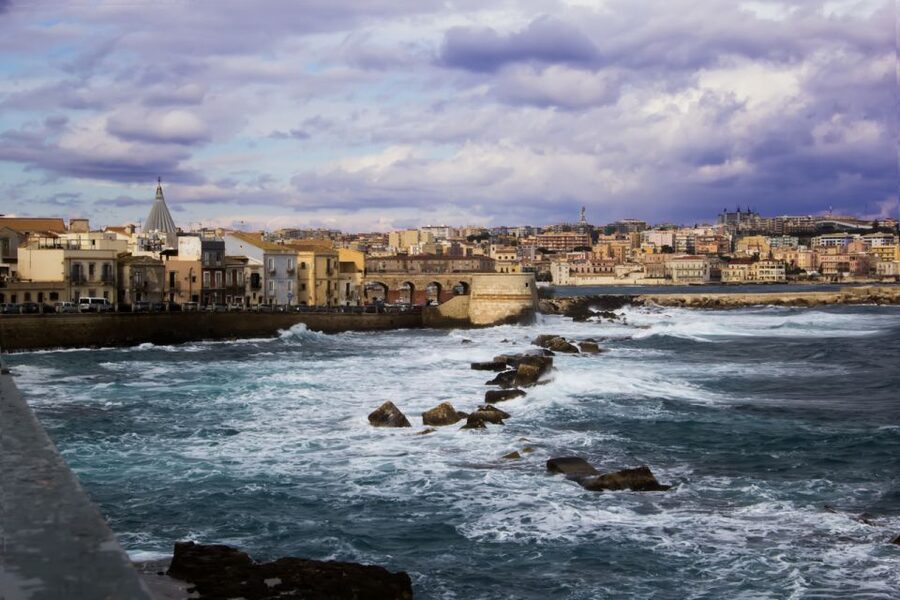
Ortigia is the historic heart of Syracuse, set on a small island joined to the mainland by bridges. Its compact layout makes a walking tour especially useful. You are not spending half the morning moving between distant sights. Instead, the route takes you from one square or monument to the next, with the city’s layers appearing along the way.
Greek foundations, Roman traces, medieval streets, and Baroque façades all share the same small area. A guide helps you sort out what you are seeing, since Syracuse often places several centuries of history in a single view.
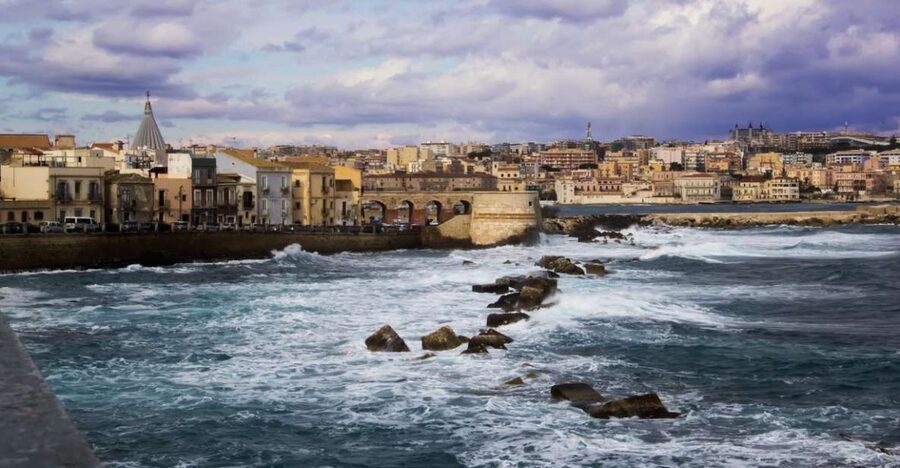
The route is also easy to understand geographically. It begins near the eastern side of Ortigia and moves through the central squares before reaching the western edge near the water. That direction gives the walk a pleasing finish at Arethusa Spring, where the city opens toward the sea.
The walking itself is generally straightforward, but you should wear comfortable shoes. Ortigia’s streets and squares are made for strolling rather than formal sightseeing, and the tour includes several stops where you will stand while listening.
More City Highlights Walking Tours in Italy
- Florence: Highlights Walking Tour with Expert Guide
★ 4.6 · 4,662 reviews - Skip-the-Line Florence Highlights and David Walking Tour
★ 5.0 · 1,127 reviews - Venice: Walking Guided Tour of the City Must-See Sites
★ 4.7 · 1,095 reviews
Starting under the pomegranate tree at Apollo
The meeting point is at Largo XXV Luglio, under the pomegranate tree in front of the Temple of Apollo. Look for a guide wearing a badge, near the roundabout where Corso Matteotti begins. Arrive at least ten minutes early. The starting point is specific, but a few extra minutes will help you find the group without a rushed beginning.
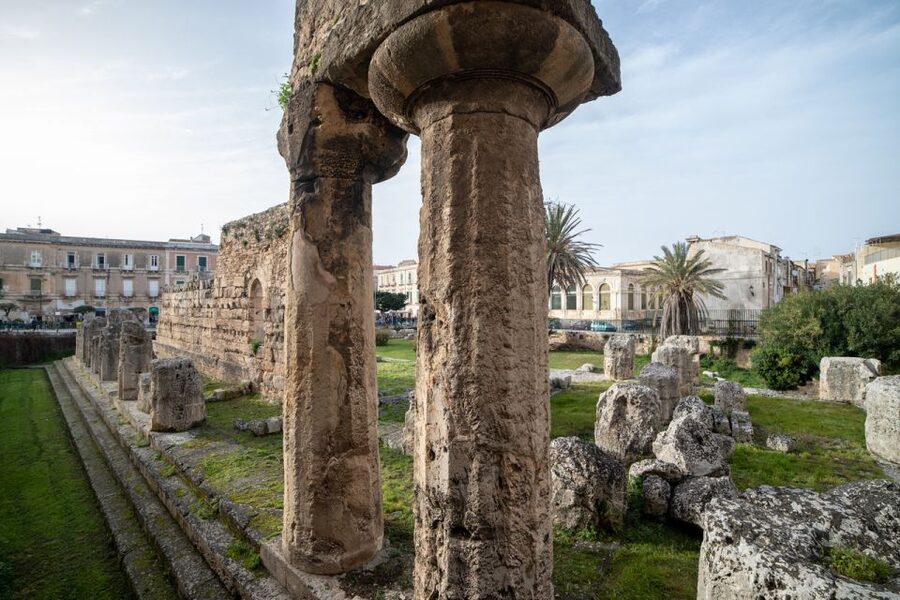
The Temple of Apollo is a fitting place to start. It is described as the oldest Greek temple in the entire Western world, and its weathered remains immediately set the tone for the tour. You are not beginning with a polished palace or a grand church. You are beginning with stones that point back to the Greek foundation of Syracuse.
The guide spends about 30 minutes here. That is a useful amount of time for explaining the site rather than simply stopping for a photograph. You can expect the focus to be on the temple’s age, its place in Syracuse’s early story, and the way later city life grew around ancient remains.
Apollo’s temple also gives you an early lesson in Ortigia’s character. The monument is not isolated in a remote archaeological park. It is part of the modern city, surrounded by roads and daily activity. That contrast helps you understand how old Syracuse is woven into ordinary life.
Piazza Archimede and the Fountain of Diana
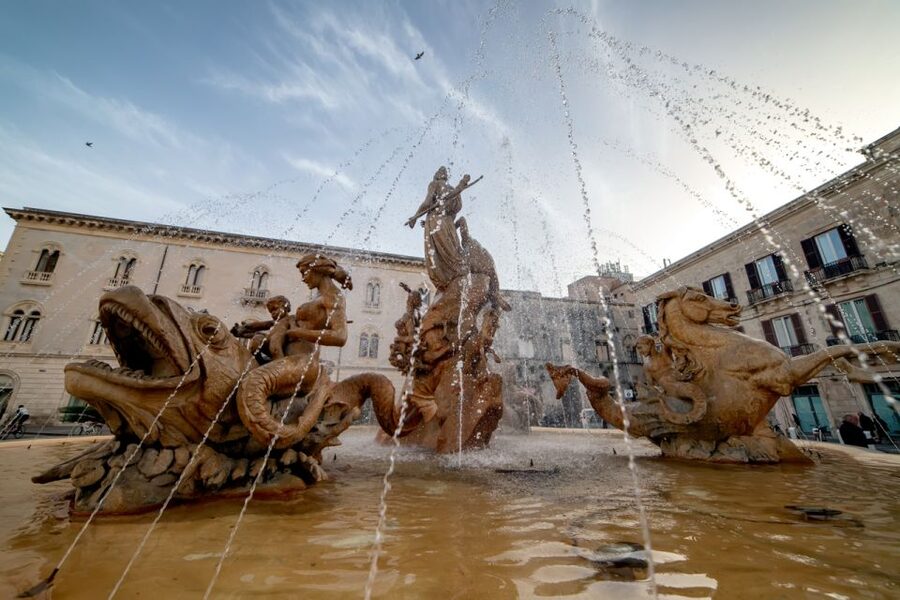
From the temple, the group continues toward Piazza Archimede. The walk takes about 20 minutes with guiding and stops along the way. This part of the route helps connect the ancient starting point with the more decorative heart of Ortigia.
The focus here is the Fountain of Diana, a large sculptural centerpiece linked to the myth of Arethusa. Diana is the Roman name for Artemis, the Greek goddess shown at the moment when Arethusa is transformed into a spring.
That story gives the fountain more meaning than its marble figures alone. You can look at the sculpture as a public monument, but the guide also gives you the myth that shaped its imagery. This is one of the tour’s strengths: the monuments are not presented only as dates and architectural labels.
Piazza Archimede is also a good place to appreciate how Ortigia uses public squares. The fountain is not tucked away behind museum walls. It sits in the middle of the city, where people pass through and gather. Your guide may also add local details and stories here, depending on the group and the person leading the walk.
The explanation style can vary. Guides such as Vincenzo have been praised for going beyond basic facts and answering questions carefully, while other guides have been especially good at sharing local lore. If you enjoy stories about the people and daily life connected to a place, it is worth asking questions rather than simply listening to the prepared route.
Piazza Duomo, marble, and Syracuse Cathedral
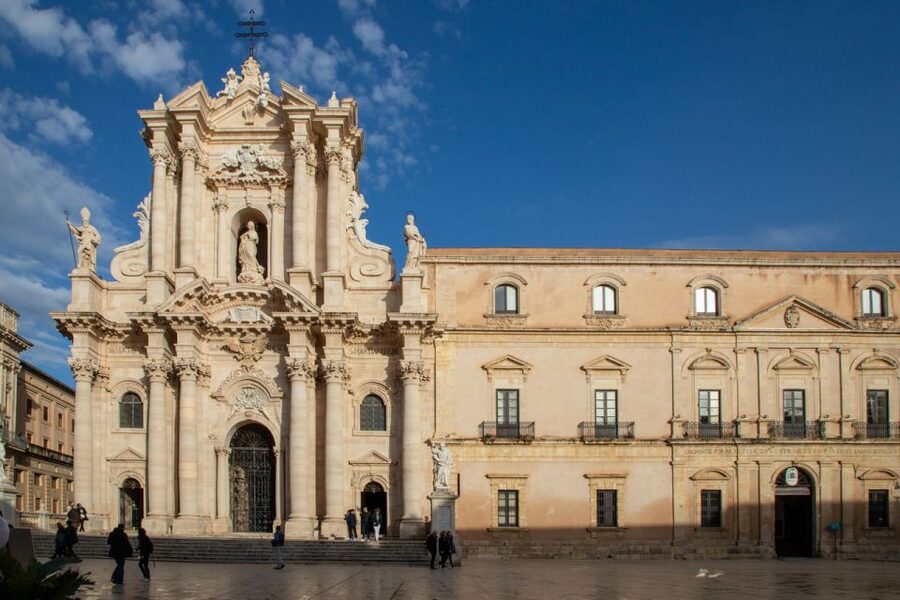
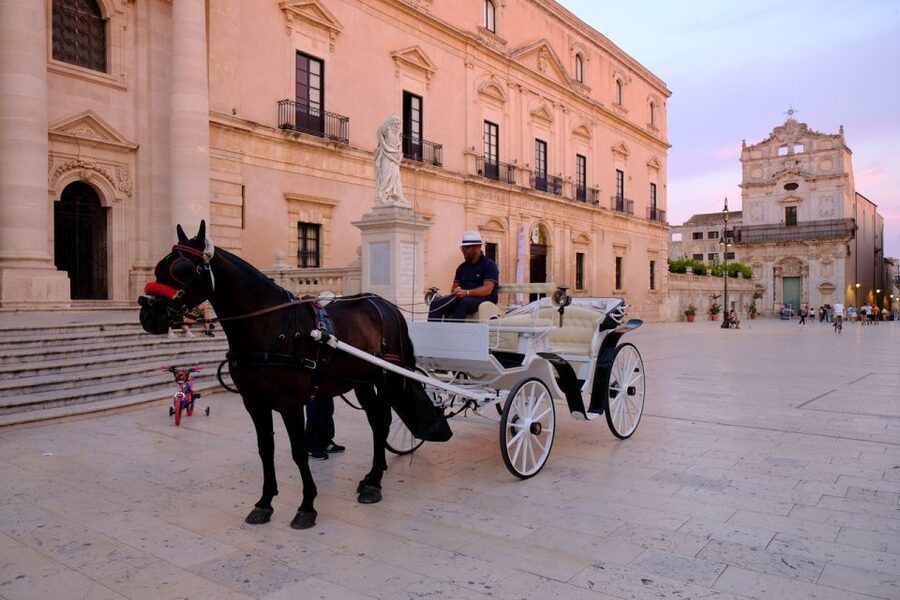
The next major stop is Piazza Duomo, usually the visual high point of the walk. The square is known for its pale marble and elegant Baroque setting. It is one of Italy’s most beautiful urban spaces, and the wide open design offers a sharp change from Ortigia’s narrower streets.
The square also carries an important piece of Syracuse’s foundation story. This is the place where the city’s founders from Corinth settled. The tour uses that setting to connect the present-day square with the Greek origins of Syracuse.
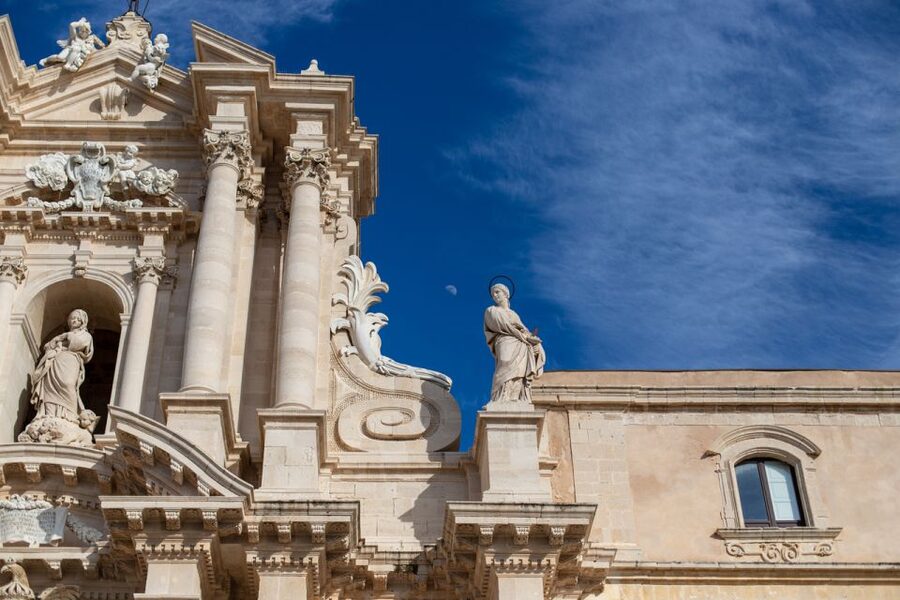
Syracuse Cathedral is the main monument here. Its exterior and interior reflect several periods of construction, and the building incorporates the structure of an older Greek temple. That combination is one of the clearest examples of Ortigia’s layered past. You are not looking at a church that replaced history entirely. You are seeing a Christian building adapted around an ancient Greek framework.
The tour allows roughly 45 minutes for this part of the visit, though the exact timing can depend on opening hours and the guide’s pace. Cathedral entry is not included in the $29 tour price, so you should budget separately for the ticket. The tour information also notes that tickets must be paid on site, so clarify the current entry arrangement with the guide.
Dress with places of worship in mind. Shoulders and knees may need to be covered for entry, and the dress code is worth taking seriously if you want to go inside. If access is limited because of a holiday or opening-hour change, the monument portion of the route can be adjusted.
One practical point: some participants found the cathedral visit brief, with only about 15 minutes available inside on one departure. If you care most about the cathedral’s interior, ask at the start how much time the schedule allows. The walk is designed to cover several sights, not to provide an extended architectural study of one building.
Same streets, a different guide:
- Venice: Doge’s Palace and St Mark’s Basilica Walking Tour
★ 4.4 · 6,291 reviews - Milan: Guided Walking Tour & Last Supper Visit with Ticket
★ 4.7 · 5,409 reviews - Naples: Street Food Walking Tour with Local Guide
★ 4.9 · 4,976 reviews - Venice: San Marco to Rialto Walk & Spritz Like a Local
★ 4.2 · 3,651 reviews
Finishing at Arethusa Spring beside the sea
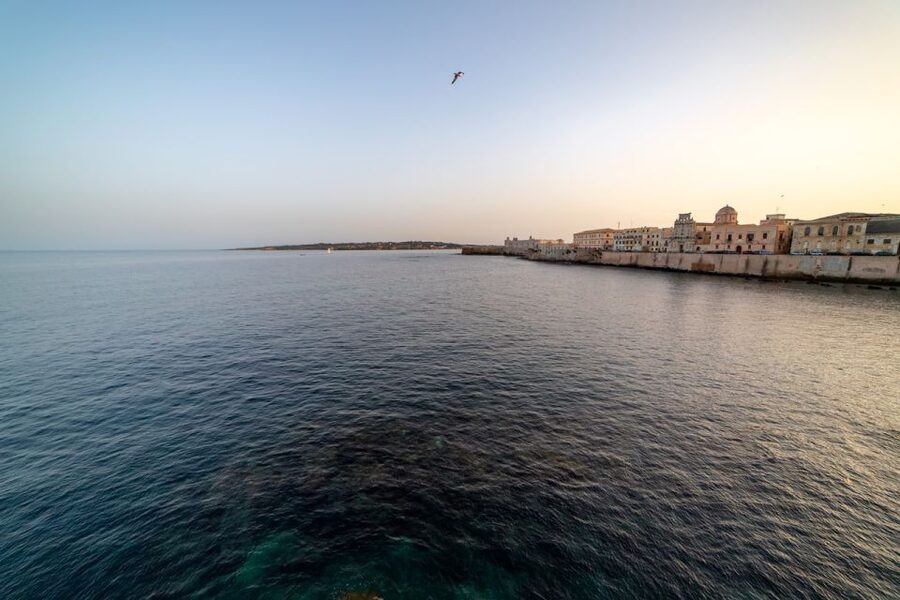
The tour ends at Arethusa Spring, a freshwater spring only a few meters from the sea. This is an unusual sight, and it gives the route a memorable final stop. Fresh water emerging beside salt water is the kind of detail that makes Ortigia feel different from a standard historic-center walk.
The spring is tied to the myth of Arethusa and Alpheus. In the story, Arethusa becomes a fountain, while Alpheus is connected to her through a tale of pursuit and love. The Fountain of Diana earlier in the tour shows the moment of transformation, while the spring gives you the physical place associated with the myth.
That connection makes the route feel planned rather than like a list of unrelated stops. Apollo, Artemis, Arethusa, and the ancient Greek foundations of Syracuse appear in different forms as you move through the island.
Arethusa Spring is also a calm place to pause after the busier central squares. You can look toward the water, take in the setting, and reflect on how myth, geography, and city history overlap here. The stop is scheduled for about 40 minutes, though the total tour is advertised at two hours and actual timing can vary.
The guides make the biggest difference
The strongest part of this experience is the guide. The tour is not built around entry to a major museum or an elaborate activity. Its value comes from the person explaining what you are seeing.
Michael, who has lived in Syracuse for 22 years, has been singled out for combining local experience with a good sense of humor and strong value. In very hot weather, he has also adjusted the route to keep the group in the shade where possible. That matters in summer, when Ortigia’s stone squares can feel intense.
Letizia has led tours with a clear account of Ortigia’s history while also pointing out less obvious places. Vincenzo has been praised for answering questions and explaining how the island changed over time instead of limiting the talk to dates. Giuseppe has also received praise for being friendly and well prepared.
Other guides, including Eva and Margaret, have been described as warm and informative. The exact experience will depend on who leads your departure, but the pattern is clear: this tour works best when you engage with the guide and ask about local life, architecture, and stories.
Some guides use audio equipment or headsets. The equipment has not always been perfect, and you may bring your own headset or buy a disposable one on site for €1. If you have trouble hearing in a group, stand near the guide and ask about the headset before the walk begins.
Language, heat, and the pace of the walk
The tour is offered in English and Italian. An English booking does not always mean English is the only language used. Some departures combine both languages, with the guide repeating each explanation. That arrangement can make the walk slower and may reduce the amount of time available at each sight.
For some people, the shared format is not a problem. You still receive the information, and the slower pace may give you more time to look around. If you want a fast, highly focused English tour, ask whether your departure will be bilingual before booking.
Heat is another practical concern. Syracuse can be very hot, and the route includes open squares such as Piazza Duomo and Piazza Archimede. A guide may seek shade when possible, but you should still bring water, wear a hat, and avoid heavy clothing.
The tour is scheduled for two hours. One departure was closer to an hour and a half, while bilingual guiding or late arrivals can make another departure run longer. The group has also had to wait for late participants, so arrive early and do not count on the walk ending at the exact minute.
The route may change around holidays or monument opening hours. That is especially important for the cathedral. You should think of the experience as a guided overview of Ortigia, not as a fixed guarantee that every interior space will be open.
Is $29 a fair price?
At $29 per person, this is a sensible introduction to Ortigia if you want structure and context. You receive a live guide and a route covering the Temple of Apollo, Piazza Archimede, the Fountain of Diana, Piazza Duomo, Syracuse Cathedral, and Arethusa Spring.
The price does not include food, drinks, or the cathedral entry ticket. Those extras are reasonable to keep in mind, but the main cost is still modest for a two-hour guided walk in a major historic center.
The value is strongest on a first visit. You can use the tour to understand the layout, note places you want to revisit, and learn the basic myths and history before exploring on your own. If you already know Syracuse well, the walk may feel more introductory unless you get a particularly story-focused guide.
For the best value, treat it as an orientation walk rather than a full archaeological tour. You are paying for explanations, local perspective, and a sensible route through the island. You are not paying for long interior visits or extensive free time at each monument.
Free cancellation up to 24 hours before the start and a reserve-now, pay-later option make it easier to fit the walk into a changing Sicily itinerary. Still, check the starting time carefully, since the available schedule can change.
Who should book this Ortigia walk?
I would recommend it to first-time visitors who want to understand Syracuse without arranging several separate monument visits. It also suits you if you enjoy Greek mythology, city stories, and architecture but prefer a relaxed walk to a large museum tour.
It is a good choice for couples, families with older children, and independent visitors who want an expert introduction before exploring the island alone. The route stays within Ortigia and concentrates on major sights, so you get a clear sense of the historic center quickly.
You may want another option if you need a private tour, a guaranteed English-only departure, or a long visit inside Syracuse Cathedral. It may also disappoint you if you expect every important sight in Ortigia to be covered in detail. The tour covers the main route, but two hours leaves limited time for side streets and extended interior visits.
Final verdict: a useful first look at Syracuse
Book this tour if you want good historical orientation for a fair price, especially on your first day in Syracuse. The Temple of Apollo, Piazza Duomo, and Arethusa Spring create a strong route, and the Greek myths give the walk more life than a simple list of buildings.
Go in with realistic expectations. The cathedral ticket costs extra, the route may be bilingual, equipment can be basic, and heat or late arrivals can affect the timing. Arrive early, bring water, dress suitably for the cathedral, and ask questions.
The guide is the deciding factor. With someone like Michael, Letizia, Giuseppe, or Vincenzo, the walk can become a lively introduction to the island’s past and present. Even with a more formal guide, the route gives you the essential landmarks and a useful map of Ortigia in your head.
FAQ
How long does the Ortigia walking tour last?
The tour is advertised as two hours. Timing can vary because of bilingual explanations, late arrivals, holidays, and monument opening hours.
Where is the meeting point?
Meet under the pomegranate tree in front of the Temple of Apollo at Largo XXV Luglio, near the roundabout where Corso Matteotti begins. Look for a guide wearing a badge.
Which languages are available?
The tour is offered in English and Italian. Some departures may conduct the tour in both languages at the same time.
Is Syracuse Cathedral entry included?
No. Entry to Syracuse Cathedral is not included in the $29 tour price. Cathedral tickets must be paid for on site.
Do I need to follow a dress code?
Yes. You need suitable clothing to enter places of worship. Covering shoulders and knees is the safest approach.
Can I cancel the tour?
You can cancel up to 24 hours in advance for a full refund. A reserve-now, pay-later option is also available.
New routes in Italy
- Private St. Francis Basilica of Assisi and City Walking Tour★ 5.0 · 114 reviews
- Assisi Private Walking Tour including St. Francis Basilica★ 5.0 · 124 reviews
- Milan: City Highlights Walking Tour with The Last Supper★ 4.9 · 195 reviews
- Florence: Heart of Florence Guided Walking Tour★ 4.0 · 81 reviews
- Milan: Private or Shared Essential Walking Tour★ 4.7 · 84 reviews
- Taormina: Shared or Private Food & Wine Walking Tour★ 4.6 · 167 reviews
- Syracuse: Ortigia Private Walking Tour★ 4.8 · 181 reviews
- Syracuse: Ortigia and Neapolis Guided Walking Tour★ 4.7 · 205 reviews
Italy Walking Tours, compared.
Doge’s Palace and St Mark’s Basilica Walking Tour
Read our review →
Guided Walking Tour & Last Supper Visit with Ticket
Read our review →
San Marco to Rialto Walk & Spritz Like a Local
Read our review →
Uffizi & Accademia Timed Entry: Small Group Duomo Walking Tour
Read our review →
Browse the lists this tour appears in