
Review · OSLO
Oslo: Historic Myths & Legends Evening Walking Tour
Oslo’s old center gets more interesting after dark, when City Hall murals, fortress walls, and quiet squares become the setting for stories about trolls, nisse, huldra, and Norse gods. This two-hour walk mixes folklore with solid city history, so you are not simply hearing spooky tales. You are learning how old beliefs shaped Norwegian culture.
I like the way the route links major sights with less obvious details. The wooden friezes inside City Hall explain Viking beliefs, while Akershus Fortress brings in prisoners, punishment, and medieval engineering. I also like the guides’ friendly style. Maria and Anastasia are often singled out for lively storytelling, humor, clear English, and useful suggestions for the rest of your stay.
The main drawback is practical: this is an outdoor walk in Oslo weather. Winter can mean darkness, snow, and piercing wind, and the route is not suitable for wheelchair users or people with mobility impairments. Wear warm layers and good shoes, and remember that this is a cultural history walk, not a ghost-hunting expedition.
Key points to know before you book
- City Hall starts the story: See wooden friezes tied to Viking beliefs and learn how old myths still shape Norwegian culture.
- Akershus Fortress adds real drama: Hear about its design, defenses, prisoners, and grim punishments.
- The folklore has range: Trolls, friendly nisse, mysterious huldra, ghosts, underground kingdoms, and protective bells all enter the tale.
- Bankplassen brings in crime: Learn about bold thefts, robberies, and the justice system of medieval Oslo.
- The guide makes the difference: Maria and Anastasia are praised for warm humor, strong English, lively delivery, and practical city advice.
- Plan for the conditions: The tour lasts two hours, takes place outdoors, and requires comfortable shoes. It is intended for ages 13 and up.
Why Oslo’s myths work best on an evening walk
This tour succeeds because it treats folklore as part of everyday culture, not as a collection of random ghost stories. You hear about trolls and huldra, but you also learn why these figures mattered to people who lived with dark winters, dangerous journeys, and a world that offered fewer clear answers.
The evening setting helps. In December, darkness may arrive before the tour begins, and even in warmer months the city lights give the old streets a different mood. You will see Oslo’s central sights in a quieter setting, while the guide uses each stop to connect a place with a story.
The tone is relaxed rather than theatrical. You should expect a walking tour with history, humor, and folklore, not actors in costume or staged scares. The guide’s job is to explain the cultural meaning behind the tales, including stories about ghosts and underground kingdoms, while keeping the focus above ground and in the city streets.
That balance makes the experience useful for first-time visitors. You get a quick introduction to Oslo’s past, but you also gain a way to read symbols, buildings, and local stories during the rest of your trip.
More Crime and Mystery Walking Tours in Norway:
- Prague: Ghost Walking Tour Where Legends Come To Life
★ 4.4 · 5,253 reviews - Edinburgh Darkside Walking Tour: Mysteries, Murder and Legends
★ 5.0 · 3,862 reviews - Historical Walking Tour: Legends of Bruges
★ 5.0 · 2,541 reviews
Meeting at City Hall and the Swans fountain
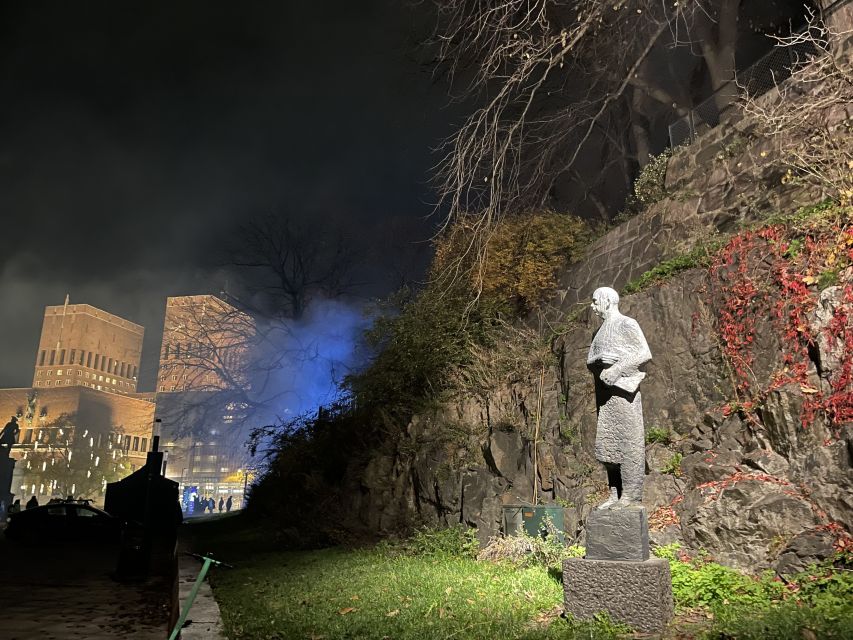
The walk begins near the Swans fountain at the entrance to Oslo City Hall on Fridtjof Nansen’s square. This is a practical starting point because City Hall is easy to identify, and the opening section gives you an immediate introduction to Norway’s old beliefs.
Inside City Hall, the wooden friezes are a key part of the experience. They show Viking-related beliefs and offer a visual entry point into the stories the guide will tell later. Rather than treating the artwork as decoration, the tour uses it to explain how myths and symbols appear in Norwegian public spaces.
The City Hall section also introduces the Vikings and their seafaring world. You should not expect a full museum lecture on Viking archaeology. Instead, you get selected stories that help explain the cultural background of Norway and give meaning to what you see around you.
This first stop is especially useful if you are new to Norwegian mythology. The guide can explain the difference between familiar figures and less familiar ones, from mischievous trolls to kind-hearted nisse and mysterious huldra. The stories are easy to follow, and the humor keeps the subject from feeling too academic.
Christiania Torv and Oslo’s changing identity
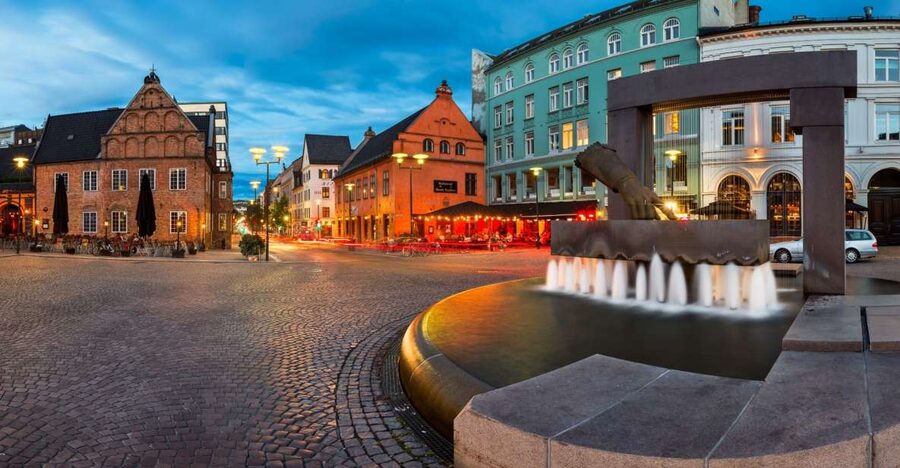
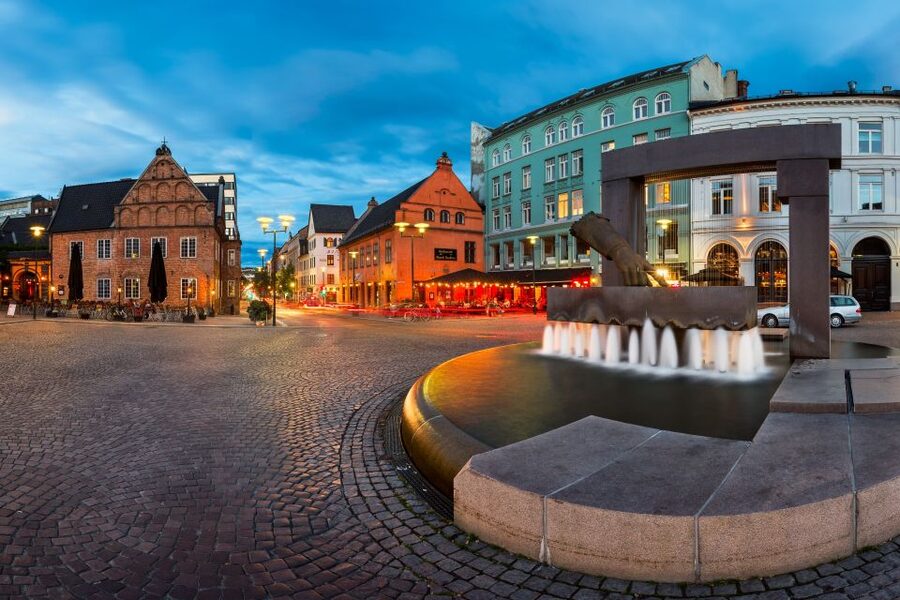
From City Hall, the route continues toward Christiania Torv, one of the city’s historic squares. Here, the focus shifts from mythic creatures to the events and characters that shaped Oslo’s older center.
The guide uses the square to explain how Oslo changed over time and how history has left marks on the city’s streets. You may hear stories that do not appear in a standard sightseeing introduction, which is one reason this walk works well near the start of a stay.
The tour does not ask you to memorize a long list of dates. Instead, the square becomes a place where the guide can connect public spaces with episodes from the city’s past. That approach suits travelers who want context without committing to a long museum visit.
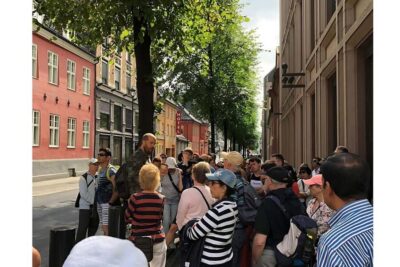
You will also have chances to ask questions and pause for photographs. The pace is described as manageable, with time for conversation rather than a rushed march between stops. That matters in the evening, when low light and weather can make a fast route less pleasant.
Akershus Fortress, engineering, prisons, and punishment
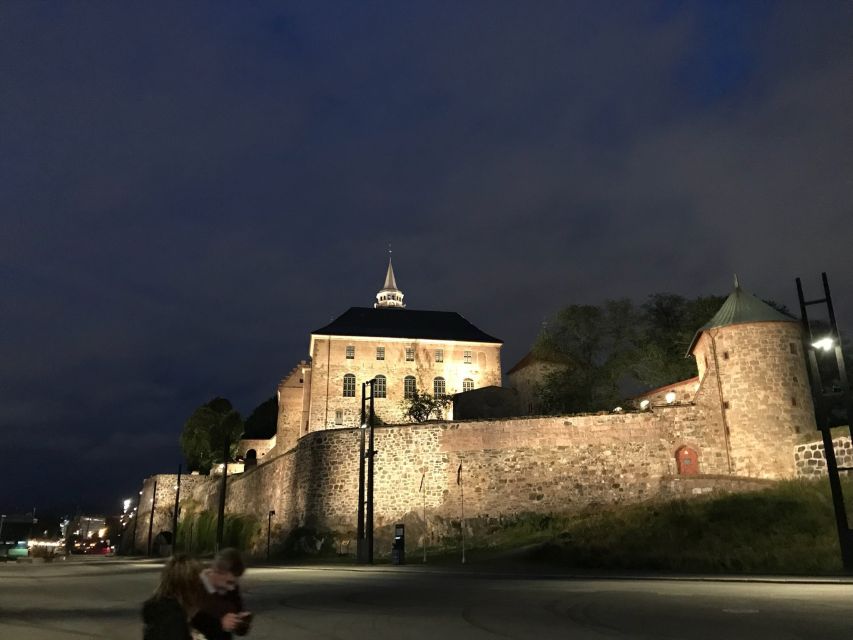
Akershus Fortress is the most substantial stop on the route. Its walls and defensive design give the folklore a more solid setting, and the guide explains how the complex protected Oslo through different periods.
The fortress is interesting for two reasons. First, you can look at its engineering and layout as a practical response to the city’s need for defense. Second, the site carries stories about prisoners and the fates they met inside its walls.
This is where the tour’s mood becomes more serious. The guide discusses crime, imprisonment, and punishment rather than relying only on pleasant myths. Medieval justice could be harsh, and the stories help you understand how fear, law, and power worked in earlier Oslo.
The fortress section also shows why a guided walk can add more than a map. You can admire walls and courtyards on your own, but a good explanation gives those structures a human purpose. You begin to picture the people who defended the site, the prisoners held there, and the authorities who decided their fate.
Do keep your expectations realistic. The tour does not promise access to every interior area of the fortress, and the activity description emphasizes locations in and around Oslo rather than an underground exploration. The attraction is the setting and the stories connected to it.
More Night Walking Tours in Norway:
- Private Street Food Evening Walking Tour in Ho Chi Minh City
★ 5.0 · 3,175 reviews - Granada: Albaicín and Sacromonte Guided Sunset Walking Tour
★ 4.9 · 2,962 reviews - Bremen: Walking Tour in German with Night Guard
★ 4.7 · 2,922 reviews - Ghosts of Charleston Night-Time Walking Tour with Unitarian Church Graveyard
★ 4.5 · 2,835 reviews
Bankplassen and Oslo’s audacious thefts
At Bankplassen, the subject turns toward robberies and daring thefts. This gives the walk a welcome change of pace. After Vikings, folklore, and fortress prisoners, you get stories about people who tested the city’s rules through elaborate crimes.
The point is not simply to entertain you with old criminal episodes. The guide also explains how medieval Oslo dealt with wrongdoing and what punishments could follow. That combination of crime story and legal context gives the stop more substance.
I find this part useful because it shows that city history is not only about rulers and grand buildings. Ordinary disputes, thefts, fear, and punishment also shaped how people lived. The guide’s storytelling makes those subjects easy to remember, especially when the details are tied to a real square.
This section may appeal to you if you enjoy social history more than battle dates. It also adds variety for companions who are less interested in mythology but enjoy true stories about people, schemes, and consequences.
Oslo Cathedral and the final stretch

Oslo Cathedral is among the landmarks included on the walk, adding another important piece of the central city. The route brings together civic buildings, a historic square, a fortress, and a religious landmark, so you get a broad sense of Oslo’s older core in just two hours.
The cathedral stop helps widen the story beyond Viking beliefs and medieval crime. It places Oslo’s cultural past in a setting tied to worship, public life, and the city’s changing identity. The guide can use the surrounding area to keep the focus on how old stories survived and how history appears in the built city.
The exact order and amount of time at each stop may vary with the guide and conditions. That is normal for a walking tour. The important thing is the pattern: you move through central Oslo while the guide explains how myths, law, religion, architecture, and local character connect.
By the end, you should have more than a list of sights. You will have a set of stories that makes later walks through Oslo more rewarding. A bell, carving, old wall, or unusual detail may catch your attention because you now know to look for the belief or event behind it.
The guides: Maria, Anastasia, and a conversational style
The strongest part of this experience is the guide’s delivery. Maria is repeatedly praised for being warm, funny, easy to listen to, and full of useful information. Anastasia is also noted for vivid storytelling, clear English, and enthusiasm for Oslo and Norway.
The guide does not simply speak at the group. Questions and small conversations fit naturally into the walk. You can stop for pictures, offer an anecdote, or ask for ideas about other places to visit. Several guides also give suggestions for exploring Oslo after the tour, which adds real value if this is your first day in the city.
The quality of a walking tour can vary with the person leading it, but the repeated pattern here is clear: expect a personable guide who mixes facts with humor and tells stories in a way that is easy to follow. Names may change depending on the departure, so you should not book on the assumption that one particular guide will lead your group.
English is the tour language. Clear communication matters on a story-based walk, and the guide also needs to make sure people can hear while standing outdoors in wind or traffic. The reported experience with English is strong, but you should still stay close enough to hear comfortably.
Winter darkness, summer light, and what to wear
Weather is the biggest practical factor. Some departures take place in deep winter, when temperatures can fall into the minus teens, snow can cover the streets, and wind can feel especially sharp. The walk can still be enjoyable in those conditions, but you need proper winter clothing, gloves, and footwear with good grip.
In December, a 4 to 6 p.m. departure may take place almost entirely in darkness. That can add atmosphere around the fortress and old streets, but it may also make it harder to see architectural details. If you want maximum daylight for photographs, check the available starting times and choose the season carefully.
In spring, summer, and early autumn, the evening can feel much easier. You might get a sunset, longer light, and a comfortable pace through the old center. Even then, comfortable shoes matter because the activity is a continuous two-hour walk.
The meeting point is outdoors near City Hall, so arrive dressed before you set off. Food and drinks are not included, and there is no hotel pickup or drop-off. Plan a snack or meal separately if you need one before or after the walk.
Is $42 fair for two hours?
At $42 per person, this is not the cheapest way to see Oslo’s center, but the price can be fair if you value interpretation. You are paying for a live English-speaking guide who brings together folklore, Viking beliefs, architecture, crime, justice, and local suggestions in one compact route.
The value is strongest for first-time visitors. A good guide can help you understand the city quickly, point out details you might miss, and suggest what to see next. The experience also saves you the effort of researching separate myths and historical episodes before your arrival.
It is less useful if you only want a fast photo walk or a formal architectural tour. The route is built around stories, and some of those stories concern supernatural beings and old beliefs. You should enjoy listening and asking questions to get the full benefit.
The free cancellation option up to 24 hours before the tour and the ability to reserve now and pay later make the booking less risky. Check the available departure time before committing, especially in winter when daylight and weather may affect your plans.
Who should book this Oslo walk?
I would choose this tour for a first or second day in Oslo. It gives you a useful orientation, introduces the old center, and leaves you with ideas for places to revisit. Solo visitors can also find it a friendly way to get local context without arranging a private guide.
It suits adults and older teenagers who enjoy folklore, city history, old crimes, and informal storytelling. The official age guidance makes it unsuitable for children under 13, even though some older family groups have enjoyed the format.
You should skip it if you have limited mobility, use a wheelchair, or dislike walking outdoors in uncertain weather. It is also not the right choice if you want a ghost hunt, underground access, or a highly theatrical performance.
Should you book the Historic Myths and Legends Evening Walking Tour?
Book it if you want Oslo explained through stories rather than a checklist of sights. The combination of City Hall carvings, Christiania Torv, Akershus Fortress, Oslo Cathedral, Bankplassen, Norse mythology, and old justice makes the two hours feel varied.
I especially recommend it as an early-city activity. You will learn enough about trolls, nisse, huldra, Vikings, fortifications, and local crime to make later sightseeing more meaningful. Just dress for the forecast, wear comfortable shoes, and accept that winter darkness is part of the experience.
At $42, it is good value for a lively introduction led by a strong English-speaking guide. Choose it for history with humor and local color, not for scares or underground adventure.
FAQ
Where does the Oslo myths and legends tour meet?
Meet the guide near the Swans fountain at the entrance to Oslo City Hall on Fridtjof Nansen’s square.
How long does the walking tour last?
The tour lasts two hours.
What language is the tour conducted in?
The live tour is conducted in English.
What sights are included?
The route includes Oslo City Hall, Christiania Torv, Akershus Fortress, Oslo Cathedral, Bankplassen, and other central locations connected with the stories.
Does the tour include ghost hunting?
No. The tour discusses ghosts and underground kingdoms as historical and cultural stories, but it is not a ghost-hunting expedition and does not go underground.
What folklore will I hear about?
The guide discusses Norwegian folklore involving trolls, nisse, huldra, Viking beliefs, ghosts, and underground kingdoms.
Is food or drink included?
No. Food and drinks are not included.
What should I bring?
Bring comfortable shoes. Warm clothing is also important in cold or windy weather, especially during winter departures.
Is the tour suitable for children or wheelchair users?
The activity is not suitable for children under 13, people with mobility impairments, or wheelchair users.
More History Walking Tours in Norway
- History and Hauntings of Salem Guided Walking Tour
★ 5.0 · 14,564 reviews - Lisbon: History, Stories and Lifestyle Walking Tour
★ 4.8 · 10,902 reviews - Boston: Freedom Trail History Small Group Walking Tour
★ 5.0 · 6,450 reviews - Historic Charleston Guided Sightseeing Walking Tour
★ 5.0 · 6,216 reviews
New routes in Norway
- 3 Hour Guided Food Walk Tour in Alesund, Norway★ 5.0 · 124 reviews
- Stavanger: Private Walking Tour with a Local★ 4.5 · 100 reviews
- Oslo: Private Walking Tour with a Local★ 4.5 · 263 reviews
- Oslo: Snowy Forest Torchlight Walk with Campfire★ 4.6 · 254 reviews
- Oslo: Private Walking Tour★ 4.8 · 87 reviews
- Oslo: Grünerløkka Food & Culture Walking Tour★ 4.5 · 204 reviews
- Oslo: Norwegian Food Tour & Hidden Gems City Walk★ 4.8 · 165 reviews
- Oslo: City Highlights Walking Tour★ 4.8 · 197 reviews
Oslo Walking Tours, compared.
Guided Walking Tour of Central Oslo with Local Guide
Read our review →





Browse the lists this tour appears in