
Review · OSLO
Oslo: Best of Oslo Walking Tour
Oslo’s best introduction may be a walk from the Nobel Peace Center or University Square through Karl Johan Street, Christiania, the harbor, and Aker Brygge. In two hours, you get the city’s main landmarks, a useful history lesson, and a sense of where to return for museums, food, and views.
I like the way the tour connects old Oslo with its newer waterfront. I also like the practical advice from guides such as Amelia, Anastasia, Olaf, Oliver, and Judit, who have helped visitors choose cafés, museums, ferries, and later walks. The main drawback is that most sights are viewed from outside, and winter snow or rain can make the walk harder, especially for anyone using a wheelchair.
Key points at a glance
- A two-hour route through central Oslo: Walk from the main shopping and civic streets to Christiania, the harbor, Akershus Fortress, City Hall, and Aker Brygge.
- History with useful context: Learn why Oslo was once called Christiania, why the Nobel Peace Prize ceremony takes place here, and how the city earned its Tiger City nickname.
- A good first-day activity: The route gives you a practical map of central Oslo before you choose which museums, restaurants, and neighborhoods deserve more time.
- English or German commentary: Select your language when booking, and arrive five minutes early at the correct starting point.
- A self-guided app is included: Scan the QR code on your voucher for more routes and sights after the live walk.
- Good value, with limits: At $38 per person, the tour is fairly priced for a live overview, but attraction entry and public transport cost extra.
Why this walk works as an Oslo introduction
Oslo can feel spread out on a first visit. The city center is compact enough to explore on foot, yet the sights range from a medieval fortress to modern harbor buildings and royal institutions. This tour gives you a thread through all of them.
The emphasis is orientation rather than long museum visits. You pass the Norwegian Parliament, Grand Hotel, National Theater, Oslo Cathedral, Opera House, Akershus Fortress, City Hall, and Aker Brygge. The guide explains what you are seeing, then keeps you moving.
That format suits me when I arrive in a new city. I can note the places I want to revisit, ask where to eat, and get enough background to make later sightseeing more meaningful. Several guides have also shared suggestions for cafés and local activities, including a recommendation for W.B. Samson and its cinnamon buns.
The tour has earned a 4.5 out of 5 rating from 458 ratings, and the strongest praise centers on the guides. Amelia, Anastasia, Olaf, Oliver, Judit, Judith, Csilla, Emilia, and others are described as friendly, clear, funny, and well prepared. The individual guide matters on any walking tour, and here the personal storytelling appears to be one of the main reasons the experience works so well.
More Walking Tours in Norway:
- Bergen: Past & Present Small Group Guided Walking Tour
★ 4.9 · 1,609 reviews - Walking Tour in Bergen of the Past and Present
★ 5.0 · 1,575 reviews - Oslo: Guided Walking Tour of Central Oslo with Local Guide
★ 4.7 · 936 reviews
Starting at University Square or the Nobel Peace Center
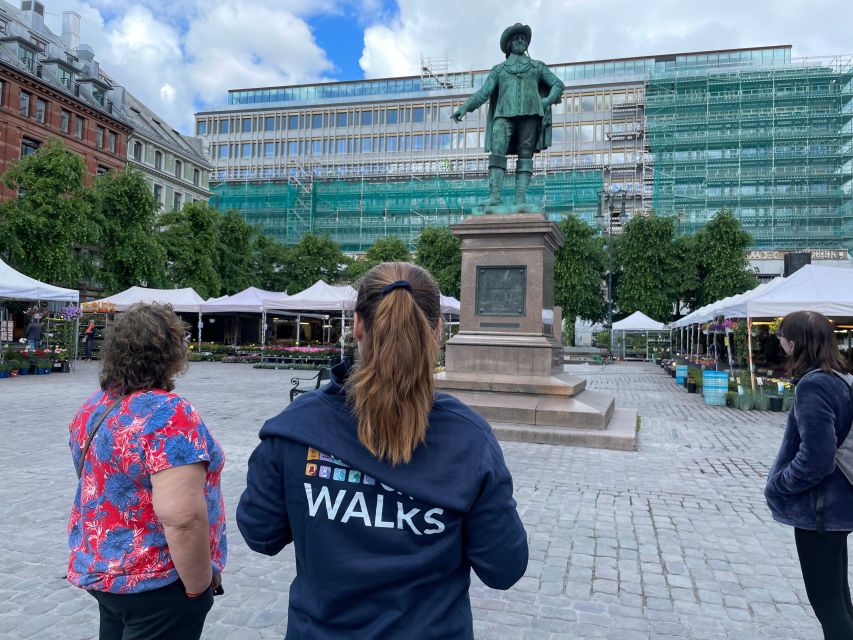
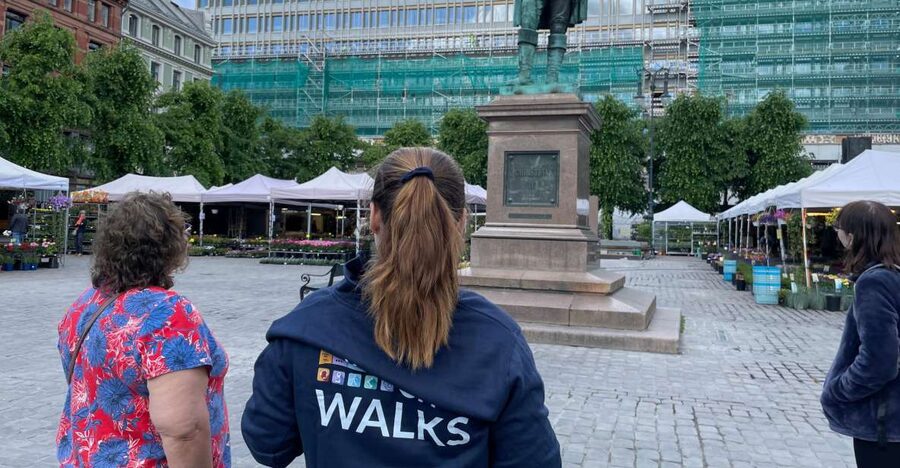
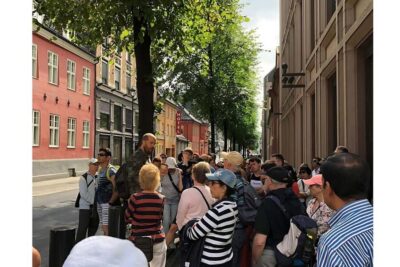
Your meeting point depends on the language and option you select. English groups meet near the statue of P.A. Munch by the Faculty of Law entrance at University Aula, Karl Johan Street 47. German groups meet at the Nobel Peace Center at Brynjulf Bulls plass 1.
Arrive about five minutes early. That small cushion matters in a city center where a few minutes of confusion can put you behind the group. The tour can finish at either University Square or the Nobel Peace Center, so check your voucher before setting out.
The route begins in an area that helps explain Oslo’s public life. University Square, the Nobel Peace Center, Parliament, the Grand Hotel, and the National Theater all sit within the central civic zone. You are not simply ticking off buildings. You are seeing where government, culture, ceremony, and commerce meet.
The Nobel Peace Prize is a key theme. It is the one Nobel award presented outside Sweden, and the guide explains why Oslo has that role. This gives the opening part of the tour a clear point of focus rather than a string of unrelated facts.
Karl Johan Street and Oslo’s civic heart
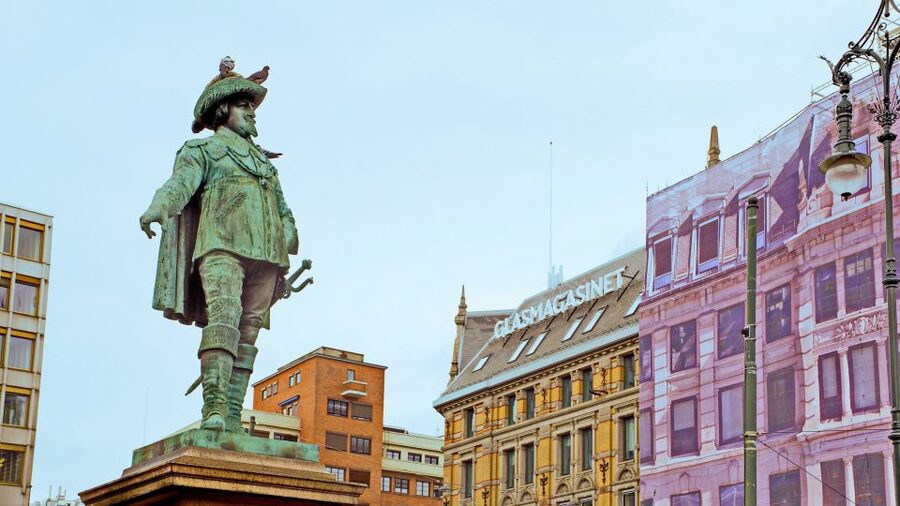
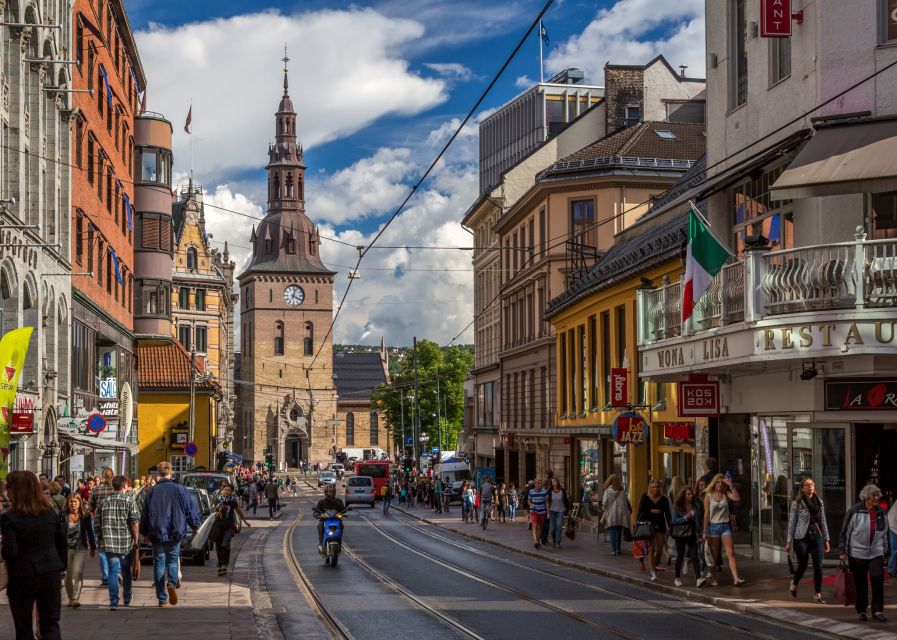
Karl Johan Street is Oslo’s main ceremonial and shopping road. Along the way, you pass Paleet, the Norwegian Parliament, the Grand Hotel, the National Theater, and the monument to King Karl Johan.
This section is useful because it shows how central Oslo is laid out. The street links major public buildings with shops, cafés, and open spaces. You can also see how Norway presents its national identity through architecture and public monuments.
The Parliament is viewed from outside, so do not expect an interior visit or a detailed tour of government rooms. The value comes from the explanation of Norway’s political system and the building’s place in the city.
At the Grand Hotel, the Nobel connection returns. The building is tied to the annual Peace Prize ceremony, giving the guide a chance to connect a familiar hotel façade with one of Norway’s best-known international events.
The route also passes the National Theater and the University of Oslo. These stops help widen the picture beyond castles and monuments. You get a sense of Oslo as a working capital, not just a sightseeing backdrop.
Bazaars, GlasMagasinet, and Oslo Cathedral
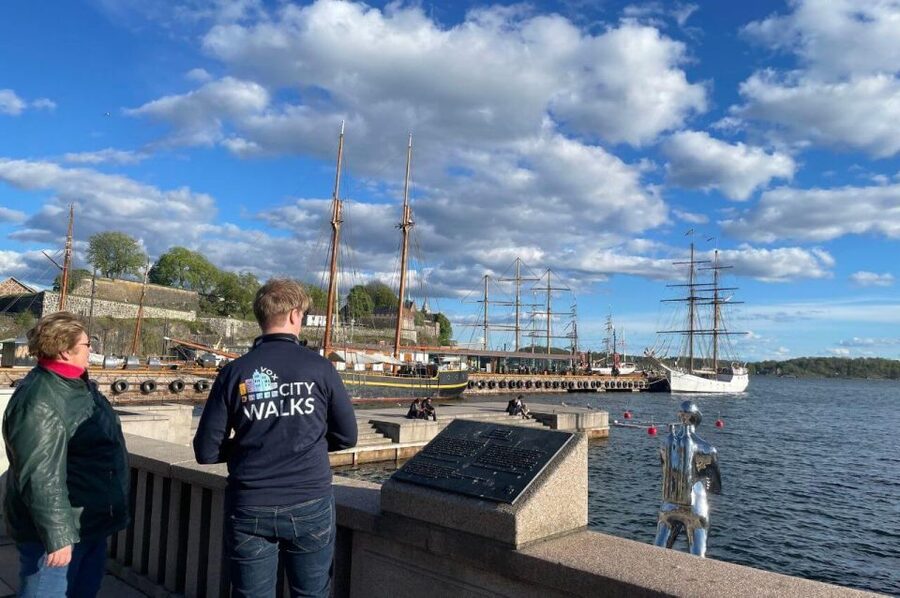
The Oslo Bazaars and GlasMagasinet Stortorvet shift the mood from formal avenues to older commercial streets. This is a good point to watch the details around you, since the route is about how the city’s parts fit together as much as it is about major landmarks.
Oslo Cathedral is another exterior stop. Its location near the central shopping streets makes it easy to include, but it also marks an older layer of the city. The guide places the church within Oslo’s changing story and helps you understand why the historic core is not limited to one single square.
The tour also includes the Fire Tower and the Tiger Sculpture among its named sights. The tiger is tied to Oslo’s nickname as the Tiger City, a phrase with a more complicated background than a simple city mascot. A guide can make that detail memorable by explaining the story instead of leaving you to guess why a large tiger sits near the station area.
This is the kind of small city detail I value. You can photograph a monument in seconds, but understanding why it is there gives it staying power.
Same streets, a different guide:
- Oslo: Historic Myths & Legends Evening Walking Tour
★ 4.8 · 408 reviews - Bergen: Sightseeing Walking Tour with Ferry Ride
★ 4.9 · 296 reviews - Taste of Oslo Walking Tour
★ 4.5 · 282 reviews - Oslo: Private Walking Tour with a Local
★ 4.5 · 263 reviews
Christiania Torv and the old city center
Christiania Torv is one of the most important historical stops. Here, the guide explains Christiania, the earlier name and original center of Oslo, and why the capital has changed names several times over the last 300 years.
That name change is a useful way to understand Oslo’s past. The city’s identity is not fixed in one medieval chapter. It has shifted through fires, rebuilding, political change, and changing ideas about what the capital should be called and where its center should sit.
The route includes Kvadraturen, the area associated with the older planned city, as well as Gamle rådhus and Anatomigården. These stops add texture to the walk. You see quieter historic corners close to the modern shopping streets and harbor.
This part rewards attentive walking. The buildings are not presented as isolated attractions. They form a street pattern that helps you picture earlier Oslo. Since the tour passes by rather than enters most places, listen closely to the guide here. The explanation is what turns a short stop into a useful history lesson.
The Opera House, sauna harbor, and Akershus Fortress
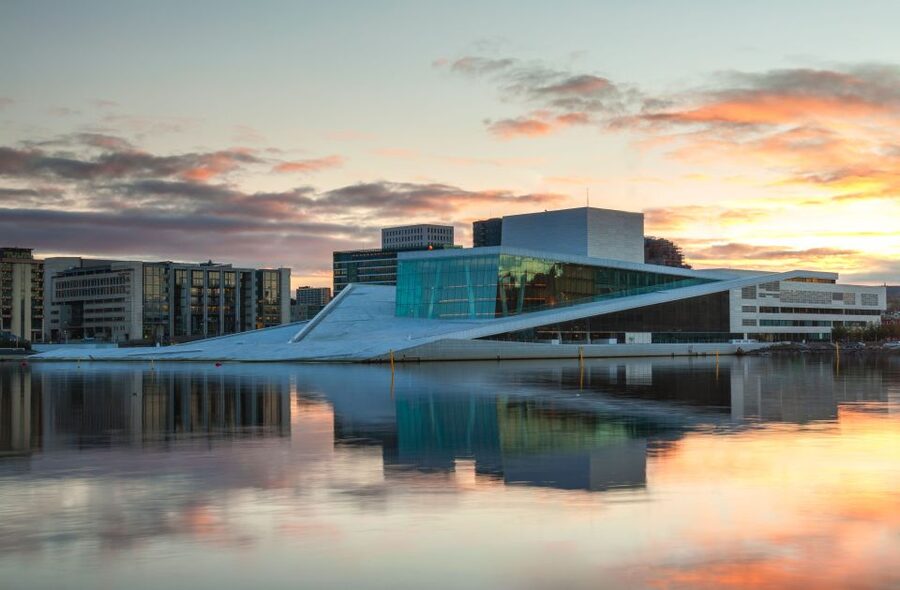
From the older streets, the route moves toward the water. The Norwegian Opera House is one of Oslo’s most recognizable modern buildings, and its relationship with the harbor gives the city a distinctly contemporary face.
You pass the Opera House rather than receive an interior performance or building tour. Still, it is a strong visual landmark and a good counterpoint to Christiania Torv. In a few blocks, Oslo moves from old civic streets to a waterfront shaped by modern design.
Near Langkaia, you pass KOK Oslo Sauna. This is a quick glimpse of Oslo’s sauna culture and its close connection with the fjord. The tour does not include sauna access, so treat it as a local-life detail, not an included activity.
Akershus Fortress adds a very different mood. Its walls and position near the harbor help explain Oslo’s strategic importance. The stop is valuable even if you do not enter, since the fortress links the old city with the waterfront and gives you a strong sense of the harbor’s role.
Entry tickets are not included anywhere in this tour. If you want to explore Akershus Fortress or another attraction more fully, plan a separate visit and budget for any required admission.
City Hall, Aker Brygge, and Tjuvholmen
Oslo City Hall is one of the route’s major civic landmarks. It is also connected to the Nobel Peace Prize ceremony, so the guide can bring together two themes introduced near the start: Oslo’s public institutions and its international role.
From there, the walk continues toward Aker Brygge, a former industrial area now known for restaurants, bars, shops, and waterfront spaces. The tour presents it as an alternative quarter, and it is a useful place to compare Oslo’s older center with its newer harbor life.
Tjuvholmen extends that modern waterfront experience. You get a view of the area’s newer development and a good sense of where to return if you want a meal or a slower stroll after the tour.
The harbor portion also shows why the route can feel varied despite lasting only two hours. You move from royal and government buildings to historic lanes, then to public art, restaurants, ferries, and the fjord. It is not a single-theme history walk. It is a quick portrait of Oslo’s changing character.
What you will and will not see
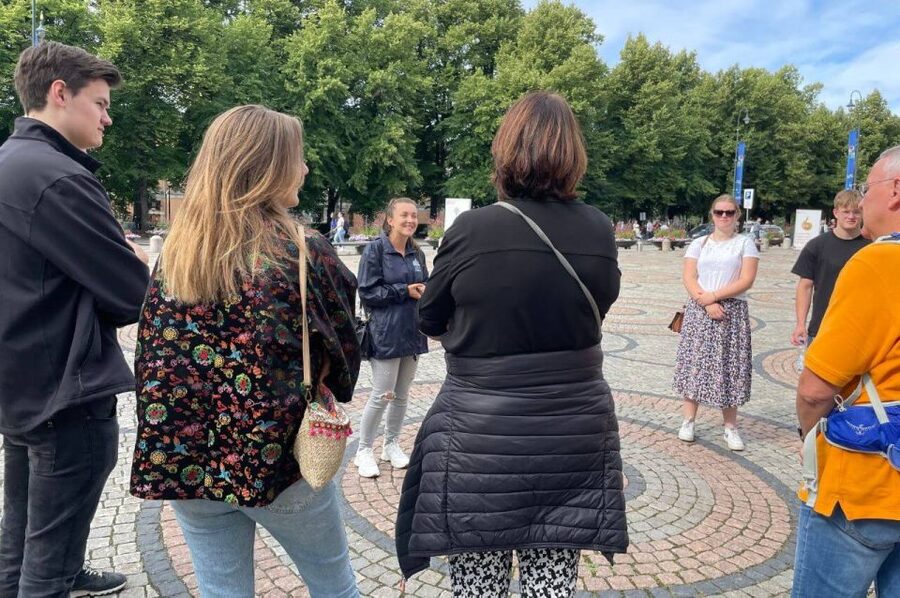
The route covers a large list of places, but nearly all are pass-by stops. That is both the strength and the limitation.
You will see:
- The Norwegian Parliament and Grand Hotel
- Karl Johan Street and the National Theater
- Oslo Cathedral and the Oslo Bazaars
- GlasMagasinet Stortorvet and the Tiger Sculpture
- Kvadraturen and Christiania Torv
- The Opera House and KOK Oslo Sauna
- Akershus Fortress and Oslo City Hall
- Aker Brygge and Tjuvholmen
- The Royal Palace and the monument to Karl Johan
You should not book this expecting admission to the Opera House, City Hall, Akershus Fortress, museums, or other attractions. The guide provides context from the street, which is ideal for orientation but not a substitute for an indoor visit.
The route includes many stops, so the guide must balance detail with pace. Strong guides such as Anastasia, Olaf, and Oliver have been praised for fitting substantial information into two hours without rushing. A well-run walk should leave you informed but still able to keep up.
The guide makes the biggest difference
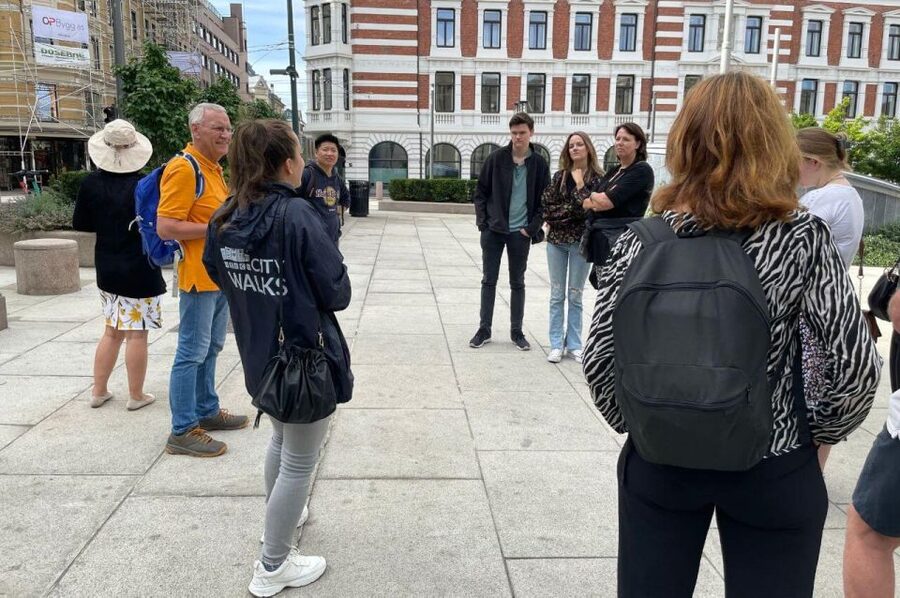
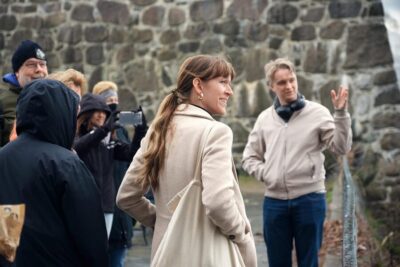
The most highly praised part of this experience is the live commentary. Guides have been singled out for clear English, humor, patience, and the ability to answer questions without losing the group.
Amelia has been noted for handling questions and keeping a group together. Anastasia has been praised for storytelling and a strong overview of the city. Olaf is described as funny and full of stories, while Oliver has been appreciated for local suggestions and clear answers.
Judit and Judith have also been praised for making history easy to absorb. One guide provided an earpiece for a larger group of 13, which can make a real difference when traffic, wind, or city noise gets in the way.
The tour is offered in English or German. Select carefully at checkout, since the meeting point changes with the language. A guide may have a different nationality from Norway, but that is not a problem here. The important point is the ability to explain Oslo clearly and respond to questions.
Timing, weather, and walking conditions
Two hours is a good length for a first look at central Oslo. It is long enough to cover the main district but short enough to fit beside a museum visit, lunch, or a ferry trip.
You will be outdoors for the full walk, so wear shoes suited to pavement and bring protection from rain. Several tours have continued in rain, hail, snow, or cold weather, and the route can still be worthwhile, but poor weather affects comfort and hearing.
Winter deserves special caution. Snow and uncleared sidewalks can make the route difficult for wheelchair users or anyone with limited mobility. One visitor had to end the walk early because of these conditions. The guide may try to help, but the operator does not promise fully cleared surfaces.
The route was described as reasonably flat in one account, yet flat does not mean effortless in winter. If you have mobility concerns, contact the provider before booking and check the forecast on the day.
The included app adds value after the walk
After the live tour, scan the QR code on your voucher to access the sightseeing app. It includes an audio-guided route through more parts of Oslo, with sights such as Frogner Stadion, Trinity Church, Grensen, Karl Johan’s monument, and Aamodt Bridge.
This is a useful extra because the live walk concentrates on the center. The app lets you keep exploring at your own pace instead of trying to remember every suggestion from the guide.
It does not replace the guide’s ability to answer questions or adjust the story to your interests. Think of it as a bonus walking plan for later, especially if you have another free afternoon.
Is $38 a fair price?
At $38 per person, I consider this fair value if you want a live guide and a broad first look at Oslo. You are paying for two hours of commentary, a planned route through major sights, and access to the app.
The value is strongest if you take it early in your stay. You can return to Christiania Torv, Akershus Fortress, Aker Brygge, or the Opera House after you know what you are looking at. You can also use the guide’s café and museum suggestions to shape the rest of your day.
The price is less attractive if you only want to photograph a few landmarks or prefer to explore without a group. Since attractions and public transport are not included, add those costs if you plan to go inside buildings or travel beyond the walking route.
Free cancellation up to 24 hours before departure and the reserve-now, pay-later option make it easier to fit into a changing schedule.
Who should book this Oslo walking tour?
I would choose this tour for a first or second day in Oslo. It suits solo visitors, couples, families with older children, and anyone who wants history explained in plain language while getting a practical sense of the center.
It is particularly useful if you have limited time. The route covers the main civic, historic, and waterfront areas without asking you to spend half a day inside one attraction.
History fans will get plenty to think about, especially around Christiania, the Nobel Peace Prize, and Oslo’s changing names. Culture-curious visitors will also appreciate the mix of public buildings, local streets, cafés, restaurants, harbor life, and modern architecture.
I would be more cautious if you need a fully accessible route, dislike outdoor walks in bad weather, or want extensive interior visits. In those cases, the tour may still help with orientation, but it should not be your only Oslo sightseeing plan.
Should you book it?
Book this tour if you want a friendly, story-led introduction to Oslo and plan to explore further on your own. The strongest guides turn a list of buildings into a clear story about Norway’s capital, and the app gives you a useful follow-up route.
Skip it if you already know central Oslo well or prefer museums and private sightseeing. For most first-time visitors, though, $38 buys a sensible starting point, especially when you take it near the beginning of your trip and use the guide’s suggestions afterward.
FAQ
How long is the Best of Oslo Walking Tour?
The guided walk lasts approximately two hours.
What languages are available?
The live tour is offered in English or German. Choose your language when booking.
Where does the English tour meet?
The English tour meets near the statue of P.A. Munch by the Faculty of Law entrance at University Aula, Karl Johan Street 47.
Where does the German tour meet?
The German tour meets at the Nobel Peace Center at Brynjulf Bulls plass 1.
Does the tour include attraction entry?
No. The walk passes the listed sights, but entry tickets are not included.
Is public transportation included?
No. You need to arrange and pay for any public transportation separately.
What is included after the guided walk?
You receive access to a sightseeing mobile app. Scan the QR code on your voucher to use the audio-guided routes.
New routes in Norway
- 3 Hour Guided Food Walk Tour in Alesund, Norway★ 5.0 · 124 reviews
- Stavanger: Private Walking Tour with a Local★ 4.5 · 100 reviews
- Oslo: Private Walking Tour with a Local★ 4.5 · 263 reviews
- Oslo: Snowy Forest Torchlight Walk with Campfire★ 4.6 · 254 reviews
- Oslo: Private Walking Tour★ 4.8 · 87 reviews
- Oslo: Norwegian Food Tour & Hidden Gems City Walk★ 4.8 · 165 reviews
- Oslo: Grünerløkka Food & Culture Walking Tour★ 4.5 · 204 reviews
- Oslo: City Highlights Walking Tour★ 4.8 · 197 reviews
Oslo Walking Tours, compared.
Guided Walking Tour of Central Oslo with Local Guide
Read our review →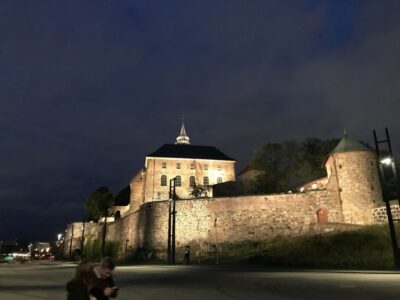




Browse the lists this tour appears in