Review · ROME
Highlights of Jewish Ghetto And Trastevere Walking Tour
Rome’s Jewish Ghetto and Trastevere are only a short walk apart, but they tell very different stories. This tour links them through ancient ruins, the Great Synagogue, Tiber Island, medieval lanes, and the churches and piazzas of Trastevere. You get Rome’s grand past, but also its sharper edges: restriction, survival, faith, romance, politics, and plenty of local gossip.
I like the strong human focus. The tour explains how Rome’s Jewish community preserved its identity under papal rule, rather than treating the Ghetto as just another pretty street. I also like the food advice, which continues into Trastevere and can help you choose dinner after the walk.
The main consideration is the pace. Most of the route is easy city walking, but one participant found the guide’s speed hard to keep up with. This is also a tip-based tour, so the low booking price is not the final cost if you want to compensate the guide fairly.
Key points to know before you book
- Rome’s Jewish Ghetto comes first: Begin at the Turtle Fountain, then explore the former restricted district near the Theatre of Marcellus and Portico d’Ottavia.
- The Great Synagogue anchors the history: The route gives context about Jewish life in Rome across centuries, including the painful wartime past.
- Tiber Island links the two neighborhoods: This small island adds an ancient story about healing, refuge, and Roman mythology.
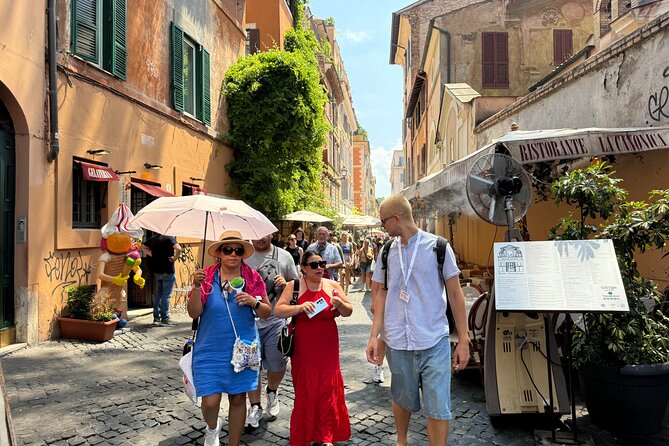
- Trastevere brings a different mood: Expect medieval lanes, ivy-covered façades, Santa Maria in Trastevere, Ponte Sisto, and Piazza Trilussa.
- Guides shape the experience: Ivan, Iris, Max, Martina, Skylar, and other English-speaking guides are praised for storytelling, humor, and food advice.
- Budget carefully: The listed price is $3.77 per person, but the guide works for tips, commonly stated as about €15 to €50, or the equivalent in dollars.
Starting at the Turtle Fountain
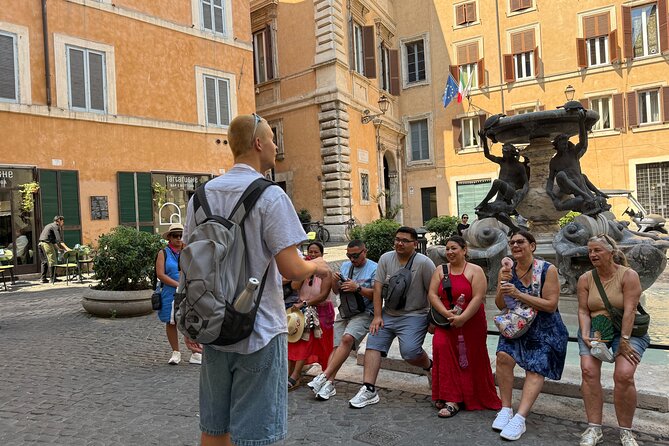
Your walk begins at the Fontana delle Tartarughe, or Turtle Fountain, in Rome’s historic center. The fountain is a fitting meeting point: compact, attractive, and easy to recognize. Your guide carries a sign with the tour name, so you should not need to search a large square or building entrance.
The opening stop lasts about ten minutes. That is enough time to look closely at the fountain and hear why this corner matters before moving toward the Jewish Ghetto. The tour does not waste its early minutes on a long introduction. It gets you into the story quickly.
This is a useful tour to take early in your Rome visit. The guide points out places to eat in both the Ghetto and Trastevere, and several guides, including Ivan, Iris, and Max, are praised for giving practical restaurant and bakery suggestions. Write them down as you go. It is easy to remember a recommendation in the moment and forget it by dinner.
More City Highlights Walking Tours in Italy
- Rome: Guided City Center Evening Sightseeing Walking Tour
★ 4.4 · 953 reviews - Rome: Small-Group City Highlights Moonlight Walking Tour
★ 4.9 · 949 reviews - Rome: Guided Small Group Walking Tour of City Highlights
★ 5.0 · 682 reviews
Entering Rome’s Jewish Ghetto
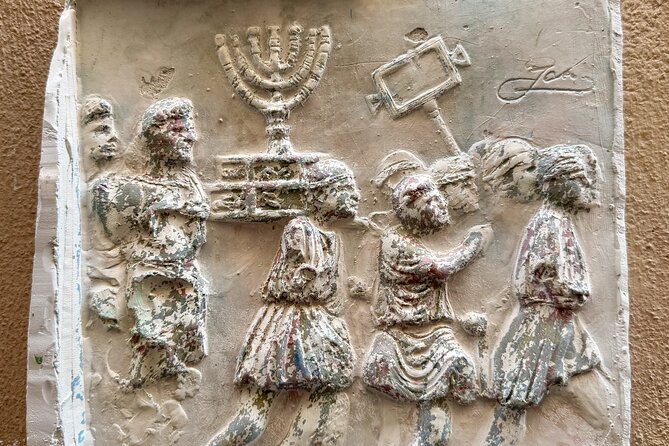
The first major section focuses on one of the oldest Jewish communities in the world. The word Ghetto can sound like a modern neighborhood label, but here it refers to a district that Jews were required to live in under papal rule. The tour explains how an area connected to ancient Rome became a restricted quarter, and what daily life looked like behind its walls.
The setting makes the lesson unusually direct. You are not hearing about Rome from a museum room. You are standing near the Theatre of Marcellus and the Portico d’Ottavia, where ancient Roman remains frame the later story of Jewish life. The contrast is powerful: imperial ruins on one side, a community building its own traditions and routines on the other.
Expect the guide to cover faith, culture, family life, and quiet resistance. The emphasis is not only on major political events. You also hear about how ordinary people maintained a shared identity through difficult periods.
This part can be serious, especially when the tour reaches the story of the Second World War and the persecution of Rome’s Jewish population. The strongest guides handle the subject with care while still speaking plainly. Iris is repeatedly praised for explaining Jewish life in Rome and the events of the war with empathy. Ivan is also known for making difficult history accessible without turning it into a dry lecture.
The tour’s advertised promise of history with no filters means the tone can be frank. The guides also use dark humor and politically incorrect jokes. That may appeal to you if you enjoy a guide who challenges polite tourist storytelling. If you prefer a solemn, academic presentation at every moment, this tour may feel less controlled.
The Great Synagogue and the Jewish story of Rome
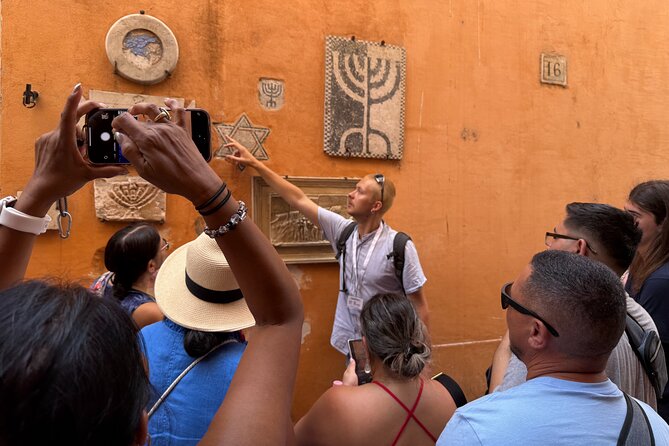
The walk continues to the Great Synagogue of Rome, one of the most important sights in this section. The stop is planned for about ten minutes, with time for photographs, explanation, and a closer look at the setting.
Do not expect this short walking experience to replace a full synagogue or museum visit. Its value is the context. The guide explains why the synagogue matters within the wider history of Rome’s Jewish community and how the neighborhood’s religious and cultural life continued through changing political conditions.
This is also where a good guide makes a difference. Ivan is often singled out for his ability to connect centuries of Jewish history with the city you see today. Iris is praised for clear explanations and for making the subject accessible to people with different levels of background knowledge.
You should listen for the links between ancient Rome, papal Rome, modern Rome, and the Jewish community’s endurance. The walk gives you a framework that helps the streets make sense. Without that framework, you might see the synagogue, the ruins, and the narrow lanes as separate sights. Together, they form one of the clearest historical chapters in this part of the city.
Crossing Tiber Island
From the Ghetto, the group crosses to Tiber Island. The stop is short, about five minutes, but it changes the pace and setting of the walk.
The island has been associated with healing and refuge since antiquity. The tour explores the meeting point between myth and medicine, explaining why this small piece of land gained such importance long before modern hospitals existed.
You will not spend a long time here, so think of Tiber Island as a connecting chapter rather than a full sightseeing stop. It provides a physical bridge between the Jewish Ghetto and Trastevere, while also adding another layer of Rome’s ancient past.
This section is useful because it keeps the walk from becoming a single-subject history lesson. You move from Jewish religious and social history to Roman beliefs about health, protection, and sacred places. The change helps the route feel like a tour of Rome itself, not only a tour of one neighborhood.
More City Highlights Walking Tours in Rome
- Rome: City Highlights Walking Tour
★ 4.6 · 368 reviews - Rome Highlights & Hidden Gems Guided Walking Tour
★ 4.8 · 280 reviews - Rome: City Highlights Walking Tour
★ 4.8 · 124 reviews - Rome: Piazza del Popolo and City Sights Free Walking Tour
★ 4.8 · 83 reviews
Finding medieval Trastevere
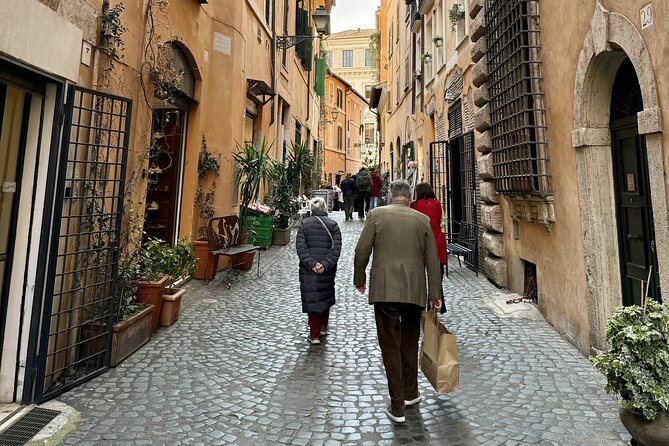
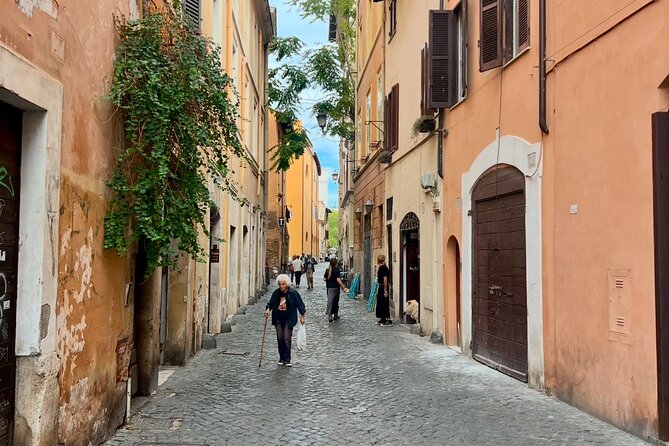
Trastevere begins with a shift in mood. The streets become more intimate, with medieval lanes, older façades, ivy-covered buildings, and a reputation for nightlife and rebellion. The tour does not treat Trastevere as merely a photogenic place for an evening stroll. It asks why this neighborhood has long attracted people who live outside the city’s polished center.
The route takes about ten minutes through Trastevere before reaching Santa Maria in Trastevere. Here, your guide adds legends and local stories to the architectural setting. Some details concern the neighborhood’s old reputation for passion, disorder, and independence. Others involve people who shaped Rome’s artistic and social life.
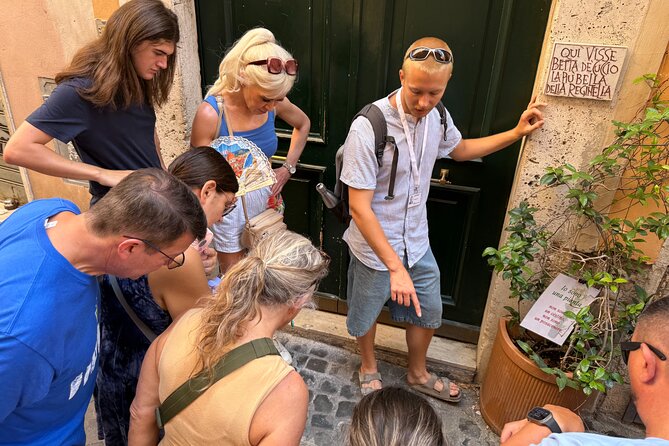
One of the more unusual stories concerns the location of Raphael’s lover’s house. The guide uses the spot to discuss clues about the artist’s private life, adding Renaissance intrigue to the ancient and medieval material. This is exactly the kind of detail that can change the way you see a street. You are no longer passing a doorway only because it looks old. You are looking for the human drama attached to it.
The storytelling style varies by guide, but the strongest names in the feedback are Ivan, Iris, and Max. Ivan is praised for a clear voice, strong organization, and a talent for bringing old streets to life. Max is described as funny, inclusive, and especially good at keeping a group involved. Iris is praised for making teenagers pay attention, which is a useful sign if you are traveling with older children.
Santa Maria in Trastevere
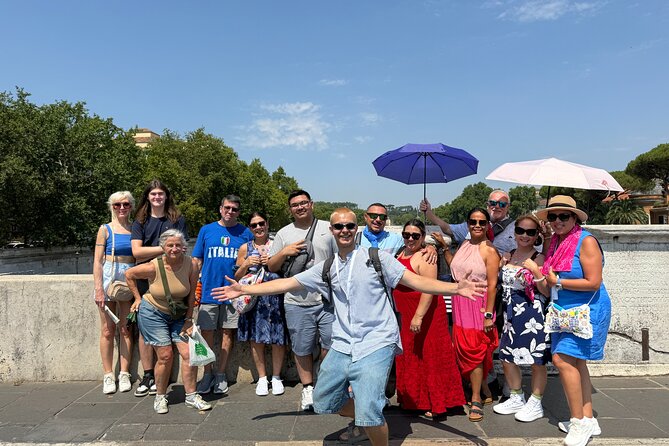
The stop at Santa Maria in Trastevere lasts about five minutes. That is enough for a guided look and some sightseeing, but not a long church visit.
The short timing matters. You are getting an overview of the church and its place in Trastevere, not an extended art-history lesson. If you want to study every mosaic, chapel, or architectural detail, you will need to return on your own.
Still, this stop helps anchor the neighborhood. Trastevere can feel like a maze of restaurants and narrow lanes. Santa Maria gives the area a historic center and shows how religious life shaped the neighborhood alongside its taverns, homes, and street culture.
The guide’s stories are the main reason to include this stop. A short explanation can point out what you should notice, even if you do not have time for a detailed visit. I find that helpful in Rome, where it is easy to walk past an important church while focusing only on the next café.
Ponte Sisto and the final stop at Piazza Trilussa
The route continues toward Ponte Sisto, where you get another chance to see the Tiber and the connection between central Rome and Trastevere. The bridge stop takes about five minutes and works well as a scenic pause after the denser historical sections.
The tour ends at Piazza Trilussa, a lively square in Trastevere. This is a practical finish because you are already in a good area for food and drinks, and the guide’s restaurant advice can be used immediately.
The end point also gives the tour a natural shape. You begin with a fountain in the historic center, pass through the Jewish Ghetto and Tiber Island, and finish in one of Rome’s best-known evening neighborhoods. The route is not a museum crawl. It is a connected walk across several districts, with history changing as the streets change.
What the 87 minutes really means
The advertised duration is 87 minutes. Several departures have lasted longer, including some that ran for two hours or more. You should plan around the stated 87 minutes, but leave extra time afterward if you do not want to rush a meal reservation or another appointment.
The route includes regular city walking, standing, photo stops, and pauses while the guide speaks. One person found the pace close to four miles per hour, while other feedback describes the pace as comfortable and considerate of people who walk more slowly. That difference suggests the experience can depend on the guide and group.
Wear comfortable shoes. The distance is not described in miles, but you will be on your feet through several neighborhoods and crowded streets. Keep the group together, especially in narrow lanes and around traffic. Ivan is praised for watching the group’s safety, but you should still pay attention when crossing streets.
The tour is in English. Guides include Ivan, Iris, Max, Martina, Skylar, and others, so the precise tone may vary. Some guides lean into humor, some into historical explanation, and some do both. The common thread is an informal presentation rather than a formal lecture.
Food advice that can improve the rest of your evening
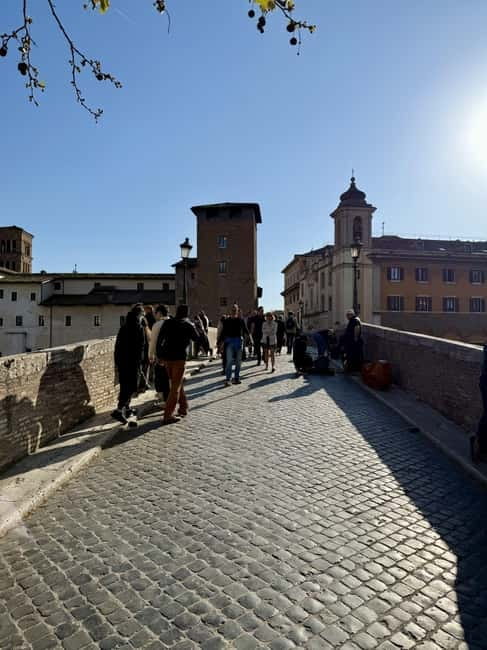
Food is not a tasting activity on this walk. The included food recommendations are one of the tour’s practical extras, not a promise of meals or samples.
That distinction matters when comparing it with a dedicated food tour. You should not book this experience expecting stops where you eat several dishes. You should book it if you want history first, then useful suggestions for where to eat in the Jewish Ghetto or Trastevere afterward.
The advice is especially helpful because both areas are full of choices. A guide who knows the neighborhoods can point you toward restaurants, bakeries, and local food spots that fit your evening plans. Louise and Iris are specifically praised for restaurant and bakery suggestions, while Max and Ivan are also noted for recommending places to eat.
If you have dietary needs, the supplied information does not promise specific options for this walking tour. One separate food-focused experience mentions gluten-free choices, but you should not assume that applies here. Ask the guide directly if food recommendations are important to you.
The tip-based price and its real value
The booking price is listed at $3.77 per person. That makes the tour easy to reserve, but it is not the true expected price because the guide works for tips alone.
The stated tipping range is about €15 to €50, with another note giving €15 to $50. The exact amount is your choice, but the model works only when you treat the tip as part of the cost, not as an optional surprise at the end.
At the lower end of that range, you are paying very little for a nearly 90-minute introduction to three important parts of Rome. At the higher end, you may spend about as much as you would on a conventional guided walk, especially if your group is large. The value depends on the guide’s storytelling, pace, and practical help.
I would budget the tip before booking. That keeps the low advertised price from creating confusion and lets you judge the experience fairly. A guide who gives clear history, answers questions, keeps the group safe, and offers useful dinner suggestions is providing more than a free orientation.
Who should choose this walk
This tour suits you if you want a broad introduction to Rome’s Jewish history and Trastevere without spending half a day indoors. It is also a good fit if you enjoy stories about private lives, legends, religious history, ancient customs, and the less polished side of Rome.
Families can do well here. Martina is praised for keeping adults, children, and grandparents involved, and another guide is praised for holding the attention of teenagers. Still, the walking pace and serious wartime material mean you should judge the tour for your own children.
The tour is less suitable if you want an in-depth visit to the Great Synagogue, a long church tour, or a formal academic treatment of Jewish history. It also may not suit you if dark humor or politically incorrect jokes are unwelcome.
Free cancellation up to 24 hours before the start and the reserve-now, pay-later option make it easy to fit into a changing Rome schedule. Availability and starting times vary, so check the departure that fits your day.
Should you book the Jewish Ghetto and Trastevere walk?
Book it if you want Rome explained through neighborhoods rather than isolated monuments. The most valuable part is the connection between the Jewish Ghetto, Tiber Island, and Trastevere, with a guide turning ordinary streets into places tied to survival, faith, art, medicine, and local life.
I would choose it early in a Rome stay, then use the restaurant advice at the end of the same day. Plan for comfortable shoes, an open mind about the humor, and a tip of roughly €15 to €50 per person. If you need a slow pace, tell the guide at the start and stay near the front.
FAQ
Where does the tour begin?
It begins at the Fontana delle Tartarughe, or Turtle Fountain. The guide holds a sign with the name of the tour.
Where does the tour finish?
The walk finishes at Piazza Trilussa in Trastevere.
How long does the tour last?
The advertised duration is 87 minutes. Some departures may last longer, with some reported at two hours or more.
What language is the tour in?
The live tour is in English.
Is the Great Synagogue included?
Yes. The route includes a guided stop at the Great Synagogue of Rome.
Does the tour visit Tiber Island?
Yes. Tiber Island is included as a guided sightseeing stop between the Jewish Ghetto and Trastevere.
Does the tour include food?
It includes food recommendations, but the supplied details do not describe food tastings or meals as part of the walk.
How much does the tour cost?
The listed booking price is $3.77 per person. It is tip-based, and the stated usual tip is about €15 to €50, or the equivalent in dollars.
Can I cancel the booking?
You can cancel up to 24 hours in advance for a full refund.
Who are some of the guides?
English-speaking guides named in the supplied information include Ivan, Iris, Max, Martina, Skylar, and Yvan. The exact guide depends on the departure.
More Jewish Heritage Walking Tours in Rome
- Rome: Jewish Ghetto Walking Tour
★ 4.7 · 274 reviews - Rome: Trastevere and Roman Ghetto Guided Walking Tour
★ 4.7 · 79 reviews - Amsterdam Anne Frank: Small-Group Walking Tour & Local Guide
★ 4.8 · 12,789 reviews - Anne Frank’s Story – Guided Walking Tour through Amsterdam
★ 5.0 · 11,619 reviews
New routes in Rome
- Rome: Colosseum and Ancient Rome Guided Walking Tour★ 4.5 · 95 reviews
- Rome Walking Tour: Pantheon, Trevi, Navona & Hidden Gems★ 4.8 · 501 reviews
- Rome: Guided Walking Tour and Pantheon Priority Entry Ticket★ 4.3 · 317 reviews
- Rome: Trastevere Food Walking Tour with Beer and Wine★ 4.9 · 71 reviews
- Rome: Trevi Fountain, Spanish Steps & Pantheon Walking Tour★ 4.6 · 336 reviews
- Rome: Underground Trastevere Guided Walking Tour★ 4.8 · 87 reviews
- Rome Trastevere Walking Food Tour★ 4.8 · 97 reviews
- Rome: Relics from the Passion of the Christ Walking Tour★ 4.9 · 84 reviews
Rome Walking Tours, compared.

Guided Food Walking Tour with Wine in Trastevere
Read our review →
Trastevere & Campo de Fiori Street Food Walking Tour
Read our review →
Paranormal Night Walking Tour & Secret Backstreets
Read our review →
Colosseum Arena, Roman Forum & Palatine Hill Tour
Read our review →
Trastevere Street Food Walking Tour with Local Expert
Read our review →

Rome by Night Walking Tour – Legends & Criminal Stories
Read our review →