
Review · BOSTON
Boston’s Freedom Trail: A Revolutionary Walking Tour
Boston’s Freedom Trail is much more than a red line through downtown. In about two and a half hours, this tour links all 16 official sites with stories of Redcoats, smugglers, street protests, abolitionists, and midnight riders. You finish in the North End with views toward Bunker Hill Monument and the USS Constitution.
I like the broad sweep. You see the Paul Revere House, Old State House, Faneuil Hall, burying grounds, and more without having to plan the route yourself. I also like the range of voices, from Paul Revere and John Hancock to abolitionists, women’s rights leaders, immigrants, and lesser-known patriots. The main drawback is pace: this is a several-mile walk, and some groups may find it brisk, especially when the guide is trying to cover so much in 2.5 hours.
Key points to know before you book
- All 16 official Freedom Trail sites: This is built as a full-route overview rather than a single-site visit.
- Start at the Embrace: Meet beside the Boston Common Visitor Information Center at 139 Tremont Street.
- Finish in the North End: Copp’s Hill Terrace gives you views of Bunker Hill Monument and the USS Constitution.
- Strong storytelling is central: Guides including Alissa, Jim, Kenny, Julia, Noah, and others use humor, questions, and detailed stories.
- Plan for several miles on foot: Comfortable shoes and a moderate level of fitness are important.
- Small enough to stay manageable: The group is capped at 25 people, though some sections can still be hard to hear in street noise.
Why this Freedom Trail tour works
Boston’s Freedom Trail is easy to follow on your own, but a painted line and a phone map cannot explain why each building matters. This tour gives you a running story, moving from the political center of Massachusetts to churches, burial grounds, meeting halls, and homes tied to the Revolution.
I like the way the route connects events instead of treating each stop as a separate plaque. The Boston Massacre makes more sense after you have seen the Old State House, heard about the pressure of British rule, and learned how speeches and newspapers shaped public opinion. Paul Revere’s ride becomes more than a familiar name once you have seen his home and the church steeple used for the lantern signal.
The tour also reaches beyond the usual Revolutionary War script. You hear about Boston’s role in abolition, women’s rights, education, and immigration across four centuries. That wider frame helps correct the common habit of treating Boston as if its entire past began in 1775.
The price is $31 per person. For that amount, you get a live guide, a planned route, and a useful first look at a large part of central Boston. It is good value if you want context and would otherwise pay for several separate admissions or spend hours researching the trail yourself.
The tradeoff is that the tour focuses on outdoor interpretation and route coverage. If you want long indoor visits at individual buildings, this is not the right format. You are covering many sites in one outing, not spending half an hour inside each one.
More Walking Tours in Boston:
- Boston: Freedom Trail History Small Group Walking Tour
★ 5.0 · 6,450 reviews - Harvard University Campus Guided Walking Tour
★ 4.5 · 3,632 reviews - Boston Freedom Trail Walking Tour with Costumed Guide
★ 4.5 · 2,531 reviews
Starting at the Embrace beside Boston Common
The meeting point is The Embrace, a recent memorial to Martin Luther King Jr. and Coretta Scott King, beside the Boston Common Visitor Information Center at 139 Tremont Street. This is a thoughtful starting point because it places the Revolution inside Boston’s wider civic story.
The statue also gives you a clear landmark near public transportation. Confirmation is provided at booking, and the tour is offered in English with a mobile ticket. Arrive ready to walk rather than expecting a formal check-in inside a museum.
The guide begins by setting the city’s long story in motion. From here, the route heads toward the Massachusetts State House and the historic core. The opening section is not simply a march toward the famous sights. It signals that Boston’s story includes later struggles for civil rights and equality as well as colonial protest.
The State House and the churches that shaped debate
The Massachusetts State House is easy to recognize by its golden dome. The building dates from the late eighteenth century, with Samuel Adams laying its cornerstone in 1795. It represents the new state government, but it also sits close to places tied to the older colonial order.
One of the churches on the route was built in 1809 and had a congregation active in the abolition movement. The guide explains the anti-slavery speeches given there, including some of the earliest of their kind in the United States. This is one of the tour’s useful shifts in subject. Boston’s reform story did not end when the Revolution ended.
You also visit the stone church built in 1754, the first Anglican church in Boston. Its nearby burial ground and underground crypts offer a look at the city’s religious divisions and its colonial social structure. The value here is the contrast: one stop points toward British religious influence, while another points toward dissent and reform.
If you are hoping to enter every church, keep your expectations measured. The tour’s strength is the guide’s explanation of the buildings, their congregations, and their role in Boston’s past. Time is limited, and the group has a long way to go.
Granary Burying Ground and the people behind the names
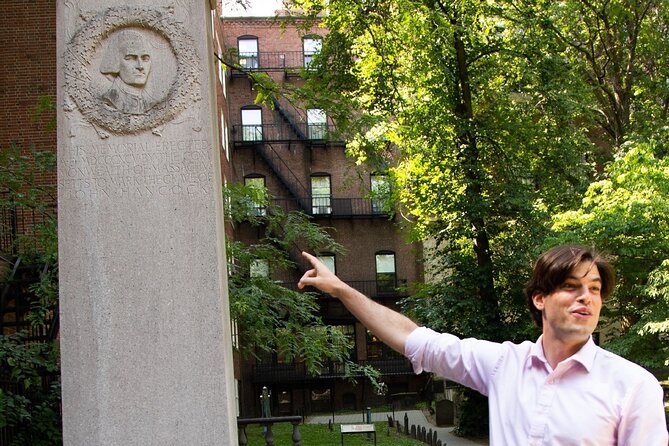
Granary Burying Ground dates to 1660 and contains the graves of John Hancock, Paul Revere, and Samuel Adams. Seeing those names in one compact cemetery makes the Revolution feel more personal. These were not distant figures in a textbook. They were Boston residents whose homes, businesses, and political networks filled the same streets you are walking.
The guide gives you stories connected to the graves rather than asking you to read every marker yourself. That matters because old cemeteries can be visually overwhelming. You may spot a famous name but miss the political or family connections around it.
This is also the place where pacing can become uneven. One guide may spend extra time on the cemetery because there is so much to explain. That can leave the rest of the walk feeling faster. If you use a walking stick, have limited mobility, or need frequent pauses, tell the guide early and consider whether a full-route walk suits you.
Same streets, a different guide:
- The Full Revolutionary Story Epic Small Group Boston Walking Tour
★ 5.0 · 2,356 reviews - Boston’s Freedom Trail: A Revolutionary Walking Tour
★ 4.9 · 1,748 reviews - Boston: Freedom Trail History Small Group Walking Tour
★ 4.9 · 1,590 reviews - Boston North End Food Tour of 6+ Tastings, Cannoli, Lobster Roll
★ 5.0 · 1,404 reviews
Old South Meeting House and the Boston Tea Party
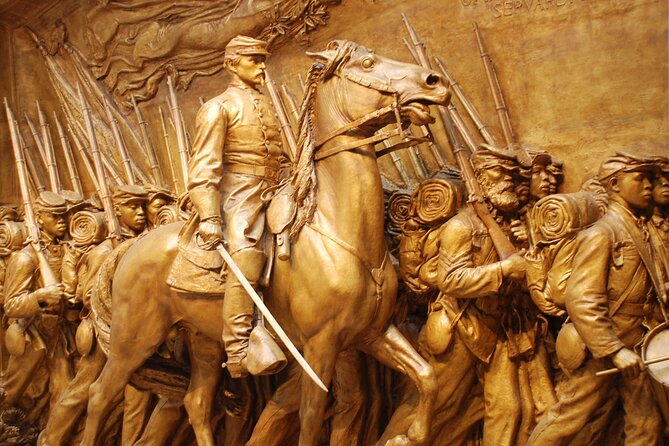
The Puritan meeting house built in 1729 is tied to the beginning of the Boston Tea Party. The event did not start at the harbor with tea thrown into the water. It began with public debate, anger over taxation, and a large gathering of colonists inside this meeting house.
This stop is especially helpful if your knowledge of the Tea Party is limited to the famous act itself. The guide provides the setting for the decision and explains how civil disobedience moved from speeches to action.
The experience is still a quick outdoor stop rather than an extended indoor program. If the Tea Party is your main interest, you may want to spend additional time at the building separately. On the tour, the emphasis is on fitting this event into the larger chain of Boston’s resistance.
Old Corner Bookstore and Old State House
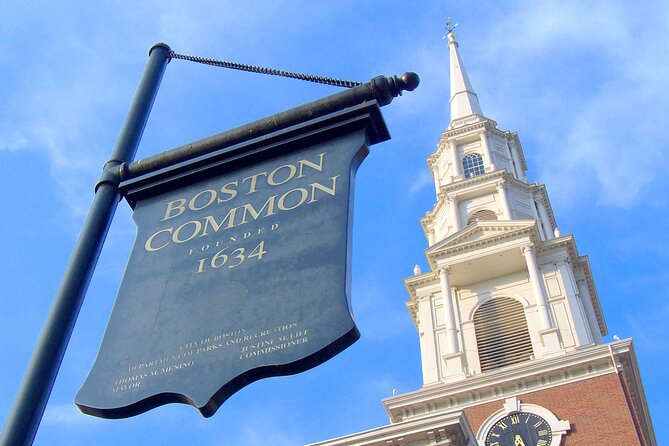
The brick building known as the Old Corner Bookstore dates to 1718. It began as a colonial apothecary and later housed the publishing firm Ticknor & Fields. The guide connects the building to major literary figures published there, giving you a reminder that Boston’s influence reached beyond politics and war.
Then comes the Old State House, built in 1713. Its Lion and Unicorn symbols point to British authority, and the building once housed the center of British government in Massachusetts. The site also saw speeches and confrontations that sharpened the conflict between officials and colonists.
These two stops work well together. One shows how a small commercial building can take on a literary life. The other shows the machinery of government and the arguments that challenged it. You get a better sense of Boston as a working city, not just a collection of monuments.
The Boston Massacre site and Faneuil Hall
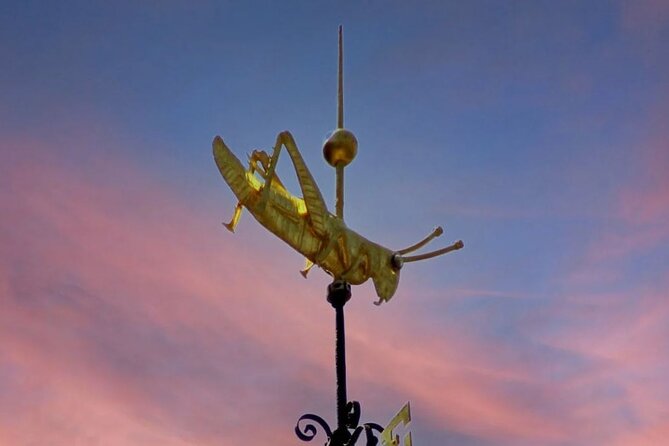
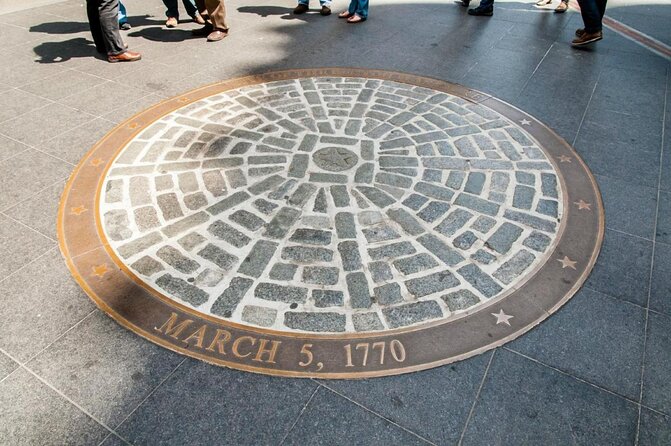
A circle of stones marks the site of the 1770 Boston Massacre. The guide reconstructs the night when British soldiers fired on a crowd and five colonists died. The value of a live explanation here is scale and sequence. A street corner can look ordinary until you understand what happened in that exact space.
The guide also explains how the event was used in colonial political messaging. That does not make the deaths less tragic. It shows how images and stories helped turn local violence into a cause that reached far beyond Boston.
At Faneuil Hall, you learn about the meeting space above the market. Often called the Cradle of Liberty, it hosted speeches that helped shape public opinion. This is one of the places where the tour’s political theme comes into focus. Boston’s revolution was fought with words before it was fought with weapons.
Crowds and street noise can affect this section. One guide made a point of facing the group so everyone could hear, while larger groups may find it harder to catch every sentence. Stay near the guide and ask for a repeat if needed. The maximum group size is 25, which helps, but it cannot remove all city noise.
Paul Revere’s home and the midnight signal
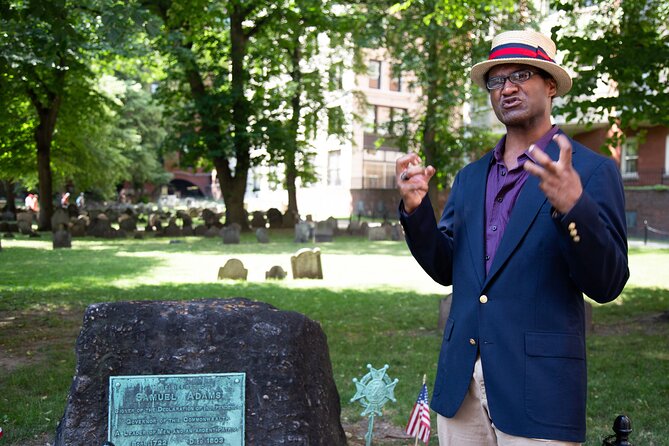
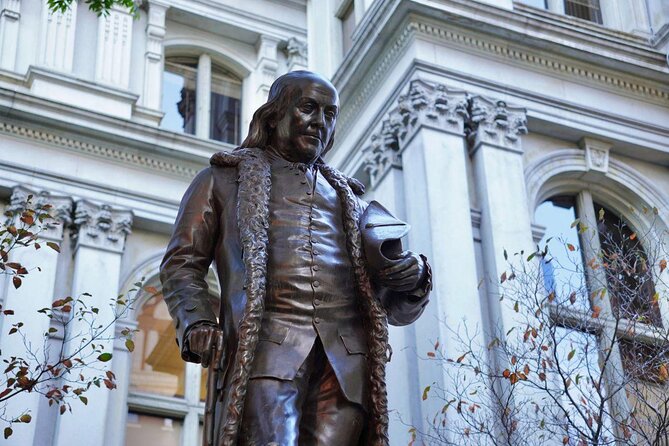
The Paul Revere House is a wooden home dating to 1680 and the oldest building in Boston. Revere lived there with his family, and the house gives the famous patriot a more ordinary setting. He was not only the rider from the familiar story. He was also a tradesman, a husband, and a Boston resident tied to the city’s daily life.
The route then reaches the Old North Church, built in 1723. Two lanterns were displayed in the steeple on April 18, 1775, sending the signal remembered in the phrase one if by land, two if by sea. The guide explains the purpose of the signal and how Paul Revere arranged it.
This pair of stops is one of the strongest parts of the tour because the places connect directly. You first see where Revere lived, then learn how a message was sent from the church. The story becomes a chain of real locations instead of a single heroic legend.
Conditions can change at the church. One tour went ahead while the Old North Church was undergoing construction, with the guide adjusting the route and explanation. That is useful to know if you are visiting during work on historic buildings. You may see the exterior and hear the story even when access is affected.
Copp’s Hill, Bunker Hill, and Old Ironsides
The route ends at Copp’s Hill Terrace in Boston’s North End. The meeting information gives the ending as Copp’s Hill Terrace, with 7 Jackson Avenue also supplied as an address. From the terrace, you can see Bunker Hill Monument and the masts and rigging of the USS Constitution in Charlestown.
Copp’s Hill Burying Ground dates to 1660. During the Battle of Bunker Hill, British cannons were placed there. The guide explains the battle and points out notable Bostonians buried in the ground.
The 221-foot Bunker Hill Monument marks the site where colonial militia defended a hastily built earthwork and repelled two British attacks before retreating. The view gives you a strong closing image because the tour ends with the battlefield across the water rather than simply stopping at another downtown plaque.
You can also see Old Ironsides, the USS Constitution, the oldest warship afloat anywhere in the world and a victor in battles during the War of 1812. The tour does not take you aboard the ship, but the view adds a naval chapter to the Revolution-era story.
Pace, guides, weather, and physical effort
The advertised duration is about 2 hours and 30 minutes. In practice, the route covers a lot of ground and several miles. Some guides keep an easy rhythm, while others may need to move quickly to reach every stop on time.
The strongest guide qualities are clear speech, humor, command of detail, and the ability to answer questions. Guides praised for those traits include Alissa, Jim, Kenny, Julia, Noah, Sam, Charles R., Stewart, Kathy, Eliot, and Rob Crean. That does not guarantee a particular guide on your date, but it gives you an idea of the style the company aims for.
Kenny has handled both intimate tours and large groups, while Noah has been especially effective with teenagers. Alissa has a lively style with well-timed humor, and Julia has managed crowded conditions and construction while keeping the route moving. The common thread is storytelling rather than a dry recital of dates.
Wear comfortable walking shoes. The tour requires moderate physical fitness, and uneven cemetery paths, city sidewalks, and a brisk pace can be tiring. Rain has not prevented every outing, but the experience requires good weather. If poor weather forces cancellation, you are offered another date or a full refund.
Who gets the most value for $31
I would book this if you are in Boston for the first time, want a strong orientation, or enjoy history but do not want to plan every stop. Families can benefit because a good guide turns names and dates into stories, and the format has worked well with teenagers.
It also suits solo visitors and couples who want a concentrated introduction before exploring the city on their own. The tour is particularly useful at the start of a Boston visit. Afterward, you will know which sites deserve a longer return visit.
I would think twice if you dislike group walks, need a slow pace, or want extensive indoor access. A private guide or a shorter single-neighborhood visit may serve you better. You should also avoid packing this into a tight schedule immediately before another appointment, since the route is long and city conditions can slow the group.
Should you book Boston’s Freedom Trail tour?
Book it if you want the complete Freedom Trail route in one organized walk, with a guide who can connect the Boston Massacre, Tea Party, Paul Revere, abolition, and Bunker Hill. At $31, the cost is reasonable for the amount of ground and interpretation included.
Skip it if you want to linger inside each building or cannot comfortably walk several miles in 2.5 hours. For most first-time visitors with moderate fitness, this is a practical and lively way to get Boston’s historic core under your feet. Bring good shoes, stay close enough to hear, and leave room in your schedule for the North End at the finish.
FAQ
Where does the tour begin?
It begins at The Embrace, beside the Boston Common Visitor Information Center at 139 Tremont Street, Boston, Massachusetts.
Where does the tour end?
It ends at Copp’s Hill Terrace in Boston’s North End, with views of Bunker Hill Monument and the USS Constitution. The supplied ending information also gives 7 Jackson Avenue, Boston, as a street address.
How long does the tour last?
The tour lasts approximately 2 hours and 30 minutes.
How many Freedom Trail sites does the tour cover?
The tour is designed to cover all 16 official sites of Boston’s Freedom Trail.
How much does the tour cost?
The price is $31 per person.
Is the tour offered in English?
Yes. The tour is offered in English.
How large is the group?
The tour has a maximum of 25 participants.
Can I cancel for a refund?
Yes. You can cancel at least 24 hours before the start time for a full refund. Cancellations or changes made less than 24 hours before the start time are not refunded or accepted. If poor weather causes the tour to be canceled, you are offered another date or a full refund.
New routes in Boston
- Cambridge, Massachusetts: MIT and Harvard Walking Tour★ 4.7 · 486 reviews
- Boston: Salem by Boat – Witch Trials & Walking Tour★ 4.3 · 263 reviews
- Boston: 2-Hour Historic Walking Tour★ 4.7 · 88 reviews
- Boston: Full Revolution Story Epic Small Group Walking Tour★ 4.9 · 132 reviews
- Boston: North End Pizza Walking Tour with 3 Slices & Cannoli★ 4.8 · 162 reviews
- Boston: Freedom Trail Guided Walking Tour in French★ 4.9 · 106 reviews
- Self Guided Classic Freedom Trail Location Aware (GPS) Walking Audio Tour★ 4.5 · 258 reviews
- Boston History Tour: Scenic Walk Through Time & Landmarks★ 5.0 · 627 reviews
Boston Walking Tours, compared.
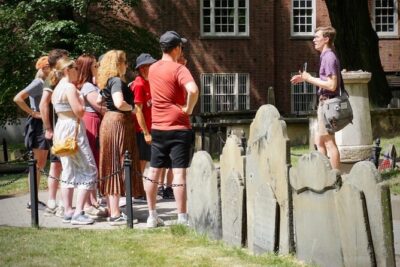
Freedom Trail History Small Group Walking Tour
Read our review →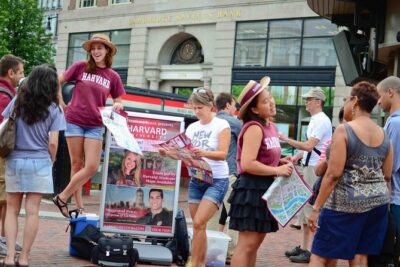
Harvard University Campus Guided Walking Tour
Read our review →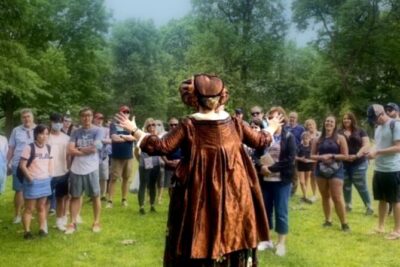
Boston Freedom Trail Walking Tour with Costumed Guide
Read our review →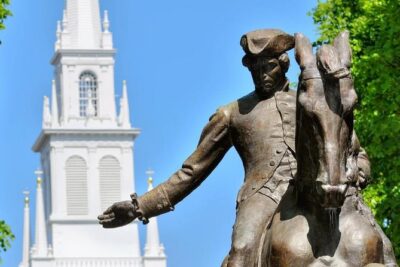
The Full Revolutionary Story Epic Small Group Boston Walking Tour
Read our review →
Boston North End Food Tour of 6+ Tastings, Cannoli, Lobster Roll
Read our review →

Boston Pizza Lovers Food and History Walking Food Tour
Read our review →
Boston History Tour: Scenic Walk Through Time & Landmarks
Read our review →Browse the lists this tour appears in