
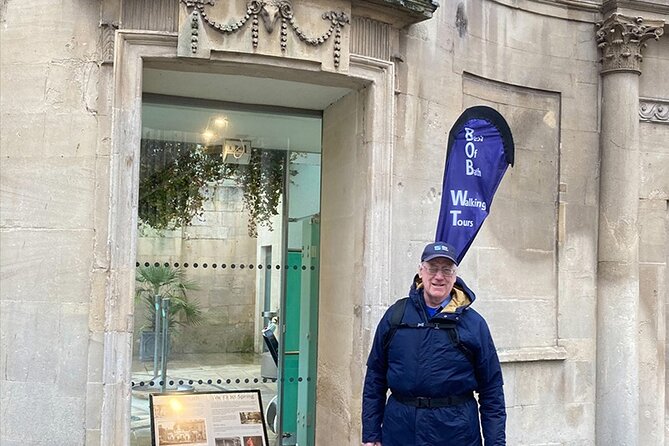
Review · BATH
Best of Bath Walking Tours – Georgian Tour
Bath’s Georgian architecture is best understood on foot, where grand façades, hidden lanes, old walls, and the River Avon connect into one story. Bob leads you through the city center, from Bath Abbey and the hot springs to the Circus, Royal Crescent, and Pulteney Bridge, with plenty of explanation along the way.
I like the small maximum group of 15, which should make it easier to hear, ask questions, and keep a comfortable pace. I also like Bob’s relaxed approach: he mixes architecture with the people who built and lived in Bath, adds dry humor, and points out details you could easily miss alone. The main consideration is that this is a walking tour, not an attraction-entry tour, so tickets for places such as the Roman Baths and Assembly Rooms are not included.
Key Points
- See Bath’s major Georgian landmarks in one walk, including Queen Square, the Circus, Royal Crescent, and Pulteney Bridge.
- Bob brings local detail and humor, with stories about residents, architects, Bath society, and the city’s changing fortunes.
- The tour usually lasts about two hours, but can run longer when the group has questions.
- The route includes lesser-noticed features, such as old city walls, medieval paths, and architectural details that are easy to pass by.
- The group is capped at 15 people, giving the tour a more personal feel than a large city walk.
- You return to Bath Abbey, making it easy to continue sightseeing, shop, visit the baths, or catch transport afterward.
Why Georgian Bath Makes a Good Walking Tour
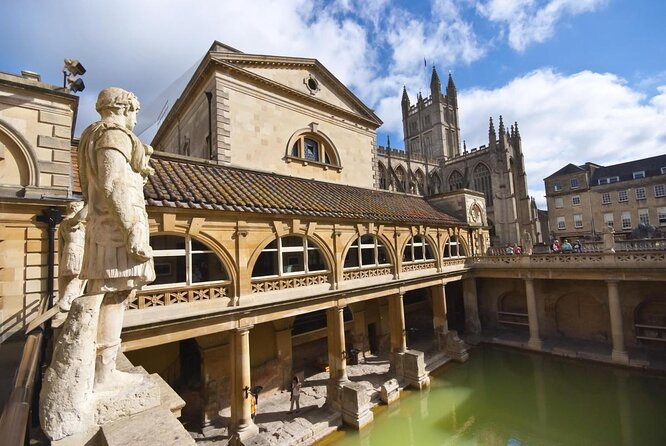
Bath can seem almost too polished at first. The honey-colored stone, sweeping terraces, and formal squares are beautiful, but they can also blur together if you do not know what you are looking at. This tour gives those buildings a purpose and a cast of characters.
The focus is the Georgian period, when Bath became a fashionable resort town and developers reshaped large parts of the city. Architects John Wood the Elder and John Wood the Younger created grand schemes that were meant to look orderly, classical, and expensive. You will see how their ideas developed from Queen Square to the Circus and then to the Royal Crescent.
I like this kind of city walk because it explains the spaces between the famous sights. You are not simply told that the Royal Crescent is impressive. You learn how its curve, proportions, columns, and position fit into the larger plan of Georgian Bath.
Bob also keeps the history human. The tour covers the architects and buildings, but it also looks at the people who came to Bath, the fashionable society that gathered here, and the role of mineral water in the city’s fortunes. That balance helps the architecture feel less like a collection of façades and more like part of daily life.
More Walking Tours in the UK:
- Magical London: Harry Potter Guided Walking Tour
★ 4.7 · 22,044 reviews - Edinburgh: Harry Potter Magical Guided Walking Tour
★ 4.8 · 11,944 reviews - Edinburgh Castle: Guided Walking Tour with Entry Ticket
★ 4.7 · 11,699 reviews
Starting Beside Bath Abbey at 1:00 pm
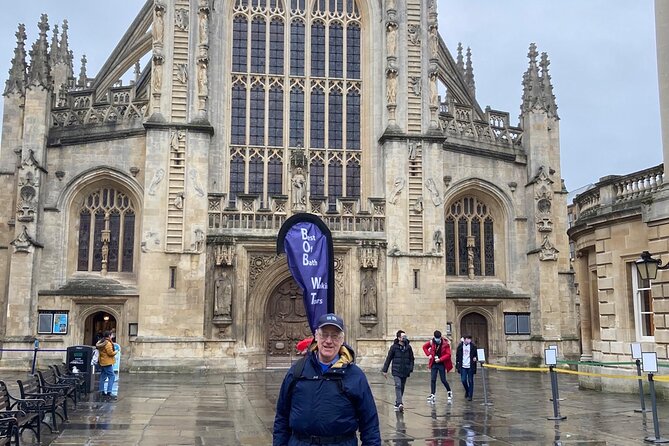
The meeting point is Abbey Churchyard, in front of Bath Abbey. This is a sensible place to begin because it puts you in the heart of the city and near several of the tour’s main themes.
Bath Abbey itself dates back to the seventh century, with later rebuilding in the twelfth and sixteenth centuries. It began as a Benedictine monastery and is now an Anglican parish church. Even if you have already seen the abbey, beginning here gives the walk a useful sense of place. Bath’s Roman, medieval, and Georgian layers are all close together.
The route returns to Abbey Churchyard at the end. That makes the tour easy to fit into a day in Bath. You can begin with the walk, then visit an attraction afterward, or schedule it between other plans without arranging a separate pickup.
The start time is 1:00 pm. That afternoon timing works well if you arrive in Bath in the morning by train or bus, though you should leave enough time to find Abbey Churchyard. The tour is offered in English.
Roman Baths, Hot Springs, and the Old City Wall
Early in the route, Bob covers the Roman Baths and the natural hot springs that helped make Bath famous. The Roman temple on the site was built between 60 and 70 AD, during the first decades of Roman Britain. The baths themselves are one of the city’s essential sights, but this walking tour only allows a short stop and does not include admission.
That distinction matters. If you want to explore the Roman Baths museum, see the ancient pools, and read the displays, plan a separate visit and budget for an admission ticket. The walking tour gives you context and orientation rather than a full indoor visit.
The old city wall adds another useful layer. Bath is often presented as a Georgian city, but its medieval boundaries and surviving traces remind you that the elegant eighteenth-century town was built over a much older settlement. Bob’s route includes the Abbey Churchyard, the hot springs, old wall, and the Royal Mineral Water Hospital, so you get a sense of how the city developed over time.
One especially appealing detail is the attention to features that sit below or beside the main streets. The route can reveal old paths and fragments of the earlier city that are easy to miss when you are focused on the grand buildings. Keep your eyes open between stops. Some of the most memorable details may not be the official landmarks.
The Royal Mineral Water Hospital and Bath’s Healing Trade
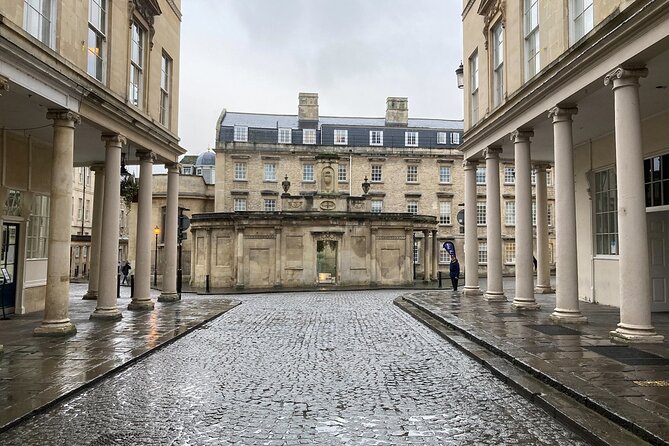
The Royal Mineral Water Hospital began construction in 1737, at a time when belief in the healing power of Bath’s waters was becoming tied to new scientific ideas. The hospital is an important reminder that the springs were not only a tourist attraction. They supported a medical and charitable tradition as well.
The stop is brief, and admission is not included. That is typical of this tour: Bob uses the buildings as outdoor teaching points, giving you the reason each place matters without turning the walk into a series of interior visits.
I find that approach useful for a first afternoon in Bath. You see the city’s structure and learn which attractions deserve more of your time. You can then decide if you want to return to the Roman Baths or visit another site with a clearer idea of what you are looking at.
Same streets, a different guide:
- Underground Vaults Walking Tour in Edinburgh Old Town
★ 4.5 · 8,506 reviews - London: The Original Jack the Ripper Walking Tour
★ 4.7 · 7,833 reviews - Oxford University Walking Tour With University Alumni Guide
★ 5.0 · 6,905 reviews - Edinburgh Castle: Guided Walking Tour with Entry Ticket
★ 5.0 · 5,540 reviews
Queen Square and the Georgian Plan
Queen Square is the first major piece in the architectural sequence that continues through the Circus and the Royal Crescent. Its buildings are Grade I listed, and the square gives you an early example of the formal planning that transformed Bath.
Here, the important point is not simply that the buildings are old or grand. The square was designed as part of a larger vision for a fashionable city. Georgian planners used repeated façades, symmetry, and open public spaces to create an image of order and refinement.
Bob’s explanations are especially useful for readers who do not usually notice architectural distinctions. The tour looks at why buildings were arranged in certain ways and who was responsible for them. You are encouraged to ask questions, and the pace leaves room for discussion instead of forcing everyone through a memorized speech.
Inside the Circle of the Circus
The Circus is one of Bath’s great architectural surprises. It is a circular group of large townhouses designed by John Wood the Elder and built between 1754 and 1768. Three entrances lead into the circle, and each section is arranged so that a classical façade appears directly ahead.
This is the sort of place that rewards a guide. On your own, you may admire the curve and take a photograph. With an explanation, you can notice the planning logic, the repeated details, and the way the space was intended to impress from several directions.
The stop lasts about ten minutes, but the structure deserves a slow look. Stand near one of the entrances and study how the houses frame the view. The Circus is also a good point to appreciate the difference between Georgian architecture as a set of decorative features and Georgian planning as a complete urban idea.
Royal Crescent and No. 1 Royal Crescent
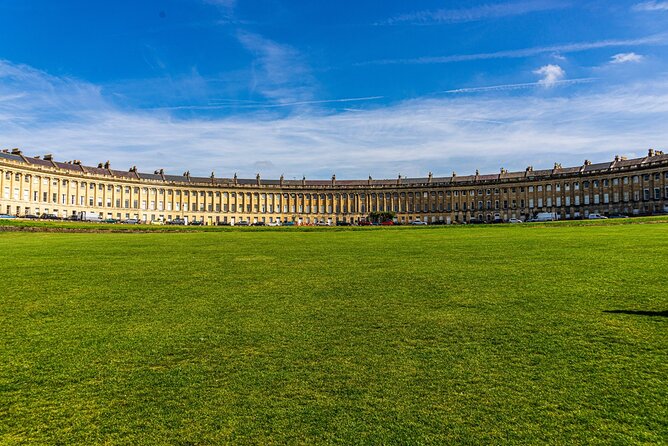
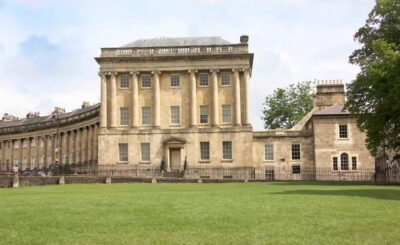
The Royal Crescent is Bath’s most famous Georgian view, a sweeping row of 30 terraced houses designed by John Wood the Younger and built between 1767 and 1774. It is one of the clearest examples of the style in Britain and is Grade I listed.
The tour includes No. 1 Royal Crescent as a stopping point, but admission is not included. You will mainly discuss the exterior unless you arrange a separate visit. That is worth knowing before you book, especially if you want to see how an eighteenth-century townhouse looked inside.
The crescent is more than a postcard backdrop. Its wide curve creates a grand public face while the houses behind it served private lives, servants, visitors, and social rituals. Bob’s focus on the people connected to Bath helps make that contrast clearer.
The pace is gentle rather than athletic, but you should still expect to walk outdoors for two hours or more. Wear comfortable shoes, and allow for the fact that Bath’s streets can be uneven in places. A moderate level of physical fitness is recommended.
Assembly Rooms and Fashionable Georgian Society
The Assembly Rooms help explain why Bath grew into such a fashionable destination. The upper rooms opened in 1771 and were used for balls, concerts, and gambling. They became a center of social life for the city’s wealthy visitors and residents.
Jane Austen and Charles Dickens were among the well-known figures associated with Bath’s social world, along with members of the nobility. The building gives the tour a chance to move beyond architecture and talk about how people actually used these grand spaces.
Admission is not included, so treat this as an exterior and historical stop unless you plan to visit inside separately. The discussion still has value because the Assembly Rooms connect several themes: architecture, entertainment, status, and the business of attracting fashionable company.
If you have read Austen or are interested in the social setting behind Georgian novels, this part of the walk may be especially rewarding. If you prefer only major monuments, it is still a useful explanation of why Bath’s buildings became so elaborate.
Pulteney Bridge and the River Avon
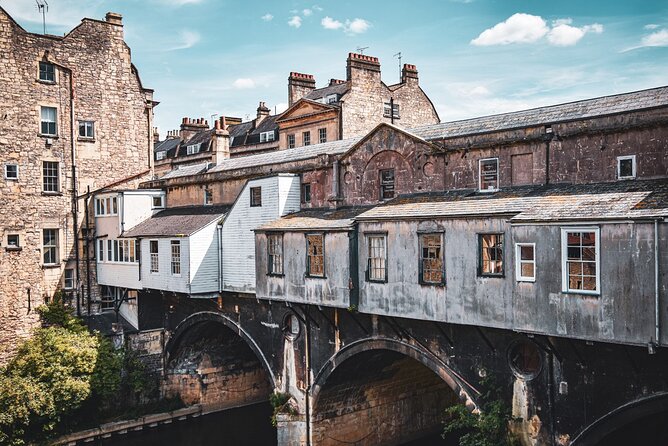
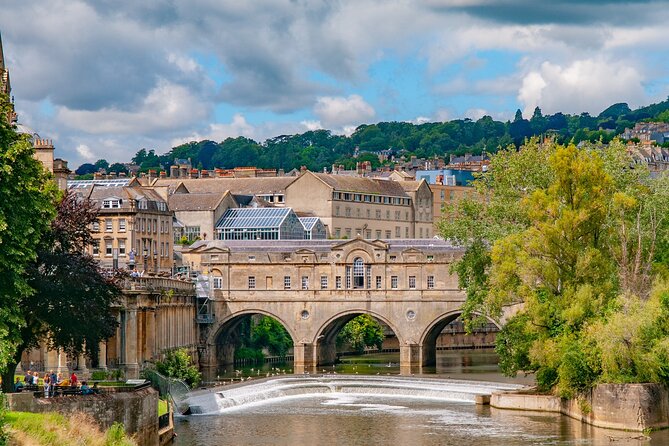
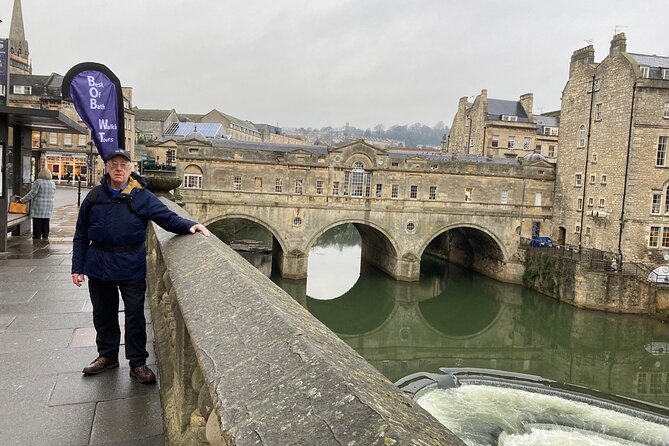
Pulteney Bridge provides a change of scale and mood. Completed by 1774 and designed by Robert Adam, it crosses the River Avon in Palladian style. Its most unusual feature is the line of shops built across the bridge on both sides.
That arrangement makes Pulteney Bridge feel like a street suspended over the river rather than a simple crossing. It was built to connect Bath with land owned by the Pulteney family, which they hoped to develop.
This stop also gives you a chance to look away from façades and toward the river. The bridge links architecture, commerce, and property development in one compact place. It is a good example of how Georgian ambition shaped not only grand squares but also practical parts of the city.
The visit is short, so you should not expect time to browse every shop or linger by the water. Still, the bridge is easy to revisit after the tour because the route ends back near Bath Abbey.
Guildhall Market and the Walk Back to the Abbey
Bath Guildhall Market has been established since 1284 and occupies a handsome indoor building. The stop gives the walk a more everyday finish after the formal squares and terraces.
You can wander through the market and look at the stalls, though the visit is brief. It is not a full market tour, but it adds a useful reminder that Bath is not only a historic showpiece. People have traded in this part of the city for centuries.
The group then returns to Abbey Churchyard. Bob allows time for more questions and discussion at the end, which is useful if a particular building or story caught your attention. Several experiences with this tour have lasted beyond the planned two hours when the group kept asking questions, so do not schedule a train immediately after the advertised end time.
Bob’s Guiding Style and Group Size
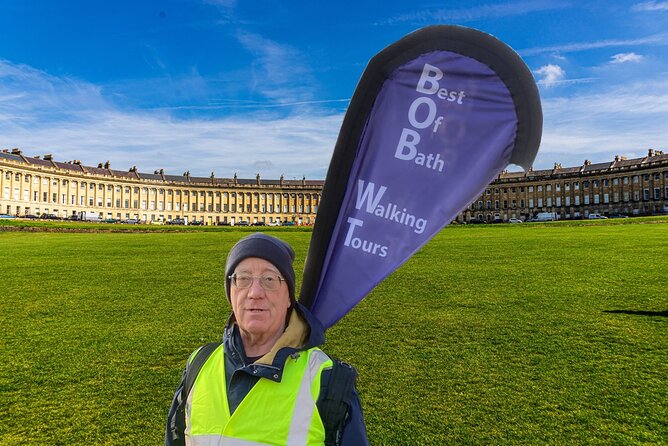
Bob is the central part of this experience. His style is friendly, informal, and lightly humorous. He explains architecture in plain language, answers side questions, and is comfortable admitting when he does not know something rather than pretending otherwise.
That matters on a city walk. A rigid script can make a historic center feel flat, while an overly loose walk can lose its shape. Here, the route stays focused on Georgian Bath but leaves room for questions about other periods, local characters, filming locations, and details just outside the main plan.
The group maximum is 15 people. That is small enough for you to hear the guide and ask questions without needing to fight for attention. It also makes it easier for Bob to adjust the pace and check that everyone is keeping up.
The tour is not built around theatrical costumes or staged entertainment. Its appeal is the combination of solid local detail, humor, and a clear walking route. You get an informed introduction without the heavy feel of a formal lecture.
Price, Timing, and What You Actually Receive
At $27.73 per person, the tour is reasonably priced for a two to three-hour guided walk through Bath’s central sights. The value comes from the amount of ground covered and the interpretation between landmarks, not from included admissions.
You should budget separately for the Roman Baths, Assembly Rooms, No. 1 Royal Crescent, and any other indoor attractions you choose to visit. This is not a ticket bundle. It is a city orientation and architecture walk.
The tour is a particularly good deal if you have only one day in Bath or want to get your bearings before exploring on your own. It can save you from walking past important buildings without understanding them, and it may help you decide which interiors deserve your limited time.
The experience requires good weather and a minimum number of participants. If poor weather or low enrollment causes cancellation, you can choose another date or receive a full refund. You can also cancel up to 24 hours before the start time for a full refund, while later cancellations are not refunded.
Who Should Book the Georgian Tour
I would choose this walk if you want to understand Bath rather than simply photograph it. It suits first-time visitors, architecture fans, readers interested in Georgian society, and anyone who likes local stories mixed with practical sightseeing.
It is also a good choice if you have already walked around Bath and feel you may have missed the point of some buildings. The route covers the headline landmarks, but Bob also calls attention to old paths, walls, side details, and locations that are easy to overlook.
You should think twice if you want extensive time inside the Roman Baths or Assembly Rooms. The tour only pauses briefly at those places, and admission costs extra. It may also be less suitable if you have difficulty walking for two or more hours, although the pace is described as comfortable and moderate fitness is the stated expectation.
Service animals are allowed, and the meeting point is near public transportation. The route ends where it begins, which keeps the rest of your day simple.
Should You Book Best of Bath Walking Tours?
Yes, if you want a well-priced introduction to Bath’s Georgian center and prefer a guide who can explain why the buildings look the way they do. Bob’s strengths are his local knowledge, humor, patience with questions, and ability to connect famous landmarks with less obvious traces of the older city.
Book it early if your schedule is fixed, since the tour is often reserved around four weeks ahead. Choose this experience before an independent visit to the Roman Baths if you want context first, or use it as a complete outdoor overview when your time is short.
Skip it only if you mainly want indoor admissions, a private tour, or a very short sightseeing circuit. For most people who want Bath’s architecture to make sense, this is a practical and personable way to spend an afternoon.
FAQ
How long does the Georgian walking tour last?
The tour is scheduled for approximately two to three hours. The main walk is described as taking about two hours, but it may run longer when the group asks additional questions.
Where does the tour start?
The meeting point is Abbey Churchyard, Bath BA1, in front of Bath Abbey. The tour starts at 1:00 pm.
Where does the tour finish?
The walk ends back at Abbey Churchyard, the same place where it begins.
Are admission tickets included?
Admission is not included for the Roman Baths, Royal Mineral Water Hospital, Assembly Rooms, or No. 1 Royal Crescent. The tour includes the guided walking experience and outdoor stops.
How large is the group?
The maximum group size is 15 people. This allows for a more personal walk and easier communication with the guide.
What happens if the weather is poor?
The experience requires good weather. If it is canceled because of poor weather, you will be offered a different date or a full refund.
New routes in the UK
- Belfast Political Tour-Conflicting Stories Walking Tour★ 4.5 · 459 reviews
- Best of Belfast Walking Tour★ 5.0 · 399 reviews
- The Real Story of Belfast walking tour with a local guide★ 5.0 · 144 reviews
- Belfast Troubles Murals Street Art and Peace Wall Walking Tour★ 5.0 · 163 reviews
- Belfast Centre Food Tour of 12+ Local Irish Dishes & Drinks★ 5.0 · 266 reviews
- BATH: 2-Hour Bath Walking Tour of Bridgerton Filming Locations★ 5.0 · 99 reviews
- Bridgerton Walking Tour of Filming Locations & Storylines – Bath★ 4.5 · 178 reviews
- Bad of Bath fun Walking Tour of Bath★ 5.0 · 402 reviews
Bath Walking Tours, compared.
Walking Tour of Bath with Blue Badge Tourist Guide
Read our review →
City Walking Tour with Optional Roman Baths Entry
Read our review →
Bridgerton Filming Locations Walking Tour with Music
Read our review →
Private Bridgerton Walking Tour for upto 20 people
Read our review →Browse the lists this tour appears in