
Review · ROME
Alternative Walking Tour of Rome’s City Center & Hidden Gems
Rome’s most interesting stories are often found beside the famous sights, not inside the guidebook checklist. This 2.5-hour walk connects Trajan’s Column, Trevi Fountain, the Pantheon, and Piazza Navona with tales of powerful families, papal politics, crime, betrayal, and art.
I like the way the tour mixes major monuments with lesser-known churches and private or restricted areas when access allows. I also like the guides’ lively style. Simone, Jacopo, Iris, and Jacob are repeatedly praised for clear explanations, humor, energy, and an easy willingness to answer questions. The main thing to consider is the tip-based price: the advertised amount is very low, but you should budget a separate tip, commonly around €10 to $50.
Key points at a glance
- Trajan’s Column sets the historical scene: Begin beside one of Rome’s great ancient monuments before moving into the city’s later political and religious layers.
- Famous sights get a different story: Trevi Fountain, the Pantheon, and Piazza Navona are explained through power, propaganda, family rivalries, and artistic ambition.
- The focus is on people and dynasties: Expect stories about the families and individuals who shaped Rome, not just dates and architectural labels.
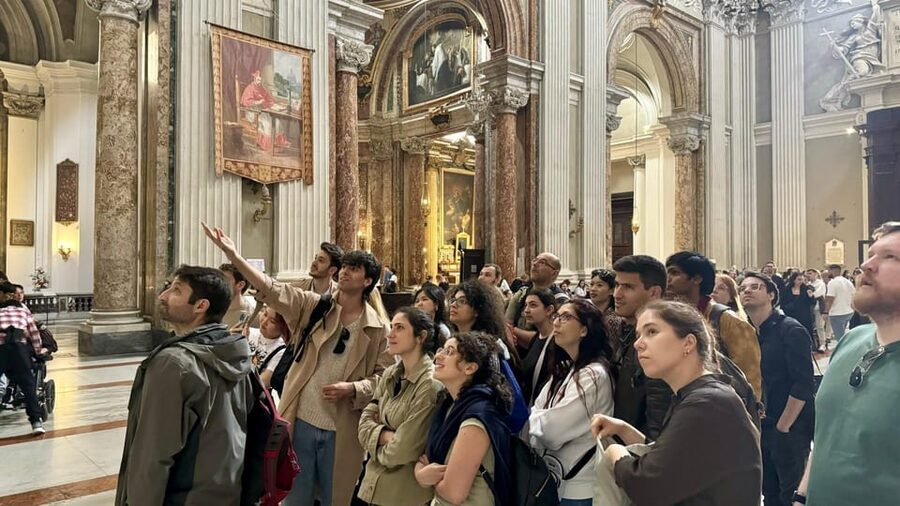
- Church interiors add welcome surprises: Sant’Ignazio di Loyola and a monastery stop bring in illusionistic art, religious politics, and lesser-known details.
- The guide makes or breaks the experience: Simone, Jacopo, Iris, Jacob, and other named guides are praised for humor, clarity, and strong storytelling.
- The tip is part of the real cost: The booking price is only the starting point, so decide in advance what the walk is worth to you.
Why this Rome walking tour feels different
This is not an alternative route that avoids Rome’s big names. You still see the monuments most first-time visitors want, but the angle is different. Instead of simply hearing when a fountain was built or who painted a ceiling, you hear how power worked around it.
The tour looks at Rome through its families, emperors, popes, artists, invaders, and political operators. That gives the walk a useful human scale. A church becomes more than a religious building. A fountain becomes a public message. A grand square becomes a stage for status and rivalry.
The tone is lively, and dark humor is part of the sales pitch. That will suit you if you enjoy stories about scandals, corruption, murder, war, and betrayal delivered with a wink. If you prefer a quiet, strictly academic account of Roman history, the jokes may not be your style.
The guides also respond to the group. Jacopo is praised for branching into other topics and regions when questions come up. Simone is praised for explaining Latin and Ancient Greek inscriptions. Several guides are described as speaking clearly enough to be heard in noisy places, and one guide was especially appreciated for avoiding headphones and keeping the conversation face to face.
More Hidden Gems Walking Tours in Rome:
- Rome: Paranormal Night Walking Tour & Secret Backstreets
★ 4.9 · 1,921 reviews - Rome Walking Tour: Pantheon, Trevi, Navona & Hidden Gems
★ 4.8 · 501 reviews - Rome Highlights & Hidden Gems Guided Walking Tour
★ 4.8 · 280 reviews
Starting beside Trajan’s Column
Meet on the church steps at Chiesa del Santissimo Nome di Maria al Foro Traiano, next to Trajan’s Column and Trajan’s Forum. Look for a guide holding a sign with the tour name.
This is a strong starting point because Rome’s layers are visible before you take a single step. Trajan’s Column records a military campaign in carved stone, while the surrounding forum shows how emperors used architecture to project authority. Your guide uses this setting to introduce the forces that shaped Rome and the powerful families who later fought to control its story.
The scheduled stop lasts about 15 minutes and includes time for photographs, explanation, and a short walk. Wear shoes with a decent grip. The tour covers several central streets and squares, and Rome’s paving stones can be hard on thin soles.
Piazza Venezia and the politics of public space
The next stop is Piazza Venezia, a brief five-minute sightseeing pause. It may sound short, but that is useful on a walking tour with many stops. You get the setting and the explanation without spending half an hour on a single monument.
Here the guide can connect ancient Rome with later political power and urban change. The point is less about entering a building and more about understanding how Rome’s central spaces were shaped by rulers, institutions, and public display.
Do not expect long free time at every location. This is a moving narrative, not a series of museum visits. Keep your group in sight and listen for instructions before the walk continues.
A secret stop and a monastery visit
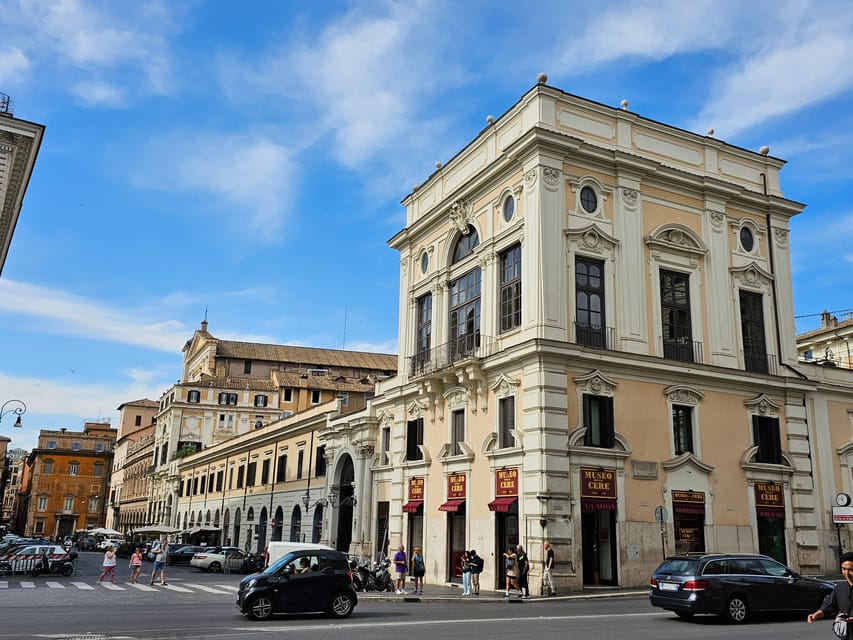
The itinerary includes a short secret stop of about five minutes, followed by approximately 25 minutes at a monastery. The exact secret location is not identified in the supplied details, so you should treat it as a surprise rather than planning your day around a specific sight.
That uncertainty is part of the appeal. The tour promises access to places and details that are not part of the usual Rome circuit, and one account describes a guide persuading a priest to allow the group to see something not normally open to the public. Access like this can depend on the day, the site, and local permission, so it should not be treated as guaranteed.
The monastery stop is likely to be the most substantial lesser-known section of the walk. This is where the tour’s focus on church power, architecture, and everyday Roman life comes together. You may hear why Rome has so many churches, how religious institutions shaped the city, and how old buildings can hide details that are easy to miss when walking alone.
The tour information also says admission to papal private gardens is included. Because the listed route does not clearly identify where that admission fits, confirm the current details when booking if this feature matters to you.
More Walking Tours in Rome:
- Rome: Guided Food Walking Tour with Wine in Trastevere
★ 4.9 · 3,105 reviews - Rome: Trastevere & Campo de Fiori Street Food Walking Tour
★ 4.9 · 2,768 reviews - Rome: Trastevere Street Food Walking Tour with Local Expert
★ 4.8 · 1,784 reviews - Rome: Small-Group Guided Day or Night Walking Tour
★ 4.8 · 1,009 reviews
Trevi Fountain beyond the usual photograph
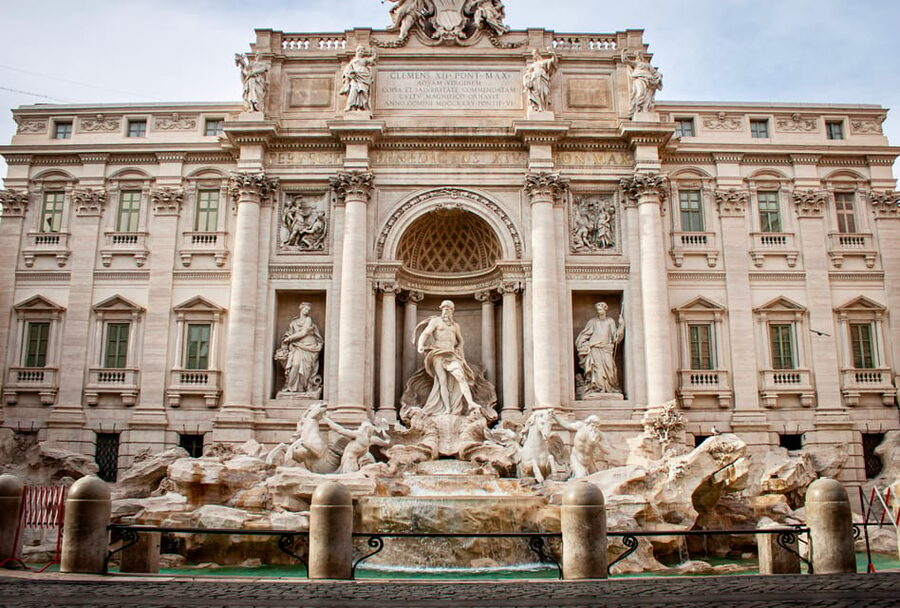
Trevi Fountain gets about 15 minutes, including a break, photographs, guided explanation, and free time. The stop gives you a chance to see one of Rome’s most famous theatrical spaces while learning why fountains were used as signs of authority and public generosity.
You will have time for pictures, but this is not a long pause for sitting or people-watching. Trevi can be crowded, and the guide’s job is to keep the story moving while helping the group stay together.
I like this stop because the tour does not treat the fountain as a stand-alone photo backdrop. The broader theme is how Rome’s rulers and institutions used water, stone, sculpture, and spectacle to make power visible. That idea also helps explain other fountains you will encounter later in the city.
Sant’Ignazio and Rome’s optical tricks
The Church of Sant’Ignazio di Loyola receives about 10 minutes. This is one of the stops that makes the walk more than a standard tour of Rome’s outdoor monuments.
The church is known for its striking ceiling fresco, and the stop gives the guide room to discuss art, religion, and the visual strategies used inside Roman churches. You may hear how architecture and painted illusion can make a space appear larger or more dramatic than it really is.
This is also a good example of the tour’s promise to show you places you might miss on your own. You can pass a church in Rome without realizing what is inside. A short guided visit changes the way you look at the city’s countless facades.
The Pantheon in five minutes
The Pantheon is listed as a five-minute guided stop with photographs and a short walk. That is enough for orientation and key facts, but it is not enough for a leisurely interior visit or a detailed architectural study.
Plan your expectations accordingly. The guide will help you understand why the building matters and how it fits into Rome’s long development, but the schedule does not provide extended independent time inside. If you want a slow look at the Pantheon, return later on your own.
This brief format can work well for a first orientation. You see the building, hear the main story, and avoid using the entire tour on one famous monument. It is less suitable if your main goal is to study the Pantheon in detail.
Piazza Navona, Bernini, and the final stories
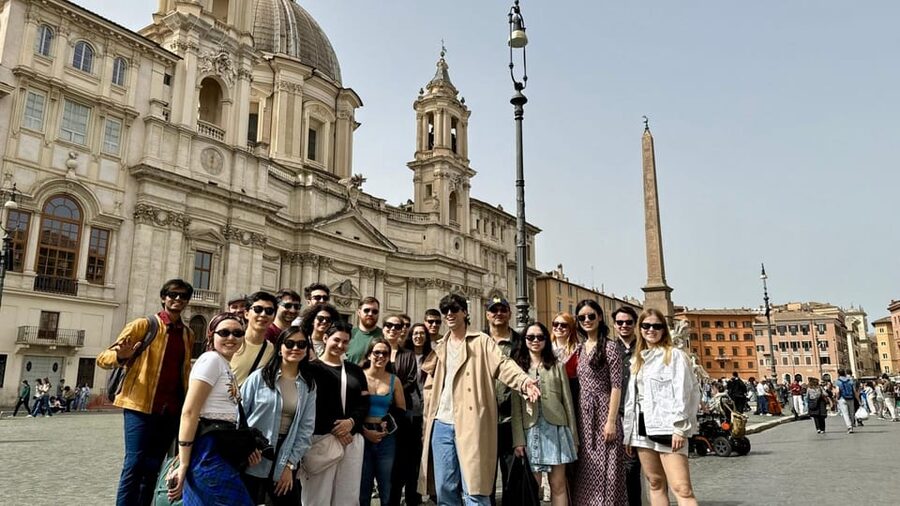
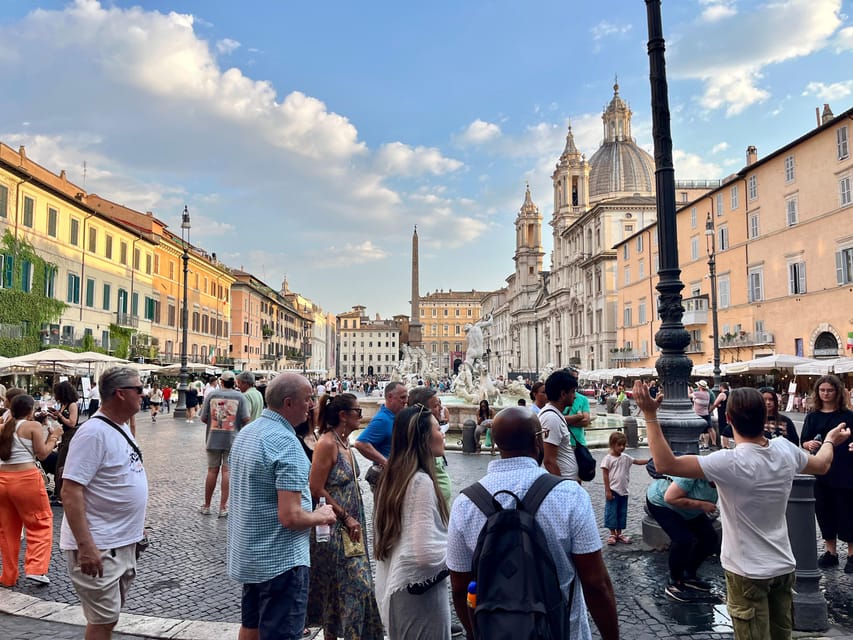
The walk ends at Piazza Navona after about 15 minutes of sightseeing, photographs, and walking. This is a satisfying finish because the square brings together ancient urban planning, Baroque design, fountains, church architecture, and public life.
The guide can tie the walk’s main themes together here: family influence, papal ambition, art as propaganda, and the way Rome keeps building over its older foundations. Piazza Navona is not just a pretty place to finish. It is a useful final example of how Rome’s rulers turned public space into a display of power.
You are left in a practical location for continuing your day. The tour ends in the square, not back at the starting church, so plan your next stop from Piazza Navona.
How the storytelling affects the experience
The strongest part of this tour is the guide’s delivery. The subject matter is broad, but the best guides give it shape through people and conflict. Simone is often praised for energy, humor, and careful explanations. Jacopo is noted for family history, ancient Rome, art, and easy-to-understand English. Iris is praised for combining information with humor, while Jacob is described as clear, kind, and well paced.
The guide names may vary by date, and the exact feel of the tour may change with the person leading it. That is worth keeping in mind. The route gives a solid framework, but the guide determines how much attention goes to dynasties, art, church history, food culture, or local customs.
The pace is designed to keep you moving without overwhelming you. One account describes a comfortable pace and a small group, while another mentions a private experience with no other participants. Group size can change, so do not book on the assumption that every departure will be private or intimate.
Questions are welcome. The guides are described as open to discussion, and some continue into related topics when the group shows interest. That is a major advantage if you prefer a conversation rather than a memorized speech.
What the low price really means
The listed price of $3.77 per person looks remarkably cheap, but this is a tip-based tour. The guide works primarily for gratuities, and you are asked to decide what the experience was worth at the end.
The suggested range is usually €10 to $50. That is a wide spread because the final amount depends on group size, your budget, the quality of the guiding, and how much value you place on the experience. A family or couple should think about the total tip before booking, not just the small advertised charge.
At the lower end, the tour can be an excellent-value introduction to central Rome. You get a live guide, a planned route, major sights, lesser-known stops, and historical context without paying the price of a conventional private tour. At the higher end, the total cost can approach that of other guided walks, so compare the experience rather than focusing only on the booking figure.
Payment can be made by cash or card according to the supplied information. If you like knowing the full cost upfront, this payment model may feel less comfortable. If you appreciate flexibility and want to set the amount yourself, it can work well.
Who should book this walk
I would recommend it for a first visit if you want a strong introduction before exploring Rome on your own. It gives you the basic map of the historic center while showing how the city’s monuments connect to politics, religion, family power, and artistic competition.
It is also a good choice for repeat visitors. One participant who had already seen Rome’s major sights used the walk to find new places and left with ideas for a future visit. That is exactly where the tour earns its alternative label: not by avoiding Trevi or the Pantheon, but by adding context and less familiar stops.
History fans, art lovers, and people who enjoy scandalous stories will get the most from it. It also suits anyone who finds standard date-heavy tours dull. The jokes and occasional dark subject matter make the walk more conversational.
You may want a different tour if you need long interior visits, a fully fixed schedule, or detailed archaeological treatment of one site. The walk covers a lot in 2.5 hours, so each stop is selective. For the Colosseum, Roman Forum, Vatican Museums, or a detailed Pantheon visit, choose a dedicated tour instead.
Book comfortable shoes, bring water, and allow time for crowds around Trevi Fountain. English and Spanish departures are available. Cancellation is free up to 24 hours before the experience, and you can reserve now and pay later, which helps if your Rome plans are still shifting.
Should you book the Rome alternative walking tour?
Book it if you want Rome explained through its characters and power struggles, with famous monuments used as chapters in a larger story. The route is well chosen, the guides are repeatedly praised for humor and clarity, and the combination of major sights with churches and surprise stops gives you more than a simple orientation walk.
Go in knowing that the advertised price is not the full financial picture, the exact guide may vary, and special access cannot be guaranteed every time. With those points clear, this is a strong-value choice for curious first-time visitors and repeat visitors who want Rome to feel less familiar.
FAQ
How long does the walking tour last?
The tour lasts 2.5 hours.
Where does the tour begin?
It begins on the steps of Chiesa del Santissimo Nome di Maria al Foro Traiano, beside Trajan’s Column and Trajan’s Forum.
Where does the tour end?
The tour ends at Piazza Navona.
Which languages are available?
The live tour is available in English and Spanish.
Is the tour tip-based?
Yes. The guides work on a pay-what-you-want model and rely on tips. The usual tip is stated as approximately €10 to $50.
Which sights are included?
The route includes Trajan’s Column, Piazza Venezia, a secret stop, a monastery, Trevi Fountain, the Church of Sant’Ignazio di Loyola, the Pantheon, and Piazza Navona. Admission to papal private gardens is also listed as included.
New routes in Rome
- Rome: Colosseum and Ancient Rome Guided Walking Tour★ 4.5 · 95 reviews
- Rome Walking Tour: Pantheon, Trevi, Navona & Hidden Gems★ 4.8 · 501 reviews
- Rome: Guided Walking Tour and Pantheon Priority Entry Ticket★ 4.3 · 317 reviews
- Rome: Trastevere Food Walking Tour with Beer and Wine★ 4.9 · 71 reviews
- Rome: Trevi Fountain, Spanish Steps & Pantheon Walking Tour★ 4.6 · 336 reviews
- Rome: Underground Trastevere Guided Walking Tour★ 4.8 · 87 reviews
- Rome: Relics from the Passion of the Christ Walking Tour★ 4.9 · 84 reviews
- Rome: Trastevere and Roman Ghetto Guided Walking Tour★ 4.7 · 79 reviews
Rome Walking Tours, compared.

Guided Food Walking Tour with Wine in Trastevere
Read our review →
Trastevere & Campo de Fiori Street Food Walking Tour
Read our review →
Paranormal Night Walking Tour & Secret Backstreets
Read our review →
Colosseum Arena, Roman Forum & Palatine Hill Tour
Read our review →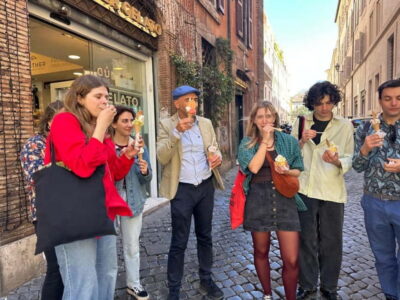
Trastevere Street Food Walking Tour with Local Expert
Read our review →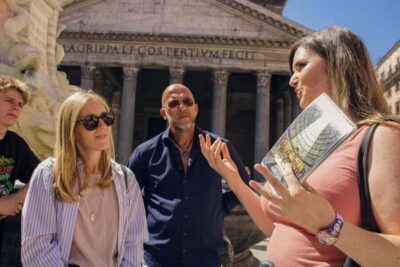
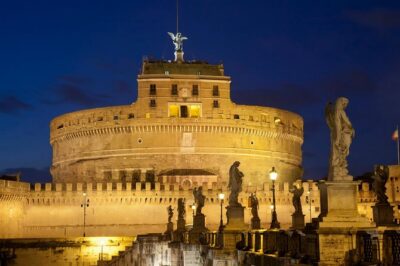
Rome by Night Walking Tour – Legends & Criminal Stories
Read our review →
Rome Food Tour in the Historic Centre with 8+ Food Tastings
Read our review →Browse the lists this tour appears in