
Review · PHILADELPHIA
The Constitutional Walking Tour of Philadelphia
Philadelphia’s founding story comes alive block by block on this brisk walk through Independence National Historical Park. In about 75 minutes, you pass the places where the Declaration of Independence, the Constitution, and the early federal government took shape, from Independence Hall to Franklin’s former home.
I like the wide sweep of the route and the chance to see more than 20 important sites without spending half a day on one museum. I also like the guides’ personal touch. PJ, Connor, Will, Avi, John, Michael, and others have been praised for clear explanations, lively stories, and a willingness to answer questions.
The main catch is simple: this is an outdoor overview, not an admission tour. You see the Liberty Bell Center and Independence Hall from the outside, and you do not enter the historic buildings during the walk. If you want interiors, plan separate visits and allow extra time.
Key points to know before you book
- A 1.25-mile introduction to Philadelphia’s founding district: You cover a remarkable number of sites in a compact area.
- Nineteen named stops, plus nearby historic landmarks: The route includes Independence Hall, Franklin Court, Carpenters’ Hall, Christ Church, and more.
- Outdoor sightseeing only: Admission to historic buildings and museums is not included.
- A brisk 75-minute pace: There are stops to listen and catch your breath, but few places to sit.
- $30 per person: The price is fair if you want orientation and historical context before exploring on your own.
- Rain or shine: Wear shoes and clothing that match the forecast, and check in outside the National Constitution Center 15 minutes early.
What this Philadelphia walk really covers
This tour is best understood as a first look at Philadelphia’s historic core. You move through the area where the United States was debated, declared, organized, and governed during its earliest years.
The route is only about 1.25 miles, but the subject matter is large. You will hear about the Declaration of Independence, the Constitution, the first national capital, early American finance, religious life, military organization, slavery and freedom in the young republic, and the people who shaped the city.
The guide keeps the group moving from one landmark to the next. That makes the tour useful on a first day in Philadelphia, when you want to get your bearings quickly and decide which sites deserve a longer visit.
You should not expect a slow architectural walk or a detailed museum lecture. The guide has roughly 75 minutes to cover more than 20 locations. Some stops last only two or three minutes, so the value comes from the connections between places rather than from a long talk at any single building.
More Walking Tours in the USA:
- History and Hauntings of Salem Guided Walking Tour
★ 5.0 · 14,564 reviews - New Orleans Premier Ghost, Voodoo and Vampire Walking Tour
★ 4.5 · 12,856 reviews - Little Havana Food and Walking Tour in Miami
★ 5.0 · 8,882 reviews
Meeting outside the National Constitution Center
The walk begins at 525 Arch Street, directly outside the main entrance of the National Constitution Center. Look for the three large stone benches. You do not meet inside the museum.
This detail matters. One unhappy customer went into the Constitution Center, received information for the museum, and missed the outdoor walking tour. The operator says the guide was waiting outside and tried to make contact before the group left. Arrive at least 15 minutes early, and if you are unsure, ask for the outdoor meeting point rather than entering the building.
The group can include up to 40 people. That is not a tiny private walk, so your ability to hear may depend on where you are standing. Traffic, wind, and street noise can also make a soft or fast-speaking guide harder to follow. Stay near the guide, especially at busy corners.
The tour ends back at the same meeting point. That is convenient because you can then head into the Constitution Center, visit Independence Hall, or return to any stop that caught your interest.
The first stops: government, Jefferson, and the Liberty Bell
The National Constitution Center provides the opening setting and a short introduction. Since admission is not included, you see the exterior and use the location as your starting point.
Next comes the President’s House site, an open-air memorial marking the place where George Washington and John Adams lived while Philadelphia served as the national capital from 1790 to 1800. It is a useful reminder that the White House did not always sit in Washington, D.C. The stop also gives you a quick look at the complicated early republic, including the presence of enslaved people in the household of the first president.
At Declaration House, also called the Graff House, the guide points out the location where Thomas Jefferson lived while writing the Declaration of Independence. The stop is brief, but its importance is clear: you are standing near the physical setting of one of the country’s most familiar founding documents.
The Liberty Bell Center is next. You see the building and learn about the bell as an American symbol, but you do not enter to view the bell. Security lines can take considerable time, and the tour is too short to include that process. If the bell is a priority, return later and allow time for the separate visit.
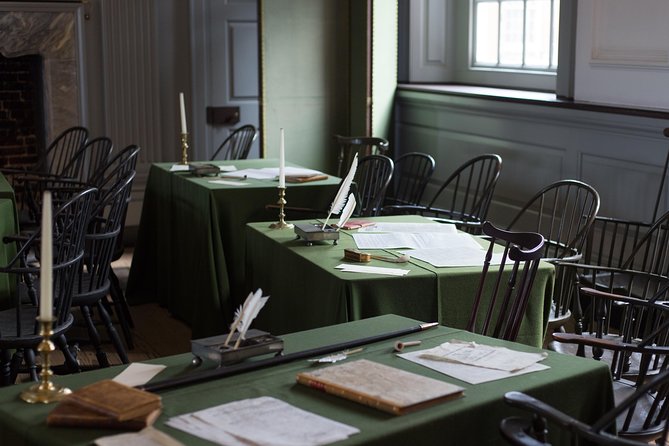
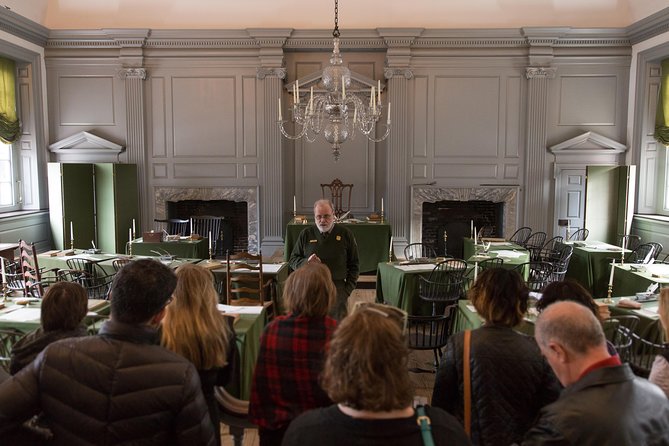
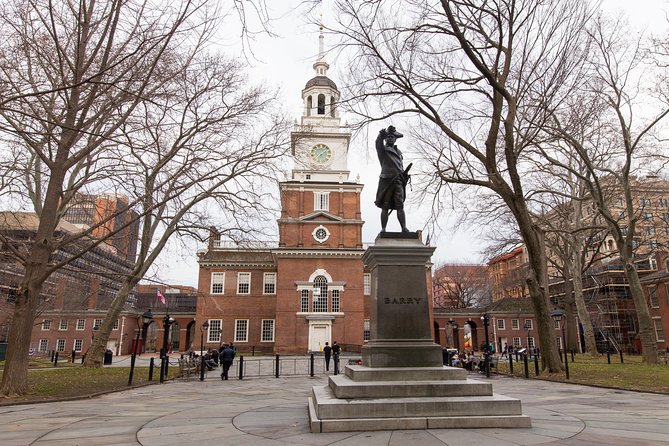
Independence Hall receives the same treatment. You see the exterior of the building where the Declaration of Independence and the United States Constitution were created. Entry requires its own arrangements, and an interior visit is not part of this walking tour.
This is the point where you need to set your expectations correctly. The route includes the Liberty Bell and Independence Hall as landmarks, but not as inside attractions. The distinction is clear once you know it, yet the tour name and marketing can lead some people to expect admission.
Congress Hall, Old City Hall, and the early federal government
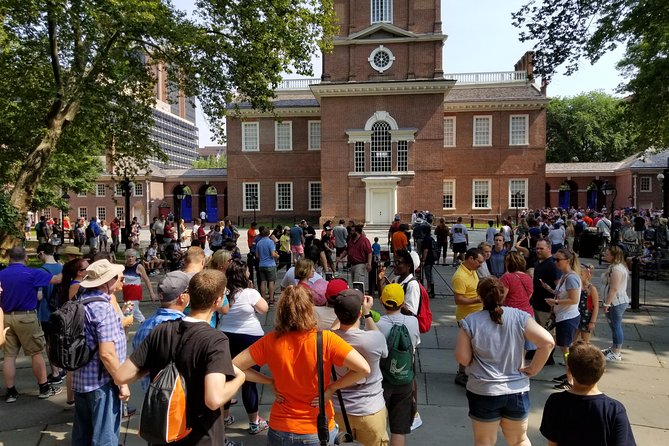
The walk continues to Congress Hall, built as the Philadelphia County Courthouse and used as the United States Capitol from 1790 to 1800. This stop helps explain how a new national government operated before Washington, D.C. was ready.
Old City Hall follows. The building once housed the United States Supreme Court, a reminder that the early federal government occupied a small, concentrated part of Philadelphia. The guide then points out The Signer, a statue inspired by George Clymer, one of the men involved in the founding era.
These stops are not flashy, but they add useful context. Independence Hall is the famous symbol. Congress Hall and Old City Hall show how the machinery of government worked around it.
The American Philosophical Society Museum is identified as the country’s oldest scholarly society. Nearby Library Hall recalls the nation’s first public library and the former Library of Congress. Together, these stops widen the story beyond presidents and military heroes.
That is one of the route’s strengths. You are not shown only the places where famous speeches were made. You also hear about libraries, science, scholarship, and the institutions that helped the new nation exchange ideas.
Same streets, a different guide:
- Chicago: Gangsters and Ghosts Walking Tour
★ 5.0 · 7,155 reviews - Boston: Freedom Trail History Small Group Walking Tour
★ 5.0 · 6,450 reviews - Historic Charleston Guided Sightseeing Walking Tour
★ 5.0 · 6,216 reviews - New Orleans Food Walking Tour of the French Quarter with Small-Group Option
★ 5.0 · 6,118 reviews
Banks, debates, and the financial birth of the United States
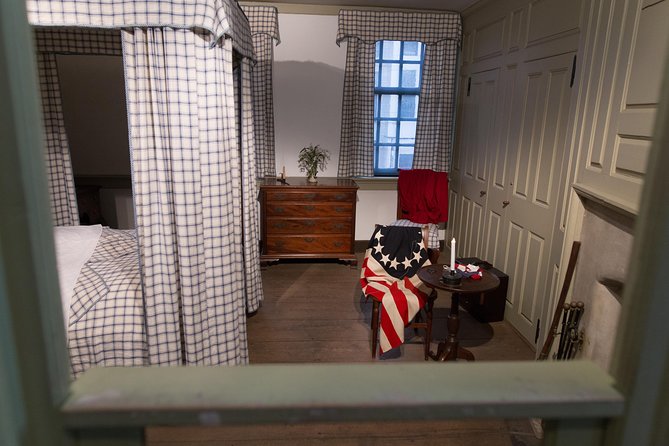
The Second Bank of the United States is now a portrait gallery, but its original role was financial and political. The guide uses it to explain the power of early American banking and the arguments over how much authority the federal government should have.
At Carpenters’ Hall, the focus shifts to the First Continental Congress. The building is tied to the early American identity because representatives met there before independence was declared. Its modest scale makes the political risk of those meetings easier to imagine.
The New Hall Military Museum interprets the role of the military in early United States history. Then you pass the First Bank of the United States, a place connected to one of the first major constitutional disputes.
The route does not give you enough time for a full treatment of Alexander Hamilton, federal power, state authority, and banking policy. It does give you the basic framework, which can make a later visit to the First Bank or the National Constitution Center more meaningful.
I find this section particularly useful if you know the familiar Revolutionary War story but want to understand what happened after independence. Philadelphia was not only the place where the country was declared. It was also where the new government struggled to define its powers.
Franklin Court and the city’s colonial character
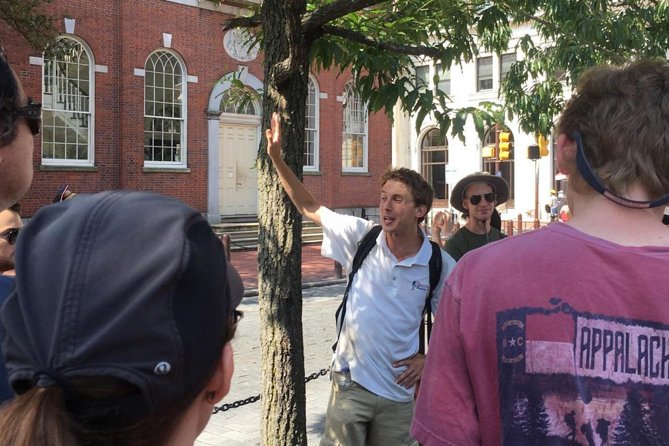
Franklin Court is one of the longer stops, with about five minutes devoted to the site. It marks the location associated with Benjamin Franklin’s home and includes the only Colonial-themed post office.
You do not enter a reconstructed Franklin house during this tour. Instead, you receive the setting and the main idea: Franklin’s life linked printing, science, diplomacy, civic projects, and international politics.
This stop often works well for families because Franklin’s story connects practical inventions with public life. It also gives the guide a chance to move away from the narrow sequence of battles and documents.
From Franklin Court, the route reaches Christ Church, an active parish dating to 1695 and often called the Nation’s Church. The building’s importance comes from the people associated with it and from the role of religion in early Philadelphia.
The outside stops are short, so anyone wanting architectural details or a closer look inside should return afterward. The route gives you the historical address. Your separate visit supplies the time to look around.
Betsy Ross House, Quaker Philadelphia, and Franklin’s grave
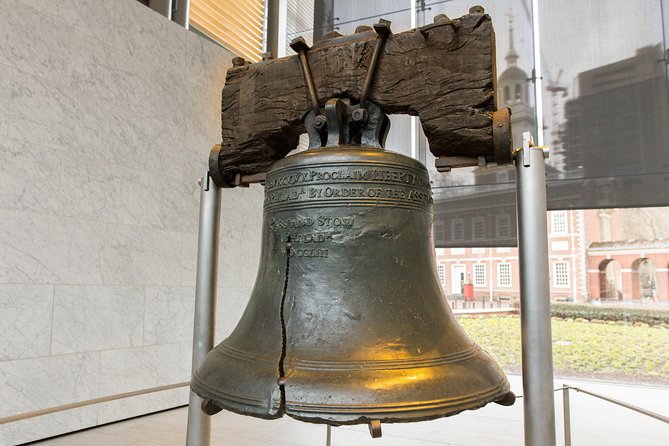
The Betsy Ross House is one of the most recognizable stops on the route. The traditional story connects Ross with sewing the first Stars and Stripes. The guide points out the house, but you do not enter as part of the $30 tour.
The stop is useful, though it deserves a careful approach. The familiar story is part of Philadelphia’s popular memory, while the documentary record is more complicated. A good guide can explain the difference between tradition and firm evidence without turning a quick stop into a long argument.
The Arch Street Meeting House introduces the Society of Friends, or Quakers, and their role in Philadelphia. This is another place where the tour broadens its focus. The city’s founding story includes religious communities, civic groups, and ordinary institutions, not only the men whose names appear in schoolbooks.
The last named stop is Christ Church Burial Ground, where Benjamin Franklin is buried. The cemetery also contains the graves of other early American figures. You may want to return later to look at the markers at your own pace, since the walking tour moves on after a short explanation.
Ending near Franklin’s grave is a fitting close. The route has moved from the national government to finance, religion, science, printing, and public life, and Franklin’s career touches nearly all of those subjects.
Guides, storytelling, and the pace of the walk
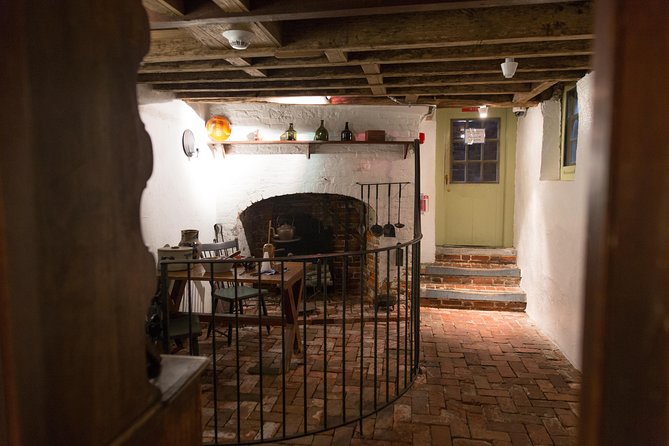
The quality of a short history tour depends heavily on the person holding the group together. The strongest guides on this experience are described as friendly, focused, energetic, and comfortable with questions.
PJ has been praised for warmth and clear answers. Connor is especially well regarded for combining strong historical knowledge with a calm, nonpartisan presentation. Will is described as enthusiastic and attentive to the group, while Avi has been noted for mixing stories with historical facts. John, Michael, Viv, Abby, and Jon have also led tours that visitors found useful and engaging.
You may not get the same guide on every departure, so the tone can vary. One guide may perform more than explain. Another may speak quickly or quietly, which can be a problem near traffic. The overall rating is 4.7 from 902 ratings, and 92 percent of customers recommend the experience, but those numbers should not make you expect a private seminar.
The best way to get more from the tour is to stay close, ask questions when the guide pauses, and take brief notes about the places you want to revisit. The route is designed to spark follow-up visits, not replace them.
Is $30 a fair price?
At $30 per person, I consider this a reasonable orientation tour. You are paying for a guide, a planned route, and a coherent explanation of a district that can otherwise feel like a collection of old buildings.
The value is strongest if this is your first visit to Philadelphia or if you want to understand how the sites relate to one another. The price is less attractive if you already know Independence National Historical Park well or prefer to explore at your own pace with a guidebook.
No food, drinks, or admission fees are included. The major sites may require their own arrangements, and the tour does not get you past security or into the buildings. Treat the $30 as the cost of the guided introduction, then budget separately for the interiors that matter most to you.
Practical advice for weather and comfort
The tour operates in rain or shine. Wear supportive walking shoes, bring water, and dress for the forecast. There are stops where you can pause, but few places to sit, so this is not the right choice if you need frequent seated breaks.
A sunny day can make the paved streets feel tiring, especially in warm clothing. A cold or wet day does not cancel the tour, but it can make it harder to hear and less pleasant to linger. A hat and lightweight clothing help in warm weather, while rain protection is essential in poor weather.
Most people can participate, and the walk is not described as strenuous. Still, the pace is steady and the route involves standing outdoors. Plan around that rather than assuming this is a hop-on, hop-off sightseeing experience.
Free cancellation is available if you cancel at least 24 hours before the start time. Changes or cancellations made inside that window are not accepted for a refund.
Who should book this walk?
I would choose this tour for a first-time Philadelphia visitor, a family with older children, a history-minded couple, or anyone who wants a short introduction before selecting museums and historic interiors.
It is also a good fit for locals who want a refresher. The route connects places you might otherwise pass without understanding, and even a Philadelphia history professor could find a few useful links in the story.
I would skip it if your main goal is to enter Independence Hall or see the Liberty Bell up close during the same booking. In that case, reserve those attractions separately and use this walk only if you want a broader outdoor orientation.
My verdict: book it for context, not admission
Book this Constitutional Walking Tour if you want a brisk, well-organized introduction to Philadelphia’s founding district for $30. The route covers a great deal in 75 minutes, and a strong guide can turn familiar names into a connected story.
Just remember what you are buying. You will see the exteriors of Independence Hall, the Liberty Bell Center, Franklin Court, Carpenters’ Hall, Betsy Ross House, and many other landmarks. You will not tour the interiors. Arrive early at the three stone benches outside the National Constitution Center, wear good shoes, and plan a second round for the sites that deserve more time.
FAQ
How long is the Constitutional Walking Tour of Philadelphia?
The tour lasts approximately 1 hour and 15 minutes. The route covers about 1.25 miles.
Where does the tour begin?
It begins outside the main entrance of the National Constitution Center at 525 Arch Street in Philadelphia. Check in by the three large stone benches.
Where does the tour end?
The activity ends back at the National Constitution Center meeting point.
Does the tour enter Independence Hall?
No. The tour stops outside Independence Hall. Admission to the building is not included.
Can I see the Liberty Bell during the tour?
The route stops at the Liberty Bell Center, but admission to the center is not included. You see the site from outside and need to return separately if you want to view the bell.
Are admission fees included?
No. Admission to historic sites is not included, and fees vary by location.
Does the tour operate in bad weather?
Yes. The tour operates rain or shine, so dress for the weather.
How much does the tour cost?
The listed price is $30 per person. Food, drinks, and admission to historic sites are not included.
New routes in the USA
- Baltimore Walking Foodie Tour in Fells Point★ 5.0 · 182 reviews
- The Madam’s Curse Walking Ghost Tour★ 4.5 · 103 reviews
- Austin Small Group Morning Walk★ 5.0 · 412 reviews
- Austin Haunted Pub Crawl Walking Tour★ 4.5 · 232 reviews
- Austin Downtown Private Walking Food Tour With Secret Food Tours★ 5.0 · 71 reviews
- Austin Murder Walk★ 5.0 · 310 reviews
- The Ghosts of Austin Walking Tour★ 4.5 · 72 reviews
- Martin Luther King Jr. History Walking Tour★ 5.0 · 687 reviews
Philadelphia Walking Tours, compared.
Philadelphia Old City Historic Walking Tour with 10+ Top Sites
Read our review →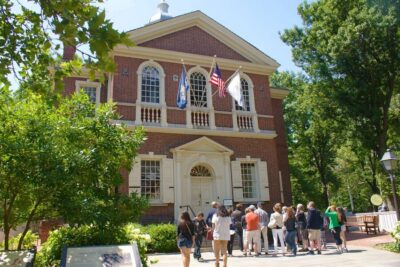
Browse the lists this tour appears in