
Review · BUDAPEST
Budapest City Landmarks Walking Tour in 2 Hours
Budapest reveals itself quickly on this walk: grand churches, riverfront views, palace façades, public art, and the painful memory of the Shoes on the Danube. You move from Erzsébet Square to Parliament, seeing how Pest fits together before you spend the rest of your visit exploring on your own.
I like two things especially. First, the tour mixes famous sights with useful local advice, including what to eat, how to avoid tourist traps, and where to go for restaurants or nightlife. Second, the guide adds small human touches, from Hungarian phrases to the shiny knees of the Little Princess statue.
The main drawback is that this is an outdoor overview, not an in-depth visit to Budapest’s interiors. You do not enter St. Stephen’s Basilica, and a group of up to 30 people can make it harder to hear unless the guide uses a speaker. Wear comfortable shoes and bring water.
Key points to know before you book

- A fast introduction to Pest: The route links the Basilica, Váci utca area, Danube embankment, Chain Bridge, and Parliament.
- Strong practical advice: Guides discuss Hungarian food, restaurant choices, nightlife, Christmas markets, and places to return to later.
- Local details beyond monuments: You learn basic Hungarian, see public art, and hear about inventions and famous Hungarian figures.
- A serious final section: The Shoes on the Danube memorial brings World War II and the persecution of Hungarian Jews into the tour.
- Very low upfront cost: The listed price is $3.63 per person, but guides depend on donations, so plan to tip at the end.
- Best for first-time visitors: The route gives you a map in your head before you tackle Buda Castle, museums, and the city’s baths.
Why this two-hour walk works as a first look at Budapest
This is a city-orientation walk rather than a single-site tour. You cross central Pest from its parks and cafés to the Danube, then follow the river toward Parliament. Along the way, the guide connects architecture, politics, food, language, public art, and the lives of ordinary Hungarians.
That broad approach is useful on your first day. You will not master Budapest in two hours, but you will learn which landmarks deserve a return visit and how the central districts relate to one another. The final stop at Parliament also gives you a practical starting point for planning the next day.
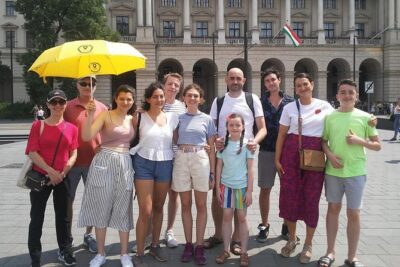
The route is led in English by a licensed local guide holding a small blue flag at the meeting point. Guides named in feedback include Esther, Gary, Dora, Rita, Judith, Andy, Sophie, Marton, Emmy, and Endre. The style can vary by guide, but the most praised qualities are clear explanations, humor, strong local recommendations, and an ability to answer questions without turning the walk into a lecture.
The group can include up to 30 people. That is not a tiny private walk, so stay close to the guide at crossings and crowded squares. A speaker is sometimes used, which helps, but standing near the front still makes sense.
More City Highlights Walking Tours in Budapest:
- Budapest Historical Sightseeing – Free Walking Tour
★ 5.0 · 1,302 reviews - Ho Chi Minh City Street Food Tour & Sightseeing By Motorbike
★ 5.0 · 9,413 reviews - Historic Charleston Guided Sightseeing Walking Tour
★ 5.0 · 6,216 reviews
Erzsébet Square starts the story of central Pest
Meet about 20 meters from the Budapest Eye in Erzsébet Square. This is a sensible starting place because it puts you near public transport, cafés, the central shopping streets, and the first cluster of important sights.
The guide begins with a map and an outline of the route. You get a preview of the major landmarks, along with less obvious backstreets and city details. The opening also sets the tone: this is not only a march from monument to monument. You hear about architecture, society, food, public art, and what Hungarians are actually like.
This introduction takes about 15 minutes, so it is more than a quick roll call of names. Pay attention to the guide’s suggestions here. They can help you decide which places deserve a return visit and which parts of the city fit your interests.
St. Stephen’s Basilica and the food stop
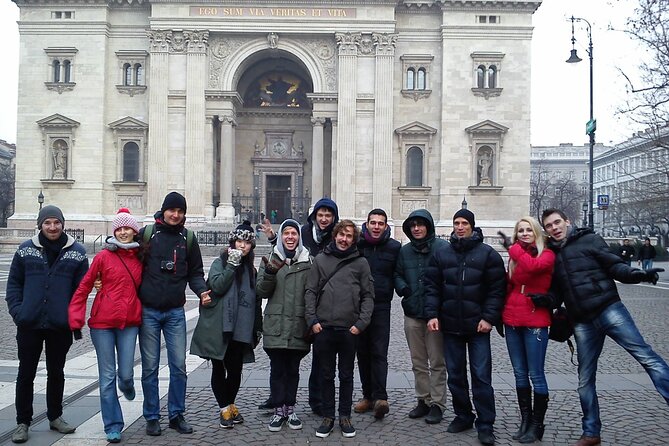
St. Stephen’s Basilica is one of the tour’s first major landmarks. The guide explains its size, including seating for about 8,500 people, and the way its architecture reflects different periods of Budapest’s fortunes.
You will see the exterior and the handsome pedestrian space around it, but you do not go inside the Basilica. That distinction matters if you want to see the interior or climb for a view. Treat this stop as an introduction, then return on your own if the building catches your eye.
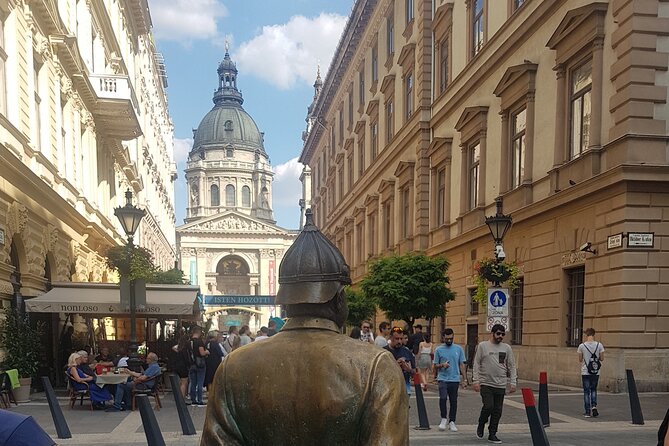
At St. Stephen’s Square, the subject shifts from architecture to food and public art. A humorous statue of fat policemen with shiny bellies opens the door to Hungarian culinary traditions. You learn what to try in Budapest and how to avoid tourist traps.
I like this practical break from formal history. A city tour is more useful when it tells you what to order later, not just who built a building. Guides also offer restaurant suggestions at the end, and several people used those recommendations during their stay.
József Nádor Square and Vörösmarty Square
József Nádor Square brings in the Habsburg period and Hungarian decorative arts. You learn about the Hungarian Habsburg connected with the square and see examples of Herendi porcelain and brightly glazed Zsolnay ceramics.
These details help you notice Budapest’s interiors and shop windows later. Herend and Zsolnay are not just names attached to museum labels. They point to the city’s long interest in design, craft, and grand presentation.
The route then reaches Vörösmarty Square, a broad people-watching area at the end of Váci utca. The guide points out the terminal of the second-oldest underground railway in the world, the elegant Gerbeaud café, and the surrounding neo-classical buildings.
This is also where Budapest’s Christmas markets and seasonal traditions enter the story. If you visit in winter, the information will have direct use. At other times, it gives you a better sense of why this square matters to local city life.
The listed stop is short, only about five minutes, so do not expect a long café break or shopping pause. You get context and orientation. Save your pastry or coffee stop for after the walk.
More Two-Hour Walks in Budapest:
- Berlin’s Best: 2 Hour Walking Tour Third Reich and the Cold War
★ 5.0 · 5,486 reviews - Leipzig: 2-Hour Guided Walking Tour in German
★ 4.8 · 1,612 reviews - Lucca: 2-Hour City Center Walking Tour
★ 4.7 · 1,314 reviews - 2-Hour Bonaventure Cemetery Walking Tour
★ 5.0 · 1,270 reviews
The Danube embankment delivers the big views
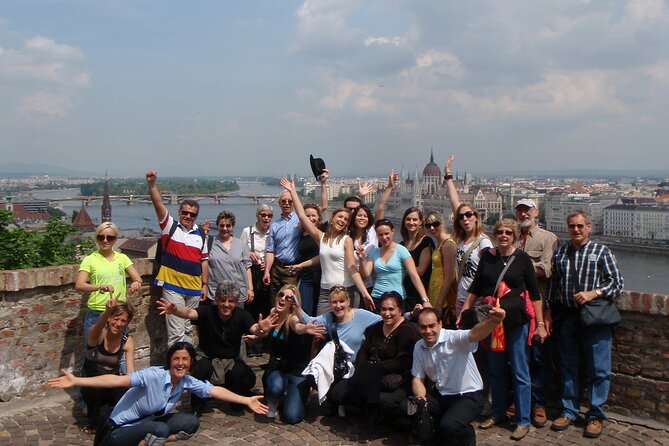
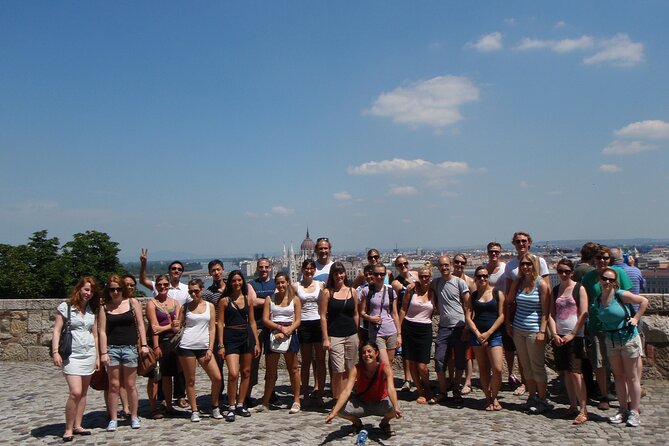
At the Korzó, or Danube embankment, the route opens up. This is one of the most rewarding parts of the walk because you can see across the river toward Buda Castle, Matthias Church, Fisherman’s Bastion, and Gellért Hill with its Citadel.
You also hear about the riverside buildings and the panoramic tram line. The guide points out the first non-Communist statue in Budapest, adding a piece of modern political history to the river view.
Bring your camera, but do not spend the whole stop looking through it. The view helps explain Budapest better than a map can. Buda rises across the water, while the Pest side carries the broad avenues, public buildings, and commercial streets you have just walked through.
At the Little Princess statue, the mood becomes playful. You can touch the statue’s shiny knees while making a secret wish. It takes only a couple of minutes, but it gives the route a welcome human pause after the heavier historical material.
Nearby Vigadó Square connects Budapest to court life and music. This is where a coronation banquet for Franz Joseph and Sissy was held in the 19th century, and where major Central European musicians such as Franz Liszt, Debussy, and Brahms performed.
The short stop will not satisfy a music historian, but it adds another layer to the riverfront. Budapest is not presented only as a capital of buildings and political events. You also see its place in Central European cultural life.
Chain Bridge and Gresham Palace show Budapest’s changing face
The Chain Bridge is more than a fine photo stop. It is the first permanent bridge built in the city and a useful way to understand the old relationship between Buda and Pest.
The guide uses the bridge’s story to explain the two sides of Budapest. That is valuable because many first-time visitors treat the city as one large center without noticing how strongly the river and hills shape it.
You do not cross the bridge as part of this route. Instead, you pause to learn its history and look toward the Buda side. Save a separate crossing for later if you want to walk between the two halves of the city.
At Gresham Palace, the focus shifts to Budapest’s golden age around the turn of the 20th century. The guide introduces the secessionist style, the local form of Art Nouveau, and the building’s decorative details.
This stop is especially helpful if you like architecture but do not know the vocabulary. You learn to look for the ornaments and shapes that make the palace different from the neo-classical buildings at Vörösmarty Square or the neo-Gothic Parliament farther along the river.
Hungarian Academy of Sciences adds language, inventions, and pride
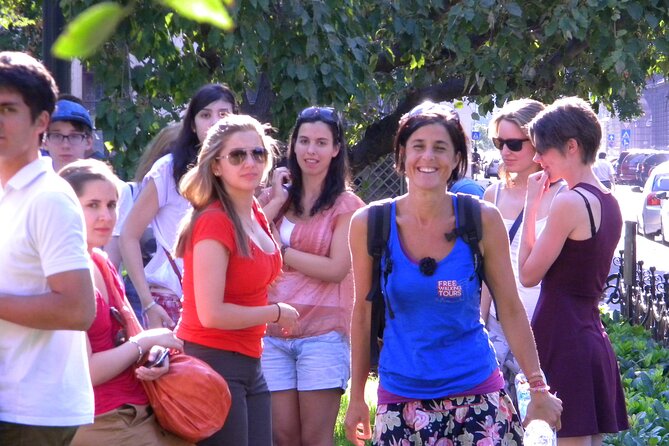
The Hungarian Academy of Sciences provides a natural place for a lighter cultural section. The guide teaches a few Hungarian words and phrases, then explains Hungarian achievements, famous people of Hungarian origin, and inventions used in everyday life.
The point is not to turn you into a Hungarian speaker in eight minutes. It is to give you a few sounds and facts that make conversations and signs feel less foreign. Hungarian can look intimidating on a menu or street sign, so even a little help has value.
This is also where the guide discusses Hungary’s Nobel Prize record per capita. The subject broadens the tour beyond royal buildings and monuments. You get a sense of national pride, scientific achievement, and the complicated question of what counts as Hungarian identity.
The Shoes on the Danube demand a slower pace
The most serious stop comes at the Shoes on the Danube memorial. Sixty pairs of metal shoes recall Jewish people murdered along the river during World War II.
The guide explains the deportations, the killings, and the recent history of Hungary’s Jewish community. You are asked to imagine the individuals represented by the shoes, from older people to children, factory workers to factory owners, religious Jews to assimilated Jewish families.
This is not a place for casual photographs or quick jokes. The memorial is simple, exposed, and powerful precisely because it shows ordinary shoes rather than a grand statue. The stop lasts about eight minutes, but give yourself extra time to return later if you want to reflect without the group around you.
The walk handles an essential part of Budapest’s story that can otherwise be missed during a sightseeing day. Its placement near the end also changes how you see the riverfront. The Danube is not only a beautiful view. It is also a witness to the city’s worst years.
Parliament finishes the route with modern Hungary
The final stop is the Hungarian Parliament Building on Kossuth Lajos Square. The guide covers its neo-Gothic architecture, recent history, elections, and role in Hungarian public life.
The building is an impressive endpoint, but this tour does not include an interior visit. If you want to tour Parliament inside, you need to make a separate plan. Here, the value is the outside explanation and the chance to understand the building in the context of Hungary’s political story.
The guide finishes with orientation and suggestions for restaurants, nightlife, and things to do on later days. That closing advice may be the most useful part for a short stay. You can ask about the next district you plan to visit or get help deciding between more sightseeing and a slower evening.
The route therefore ends with both a landmark and a plan. You have seen where the river, political center, shopping streets, and main public spaces fit together.
Price, tipping, and what the bargain really means
At $3.63 per person, this is an unusually inexpensive way to get a two-hour introduction to Budapest. The price includes the booking fee, but that fee supports administration and does not pay the guide.
The important point is that the guide depends entirely on donations at the end. You choose the amount, but you should treat the listed price as a low booking charge rather than the full cost of the experience. If the guide gives you useful history, answers questions, and helps shape your stay, budget for a tip.
That donation model can work well for a broad introductory walk. You pay according to the value you received, while the guide has a reason to keep the tour lively and helpful. It also means you should not compare the $3.63 directly with the price of a private guide or a ticketed museum tour. The services are different.
Timing, walking comfort, and weather
The advertised duration is about two hours, with the supplied schedule also describing a tour of around two and a half hours. Plan for some flexibility rather than booking a tight appointment immediately afterward.
The route includes many stops but no entrance tickets. You spend most of the time outdoors and on your feet, moving through central streets and squares. Comfortable shoes and water are sensible, especially in warm weather. One person specifically advised bringing a drink, and that is practical advice.
The tour requires good weather. If poor weather cancels it, you can choose another date or receive a full refund. You can cancel for a full refund up to 24 hours before the start time, but changes or cancellations inside that window are not accepted.
The meeting point is by the Budapest Eye in Erzsébet Square. The guide carries a small blue flag, so arrive early and use the exact location in your booking confirmation. A missed meeting can be costly in time, particularly because the group leaves on schedule.
Most people can take part, service animals are allowed, and the route is near public transportation. The group limit is 30, which keeps it manageable but does not make it private.
Who should book this Budapest walk?
I would choose this tour if you are visiting Budapest for the first time, have only a few days, or want a clear introduction before choosing your own museums and neighborhoods.
It is also a good fit if you like history with practical travel advice. The mix of food tips, Hungarian phrases, architecture, political background, and local recommendations gives you more than a list of photo stops.
You may want something else if you want extensive interior visits, a private pace, or a detailed focus on one subject. The Basilica and Parliament are viewed from outside, and the route cannot spend long at every landmark.
Should you book it?
Book it if you want an affordable, wide-ranging first walk through Pest and you are willing to tip the guide at the end. The strongest reasons are the efficient route, the river views, the serious memorial stop, and the useful advice about food and later sightseeing.
Skip it if you dislike group walks, need guaranteed entry into major buildings, or want a slow architectural tour. For most first-time visitors, though, it gives you the bearings and local context needed to make the rest of Budapest easier to explore.
FAQ
Where does the Budapest City Landmarks Walking Tour start?
The tour starts at the Ferris Wheel of Budapest, near Budapest Eye in Erzsébet Square, Budapest 1051.
Where does the walking tour end?
The final stop is the Hungarian Parliament Building at Kossuth Lajos tér 1-3, Budapest 1055.
How long does the walking tour last?
The listed duration is approximately two hours. The tour information also describes the walk as taking around two and a half hours, so allow extra time.
What language is the tour offered in?
The tour is offered in English.
Does the tour enter St. Stephen’s Basilica?
No. You see the Basilica and learn about its architecture, but admission inside is not included.
Is the Hungarian Parliament Building tour included?
No. The walking tour ends outside Parliament with information about its architecture, history, and Hungarian politics.
What is included in the price?
The booking fee is included. It covers administration and does not contribute to the guide’s earnings.
Do I need to tip the guide?
Tips are not included. Guides depend entirely on donations at the end, and the amount is your choice.
Can I cancel for a full refund?
Yes. You can cancel at least 24 hours before the experience start time for a full refund. If poor weather cancels the tour, you can choose another date or receive a full refund.
New routes in Budapest
- Budapest: Street Art and Underground Movements Walking Tour★ 5.0 · 365 reviews
- Jewish Quarter of Budapest Walking Tour★ 4.7 · 369 reviews
- Budapest 3-Hour Walking Tour in Italian★ 4.6 · 217 reviews
- Budapest: Castle District Walking Tour★ 4.8 · 223 reviews
- Budapest: Walking Tour to the Shoes Memorial and Parliament★ 4.7 · 151 reviews
- Budapest: Jewish History Guided Walking Tour with Historian★ 4.8 · 205 reviews
- Budapest: Walking Tour and Photoshoot with Digital Photos★ 4.7 · 82 reviews
- Budapest: Inner City Walking Tour in German★ 5.0 · 76 reviews
Budapest Walking Tours, compared.
Big Bus Budapest Hop-On Hop-Off Bus and Walking Tour
Read our review →
3-Hour Orientation Walking Tour of Buda and Pest
Read our review →
Budapest Historical Sightseeing – Free Walking Tour
Read our review →
Budapest All in One Small Group Walking Tour with Strudel Stop
Read our review →
Budapest Food Walking Tour: Eat, Sip & Explore Like a Local
Read our review →Browse the lists this tour appears in