
Review · BARCELONA
Barcelona in 2 Hours: Guided Walk Through History and Sights
Barcelona’s story comes alive in its old lanes, where a café once drew Picasso and Gaudí, Roman aqueducts still peek through later buildings, and a small bridge carries a strange local legend. This two-hour walking tour connects those pieces across the Gothic Quarter and El Born without asking you to spend half a day in a museum.
I like the route for two reasons: it gives you a useful first look at Barcelona’s political and cultural past, and it includes places you could easily miss on your own, such as Casa de l’Ardiaca and Plaça de Sant Felip Neri. Guides including Darren, Petra, Jorge, Sonia, and Vanessa have been singled out for clear storytelling, local suggestions, and an ability to answer questions.
The main consideration is pace. Eleven stops in about two hours means short explanations and frequent movement. Street noise can also make the guide hard to hear, especially without a speaker or audio system, so stay close and choose a small or private option if hearing every word matters.
Key points to know before you book
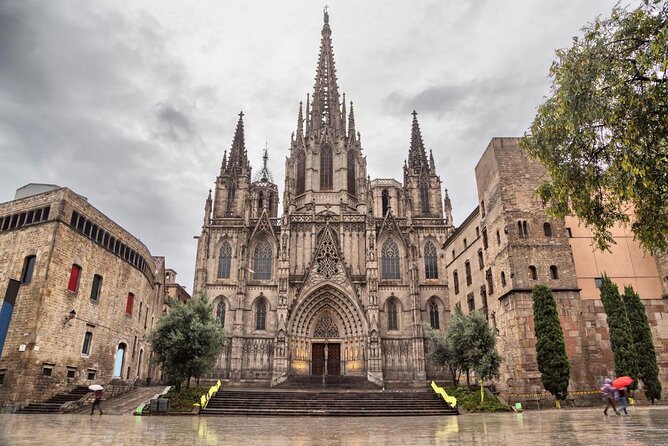
- The route covers two old-city districts: You walk from the Gothic Quarter toward El Born, finishing at Santa Maria del Mar.
- The history goes beyond monuments: Expect stories about Catalan identity, the 1714 defeat, the Spanish Inquisition, Barcelona’s Jewish community, and the city’s Roman beginnings.
- Els 4 Gats starts the story: This Art Nouveau café connects the old city with Picasso, Gaudí, and Barcelona’s artistic life.
- The group can reach 20 people: That is manageable, but a private upgrade may suit you better if you want more questions and personal attention.
- The price is modest: At $22.99 per person, the tour offers a low-cost orientation, though admission to Barcelona Cathedral and Santa Maria del Mar is not included.
- Good shoes and sun protection matter: You will be on foot for the full tour, and one guide specifically advised both.
Why this old-city walk works as a first look
This is not a tour built around one grand sight. It is a chain of short stops that shows how Barcelona grew from Roman Barcino into a medieval religious center, a modern artistic capital, and the political heart of Catalonia.
That mix is the best reason to book it early in your stay. You get a map in your head, learn which streets belong to the Gothic Quarter and El Born, and leave with ideas for places to revisit at your own pace. Jorge, for example, was praised for offering local tips and pointing out places that were easy to overlook. Sonia’s archaeological angle also added a useful layer to the route.
The tour costs $22.99, which is fair for a two-hour introduction if you want context rather than a simple list of photo stops. You are paying for a guide who links the sights together. You are not paying for major attraction admissions, transport, or a long visit inside each church.
The group limit of 20 keeps the tour from becoming a large crowd, though it is still large enough for street noise to matter. If you want the guide to stop often for your questions, or if you prefer a slower pace, the private upgrade deserves a look.
More History Walking Tours in Barcelona
- Barcelona: Tapas Walking Tour with Food, Wine, and History
★ 4.8 · 4,261 reviews - Barcelona Tapas Walking Tour: Food, Wine & History
★ 4.5 · 1,928 reviews - Barcelona: Dark History Night Walking Tour
★ 4.8 · 344 reviews
Els 4 Gats and Barcelona’s artistic circle
The walk begins at Els 4 Gats, a historic café and restaurant with a distinctive Art Nouveau front. Its importance is not just architectural. It was a meeting place for artists and thinkers, including Pablo Picasso and Antoni Gaudí.
This is a smart opening stop because it introduces Barcelona as a city where architecture, food, art, and politics often meet in the same room. You will hear about the café’s role in the city’s creative life, then move on with a better sense of why Barcelona became such a strong center for modern art.
The stop lasts about 10 minutes and is free to view. Do not expect a long meal or extended indoor visit as part of the tour. The value is in the setting and the story.
A mosaic with a painful national story
Next comes El Món Neix en Cada Besada, a photomosaic often treated as an easy photo opportunity. The guide uses it to explain the Catalan defeat of September 11, 1714, and the later importance of La Diada, Catalonia’s national day.
This is one of the tour’s more useful teaching moments. You see how a contemporary public artwork can carry a much older political memory. If you only photograph the mosaic, you miss the reason it matters.
The explanation also prepares you for later stops at Plaça de Sant Jaume and Plaça del Rei, where Catalan government, royal power, and conflict appear again. The tour does not treat Barcelona’s past as a simple parade of beautiful buildings. It points to the tensions that still shape local identity.
Barcelona Cathedral and the story of Saint Eulalia
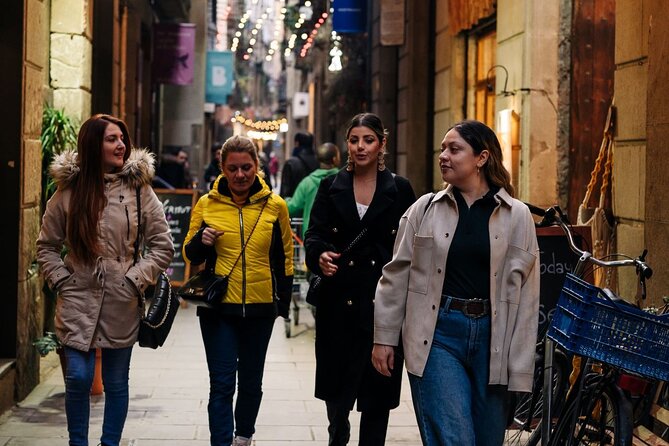
Barcelona Cathedral brings you into the Gothic setting at the center of the old city. Built over several centuries, it is linked to Saint Eulalia, Barcelona’s patron saint, whose death made her a martyr.
You should treat this as a short introduction, not a full cathedral visit. Admission is not included, and the scheduled stop is about 10 minutes. If you want time for the interior, chapels, or architectural details, plan to return later on your own.
That arrangement can work well. The guide gives you the basic story and points out why the cathedral matters, while you decide later if it deserves a longer visit. The stop also connects with the final discussion of Saint Eulalia at Plaça de l’Àngel.
Same streets, a different guide:
- Barcelona Tapas and Wine Experience Small-Group Walking Tour
★ 5.0 · 5,804 reviews - Barcelona: Food Walking Tour with Tapas and Wine
★ 4.9 · 2,180 reviews - Barcelona Helicopter, Sailboat & Old Town Private Walking Tour
★ 5.0 · 1,395 reviews - Barcelona: Old Town and Gothic Quarter Walking Tour
★ 4.8 · 1,393 reviews
Roman traces at Casa de l’Ardiaca

Casa de l’Ardiaca is small but packed with layers. Its design combines Gothic and Renaissance elements, while pieces of the Roman wall and old aqueduct remain visible.
I like this stop because it makes Barcelona’s ancient past feel physical. You do not need a long lecture to understand that the modern city was built over Barcino. A wall remnant or aqueduct arch can say more than a room full of labels.
The visit is free and lasts about 10 minutes. Since this is a compact stop, listen for the connection between Roman water systems and the later buildings around them. The point is not to tour a large site. It is to notice the old structure inside the newer city.
Pont del Bisbe and a Gothic Quarter legend
Pont del Bisbe, or Bishop’s Bridge, is one of the most photographed points in Barcelona. Its stonework creates a dramatic link above the narrow street, but the guide adds a local legend involving the bridge and the consequences of walking beneath it.
This is a lighter moment in a route that also deals with war, persecution, and political struggle. The story is meant to entertain, but it also shows how Barcelona’s old quarter mixes documented history with tales passed from one generation to the next.
The bridge can attract plenty of attention, so you may need to position yourself close to the guide. It is a quick stop, and the best value comes from hearing the story rather than simply taking a picture.
Plaça Sant Felip Neri and the scars of conflict
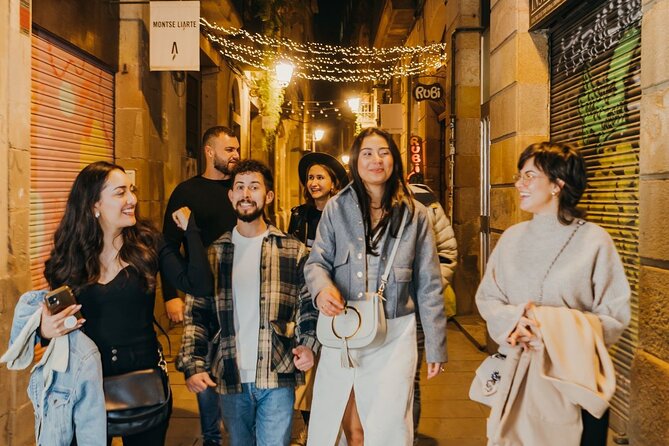
Plaça Sant Felip Neri is quieter in mood. Its walls and setting carry a tragic story tied to Catalonia’s push for independence and the violence that marked the city’s past.
This is the kind of place that rewards a guide. On your own, you might admire the square’s atmosphere and move on. With context, the setting becomes a reminder that old Barcelona is not only pretty stone and narrow lanes. Its buildings also carry memory.
Keep this stop respectful. The guide’s role here is to explain, not turn a difficult event into a spectacle. The square gives the route emotional weight before it moves into the former Jewish quarter.
El Call and the story of Jewish Barcelona
MUHBA El Call takes you through the area associated with Barcelona’s former Jewish population. Narrow medieval streets make the district easy to explore on foot, but its importance can be hard to understand without background.
The guide explains the community that once lived and worked here, helping you see the Gothic Quarter as more than a maze of old buildings. The route also gives you a broader picture of Barcelona’s medieval society, including the different religious and cultural groups that shaped the city.
This stop is free and short. If you have a strong interest in Jewish history, do not expect two hours to cover everything. Think of it as an introduction that can guide further independent visits.
Plaça de Sant Jaume, where Barcelona still gathers
Plaça de Sant Jaume is the political center of the city. It houses the Catalan government and City Hall, and it has long served as a place for celebration, public gatherings, and protest.
The square makes the earlier discussion of Catalan identity easier to place. Here, the subject is not only historical. The buildings still represent public power, and the space remains tied to the city’s political life.
A guide can point out details that you might overlook while crossing the square. The stop also connects to an important figure celebrated on one of Catalonia’s best-known holidays. Expect a compact explanation rather than an inside visit to the government buildings.
Plaça del Rei and Barcelona’s royal past
Plaça del Rei has a more formal feel, with the Royal Palace giving the square a strong medieval presence. It also introduces the darker subject of the Spanish Inquisition.
This is a good contrast with Plaça Sant Felip Neri. One square reflects public politics in the present, while the other points to royal authority and religious control in the past. The route keeps showing you how power changed hands and how those changes affected ordinary life.
As with many stops, the tour gives you the setting and main story, not a full palace tour. Admission details for this stop are not listed as an added cost, but the itinerary does not promise an extended interior visit.
Plaça de l’Àngel and Saint Eulalia’s legend
The route then reaches Plaça de l’Àngel, once known as Wheat Square because it was a center for grain trading. Its name changed after an angelic apparition connected with a procession carrying the body of Saint Eulalia.
This stop brings the saint’s story back into the walk after the cathedral introduction. It also shows how place names preserve old beliefs, trades, and ceremonies. A modern square can retain traces of a working market and a religious legend at the same time.
It is a free, 10-minute stop. You will get the most from it if you pay attention to the connection between the name, the procession, and the city’s patron saint.
Santa Maria del Mar and the finish in El Born
The tour ends at the Basilica de Santa Maria del Mar in El Born. This Gothic church is closely tied to Barcelona’s maritime past and is one of the most striking buildings on the route.
Finishing here makes good practical sense. After walking through Roman remains, medieval streets, royal spaces, and political squares, you arrive at a church linked to the city’s life by the sea. It gives the route a strong final image without sending you back to the starting point.
Admission is not included, so plan a separate visit if you want to see the interior in detail. The end point is at Plaça de Santa Maria, 1, in the Ciutat Vella. From there, you can continue exploring El Born rather than retracing the entire route.
Guides, group size, and how to hear the stories
The guide is the heart of this experience. Darren was praised for clear English, enthusiasm, and useful recommendations. Petra brought Catalan culture into the route, while Jorge focused on local tips and overlooked places. Sonia was especially good for an archaeological view, and Vanessa was noted for answering questions and connecting art, religion, politics, and archaeology.
Those details matter because the route itself is compact. A strong guide makes 10-minute stops feel connected. A weaker presentation can make the same schedule feel rushed. One four-star experience specifically pointed to loud background noise and the lack of a speaker or audio guide, so this is worth considering.
Stay near the guide at busy corners and ask questions when the group pauses. The tour is offered in English, and most people can participate, but the format requires steady walking and attention. The maximum group size is 20. A private upgrade is likely the better choice if you value a slower pace, need to hear every explanation, or want the route shaped around your interests.
Who should book this Barcelona walk
I would choose this tour for a first visit, especially if you want a clear introduction before tackling larger sights on your own. It suits people who enjoy stories about cities, not just photographs of buildings.
It is also a good fit for anyone interested in Catalan culture, since the route returns several times to the 1714 defeat, La Diada, independence, and the role of public squares. Art lovers will appreciate Els 4 Gats and the mosaic, while history fans get Roman, medieval, Jewish, royal, and religious threads in one outing.
You may want something else if you prefer long interior visits, a slow architectural study, or a tour focused mainly on Gaudí. This walk mentions Gaudí through Els 4 Gats, but it does not visit his major buildings. It also does not include entry to Barcelona Cathedral or Santa Maria del Mar.
The meeting point is Plaça del Vuit de Març in Ciutat Vella, and the route ends at Santa Maria del Mar. Confirmation arrives at booking, public transport is nearby, and free cancellation is available up to 24 hours before the start time. Book at least a day ahead if your plans may change.
Is Barcelona in 2 Hours worth $22.99?
For $22.99, I think this is a sensible buy if you want orientation, local context, and a route through two of Barcelona’s most rewarding old districts. You receive a wide range of subjects in a short time, from Picasso’s café to Roman waterworks and Catalan politics.
The value depends on your expectations. You will not get a long look inside every church, and the quick pace leaves little room for lingering. But you do get a well-chosen trail through places that are easy to pass without understanding.
Book it for your first day if you like to use a guided walk to get your bearings fast. Choose the private option if hearing the guide clearly and asking questions matter more than keeping the price low. Wear good walking shoes, bring sunblock, and plan to return to the cathedral or Santa Maria del Mar if either catches your interest.
FAQ
How long does the Barcelona walking tour last?
The tour lasts approximately two hours.
What language is the tour offered in?
The tour is offered in English.
How much does the tour cost?
The listed price is $22.99 per person.
Where does the tour start?
The meeting point is Plaça del Vuit de Març in Ciutat Vella, Barcelona.
Where does the tour end?
The tour ends at Basílica de Santa Maria del Mar, Plaça de Santa Maria, 1, in Ciutat Vella.
How many people can join the group?
The maximum group size is 20 travelers.
Are admission tickets included?
Admission is not included for Barcelona Cathedral or the Basilica de Santa Maria del Mar. The other listed stops have no admission charge.
Is a private tour available?
Yes. You can upgrade to a private tour for more personalized attention.
Can I cancel for a full refund?
Yes. You can cancel up to 24 hours before the experience start time for a full refund. Cancellations or changes made less than 24 hours before the start time are not accepted for a refund.
More Two-Hour Walks in Barcelona
- Barcelona: Jewish Quarter 2-Hour Walking Tour
★ 4.8 · 333 reviews - Barcelona 2-Hour Gothic Walking Tour
★ 4.7 · 317 reviews - Jewish Walking Tour Barcelona by Expert Jewish Guide 2h
★ 5.0 · 297 reviews - Berlin’s Best: 2 Hour Walking Tour Third Reich and the Cold War
★ 5.0 · 5,486 reviews
New routes in Barcelona
- Barcelona Gothic Quarter Walking Tour with Tapas★ 5.0 · 248 reviews
- Picasso Museum and Walking Tour Plus Optional Wine & Food Tasting★ 5.0 · 596 reviews
- Barcelona Private Food Tour: Tapas, Paella & 8+ Food Tastings★ 5.0 · 164 reviews
- Barcelona Architecture Walking Tour With Casa Batlló Upgrade★ 5.0 · 137 reviews
- Montjuïc Walking Tour With Optional Flamenco Show★ 5.0 · 196 reviews
- Private Barcelona Old Town and Gothic Quarter Walking Tour★ 5.0 · 134 reviews
- Barcelona: La Boqueria Food, Wine & History Walking Tour★ 5.0 · 126 reviews
- Semi-Private Montserrat Monastery, Funicular & Scenic Nature Walk★ 5.0 · 172 reviews
Barcelona Walking Tours, compared.
Barcelona Tapas and Wine Experience Small-Group Walking Tour
Read our review →
Tapas Walking Tour with Food, Wine, and History
Read our review →
Barcelona Helicopter, Sailboat & Old Town Private Walking Tour
Read our review →

Helicopter Flight, Boat Ride, and Walking Tour
Read our review →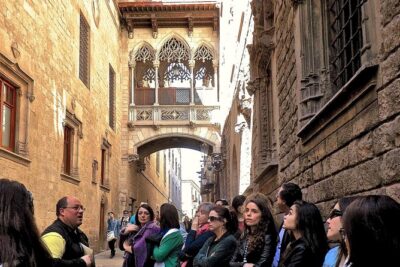
Barcelona Old Town & Gothic Quarter Small Group Tour
Read our review →
Barcelona Food Tour: Tapas, Paella, Sangria & 8+ Local Tastings
Read our review →Browse the lists this tour appears in