
Review · ITALY
Pompeii: Guided Walking Tour with Entrance Ticket
Pompeii is not a pile of broken columns. It is a Roman town with streets, shops, baths, homes, election notices, wine counters, and a public square still laid out beneath your feet. This two-hour guided walk gives you a useful route through the ruins without asking you to spend half the morning figuring out what you are looking at.
I like the included €20 entrance ticket and the headsets, which help you follow the guide across a wide archaeological site. I also like the human touch in the local operation: guides such as Elisa, Salvatore, Maria, Francesca, and Miguel have been praised for making the past clear and entertaining. The main caution is timing. Meeting-point confusion and late starts have occasionally delayed groups, and two hours covers only a small part of Pompeii.
Key points to know before you book
- The Forum gives you the town’s center: Begin with Pompeii’s main civic and religious square, where the guide can explain how public life was organized.
- The Lupanare adds an unusually direct look at Roman society: Its paintings and small rooms make the ancient town feel personal, awkward, and real.
- The route includes daily-life details: Expect streets, shops, wine signs, Thermal Baths, domestic spaces, and clues about ordinary Roman routines.
- The guide is the real value: A good guide connects broken walls and faded decoration to the people who used them.
- The meeting point needs care: Arrive early at the garden of Hotel Vittoria, outside the Cellini coral shop, and look for the guide’s sign.
- Two hours is an introduction, not a full visit: You can see important sections, then continue alone if you want to explore more.
Why a guide changes the Pompeii experience
Pompeii is huge, and its scale can work against you. Without context, you may see a doorway, a painted wall, or a line of paving stones without knowing why it matters. A guide gives those fragments a purpose.
The best part of this tour is the attention to daily life. You are not limited to grand public buildings. You may hear how shops worked, how baths served the town, how houses were arranged, and how signs advertised goods such as wine and produce.
That range matters. Pompeii was not only a place of temples and officials. It was a lived-in town where people bought food, met friends, visited public baths, worshipped, worked, and dealt with the ordinary problems of city life.
Guides on this experience have included Elisa, Salvatore, Maria, Francesca, Miguel, Imma, Mattia, and others. The strongest praise has gone to guides who mix clear explanations with humor. Francesca, Elisa, Maria, Miguel, and Mattia have each been singled out for making the walk accessible to people of different ages and levels of interest.
The style can vary. Some guides lean toward lively stories and jokes, while others offer a more serious archaeological explanation. If you want a formal academic lecture, this may not always be the right format. If you want the site explained in plain language while you walk, it is a good fit.
More Entry Tickets on the Route in Italy:
- Milan: Guided Walking Tour & Last Supper Visit with Ticket
★ 4.7 · 5,409 reviews - Florence: Duomo Complex with Tickets & City Walk Guided Tour
★ 4.7 · 2,057 reviews - David & Accademia Guided Tour with Time Entry Ticket
★ 4.5 · 1,705 reviews
Meeting at Hotel Vittoria in Pompeii
The stated meeting point is at 10:50 a.m. in the garden of Hotel Vittoria, just outside the Cellini coral shop at Via Mare, 80045 Pompei. The guide is supposed to carry a sign with the customers’ name.
This location is near the Pompeii archaeological area and is generally practical for people arriving at Pompeii Scavi station. One important detail: Pompeii has more than one station with a similar name. If you arrive by train from Naples or Rome, check your route carefully and make sure you are heading toward the archaeological entrance rather than the modern town station.
The entrance area can be crowded and confusing. A few groups have had trouble identifying their guide, especially when signs were not obvious. The operator has sometimes called or sent a representative to search for late arrivals, but you should not rely on that. Arrive early, keep your phone available, and compare the meeting instructions with the actual entrance area.
Late starts have happened. In one case, the tour began 30 to 45 minutes behind schedule because of organization problems and missing participants. Other groups were helped after train strikes, traffic trouble, or a missed connection. That flexibility is useful, but if you have a tight train departure afterward, leave a generous buffer.
Entering the archaeological area
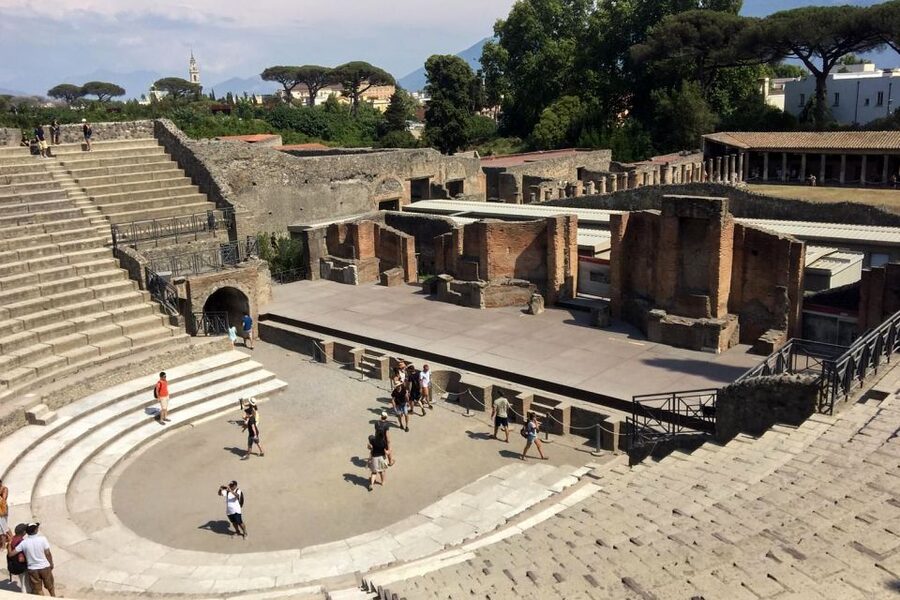
Your admission ticket is included, with the listed value of €20. The skip-line arrangement is useful at a busy entrance, though it does not mean you can ignore the meeting time or walk straight in alone. You still need to meet the group and enter with the guide.
Headsets are included so you can hear the commentary while walking. This is especially helpful on a large site where the guide may stop several steps ahead of you. Several guides have also paused for photographs and questions, though the pace is designed to cover a good amount of ground in two hours.
The equipment is not perfect for everyone. One person found the headset uncomfortable and preferred an earbud-style system. Still, the ability to hear the guide clearly is a major help, particularly if the group is large or the site is noisy.
Pompeii’s paving stones are uneven, and the route involves steady walking. Comfortable shoes are essential. The site can also feel exposed in strong sun, and one visit in mild weather still became hot on the streets. Bring water, dress for the forecast, and remember that the tour operates in rain as well as sunshine.
The Forum, where Pompeii made decisions
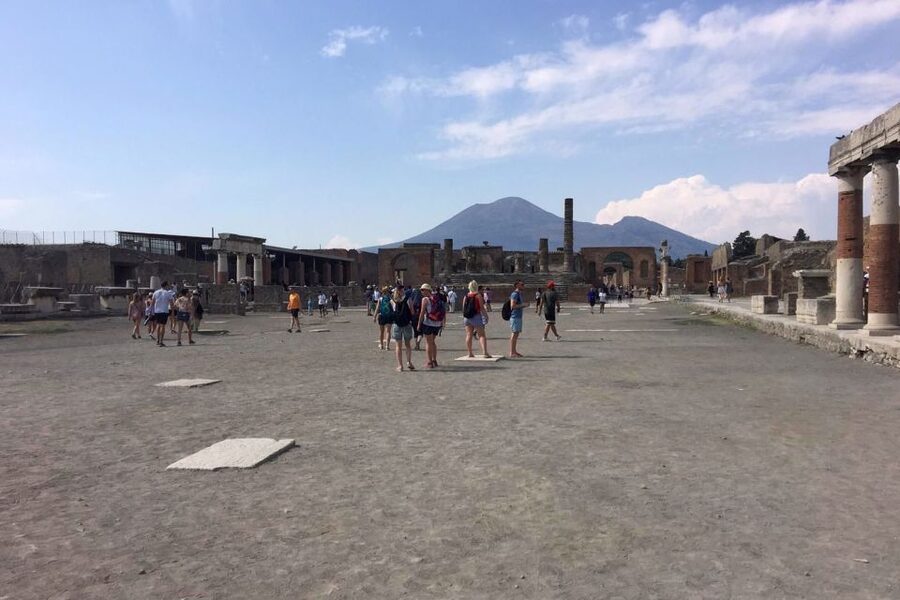
The Forum is likely to be one of the most important stops. This broad civic center was the town’s public heart, surrounded by buildings tied to government, religion, business, and community life.
A guide can help you read the space instead of simply photographing it. You will learn how the Forum related to the rest of the town and why public buildings were placed around it. From here, Pompeii begins to make sense as an organized city rather than a random collection of ruins.
The drawback is that the Forum can feel exposed and crowded. In hot weather, there is little relief from the sun. Listen carefully to the explanation, take your photographs, and avoid spending all your energy standing in one place.
More Guided Walks in Italy:
- Naples: Street Food Walking Tour with Local Guide
★ 4.9 · 4,976 reviews - Florence: Highlights Walking Tour with Expert Guide
★ 4.6 · 4,662 reviews - Rome: Guided Food Walking Tour with Wine in Trastevere
★ 4.9 · 3,105 reviews - Venice: City Center Historical Guided Walking Tour
★ 4.2 · 1,873 reviews
Thermal Baths and the mechanics of Roman comfort
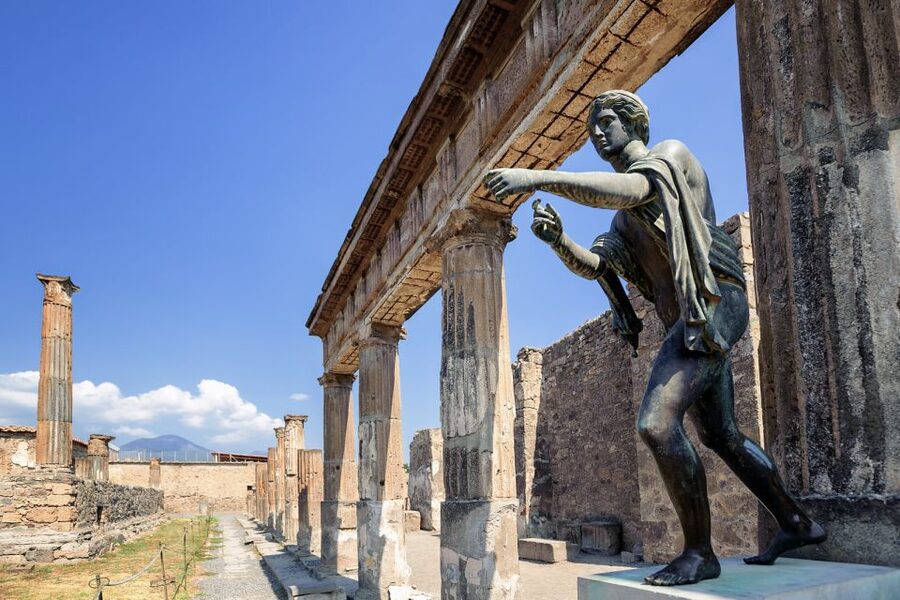
The Thermal Baths offer one of the clearest windows into routine Roman life. Baths were not simply places to wash. They were social spaces, and their rooms show the planning and engineering that supported public comfort.
The guide explains how these buildings worked and how they fitted into town life. You may see the sequence of rooms and the remains of decoration, heating systems, or practical features that are easy to miss when walking alone.
This stop is valuable because it turns Roman culture into something physical. Instead of hearing only about emperors and eruptions, you see where people spent ordinary time.
The Lupanare and Pompeii’s frank side
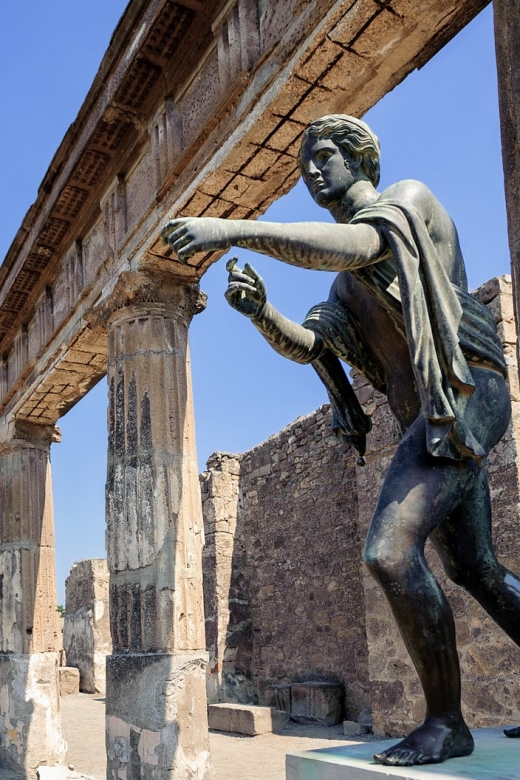
The Lupanare, commonly described as a brothel, is one of Pompeii’s most talked-about buildings. Its small rooms and surviving paintings offer an unusually direct look at sex work and social life in the ancient town.
A guide helps put the site into context without treating it as a cheap joke. The subject can be handled with humor, but it also reveals how openly some aspects of Roman life were represented and how much Pompeii’s remains can tell us about people outside the political elite.
The Lupanare is often busy, and the rooms are small. You may need to wait briefly or view parts of it from a tight passage. This is one reason the headset matters: you can keep listening even when you are not standing directly beside the guide.
Streets, shops, wine signs, and ordinary homes
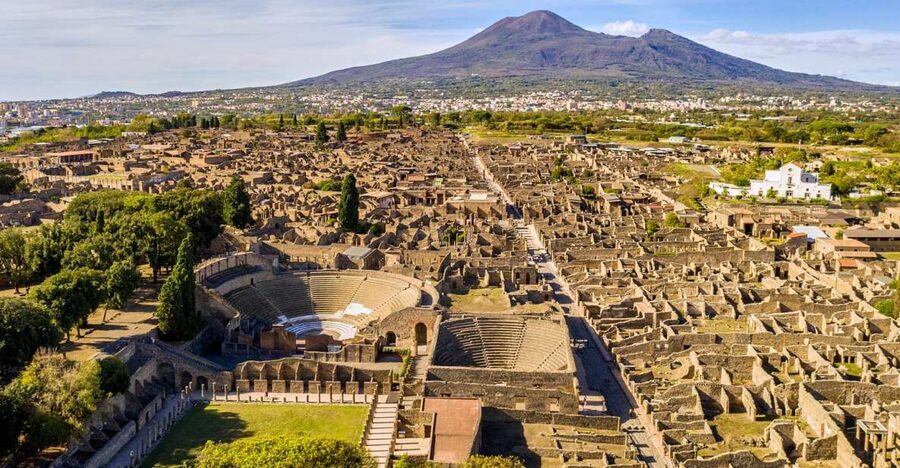
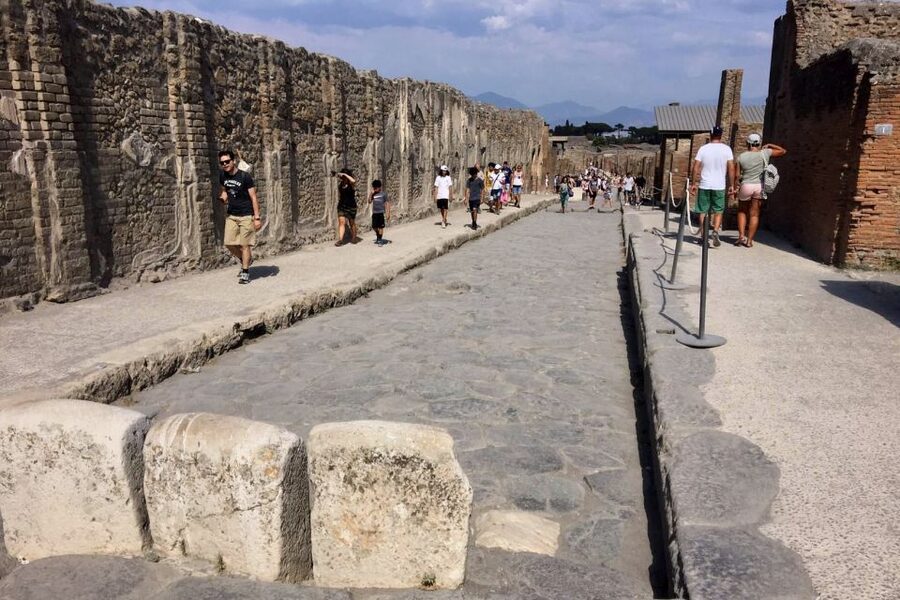
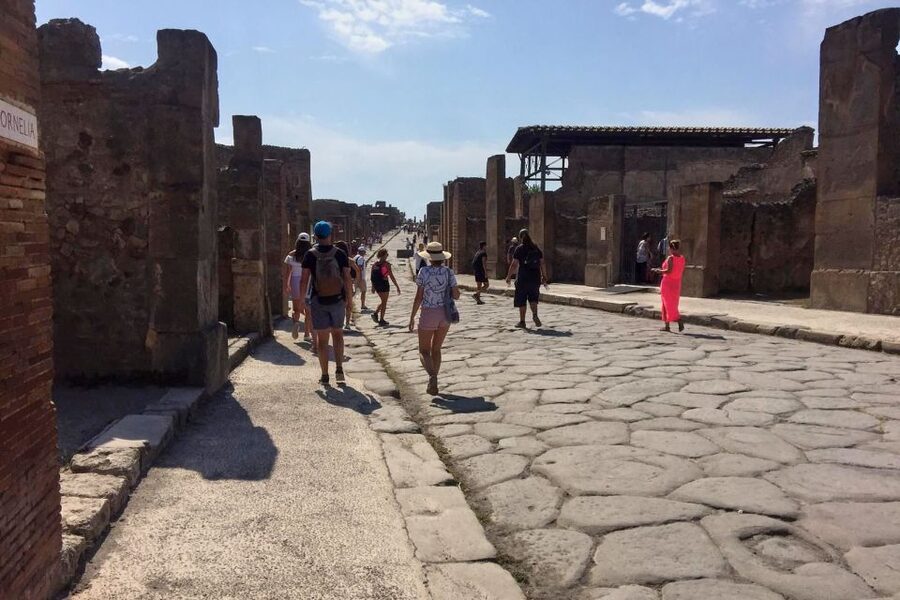
The streets may be the most revealing part of the tour. Raised paving stones, sidewalks, doorways, counters, and shop fronts show how residents moved around the town and how businesses met the street.
Look for the small clues. Signs connected to food and wine, commercial counters, and domestic spaces help you picture Pompeii as a working town. These details are less grand than the Forum, but they often leave the strongest impression.
The houses also show that Pompeii was not made up only of public monuments. Homes, courtyards, wall paintings, and household arrangements give the guide a chance to discuss family life, wealth, taste, and social position.
Not every room will be open, and the exact route can change. Excavation and preservation work continue, and some areas may be closed. The town is only partly uncovered, so you should expect a carefully chosen sample rather than a complete circuit.
Understanding the eruption of 79 A.D.
The eruption of Mount Vesuvius gives the visit its emotional force, but the tour is not only about disaster. The guide explains what happened to Pompeii when volcanic ash and rock covered the town and why so much of the urban plan survived.
The preservation is uneven. Some decorations and structures remain remarkably clear, while other sections are damaged, reconstructed, or protected behind glass. You may also hear that many movable objects are now displayed in museums, including the archaeological museum in Naples, rather than left in the ruins.
That can surprise first-time visitors. Pompeii is not a frozen city where every object remains in its original room. It is an excavation site, gradually uncovered and constantly managed. Even with missing artifacts, the streets and buildings still give you a strong sense of how the town was organized.
The most moving parts may be the simplest ones: a doorway, a painted room, a worn street, or the remains of a place where people once ate and worked. A good guide gives these details human scale.
How much can you see in two hours?
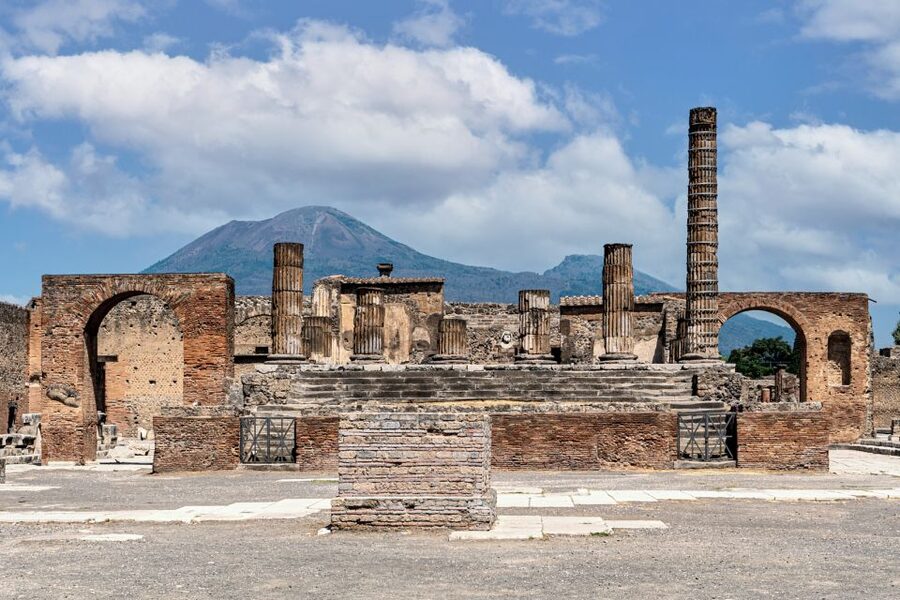
Two hours is a sensible length for a first visit, especially if you are traveling with children or want a structured introduction. The tour covers major highlights without asking you to walk aimlessly for half a day.
It is not enough to see all of Pompeii. The site is large, and one guide explained that a full look could take days. Plan to leave the group and continue alone only if your ticket and site conditions allow it, and do not assume every section will be open.
The two-hour format suits you if you are visiting from Naples, stopping during a wider Campania trip, or trying to fit Pompeii around transport connections. It is less suitable if Pompeii is your main focus and you want detailed time in every house, painting, or outlying street.
Price, value, and group conditions
At $50 per person, the tour costs more than entering Pompeii alone, but the comparison is not simply ticket price versus ticket price. The admission ticket is included, and you receive a live guide, headsets, and a planned route through a complicated site.
I think the price is reasonable for a first visit if you value interpretation and want to avoid spending time finding the entrance queue. The value drops if you dislike group touring, already know Roman archaeology well, or want to set your own pace.
Group size can affect the experience. Some outings have felt large, and one person expected a smaller group. Large groups can make narrow areas less comfortable and may reduce time for questions. On the other hand, the headset helps you hear even when you are not standing right beside the guide.
The strongest guides make the price easier to justify. The best feedback has focused on clear English, humor, patience, and the ability to involve children. Guide quality can vary, and the requested language is not guaranteed if only one participant speaks that language.
Who should book this Pompeii walk?
I would choose this tour for a first visit, especially if you are arriving by train and want a clear introduction to the site. It also suits families, couples, and adults who prefer stories and explanation to reading every sign on their own.
It is a good choice if you want English, French, Spanish, or Italian commentary and appreciate a live person who can answer questions. The tour has also handled difficult travel days with useful communication when trains, traffic, or strikes caused delays.
I would think twice if you use a wheelchair or have a mobility impairment. The experience is specifically not suitable for wheelchair users or people with mobility limitations, and Pompeii’s uneven surfaces make that restriction important.
Bring comfortable shoes, weather-appropriate clothing, and identification for children using a child fare. Cancellation is free up to 24 hours before the tour, and the reserve-now, pay-later option can help if your Campania plans are still shifting.
Should you book it?
Book this Pompeii tour if you want the main story, the essential buildings, and a guide who can connect public monuments with ordinary Roman life. The Forum, baths, Lupanare, shops, streets, and domestic spaces give you a well-rounded first look.
Do not book it expecting a complete exploration or a perfectly timed private walk. The meeting point can be confusing, starts have occasionally run late, and guide style varies. Still, with the ticket included and two hours focused on the site’s most useful highlights, this is a practical choice for most first-time visitors.
FAQ
What is included in the Pompeii tour?
The tour includes entry to the Pompeii Archaeological Site, a professional live guide, headsets, and skip-the-ticket-line access.
How long does the guided walk last?
The guided walk lasts two hours.
What languages are available?
Live guides may lead the tour in English, French, Spanish, or Italian. The requested language is not guaranteed if only one participant speaks that language.
Where is the meeting point?
Meet at 10:50 a.m. in the garden of Hotel Vittoria, outside the Cellini coral shop at Via Mare, 80045 Pompei. The guide should have a sign with the customers’ name.
Does the tour include transportation?
No. Hotel pickup, drop-off, and transportation are not included.
What should I bring?
Bring comfortable shoes, weather-appropriate clothing, and a passport or ID card for children using a child fare.
Can wheelchair users join the tour?
No. The experience is not suitable for wheelchair users or people with mobility impairments.
Can I cancel for a refund?
Yes. You can cancel up to 24 hours in advance for a full refund.
New routes in Italy
- Private St. Francis Basilica of Assisi and City Walking Tour★ 5.0 · 114 reviews
- Assisi Private Walking Tour including St. Francis Basilica★ 5.0 · 124 reviews
- Milan: City Highlights Walking Tour with The Last Supper★ 4.9 · 195 reviews
- Florence: Heart of Florence Guided Walking Tour★ 4.0 · 81 reviews
- Milan: Private or Shared Essential Walking Tour★ 4.7 · 84 reviews
- Taormina: Shared or Private Food & Wine Walking Tour★ 4.6 · 167 reviews
- Syracuse: Ortigia Private Walking Tour★ 4.8 · 181 reviews
- Syracuse: Ortigia and Neapolis Guided Walking Tour★ 4.7 · 205 reviews
Italy Walking Tours, compared.
Doge’s Palace and St Mark’s Basilica Walking Tour
Read our review →
Guided Walking Tour & Last Supper Visit with Ticket
Read our review →


San Marco to Rialto Walk & Spritz Like a Local
Read our review →
Uffizi & Accademia Timed Entry: Small Group Duomo Walking Tour
Read our review →

Browse the lists this tour appears in