
Review · PHILADELPHIA
Philadelphia: History, Highlights & Revolution Walking Tour
Philadelphia’s Revolution-era story comes alive best on foot, and this tour strings the big names together with the human stories usually left out of schoolbooks. You’ll move from Signers Garden through Independence Mall and Old City, hearing about the Declaration, the Constitution, enslaved people, artisans, religious communities, and ordinary residents who helped shape the new nation.
I like the excellent two-and-a-half-hour route, which covers a lot without sending you across town. I also like the Museum of the American Revolution presentation, especially the chance to see George Washington’s wartime tent. The one catch is that most historic buildings are viewed from outside, so you should plan extra museum visits if you want full indoor access.
Key points
- George Washington’s wartime tent: The museum presentation adds a memorable object to the walk.
- A strong Old City route: Independence Hall, the Liberty Bell, Elfreth’s Alley, Betsy Ross House, and Franklin’s grave fit into one outing.
- Stories beyond famous names: The President’s House site brings overlooked people and difficult parts of the founding era into the conversation.
- Guides make the difference: John, Adam, Tom, Nina, David, Caroline, and PJ have all led highly praised tours, with humor and plenty of time for questions.
- Good first look at Philadelphia: The pace suits a first visit or a half-day in town.
- Useful practical value: The $45 price includes a guide, a museum presentation, discounted museum admission, a community donation, and the national park fee.
Why this walk works so well in Old City
Philadelphia’s historic core is compact, but the story is not. A short walk can take you from the room where the United States was debated into streets where tradespeople, printers, shopkeepers, religious groups, and enslaved workers lived and worked.
This tour gives you that framework in 150 minutes. You are not simply checking off Independence Hall and the Liberty Bell. Your guide connects the buildings to the political arguments and personal choices behind the Revolution and the early government.
That matters because many Philadelphia sights can feel like isolated monuments. A good guide turns them into chapters. You learn what happened at one place, then walk a few minutes and see how the next site fits into the same story.
The strongest part of the experience is the storytelling. Guides such as Adam, John, Tom, Nina, David, Caroline, and PJ have been praised for clear explanations, humor, flexibility, and thoughtful answers. Names and guides change by departure, of course, but the tour is clearly built around a live person rather than an audio track or a rushed script.
More History Walking Tours in the USA
- History and Hauntings of Salem Guided Walking Tour
★ 5.0 · 14,564 reviews - Boston: Freedom Trail History Small Group Walking Tour
★ 5.0 · 6,450 reviews - Historic Charleston Guided Sightseeing Walking Tour
★ 5.0 · 6,216 reviews
Starting at Signers Garden and Independence Mall
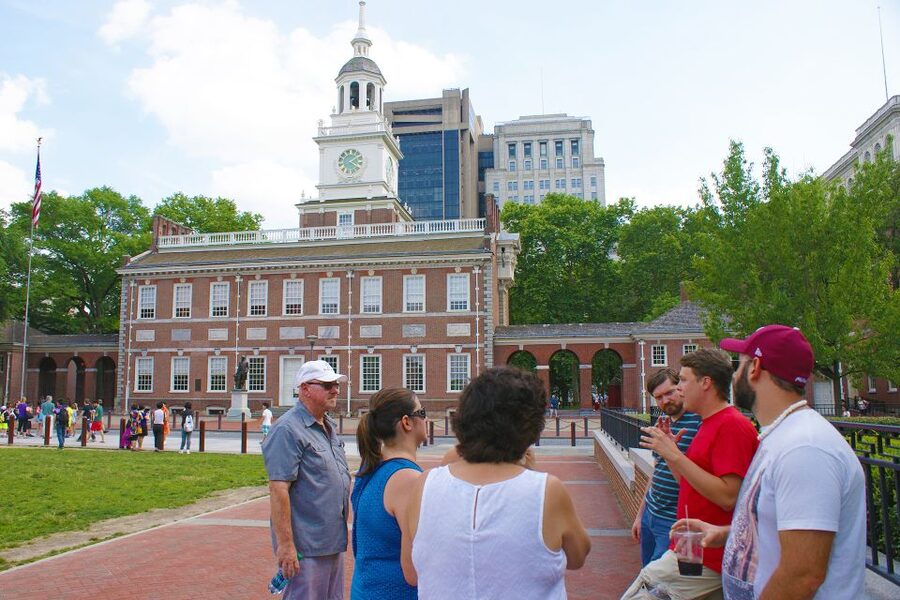
Meet at the Signer Statue in Signers Garden. Allow time to find it, especially if you are arriving from another part of the city. The walk then heads through Independence Mall and Independence National Historical Park, the main stage for Philadelphia’s founding story.
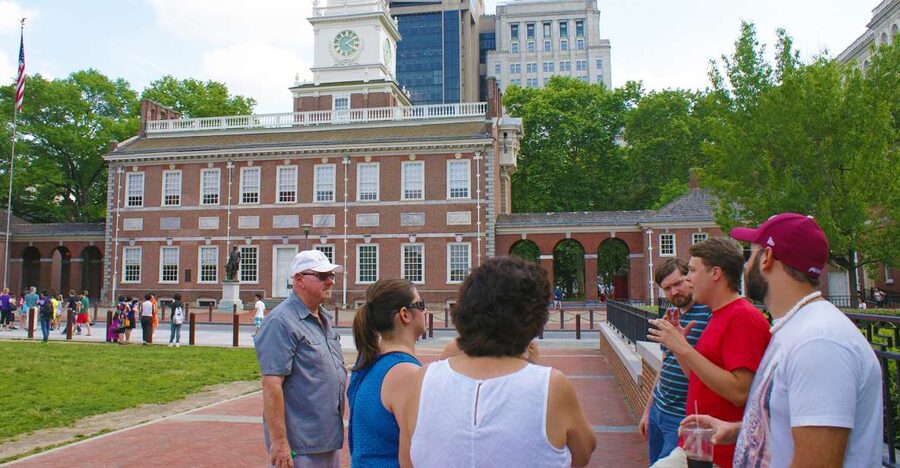
You’ll pass Independence Hall, the red-brick building associated with the Declaration of Independence and the US Constitution. From the street, you may not get the full indoor tour experience, but the exterior gives your guide a useful setting for explaining the debates that took place inside.
Congress Hall is another important stop along this opening stretch. It served as the meeting place of the US Congress when Philadelphia was the national capital. I like having it included because it widens the story beyond July 1776. The Revolution was only the beginning. The new country still had to work out how to govern itself.
This part of the route can be busy, and the area sometimes has construction or changing access around the historic sites. A guide helps you keep moving and understand what you are seeing even when a perfect view or indoor visit is not possible.
The Liberty Bell and the symbols of freedom
The Liberty Bell is one of Philadelphia’s most familiar objects, but it can be easy to treat it as a quick photograph and move on. Your guide puts it into context, explaining why it became such a powerful symbol of American freedom.
The itinerary includes a photo stop and guided explanation rather than promising a long indoor museum visit. That distinction is useful. If seeing the bell up close is a top priority, check current access details and allow separate time for the Liberty Bell Center.
I appreciate this stop because it gives your guide room to address the gap between national symbols and historical reality. Ideas about liberty were powerful in the eighteenth century, but they did not apply equally to everyone. The tour’s emphasis on lesser-heard stories helps keep the subject from becoming a simple parade of heroic names.
Carpenters’ Hall and the work behind the Revolution
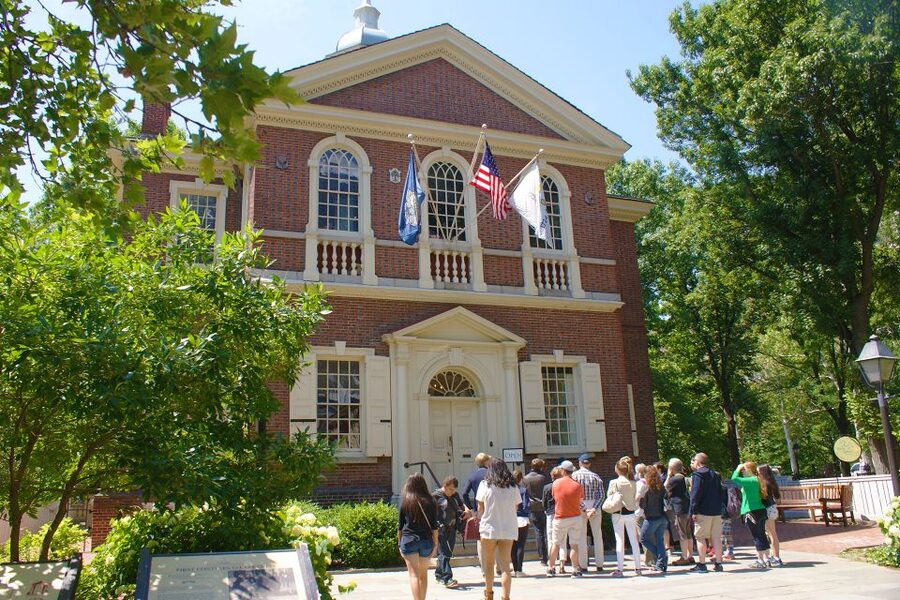
Carpenters’ Hall adds a different texture to the route. It is tied to the First Continental Congress, where colonial representatives met before the Declaration of Independence was written.
The building helps you picture the Revolution as organized work, not just dramatic speeches. Delegates had to meet, argue, exchange letters, make plans, and decide how far they were willing to go. That practical side is often missing from a standard school lesson.
Your guide may also use nearby streets and architecture to show how Old City developed around the people who lived and worked there. The appeal here is not a single grand view. It is the sense that history happened in an active neighborhood, among working buildings and ordinary daily routines.
Same streets, a different guide:
- New Orleans Premier Ghost, Voodoo and Vampire Walking Tour
★ 4.5 · 12,856 reviews - Little Havana Food and Walking Tour in Miami
★ 5.0 · 8,882 reviews - Chicago: Gangsters and Ghosts Walking Tour
★ 5.0 · 7,155 reviews - New Orleans Food Walking Tour of the French Quarter with Small-Group Option
★ 5.0 · 6,118 reviews
The President’s House site and the stories left out
The recreated President’s House site is one of the more thought-provoking parts of the walk. It marks the place where George Washington and John Adams lived while Philadelphia served as the national capital.
The site also opens the door to stories about people who worked there and had no political power. That includes enslaved individuals whose labor supported the household and the new government. This is valuable context because the founding era cannot be understood through presidents and famous statesmen alone.
I would pay close attention here. The site is not just another photo stop. It asks you to consider who was included in the language of liberty, who was excluded, and how those contradictions shaped the country that followed.
The Museum of the American Revolution presentation
The tour includes a special presentation at the Museum of the American Revolution. The featured object is George Washington’s tent, the field headquarters he used during the war.
This is a smart addition to a walking tour. After seeing streets and buildings, you get a tangible object connected to the military side of the Revolution. The tent helps bring the war out of the realm of dates and speeches. It suggests the rough, mobile life of a commander working through a long conflict.
The included feature is a presentation, not necessarily a full museum visit. You also receive discounted admission to use after the tour, which is useful if you want more exhibits and time indoors. I would plan the museum for later in the day if you have the schedule. The walking route gives you a strong introduction, while the museum can supply the extra detail.
One practical point: this is a 150-minute outdoor walk with a museum component, so weather matters. Wear comfortable shoes and dress for the forecast. The group may pause often, but you are still on your feet for much of the experience.
Elfreth’s Alley, a quieter change of pace
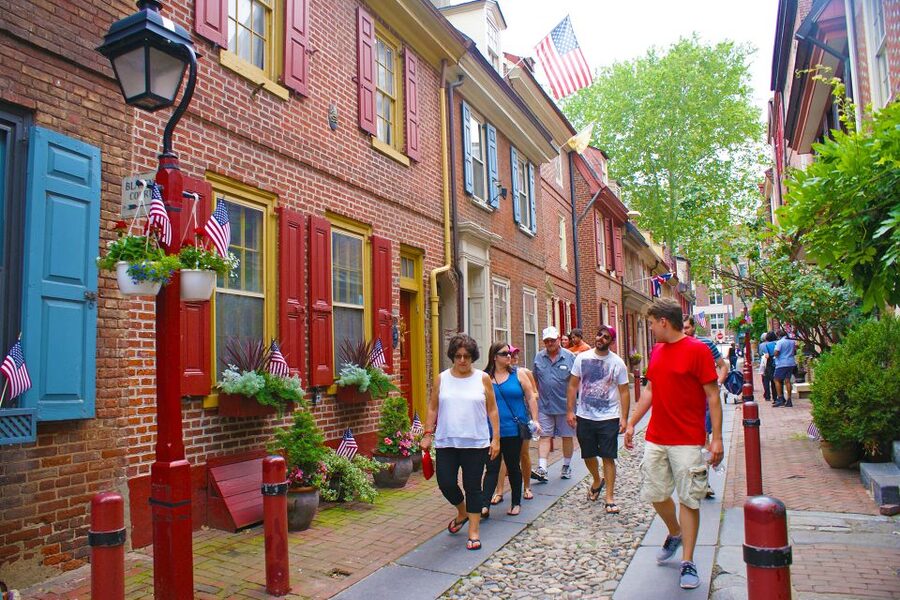
Elfreth’s Alley is one of the highlights because it shifts the focus from national politics to domestic life. It is known as the oldest continuously inhabited residential street in the United States.
The narrow lane and historic homes help you picture Philadelphia as a lived-in city, not just a collection of public monuments. Your guide can explain how residential streets fit into the city’s eighteenth-century growth and how people experienced the era away from the grand meeting halls.
You should expect sightseeing and commentary here, not a complete house-by-house interior tour. Still, the setting is highly photogenic and gives the walk a welcome change of pace after Independence Mall.
Betsy Ross House and the problem of famous stories
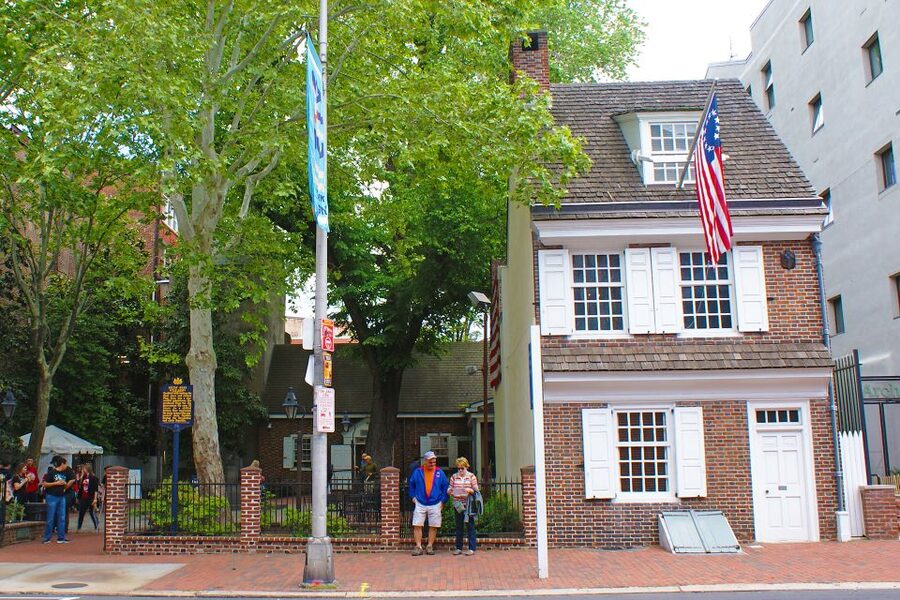
The Betsy Ross House is a popular stop and an easy place to take a memorable photo. Betsy Ross is widely credited with creating the first American flag, though the details of that story have been debated over time.
That uncertainty is part of what makes the stop useful. A good guide can explain how national legends form, why certain people become symbols, and how later generations shape the stories they inherit. The house remains an appealing historic setting even if you want to treat the flag story with some care.
The itinerary says guided visit rather than a guaranteed extended indoor tour. If you want to explore the house itself, check admission and opening details separately.
Benjamin Franklin’s grave and the US Mint area
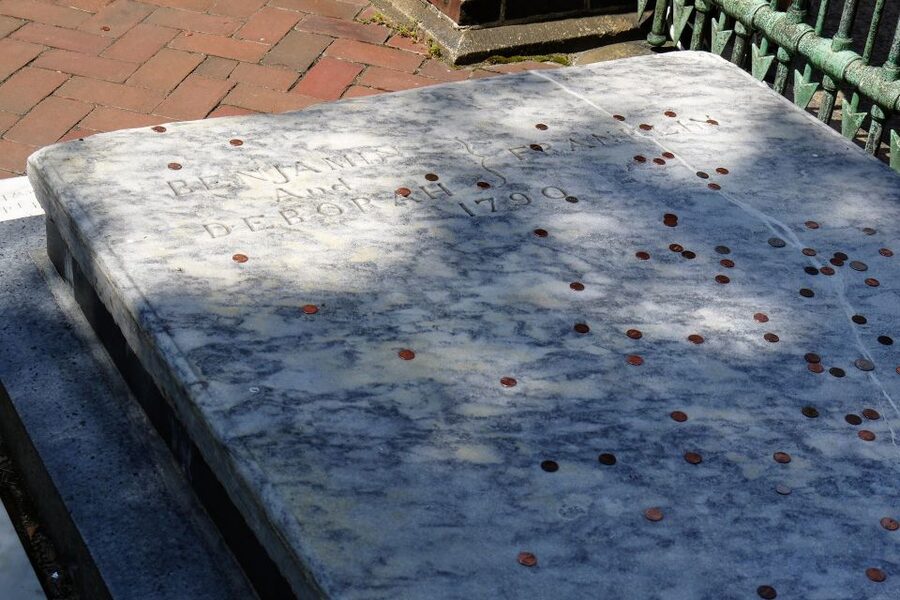
The walk includes a photo stop at Benjamin Franklin’s burial site. Franklin is one of the few founding-era figures who connects politics, science, printing, diplomacy, and everyday Philadelphia life.
A guide can make this brief stop more meaningful by showing how many different roles Franklin played. His grave is not a grand monument, but it is a fitting place to pause because Franklin’s influence reached far beyond the political meetings nearby.
The route also reaches North 6th Street and Market Street, where you can see the US Mint area. This adds another piece of the city’s civic story and helps orient you in modern Old City. The exact amount of time at each location can vary with the group and street conditions, so think of the Mint as part of the guided city view rather than a separate minting tour.
How much history fits into 150 minutes?
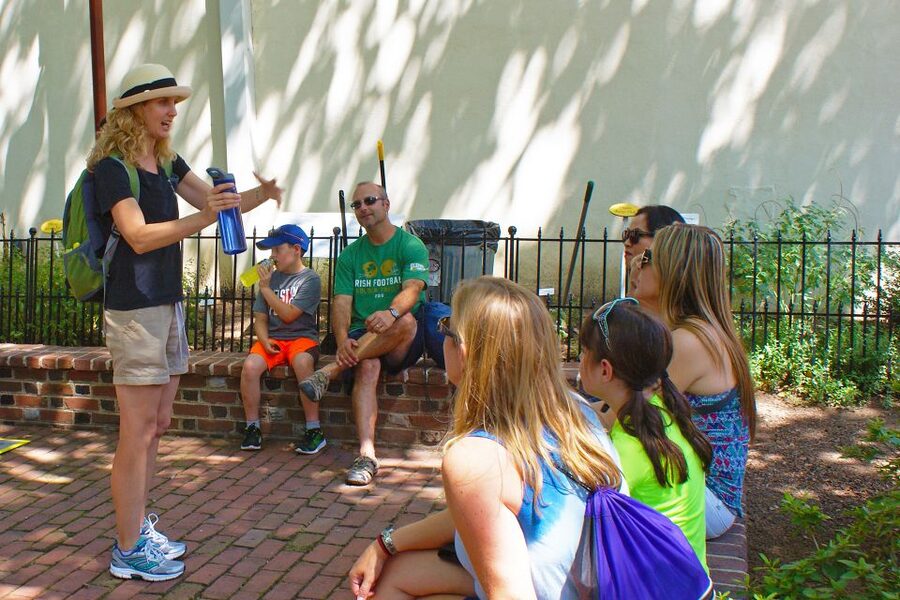
The pace is brisk but manageable. You cover many sites, yet the tour is not simply a march between landmarks. Guides pause to explain, answer questions, and sometimes adjust the pace for the group.
Several highly praised guides are described as engaging and able to keep children and adults interested. One guide was especially appreciated for adapting the walk for an older family member, while another made the subject approachable for a 14-year-old traveling with adults.
That flexibility matters. Revolutionary Philadelphia can become a lecture if the guide talks nonstop. The best version of this tour leaves room for questions and lets you connect the history to your own interests. If you want more detail about a particular person or place, speak up early.
You should also know what this tour does not try to do. It does not provide a full interior visit at every major building, and it cannot explain every chapter of Philadelphia history in two and a half hours. Think of it as a well-built introduction, not a final word.
Is $45 a fair price?
At $45 per person, the tour is reasonably priced for a guided walk of this length. The cost includes a local English-speaking guide, the Museum of the American Revolution presentation, discounted museum admission, the national park fee, and a donation to a local community organization.
The biggest value is the time you save. You could walk through Old City on your own, but you would need to prepare your route, understand what you are looking at, and connect the sites yourself. A good guide handles that work while adding stories you are unlikely to get from plaques alone.
The price is less attractive if you want a long museum visit or full access to every historic interior during the tour. In that case, treat the walk as the first part of a larger day and use the museum discount afterward.
Practical details before you book
The tour starts at the Signer Statue in Signers Garden and finishes in Old City. It is wheelchair accessible, and the tour is conducted in English.
If you drive, do not count on street or metered parking. The maximum street parking time is two hours, shorter than the 150-minute tour. Use one of the parking lots or garages in Old City and allow extra time to find a space.
Book with the weather in mind. You will be outside for most of the route, and even a light wind or drizzle can affect comfort. Comfortable shoes are essential, and a small bottle of water is sensible.
The tour offers free cancellation up to 24 hours before departure and a reserve-now, pay-later option. Starting times vary, so check availability for your chosen date.
Who should take this Philadelphia walking tour?
I would recommend it to first-time visitors who want a clear introduction to Philadelphia’s historic center. It is also a good choice if you have only half a day and want to see the major Revolutionary sites without planning every turn.
Families can benefit from the mix of famous landmarks, short walks, stories, and questions. The guides have been praised for keeping younger people involved without reducing the subject to a simple school lesson.
History fans will appreciate the links between the buildings, the museum presentation, and the discussion of people whose roles are often overlooked. At the same time, you should choose a longer museum visit or a more focused tour if you already know Philadelphia’s founding story well and want specialist-level detail.
Should you book it?
Book this tour if you want a lively, well-organized first look at Old City and prefer stories to signposts. The route is strong, the museum presentation adds real substance, and the guides are consistently praised for warmth, humor, and clear explanations.
Skip it if your main goal is to spend the entire day inside historic buildings or museums. For most visitors, though, $45 buys a useful orientation, a substantial walk, and a better sense of how Philadelphia’s famous sites connect. I would take it early in your visit, then return to the Liberty Bell, Independence Hall, or the Museum of the American Revolution on your own for a slower look.
FAQ
Where does the Philadelphia walking tour begin?
Meet your guide at the Signer Statue in Signers Garden.
Where does the tour finish?
The tour finishes in Old City.
How long is the tour?
The walking tour lasts 150 minutes, or two and a half hours.
What language is the tour conducted in?
The live tour guide speaks English.
Is the tour wheelchair accessible?
Yes, the activity is listed as wheelchair accessible.
Does the tour include admission to the Museum of the American Revolution?
The tour includes a special presentation at the museum and discounted admission you can use after the tour. It does not state that full museum admission is included.
Will I enter Independence Hall and the Liberty Bell Center?
The route includes guided sightseeing at Independence Hall and a photo stop at the Liberty Bell. Full indoor admission to those sites is not specified.
What is included in the $45 price?
The price includes a local guide, the Museum of the American Revolution presentation, discounted museum admission, a donation to a local community organization, and the national park service fee.
Can I cancel the booking?
Yes. You can cancel up to 24 hours in advance for a full refund. You can also reserve now and pay later.
More City Highlights Walking Tours in the USA
- Highlights of Charleston Guided Walking Tour
★ 5.0 · 2,206 reviews - Downtown Nashville Guided Sightseeing Walking Tour
★ 5.0 · 1,304 reviews - Boston History Tour: Scenic Walk Through Time & Landmarks
★ 5.0 · 627 reviews - Downtown Asheville Tip-Based Sightseeing Walking Tour
★ 5.0 · 360 reviews
New routes in the USA
- Baltimore Walking Foodie Tour in Fells Point★ 5.0 · 182 reviews
- The Madam’s Curse Walking Ghost Tour★ 4.5 · 103 reviews
- Austin Small Group Morning Walk★ 5.0 · 412 reviews
- Austin Haunted Pub Crawl Walking Tour★ 4.5 · 232 reviews
- Austin Downtown Private Walking Food Tour With Secret Food Tours★ 5.0 · 71 reviews
- Austin Murder Walk★ 5.0 · 310 reviews
- The Ghosts of Austin Walking Tour★ 4.5 · 72 reviews
- Martin Luther King Jr. History Walking Tour★ 5.0 · 687 reviews
Philadelphia Walking Tours, compared.

Philadelphia Old City Historic Walking Tour with 10+ Top Sites
Read our review →
The Constitutional Walking Tour of Philadelphia
Read our review →
Browse the lists this tour appears in