
Review · GRANADA
Granada: Historic Center and Lower Albaicin Walking Tour
Granada’s story comes into focus when you walk from its Christian center into the narrow lanes of the lower Albaicin. This 2.5-hour tour links the city’s major squares and buildings with its Islamic past, then finishes with a fine view of the Alhambra.
I like the strong historical thread, from the Reconquista in 1492 to the city’s surviving Moorish street plan. I also like the useful orientation: you see a lot in a short time and get suggestions for places to visit later. The main drawback is the climb into the Albaicin, which can be tiring if you have knee, heart, or mobility problems.
Key points at a glance
- See Granada’s Christian and Islamic past together, including the Madraza, Cathedral, Alcaiceria, and former Moorish streets.
- Walk through the lower Albaicin, where narrow lanes and old buildings give the neighborhood its distinct Moorish character.
- Stop for an Alhambra viewpoint, a practical chance to get photos without booking an Alhambra visit.
- Meet at an easy central landmark, the monument to Isabel la Católica and Cristóbal Colón.
- Expect a personable guide-led walk, with guides such as Pablo, Jaime, Irene, Anna, Emilio, and Rocio praised for clear explanations and good local suggestions.
- Bring proper walking shoes, since the route includes old streets and an uphill section and is not suited to people with mobility impairments.
Why this Granada walking tour works
Granada can feel confusing at first. The Cathedral sits in the middle of the modern city, the old market streets run beside it, and the Albaicin rises away toward the Alhambra. This walk gives you a map in your head before you tackle the city on your own.
The route also avoids treating Granada as a collection of isolated monuments. You move through the city while hearing how its Islamic past, Christian rule, architecture, and everyday streets fit together. That makes the tour more useful than a quick circuit of buildings with dates attached.
At $16 per person, the price is modest for 2.5 hours with a guide. You are not paying for monument admission, and the walk does not replace a proper visit to the Alhambra or Granada Cathedral. Still, it offers a good return if you want historical context, a central orientation, and a guided look at the lower Albaicin without spending much.
I would book it near the start of a Granada stay. You will know where the central sights are, understand the basic story of the city, and collect ideas for the rest of your time.
More Old Town Walking Tours in Spain
- Madrid Old Town & Royal Palace Walking Tour Skip the Line Ticket
★ 4.5 · 1,829 reviews - Barcelona Helicopter, Sailboat & Old Town Private Walking Tour
★ 5.0 · 1,395 reviews - Barcelona: Old Town and Gothic Quarter Walking Tour
★ 4.8 · 1,393 reviews
Meeting the guide beside the Catholic Monarchs
The meeting point is in front of the monument to Isabel la Católica and Cristóbal Colón, also known as Isabella of Castile and Christopher Columbus. It is in the heart of Granada, close to the main historic center.
This is a fitting place to begin. Granada’s final chapter under Muslim rule ended in 1492, when Ferdinand and Isabella took the city. Starting beside their monument places you right at the meeting point of Granada’s royal, Christian, and Islamic histories.
Look for the guide in front of the monument rather than expecting a ticket office or indoor reception area. Since the tour takes place outdoors, check the starting time carefully and arrive ready to walk.
The guides vary. Pablo has led groups with a mix of history and practical suggestions. Jaime has been praised for answering detailed questions about architecture, old paving, and the way Granada developed. Irene has guided smaller groups and is known for involving people in the discussion. Other named guides include Anna, Emilio, Elene, Rocio, and others.
That variation matters. A walking tour depends heavily on the person leading it. The available feedback gives a strong picture of guides who explain history with energy, answer questions, and adjust the pace when possible. One guide even included a quiet explanation of flamenco, adding a cultural note beyond the buildings.
English and Spanish are offered. A small number of English-speaking participants have found a guide’s accent difficult at times, although the historical content remained clear for most of the tour. If easy-to-follow spoken English is especially important to you, keep that possibility in mind when booking.
Corral del Carbón and Granada’s working past
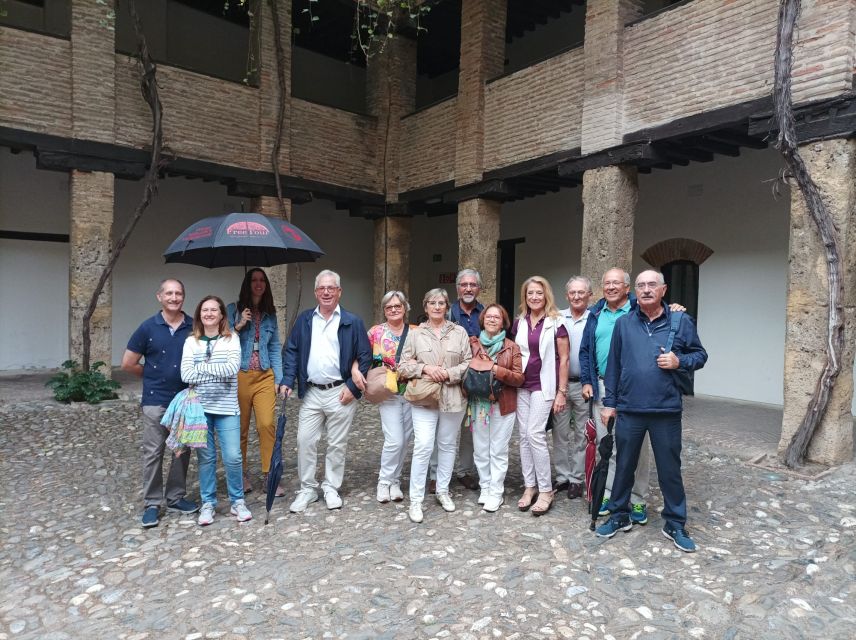
One of the early sights is the Corral del Carbón, a preserved building from Granada’s Islamic period. Its name refers to coal, though the building served as a place connected with trade and lodging.
The stop helps you picture Granada as a commercial city, not only a royal or religious one. You learn about the kind of activity that once filled the central streets, with merchants, goods, and travelers moving through the city.
The Corral del Carbón is also a useful introduction to the tour’s approach. You are not simply looking at a façade. The guide explains what the building meant in the life of the city and how Granada’s Islamic past remains visible in its central street plan and architecture.
The tour focuses on seeing and understanding the sights from the route. It does not promise entry into every monument, so you should not treat this as an indoor museum tour. That is part of the reason the price stays low, but it also means you may want separate visits later.
Alcaiceria and the old market streets
The Alcaiceria is one of the most atmospheric parts of the central route. Its name recalls Granada’s former silk market, and the narrow commercial lanes still feel different from the broad streets around them.
This is where the city’s past becomes easy to picture. The route takes you through an area shaped by trade, Islamic design, and later Christian rebuilding. You will see how Granada’s older fabric survives inside a busy city center.
The lanes can be crowded, and their narrow shape means you may need to stay close to the group. That is not a serious problem, but it can make it harder to stop for long photographs. I would use the guide’s explanation as your main purpose here, then return later if you want a slower look.
The Alcaiceria also connects naturally with the nearby Cathedral and other Christian buildings. Granada’s history is not laid out in separate districts. Islamic and Christian layers sit beside each other, sometimes in the same block.
Same streets, a different guide:
- Barcelona Tapas and Wine Experience Small-Group Walking Tour
★ 5.0 · 5,804 reviews - Barcelona: Tapas Walking Tour with Food, Wine, and History
★ 4.8 · 4,261 reviews - Madrid Tapas & Wine Tasting Walking Tour – Small Group Local Bars
★ 5.0 · 3,644 reviews - Granada: Albaicín and Sacromonte Guided Sunset Walking Tour
★ 4.9 · 2,962 reviews
Plaza Bib Rambla, the Madraza, and the Cathedral
Plaza Bib Rambla gives the walk a more open pause. The Giants Fountain is one of the square’s named sights, and the plaza has long been tied to public life in central Granada.
A square like this helps break up the route. After narrow lanes and dense old buildings, you have room to look around and listen. The guide can explain how public spaces, markets, and celebrations fit into Granada’s urban life.
From here, the tour covers several major buildings, including the Madraza and the Cathedral. The Madraza was an Islamic school, and it provides one of the clearest reminders that Granada was an important center of learning before the Christian conquest.
The Cathedral represents the city’s later Christian identity. Seeing these two places in the same walk gives you a useful contrast, especially if Granada’s history is new to you. The tour explains the transition rather than presenting the Christian monuments without context.
You will also see the Royal High Court, the Royal Chancillería, and the Royal Jail. These buildings point to Granada’s legal and administrative importance after 1492. They are easy to overlook when you are focused on the Cathedral or Alhambra, so having a guide call them out adds value.
Do not expect a full architectural lecture at every stop. The route covers many sights, and the guide has to keep the group moving. The benefit is breadth: in one morning or afternoon, you see the main central landmarks and understand how they relate.
Turning uphill into the lower Albaicin
The lower Albaicin is where the character of the walk changes. Streets narrow, the route becomes less formal, and the Moorish past feels closer in the layout of the neighborhood.
This is not the highest part of the Albaicin, but it is still an uphill walk. The route includes old streets and uneven surfaces, so comfortable shoes are essential. People with mobility impairments should choose another way to see Granada, since the tour is specifically marked as unsuitable for them.
The climb can be manageable for many people, but it is not wise to assume that a city walk means flat pavement. One family group included people with angina and knee problems. Their guide allowed breaks because the group was small, but that kind of flexibility cannot be guaranteed when the tour is fuller.
That is the key practical point: the pace may be adjusted, but the route itself still includes an uphill section. If you have a health concern, consider how comfortably you can walk for 2.5 hours before booking.
In return, the Albaicin provides a side of Granada that you do not get from the main plazas. You pass narrow lanes and buildings that recall the neighborhood’s Moorish origins. The experience is less about entering a single famous monument and more about reading the shape of the neighborhood.
The Alhambra viewpoint
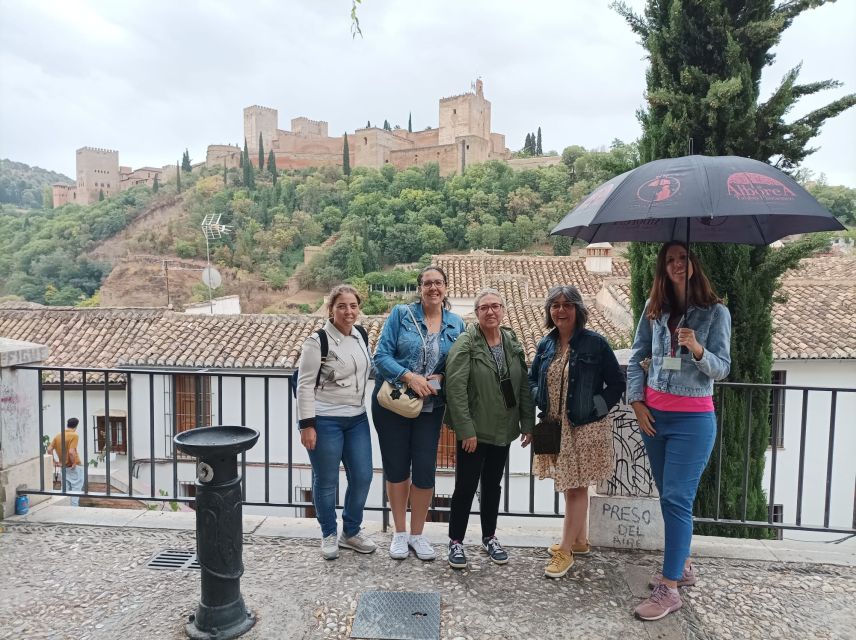
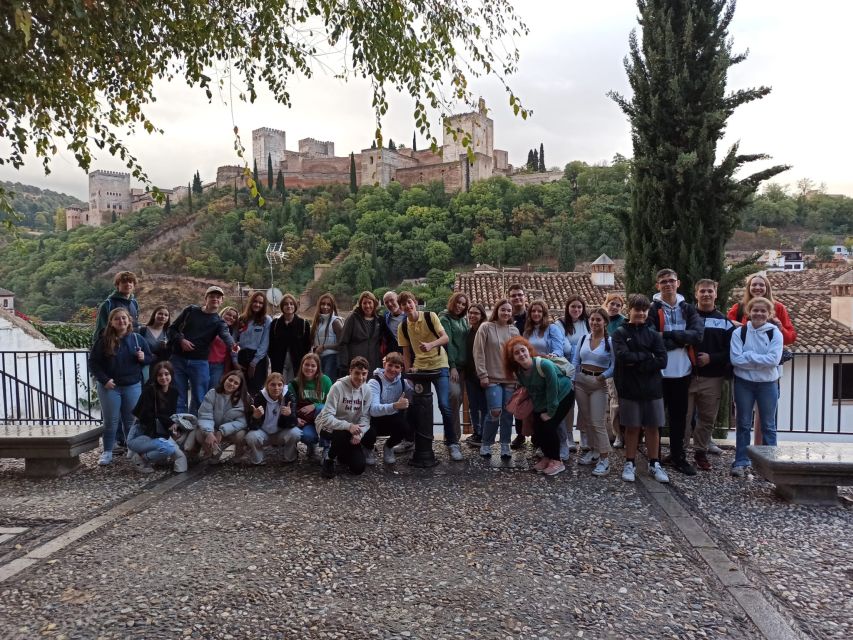
The viewpoint is the payoff for walking into the Albaicin. From the lower neighborhood, you get a clear angle toward the Alhambra, Granada’s most famous landmark.
This is not an Alhambra tour, and you do not enter the palace or fortress complex. The value is visual and geographic. The guide helps you understand where the Alhambra sits in relation to the city, while you get time for photographs.
The viewpoint also makes the earlier history easier to grasp. Looking toward the Alhambra from the old Muslim quarter connects the palace with the city below it. You see Granada as a layered place rather than a postcard with one isolated attraction.
Bring your camera, but also listen before rushing to take pictures. A guide’s explanation can turn a good view into a meaningful one. The stop is especially useful if you have not yet visited the Alhambra, since it gives you a better sense of its position and scale.
What the guide adds beyond a map
The strongest part of this experience is the human explanation. The route includes many buildings, but a list of names alone would not tell you why Granada changed so sharply after 1492 or how the old neighborhoods fit together.
Guides have answered questions about architecture, paving, local culture, and later places to visit. Several have also suggested restaurants and other sights for free time. Those tips can be valuable because they come while you are looking at the city, not after you have already left.
The best guides keep you involved. Irene has been described as asking questions of the group, while Jaime and Pablo have been praised for making history engaging rather than dry. Anna, Emilio, Elene, and Rocio have also received strong praise for patience, warmth, or clear explanations.
Group size can change the feel of the tour. In quieter periods, some groups have had only a handful of people, and one family group of seven effectively received a private-style experience. A small group makes it easier to ask questions and adjust for short rest stops. You should not count on that, but it is a possible bonus.
The advertised score is 4.7 out of 5 from 136 ratings, with most published ratings at the top level. Two ratings raise the same fair caution: the guide may be passionate and well informed, but an accent can occasionally make English harder to follow. That is a minor concern, yet worth noting for anyone who needs very crisp spoken English.
Who should book this $16 walk?
I would choose this tour if you are visiting Granada for the first time and want a quick framework for the city. It works well for people who enjoy history but do not want to spend the whole day inside museums.
It also suits you if you have limited time. The route covers the old center, the lower Albaicin, and an Alhambra viewpoint in 2.5 hours. You will not see every detail, but you will cover a useful range of Granada’s main sights.
Families and small groups may appreciate the conversational format, especially if the guide is able to pause for questions. The tour can also work well for solo visitors who want an introduction before exploring independently.
I would skip it if you want a flat route, private vehicle transport, or extended interior visits. It is also not the right choice if your main goal is a detailed Alhambra tour. For that, you need a separate experience.
Comfortable shoes are not optional advice here. Wear footwear suited to old streets and the climb into the Albaicin, and allow yourself enough time to reach the central meeting point.
Booking flexibility and practical value
The tour costs $16 per person and lasts 2.5 hours. That is strong value if you use it as an orientation walk, then return to the places that interest you most.
You can cancel up to 24 hours in advance for a full refund. The reserve-now, pay-later option also helps if your schedule is still moving around. These policies matter in Granada, where you may be arranging an Alhambra visit, train connections, and other timed activities.
The guide and walking tour are included. Monument admission is not listed, so plan to admire some buildings from outside or pay separately if you decide to return for an interior visit.
Should you book this Granada walking tour?
Book it if you want Granada explained as a connected city, not just a checklist of the Alhambra, Cathedral, and Albaicin. The mix of central monuments, Islamic history, narrow neighborhood streets, and a strong Alhambra view gives you a lot for $16.
Choose an early place in your itinerary if possible. You will get your bearings, hear the basic story of 1492, and leave with practical ideas for what to see next.
Think twice if hills, uneven streets, or long periods of walking are difficult for you. For everyone else, this is a sensible, low-cost introduction led by guides who bring personality and useful local context to Granada’s complicated past.
FAQ
How long does the Granada walking tour last?
The tour lasts 2.5 hours.
How much does the tour cost?
The listed price is $16 per person.
Where does the tour meet?
Meet the guide in front of the monument of Isabel la Católica and Cristóbal Colón in central Granada.
Which languages are available?
The tour is offered in English and Spanish.
Does the tour include an Alhambra visit?
No. The tour includes a viewpoint with a view of the Alhambra, but it does not include entry to the Alhambra.
Which sights are included on the route?
The route includes the Corral del Carbón, Alcaiceria, Plaza Bib Rambla, the Church of Saint Ana, the Royal High Court, the Giants Fountain, the Madraza, the Cathedral, the Royal Chancillería, the Royal Jail, and the lower Albaicin.
Is the tour suitable for people with mobility impairments?
No. The tour is not suitable for people with mobility impairments, and the route includes an uphill section in the lower Albaicin.
What should I bring?
Bring comfortable shoes suitable for walking through historic streets and uphill sections.
Can I cancel the tour and receive a refund?
Yes. You can cancel up to 24 hours in advance for a full refund. You can also reserve now and pay later.
More History Walking Tours in Spain
- Barcelona Tapas Walking Tour: Food, Wine & History
★ 4.5 · 1,928 reviews - Madrid Historic Centre Food Tour with Authentic Tapas & Wines
★ 5.0 · 814 reviews - Seville: Tapas, Taverns, and History Walking Tour
★ 4.9 · 676 reviews - Seville: Tapas, Taverns and History Guided Walking Tour
★ 4.9 · 515 reviews
New routes in Spain
- Toledo: Guided Walking Tour with Cathedral Ticket and Tour★ 4.2 · 98 reviews
- Toledo: Guided Monument Walking Tour with Wristband Pass★ 4.5 · 487 reviews
- Valencia: Fallas Festival Walking Tour with Entry Ticket★ 4.6 · 86 reviews
- Barcelona: “The Shadow of the Wind” Literary Walking Tour★ 4.5 · 176 reviews
- Tenerife: Underwater Walk – Sea Trek Experience★ 5.0 · 237 reviews
- Tarragona: Roman Heritage Guided Walking Tour★ 4.7 · 261 reviews
- Seville: Sunset Roof Top Walking Tour★ 4.2 · 131 reviews
- Seville: Paranormal and Legends Guided Walking Tour★ 4.7 · 336 reviews
Granada Walking Tours, compared.
Albaicín and Sacromonte Guided Sunset Walking Tour
Read our review →


Albaicín, Sacromonte & Museum of Caves Walking Tour
Read our review →

Browse the lists this tour appears in