
Review · ITALY
Ferrara: City Highlights Walking Tour with Local Guide
Ferrara’s best feature is how much history fits into a calm, human-sized city. This walk links the medieval castle to the Renaissance streets planned by Ercole I d’Este, then reaches Palazzo dei Diamanti, a leafy park, a former Carthusian complex, and Piazza Ariostea. I like the clear route and the chance to see more than the usual castle-and-cathedral circuit.
I also like that the tour enters San Cristoforo alla Certosa, rather than treating the city as an outdoor photo stop. The main consideration is pace: two hours covers a fair stretch of Ferrara, while entrance tickets are not included and the tour is conducted in Italian.
Key points to know before booking
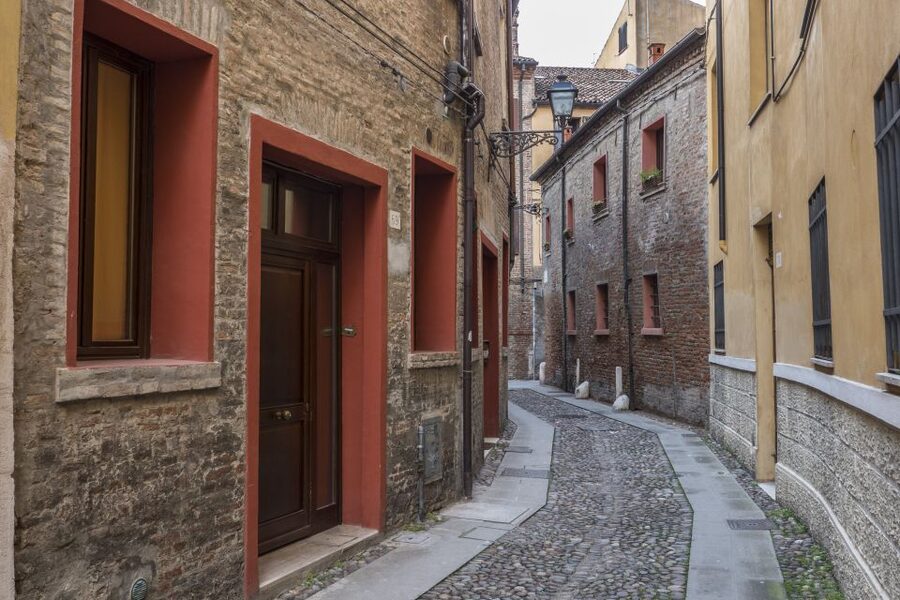
- The route crosses two eras: You begin at the medieval Estense Castle and continue into the Renaissance expansion known as the Addizione Erculea.
- Corso Ercole I d’Este is a major highlight: This long, elegant road leads toward the northern walls and shows Biagio Rossetti’s careful city planning.
- Palazzo dei Diamanti is viewed from outside: Its unusual diamond-shaped stonework is one of Ferrara’s most memorable sights, but admission is not part of the tour.
- San Cristoforo alla Certosa includes an interior visit: The former Carthusian church adds a quieter, more reflective stop to the walk.
- The guide speaks Italian: An Italian audio guide is included, and the experience is listed as wheelchair accessible.
- The price is modest: At $17 per person, the tour offers a useful orientation for the cost of a casual meal, though extra museum or castle tickets are separate.
Why Ferrara works so well on foot
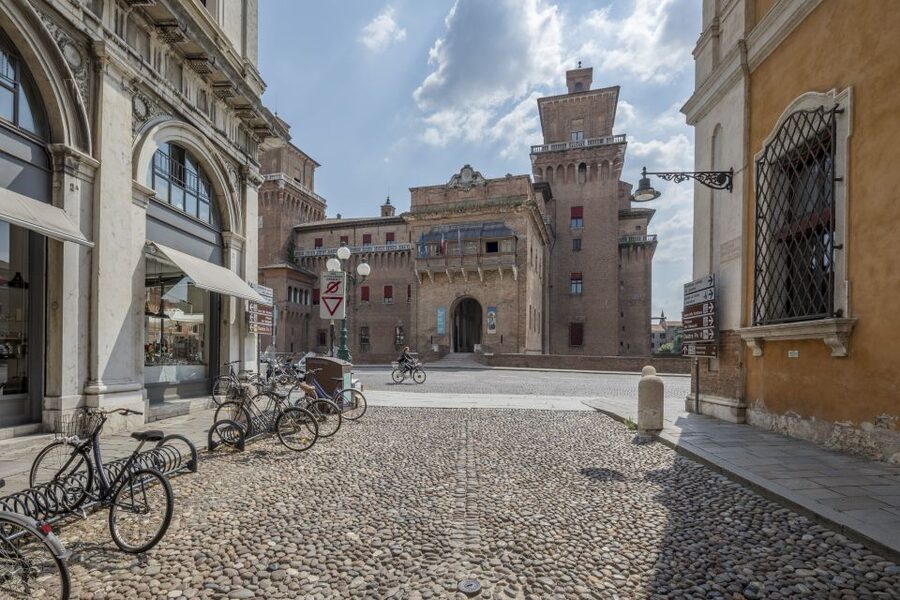
Ferrara is one of those Italian cities that rewards slow looking. Its center is compact enough to explore on foot, yet its story shifts as you move from one street to the next. Medieval power begins at the Estense Castle. Renaissance planning takes over along Corso Ercole I d’Este. Later, the route reaches parks, arcades, a cemetery, and a broad square linked to one of Italy’s major poets.
That change of mood is the real appeal of this tour. You are not simply ticking off four monuments. You are watching Ferrara change from a fortified ducal center into a carefully planned Renaissance city.
The two-hour length is useful for a first look. It is long enough to give you a sense of Ferrara’s shape, but short enough to leave time for a museum, lunch, or a second walk on your own. I would place it early in a Ferrara visit, since the route helps you understand where the main sights sit in relation to one another.
The tour costs $17 per person. That is good value if you want a guided introduction rather than a list of buildings viewed in silence. You are paying for the route, the guide’s explanations, and the chance to ask questions in Italian. You should budget separately for any paid interiors, since entrance tickets are not included.
More City Highlights Walking Tours in Italy
- Florence: Highlights Walking Tour with Expert Guide
★ 4.6 · 4,662 reviews - Skip-the-Line Florence Highlights and David Walking Tour
★ 5.0 · 1,127 reviews - Venice: Walking Guided Tour of the City Must-See Sites
★ 4.7 · 1,095 reviews
Meeting the guide at Estense Castle
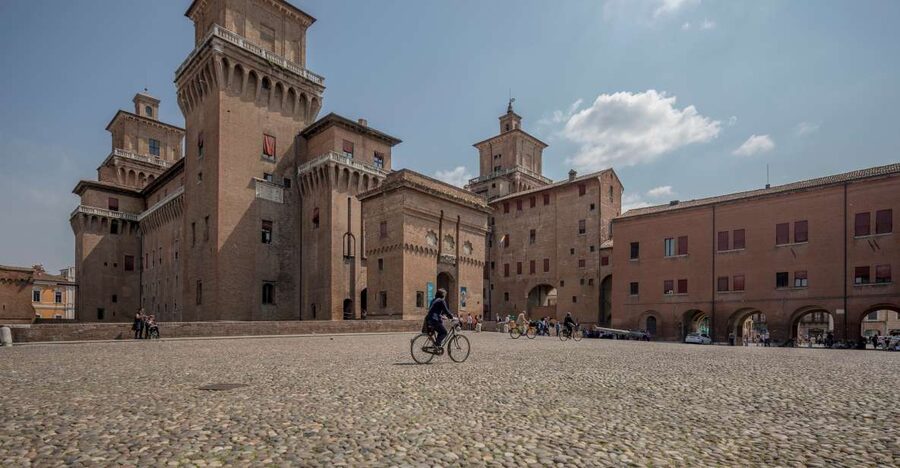
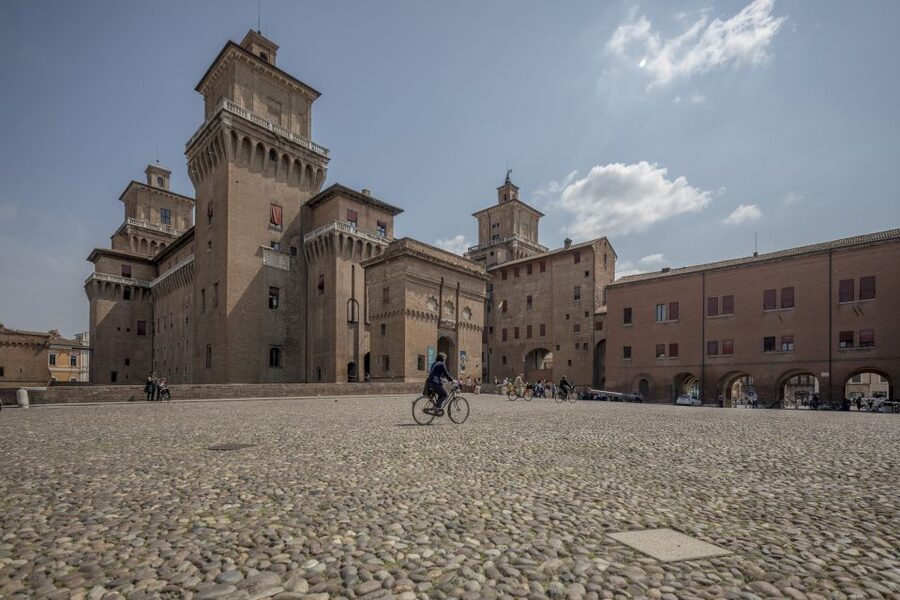
The meeting point is in the courtyard of Estense Castle, near the loggia. This is an easy place to identify, but give yourself a little time to get there. The castle is the city’s central landmark, and the courtyard offers a clear starting point for a walking tour.
The castle itself sets the tone. Its towers, moat, and heavy medieval presence recall the power of the Este family, the dynasty that shaped Ferrara for centuries. The walk uses the castle as more than a backdrop. It is the starting point for stories about the family, its ambitions, and the legends connected with its rule.
The supplied information does not specify group size, so you should not assume a private tour or a very small group. It does promise a live Italian-speaking guide, with an Italian audio guide included. If you understand Italian, the live commentary should give the tour its personality. If you do not, check the booking details carefully before reserving, since no English guiding option is listed.
A guide named Maria Chiara has been singled out for her professional and engaging approach. Guide assignments can change, but that name is useful to know when you check your confirmation.
Corso Ercole I d’Este and the Renaissance expansion
From the castle, the route looks toward Corso Ercole I d’Este. This is not just another attractive street. It connects the castle with the north gate of the city walls and crosses the Renaissance expansion ordered by Duke Ercole I d’Este.
The expansion is called the Addizione Erculea. It was planned at the end of the 15th century and carried out with the work of the Ferrarese architect Biagio Rossetti. The idea was ambitious for its time: Ferrara would grow through deliberate planning, with broad routes, palaces, open spaces, and a stronger connection between the old city and its newer northern quarter.
I like this part of the walk because a guide can make the street plan readable. Without context, you may simply notice long views and handsome buildings. With an explanation of the duke’s plan, the road becomes evidence of political confidence. Ferrara was not growing by accident. Its rulers wanted a city that expressed order, culture, and authority.
The pace may feel brisk if you want to photograph every facade. The route is designed to keep moving, so have your camera ready before the guide stops. You can always return later for a slower look.
Palazzo dei Diamanti and the historic crossroads
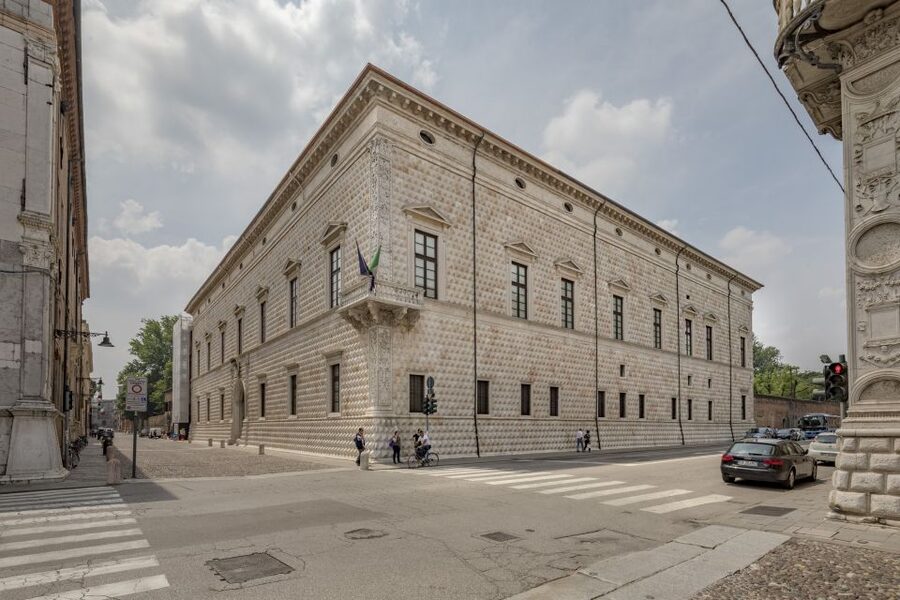
The next major sight is Palazzo dei Diamanti, one of Ferrara’s most distinctive Renaissance buildings. Its facade is covered with diamond-shaped stone points, creating a changing pattern of light and shadow. Even if you do not enter, the exterior is worth careful attention.
The palace sits at the heart of the Addizione Erculea, close to the city’s historic crossroads. This location matters. You are seeing how the planned Renaissance quarter connected important routes and made architecture part of the city’s public image.
The tour focuses on Ferrara’s palaces and churches rather than only on famous names. That makes the route feel more complete. You get the large symbols of the city, such as the castle and Palazzo dei Diamanti, but also the streets and views that join them together.
Do not expect a museum visit here. Entrance tickets are not included, and the information provided does not promise entry to Palazzo dei Diamanti. Treat this stop as an architectural and urban-planning lesson from the outside. If the palace is a top priority, return later with separate admission arrangements.
Same streets, a different guide:
- Venice: Doge’s Palace and St Mark’s Basilica Walking Tour
★ 4.4 · 6,291 reviews - Milan: Guided Walking Tour & Last Supper Visit with Ticket
★ 4.7 · 5,409 reviews - Naples: Street Food Walking Tour with Local Guide
★ 4.9 · 4,976 reviews - Venice: San Marco to Rialto Walk & Spritz Like a Local
★ 4.2 · 3,651 reviews
Massari Park and the quieter side of the city
After the historic crossroads, the walk continues toward Massari Park. The park is known for its old cedars of Lebanon and varied plant life. Its setting beside the University Botanical Garden gives this section a softer feel than the formal streets near the castle.
This is a useful change of rhythm. Ferrara’s story is not only about dukes, fortifications, and grand facades. Parks and planted spaces show how the city has made room for leisure, study, and quiet public life.
The route does not treat the park as a long break. It is part of the passage between the Renaissance center and the Certosa complex. You may find it especially pleasant on a mild day, while rainy weather will make an umbrella worthwhile. An umbrella is specifically recommended, and there is no shelter guarantee for the entire walk.
The park also gives you a chance to reset your attention. After several architectural stops, the cedars and garden views offer something less formal. That variety helps prevent the two-hour route from feeling like a continuous list of dates and names.
San Cristoforo alla Certosa and the former Carthusian complex
A few steps from the park, the tour reaches San Cristoforo alla Certosa. This is one of the most valuable parts of the route because it includes an interior visit to the Renaissance church.
The complex began as a home for Carthusian monks, who were called to Ferrara by Duke Borso d’Este in the middle of the 15th century. Over time, the site became a Monumental Cemetery. The change gives the area a layered character: religious foundation, Renaissance architecture, and later use as a cemetery.
The square in front is framed by elegant arcades. Their repeated forms create a quiet, enclosed feeling, quite different from the open routes near the castle. Inside the church, you can see the setting that once served the Carthusian community. The visit adds depth to the tour because it connects the city’s political story with its religious life.
I especially like the fact that this is not presented as a quick exterior stop. The interior visit gives you a chance to pause and look upward, across the church space, and at the relationship between the building and the former monastery complex.
As with any historic church, access can depend on local conditions, but the tour description specifically includes the interior visit. The broader activity is listed as wheelchair accessible. If you need detailed information about particular doorways or surfaces, confirm those points before booking, since the available details do not describe the route in that level of detail.
Piazza Ariostea and the final walk
The last major stop is Piazza Ariostea, a historic square named for the poet Ludovico Ariosto. His statue rises above the central column, giving the open space a clear focal point.
The square is a fitting end to the route. After the castle, planned avenues, palace facade, park, and church, you finish in a green public area with a literary connection. The tour ends under the loggia beside the green space, a pleasant place to pause before deciding what to do next.
Ariosto is an important part of Ferrara’s cultural identity, and the square helps bring literature into a route that has so far focused heavily on architecture and the Este family. You finish with a broader sense of the city, not just its buildings.
The square may also be useful for your own sightseeing plans. Once the guided walk ends, you can continue exploring nearby on foot, return toward the castle, or stop for a drink. The tour does not include transport, which is fine here: the whole experience is designed around walking.
What the guide adds to the experience
The value of this tour depends heavily on the live guide. Ferrara’s buildings are attractive, but the route becomes more useful when someone explains why the city was expanded, how the Este family shaped it, and how legends connect with the castle.
The strongest feedback centers on guides described as prepared, precise, professional, punctual, courteous, and empathetic. Those qualities matter on a two-hour walk. A guide who keeps the route organized can cover a lot without making you feel hurried, while a guide who explains the human side of the Este family can keep the tour from becoming a dry architecture lesson.
Italian is the only live-tour language listed. An Italian audio guide is included, also in Italian. That makes this experience best for Italian speakers or for people who are comfortable following an Italian tour with audio support. If you need English, French, or another language, this is not the safest booking choice based on the available information.
Wheelchair access, weather, and practical comfort
The activity is listed as wheelchair accessible, which is important for anyone planning a city walk rather than a bus tour. Still, the itinerary includes streets, a park, an arcaded square, a cemetery complex, and a church. If you have specific mobility needs, ask for details about the exact surfaces and entrance points before booking.
Wear shoes suitable for two hours of walking. The route covers a sizeable portion of Ferrara’s center and northern Renaissance quarter. The information does not give a precise distance, but the itinerary is clearly more than a short castle-area stroll.
Bring an umbrella if rain is possible. The tour is outdoors for much of its length, and Ferrara’s weather can change. The indoor church visit offers one sheltered stop, but it should not be treated as full protection from rain.
The tour offers free cancellation up to 24 hours before the start time. You can also reserve now and pay later, which helps if your Ferrara plans are still shifting. Starting times depend on availability, so check the date carefully before booking.
Who should book this $17 walk
I would recommend this tour to a first-time Ferrara visitor who wants structure and context without committing to a full-day program. It is also a good fit if you enjoy architecture, urban planning, religious buildings, and the stories of ruling families.
The route suits you especially well if:
- You want to see more than the Estense Castle.
- You prefer a guided walk to independent research.
- You can follow Italian.
- You have two hours available for a broad city introduction.
- You want an interior church visit included in the route.
- You are comfortable paying separately for optional museum or castle entries.
I would hesitate if you want an English-speaking guide, a relaxed photography walk, or detailed visits inside several monuments. This tour moves through many sights, but only the church interior is specifically included. It also does not list group size, so people seeking a private or highly personal experience should check before paying.
Should you book the Ferrara city highlights tour?
Book it if you want an affordable, well-shaped introduction to Ferrara’s medieval and Renaissance sides. The strongest reasons are the logical route from Estense Castle to Piazza Ariostea, the explanation of the Addizione Erculea, and the visit inside San Cristoforo alla Certosa.
At $17, it offers solid value for a two-hour orientation, especially if you are new to the city. Just remember that the live and audio commentary are in Italian, entrance tickets are extra, and the pace covers a lot of ground. For Italian speakers who want the city’s major sights tied into one story, this is an easy choice.
FAQ
Where does the Ferrara walking tour meet?
Meet in the courtyard of Estense Castle, near the loggia.
How long does the tour last?
The walking tour lasts two hours.
What is the price?
The listed price is $17 per person.
What language is the live tour in?
The live guide speaks Italian.
Is an audio guide included?
Yes. An Italian audio guide is included.
Are entrance tickets included?
No. Entrance tickets are not included in the price.
Is the tour wheelchair accessible?
Yes. The activity is listed as wheelchair accessible.
Does the tour enter any buildings?
The itinerary includes an interior visit to the Renaissance church of San Cristoforo alla Certosa. Other entrance arrangements and tickets are not included.
Where does the tour go?
The route begins at Estense Castle and includes Corso Ercole I d’Este, Palazzo dei Diamanti, Massari Park, San Cristoforo alla Certosa, and Piazza Ariostea.
Can I cancel for a full refund?
Yes. You can cancel up to 24 hours in advance for a full refund.
Can I reserve now and pay later?
Yes. The activity allows you to reserve now and pay later.
What should I bring if rain is possible?
Bring an umbrella. It is advisable because much of the experience takes place outdoors.
New routes in Italy
- Private St. Francis Basilica of Assisi and City Walking Tour★ 5.0 · 114 reviews
- Assisi Private Walking Tour including St. Francis Basilica★ 5.0 · 124 reviews
- Milan: City Highlights Walking Tour with The Last Supper★ 4.9 · 195 reviews
- Florence: Heart of Florence Guided Walking Tour★ 4.0 · 81 reviews
- Milan: Private or Shared Essential Walking Tour★ 4.7 · 84 reviews
- Taormina: Shared or Private Food & Wine Walking Tour★ 4.6 · 167 reviews
- Syracuse: Ortigia Private Walking Tour★ 4.8 · 181 reviews
- Syracuse: Ortigia and Neapolis Guided Walking Tour★ 4.7 · 205 reviews
Italy Walking Tours, compared.
Doge’s Palace and St Mark’s Basilica Walking Tour
Read our review →
Guided Walking Tour & Last Supper Visit with Ticket
Read our review →
San Marco to Rialto Walk & Spritz Like a Local
Read our review →
Uffizi & Accademia Timed Entry: Small Group Duomo Walking Tour
Read our review →
Browse the lists this tour appears in