

Review · BARCELONA
Private Tour Spanish Civil War & Franco’s Dictatorship
Barcelona’s Civil War story is written into ordinary streets, old churches, and damaged stone. This private walking tour follows the conflict from the fight over the Telefónica building at Plaça Catalunya to the scars of aerial bombing at Plaça Sant Felip Neri. You get political conflict, daily hardship, foreign involvement, and the later repression of Franco’s dictatorship in one compact route.
I like the private format, since your guide can spend more time on the topics that catch your interest. I also like the route’s physical evidence, including wartime damage and the church connection to the International Brigades. The main drawback is its pace: 2 hours and 30 minutes covers a lot, so you should expect a focused introduction rather than a full course in Spanish history.
Key points to know before booking
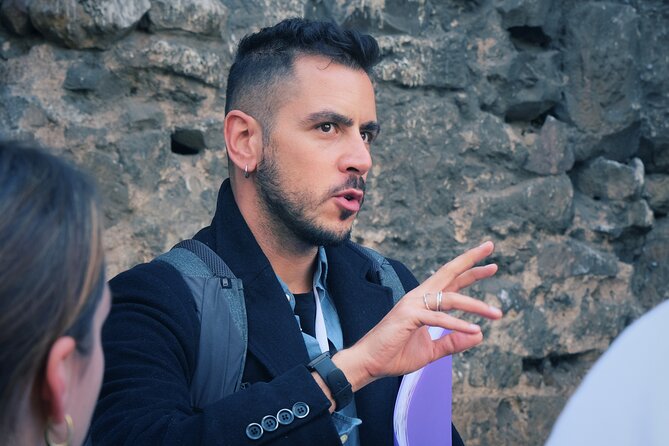
- The route begins at Plaça Catalunya, with the Telefónica building and the street fighting that made Barcelona a major Republican center.
- You walk through Raval, where working-class suffering, anarchism, and resistance shaped the city’s wartime experience.
- George Orwell’s Barcelona connection appears at La Rambla, adding a personal and literary angle to the politics.
- Plaça Sant Felip Neri shows visible bombing damage, giving the final part of the tour a stark, physical reminder of the war.
- The tour is private and offered in English, with flexible start times and attention from one expert guide.
- The $181.41 price is per person, so its value improves when shared by a larger private group.
Why Barcelona’s Civil War story deserves two and a half hours
Many visitors come to Barcelona for Gaudí, the Gothic Quarter, food, and beaches. Those are good reasons to come. But the city also carries the memory of the Spanish Civil War and the dictatorship that followed it, and that story explains parts of Barcelona that can otherwise seem disconnected.
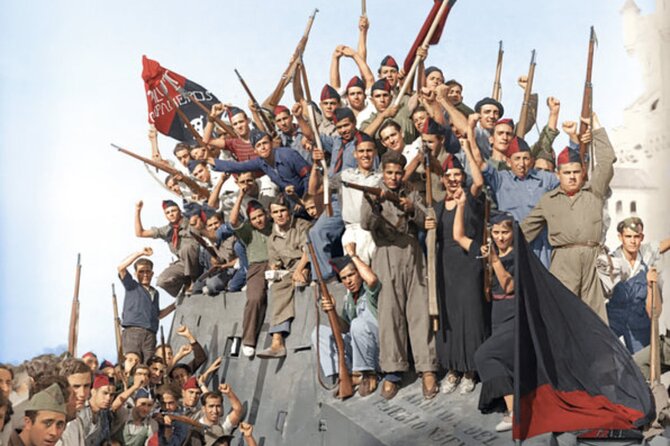
From 1936 to 1939, Barcelona was a major Republican stronghold. Political parties, trade unions, anarchists, foreign volunteers, and ordinary residents all played roles in the city’s wartime life. The fighting was not only at a distant front. It reached offices, hotels, churches, hospitals, and city streets.
This tour works because it keeps those events tied to real places. You are not simply hearing dates beside a museum display. You are moving from one urban setting to another, with each stop adding a different piece of the story.
The private setup matters here. The subject can become complicated quickly, especially when the guide explains the tensions among Republicans, anarchists, communists, socialists, and other factions. A private guide can pause, clarify terms, or spend more time on a question without worrying about a large group waiting.
If your guide is Yannis, you can expect a strongly engaged presentation. He is described as passionate and highly informed, with a clear focus on the causes of the war and the conditions that shaped it. That kind of background is useful because the tour is not limited to battlefield events. It also addresses class conflict, ideology, foreign intervention, and cultural repression.
More Private Walking Tours in Barcelona
- Barcelona Helicopter, Sailboat & Old Town Private Walking Tour
★ 5.0 · 1,395 reviews - Barcelona: Sagrada Familia, Park Guell & Tapas Private Tour
★ 5.0 · 903 reviews - Barcelona 1.5h Private Old Town, Gothic & Ramblas Walking Tour
★ 5.0 · 318 reviews
Plaça Catalunya and the fight for Telefónica
The tour starts outside Foot Locker at Plaça Catalunya, at Pl. de Catalunya, 20. This is a practical meeting place in the center of Barcelona, close to public transportation and easy to fit into a day of sightseeing.
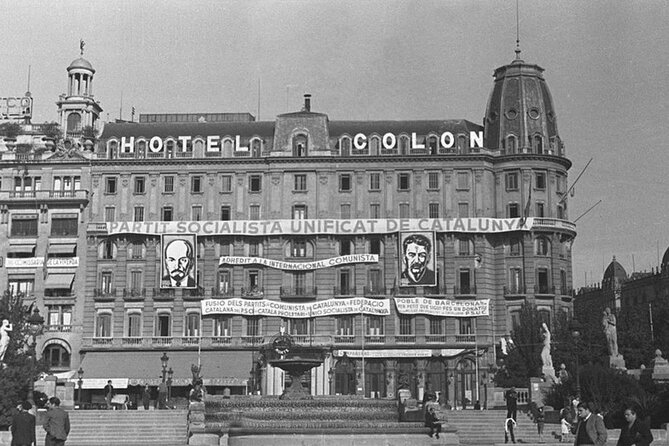
The opening stop lasts about 30 minutes. Your guide introduces the Spanish Civil War and explains the fight over the Telefónica building. That episode places you in the middle of Barcelona’s internal political tensions, where control of communications and public space had real strategic importance.
Plaça Catalunya is also a useful starting point because it is familiar, open, and central. You can orient yourself before entering the older streets. The contrast is effective: modern shops and heavy foot traffic surround a place connected to one of the city’s most tense periods.
This first section is likely to suit you if you want causes and context, not just dramatic stories. It helps explain how a national conflict became a struggle within Barcelona itself.
The drawback is that the setting is busy and commercial. You may need to concentrate on the guide rather than expect a quiet atmosphere. That is part of the trade-off of beginning in the city center.
La Rambla and Orwell’s wartime Barcelona
From Plaça Catalunya, the route continues to La Rambla for about 20 minutes. Here, the focus turns to the hotel where George Orwell stayed during the Spanish Civil War.
Orwell’s presence gives the tour a direct human link to the conflict. His experience in Barcelona brought international attention to the political divisions within the Republican side, and his writing remains one of the best-known English-language accounts connected to the war.
The value of this stop is not simply literary. Orwell’s Barcelona story helps you consider what it felt like for a foreign observer to enter a city shaped by propaganda, factional politics, street fighting, and shifting loyalties.
You should not expect a long visit inside the hotel itself. The stop is about the location and the explanation provided there. That makes it a brief but useful part of the route, especially if you have read Orwell or want to understand why international volunteers and writers were drawn to Spain.
Raval, class conflict, and anarchist resistance
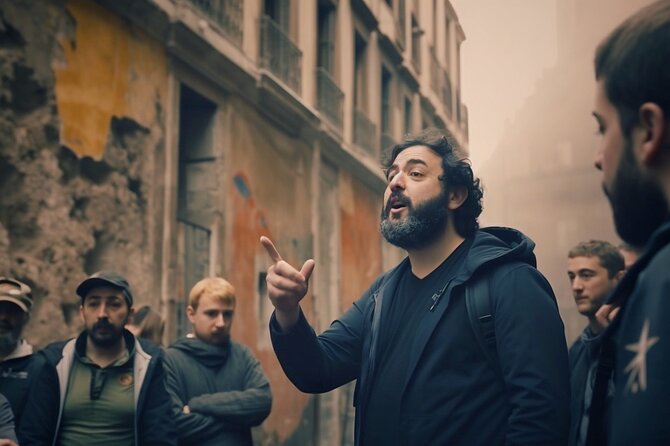
The 20-minute stop at Plaça de Vicenç Martorell moves the story into the Raval neighborhood. This part of the tour focuses on working-class suffering, resistance, and anarchism.
Raval gives the guide a chance to explain the war from below, through the experience of people who faced shortages, violence, political uncertainty, and social upheaval. It also brings attention to Barcelona’s anarchist movement, an important part of the city’s wartime identity that can receive less attention on a standard sightseeing route.
I find this section especially useful because it prevents the war from becoming only a story about famous leaders or foreign armies. The conflict affected neighborhoods and families. It changed how people worked, organized, argued, and survived.
The stop also adds political complexity. Barcelona’s Republican side was not united around one simple program. Different movements had competing goals, and those divisions affected the city during the war. A private guide can make those differences easier to follow than a short label in a museum.
There is no admission fee at this stop, or at the other locations on the route. Still, the value comes from interpretation. You are paying for the guide’s explanation and connections between places, not for entry into a monument.
More Private Walking Tours in Spain
- Barcelona: Private Walking Tour with a Local
★ 4.5 · 202 reviews - Semi-Private Montserrat Monastery, Funicular & Scenic Nature Walk
★ 5.0 · 172 reviews - Barcelona Private Food Tour: Tapas, Paella & 8+ Food Tastings
★ 5.0 · 164 reviews - Barcelona: Old Town Private Walking Tour of Past and Present
★ 5.0 · 160 reviews
Antic Hospital de la Santa Creu and the war’s human cost
The next stop is the Antic Hospital de la Santa Creu, a 15th-century hospital that treated wounded soldiers and civilians. The visit lasts about 20 minutes.
This is where the tour’s military and political story becomes more personal. Hospitals show the cost of war in a direct way. Soldiers were not the only people hurt. Civilians also passed through these medical spaces, and the hospital helps connect large events to injury, fear, and loss.
Your guide also discusses the end of the war and cultural oppression under Franco’s dictatorship. That shift is important. The experience does not stop in 1939 with the Republican defeat. It follows the conflict into the decades of authoritarian rule that came afterward.
For many visitors, this may be one of the most useful transitions in the tour. It explains that the end of fighting did not mean an immediate return to normal life. Political defeat, censorship, and pressure on cultural expression formed part of the next chapter.
The hospital itself is also an architectural site, so this stop adds an older layer of Barcelona to the wartime story. You should keep in mind that the tour is conducted outdoors as a walk through historic areas, and the stop is not presented as a separate medical-history visit.
Santa Maria del Pi and the International Brigades
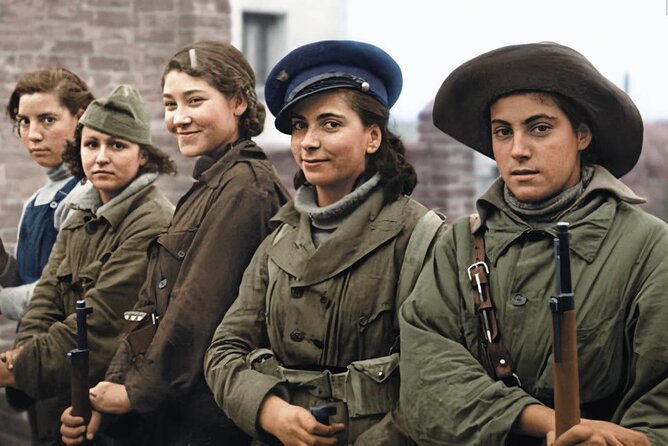
At the Basilica de Santa Maria del Pi, the guide points out a little-known remnant of the Spanish Civil War. The 30-minute stop focuses on the International Brigades.
The International Brigades brought volunteers from many countries to fight for the Republican cause. Their involvement shows how the Spanish Civil War became an international political struggle, not only a Spanish one.
This church stop is a good example of the tour’s method. The site may look primarily religious or architectural at first, but the guide uses it to reveal a wartime connection that is easy to miss. You get a new way to read the city, with older buildings carrying more recent political memories.
The length of this stop suggests room for explanation rather than a quick point-and-go visit. You can ask about the volunteers, their motives, and the wider foreign involvement in the war.
Since the tour remains a walking experience, the quality of this section depends heavily on the guide’s storytelling. A guide such as Yannis, who is described as passionate about the subject, should be well suited to making the International Brigades feel like part of a wider human story rather than a list of nationalities.
Plaça Sant Felip Neri and the scars of aerial bombing
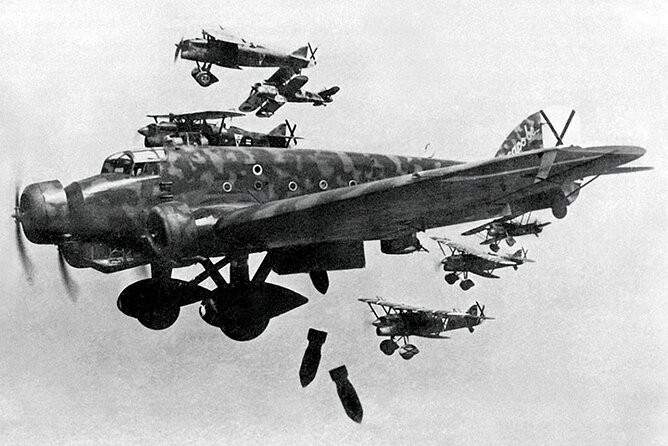
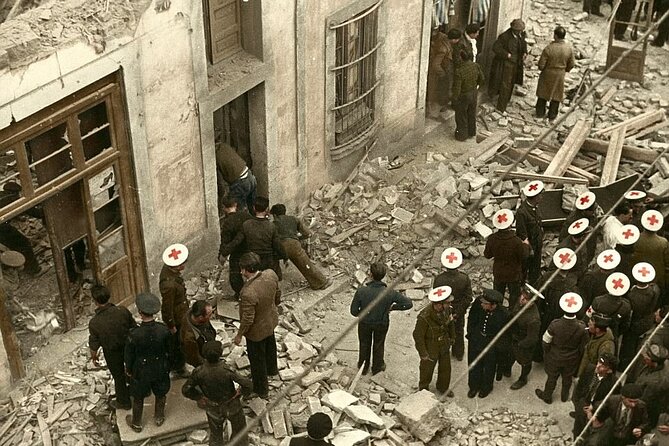
The final stop is Plaça Sant Felip Neri, reached after about 30 minutes of discussion at the previous location. This square contains the most visible damage from aerial bombing in Barcelona, and the guide explains the tragic bombing there and the role of the Axis powers.
This is likely to be the tour’s strongest visual moment. Bomb damage gives you something concrete to examine. Stone surfaces can communicate the violence of the past more forcefully than a long explanation, especially when the guide places the damage within the wider use of air power during the conflict.
The stop also brings in Germany and Italy, whose involvement helped shape the war. That international dimension fits well with the earlier discussion of the International Brigades, but from the opposing side of the conflict.
Plaça Sant Felip Neri is also a fitting end because it leaves you with the physical consequences of war rather than a neat political conclusion. The end point is Plaça Nova, close to Barcelona Cathedral, so you can continue sightseeing in the Gothic Quarter afterward.
The route ends outdoors, and the experience requires suitable weather. If poor weather forces cancellation, you are offered another date or a full refund. That policy is helpful, but you should still avoid placing the tour immediately before an important timed activity.
What the private format is worth at $181.41
The listed price is $181.41 per person. That is not a cheap casual walk, especially since no food, drinks, or admission tickets are included.
The price makes more sense if you are traveling as a private group and want a serious history lesson rather than a general orientation walk. Your group receives the guide’s full attention, and the private format lets you ask questions about political movements, foreign involvement, Orwell, the dictatorship, or particular sites.
Group discounts are available, which can improve the cost for families or friends booking together. Since the tour is private, the real value depends on how many people share the experience and how much you care about this subject.
I would not choose it if you want a broad introduction to Barcelona’s architecture or a relaxed stroll with only a few historical facts. I would consider it good value if the Spanish Civil War is a major reason for your interest in the city, or if you prefer an expert-led route to reading a book while trying to locate the sites yourself.
The tour lasts about 2 hours and 30 minutes. That is long enough to create a connected story but short enough to fit into a morning or afternoon. Start times are flexible, so you can place it around other plans.
Walking conditions, language, and practical details
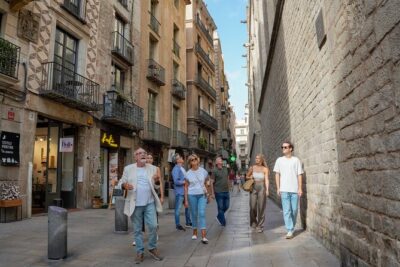
The tour is offered in English and includes an expert guide. It is a walking route through central Barcelona, beginning at Plaça Catalunya and ending near the Cathedral at Plaça Nova.
No entry tickets are required for the listed stops. You should still wear comfortable shoes because the experience moves through several central neighborhoods and historic streets. Food and drinks are not included, so plan a break before or after the tour.
Most people can participate, and service animals are allowed. The route is near public transportation, which makes both the starting point and the final location convenient.
Tips are not included. Guides gladly accept gratuities, so you may want to budget for one if the tour gives you the clear, thoughtful experience you are looking for.
You receive confirmation at booking in most cases. If you book within two days of the start date, confirmation can take up to 48 hours and remains subject to availability. Free cancellation is available until 24 hours before the start time. After that point, refunds and changes are not accepted.
Who should book this Barcelona history walk
I recommend this experience most strongly to:
- You want to understand Barcelona beyond its famous architecture.
- You have an interest in the Spanish Civil War, Franco’s dictatorship, Orwell, or the International Brigades.
- You prefer a private guide who can answer questions and adjust the emphasis.
- You are comfortable walking for two and a half hours through central neighborhoods.
- You want to see physical traces of bombing and wartime damage.
- You are traveling with a group that can share the private-tour cost.
I would be more cautious if your time in Barcelona is very short and you have no interest in modern Spanish history. The route is focused, not a general city tour, and the subject includes political conflict and cultural repression.
Should you book the Spanish Civil War and Franco’s Dictatorship tour?
Book it if you want Barcelona’s wartime past explained at street level. The route combines the Telefónica fighting, Orwell’s hotel, Raval’s anarchist history, a historic hospital, the International Brigades, and visible bombing damage at Plaça Sant Felip Neri.
The strongest reasons to choose it are the private attention, the clear progression through different parts of the conflict, and the chance to ask detailed questions. The main question is value: at $181.41 per person, it suits a group with a real interest in the subject better than someone seeking a low-cost sightseeing walk.
If Yannis is available as your guide, his reported passion for the causes and conditions behind the war could make the experience particularly strong. Either way, allow the full two and a half hours, wear sensible shoes, and keep the rest of your schedule flexible. For history-minded visitors, this is a serious and worthwhile way to see a less familiar side of Barcelona.
FAQ
Where does the tour begin?
It begins at Foot Locker, Plaça de Catalunya, 20, Ciutat Vella, Barcelona.
Where does the tour end?
It ends at Plaça Nova in Ciutat Vella, close to Barcelona Cathedral.
How long does the tour last?
The tour lasts approximately 2 hours and 30 minutes.
Is the tour private?
Yes. Only your group participates in the activity.
What language is offered?
The tour is offered in English.
What is included in the price?
An expert tour guide is included.
Are food and drinks included?
No. Lunch, food, and drinks are not included.
Are admission tickets required?
The listed stops have no admission charge, so no entry tickets are included or required for those locations.
Can I cancel for a full refund?
Yes. You can cancel up to 24 hours before the experience starts for a full refund.
What happens if bad weather cancels the tour?
If poor weather causes cancellation, you are offered a different date or a full refund.
New routes in Barcelona
- Barcelona Gothic Quarter Walking Tour with Tapas★ 5.0 · 248 reviews
- Picasso Museum and Walking Tour Plus Optional Wine & Food Tasting★ 5.0 · 596 reviews
- Barcelona Private Food Tour: Tapas, Paella & 8+ Food Tastings★ 5.0 · 164 reviews
- Barcelona Architecture Walking Tour With Casa Batlló Upgrade★ 5.0 · 137 reviews
- Montjuïc Walking Tour With Optional Flamenco Show★ 5.0 · 196 reviews
- Private Barcelona Old Town and Gothic Quarter Walking Tour★ 5.0 · 134 reviews
- Barcelona: La Boqueria Food, Wine & History Walking Tour★ 5.0 · 126 reviews
- Barcelona in 2 Hours: Guided Walk Through History and Sights★ 5.0 · 203 reviews
Barcelona Walking Tours, compared.
Barcelona Tapas and Wine Experience Small-Group Walking Tour
Read our review →
Tapas Walking Tour with Food, Wine, and History
Read our review →
Barcelona Helicopter, Sailboat & Old Town Private Walking Tour
Read our review →

Helicopter Flight, Boat Ride, and Walking Tour
Read our review →
Barcelona Old Town & Gothic Quarter Small Group Tour
Read our review →
Barcelona Food Tour: Tapas, Paella, Sangria & 8+ Local Tastings
Read our review →Browse the lists this tour appears in