Review · TORONTO
Old Town Toronto Highlights 3 Hour Walking Tour | Gratuity-Based
Toronto’s downtown is easiest to understand on foot, and this tour connects the city’s old brick core with its towers, theatres, underground PATH, and civic squares. You’ll see the playful dog fountain at Berczy Park, the Flatiron Building, Old City Hall, the Toronto Sign, and several places that are easy to miss on your own.
I like the wide range of subjects, from William Berczy and E.J. Lennox to Terry Fox, hockey, film locations, and Toronto’s theatre district. I also like the local advice, since guides such as Maya, Joel, Alex, and Zak are praised for useful tips and lively storytelling. The main caution is pace: this can cover roughly 7 km, and some guides may spend a long time talking at early stops.
Key points to know before booking
- The PATH is a major highlight: Enter Toronto’s underground tunnel network through Commerce Court and see how different building owners gave each section its own look.
- Expect a real walk: The route lasts about three hours and may cover around 7 km, with a rest stop at Nathan Phillips Square.
- The $5 price is a booking fee: Guides work for gratuities, so you should budget for a tip in addition to the advertised price.
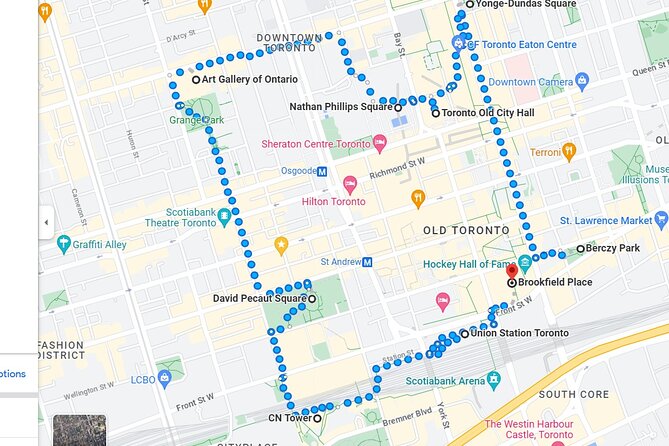
- You get a broad downtown introduction: The route covers Old Toronto, the Financial District, government buildings, the Entertainment District, Union Station, and more.
- Guide quality shapes the experience: Guides including Maya, Joel, Maria, Alex, Henry, Wei Ting, and Zak have been singled out for clear explanations, humor, and personal attention.
- Mobility matters: Most people can take part, but the distance, standing, uneven city flow, and occasional fast walking may be difficult for anyone needing frequent seating or a slower pace.
Why this route gives you a useful first look at Toronto
This is not a narrow Old Toronto architecture walk. It is a broad orientation to central Toronto, beginning among nineteenth-century buildings and ending around major transport, entertainment, and civic landmarks.
That range is useful when you first arrive. You get a sense of where the Financial District ends, where the theatres begin, how the PATH connects downtown, and how Union Station fits into the city’s daily movement. I like tours that help you plan the rest of your visit, and this one can do that.
The tour is offered at different starting times, with English and Spanish options. Groups can reach 30 people, although smaller groups may feel more personal. The guides use stories, architectural details, and local suggestions rather than simply pointing out buildings and naming dates.
The experience is gratuity-based. You pay $5 per person as a booking fee, while the guide depends on tips. One participant reported being told to consider a $30 tip, so treat the $5 as the entry charge, not the full cost of the experience. If you prefer knowing the final price in advance, this payment model may feel less comfortable.
More City Highlights Walking Tours in Canada
- Calgary City Highlights 3 Hour Walking Tour | Gratuity-Based
★ 4.5 · 378 reviews - Gratuity-Based Vancouver City Highlights 3 Hour Walking Tour
★ 4.5 · 320 reviews - Toronto: City Highlights Walking Tour | 3-Hour
★ 4.6 · 306 reviews
Berczy Park begins with dogs, fountains, and city origins
Berczy Park is a pleasant starting point because it gives the tour an immediate visual hook. Its famous dog fountain features larger-than-life dogs spraying water, and the park is more than a quick photo stop. Your guide explains William Berczy, how the park developed, and details that are easy to miss when you pass through alone.
The scheduled visit is about 15 minutes. That is enough time to gather the group, take in the fountain, and hear the opening story without turning the park into a long lecture.
This first stop also sets the pattern for the tour. You will not just hear where you are. You will hear why a place exists and what small details reveal about Toronto’s past.
The Flatiron Building puts old Toronto on a sharp corner
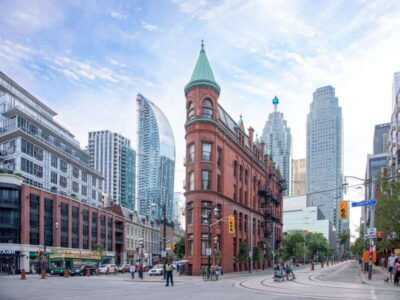
The Gooderham Building, usually called Toronto’s Flatiron Building, is one of the route’s strongest photo stops. Its narrow red-brick form fits neatly into the meeting point of Front Street and Wellington Street, giving the building a dramatic shape that works especially well from across the street.
Your guide covers the Gooderham family, the building’s cost, and its place in Toronto’s early commercial growth. The stop is planned for about 10 minutes, so expect a focused explanation rather than an extended architectural class.
This is a good example of the tour’s value. You can photograph the building on your own, but a guide adds the stories about who built it and why it mattered at the time.
Old Toronto turns facades into storybooks
The Old Toronto portion shifts attention from one landmark to a group of historic facades. Your guide points out the old Toronto Post Office and explains how the surrounding streets developed.
The post office may also be serving as a film location for a popular television production, adding a present-day layer to the older architecture. That sort of detail helps connect Toronto’s past with the city you see now.
Allow about 15 minutes here. This section is best for anyone who enjoys old streets, building fronts, and the small clues that show how a city changes. If you want interior visits, museum admissions, or long stops inside historic buildings, you should know that this is mainly an outdoor orientation.
More Old Town Walking Tours in Canada:
- Montréal: Old Town Small Group Guided Walking Tour
★ 4.8 · 258 reviews - Underground Vaults Walking Tour in Edinburgh Old Town
★ 4.5 · 8,506 reviews - Prague: 3-Hour Walking Tour of Old Town & Prague Castle
★ 4.7 · 5,696 reviews - Dubrovnik: Old Town Walking Tour
★ 4.8 · 5,174 reviews
The Financial District shows Toronto at full height
The next section moves into a much newer-looking Toronto. Glass and steel towers rise above the streets, and the headquarters of Canada’s Big Five banks sit within these few downtown blocks.
The guide explains the banking district, the visual choices behind window tint colors, and how the skyscrapers shape the feel of the area. At about 10 minutes, this is a brisk introduction rather than a detailed study of each tower.
I like the contrast here. Within a short walk, you move from red brick and nineteenth-century streets to polished office buildings and suited workers. The change helps you read Toronto as a city built in layers, not as one uniform downtown.
The PATH reveals Toronto’s underground city
Entering the PATH through Commerce Court is one of the most distinctive parts of this experience. Toronto’s PATH is a large network of underground walkways connecting downtown buildings, shops, services, and transit links.
The tour spends about 20 minutes underground. Your guide explains how the system connects much of central Toronto and points out that each section reflects the building owner responsible for it. That means the tunnel does not have one single design. Materials, lighting, and finishes change as you pass from one complex to another.
The PATH is especially useful to understand if you visit during heavy snow or cold weather. A guide can help you see it as more than a shopping corridor. It is part of how Toronto functions in winter and how office workers move through the core without returning to street level.
The PATH can also be confusing. The route has many turns, and this brief introduction will not teach you every connection. Still, it gives you enough context to return and explore with more confidence.
Old City Hall hides a personal architectural joke
Old City Hall is built in a Renaissance style, with a large clock tower and detailed stonework. Your guide draws attention to the work of architect E.J. Lennox and the private grudge that shaped some of the building’s details.
The story gives the stop a little bite. City Hall is not presented as a silent monument. It becomes a piece of civic drama, with architectural details linked to Lennox’s feelings toward city councilors.
Plan on about 10 minutes here. Look up as well as across the facade, since the best details are not always at eye level. Nearby, you also see where Toronto’s public service works today, giving you a useful comparison between the old civic building and the current government center.
Campbell House adds an older house to the downtown mix
Campbell House Museum dates to 1822 and is one of Toronto’s oldest buildings. The walking tour does not go inside, but the guide recommends returning for the museum and its cooking classes.
This stop lasts about 15 minutes and brings together several smaller stories. You may hear about maple syrup, the Canada Life weather tower visible in the distance, and Court Justice Campbell, whose life gives the house its name and historical importance.
I appreciate the change of scale here. After financial towers and a grand civic building, a modest old house shows what an earlier Toronto street could have felt like. If you have more time in the city, this is one of the places worth marking for a later visit.
The Entertainment District brings art, music, and the CN Tower
As the route enters the Entertainment District, the streets change again. Murals appear, music venues become more visible, and the CN Tower sometimes rises above the buildings or peeks between them.
The guide discusses nightlife, dancing, drinks, theatre, and the area’s role in Toronto’s evening life. You may also hear about the theatre buildings and the venues connected with concerts, touring productions, and the Toronto International Film Festival.
The precise order and length of these brief points can vary, but the route gives you useful bearings. You learn where to return if you want an evening show, a music event, or a closer look at Toronto’s film scene.
Weather affects this section. On a rainy or foggy day, the CN Tower may disappear. One guide, Henry, happened to be explaining it when the fog lifted enough for the group to see it, but you should not count on a clear tower view.
Terry Fox’s story slows the pace for a reason
David Pecaut Square provides one of the tour’s more thoughtful pauses. At the Eternal Flame of Hope for the Disabled, the guide tells the story of Terry Fox, the young Canadian athlete who lost part of his leg to cancer and went on to change how the country viewed courage, fundraising, and public service.
The stop lasts around 15 minutes. It is not simply another downtown landmark. It gives the route an important human story after so much discussion of buildings, banks, and city planning.
This is also a useful place to notice the tour’s range. You are not getting only architecture or only old Toronto. The route uses public spaces to explain people and events that shaped modern Canada.
Nathan Phillips Square offers the main break
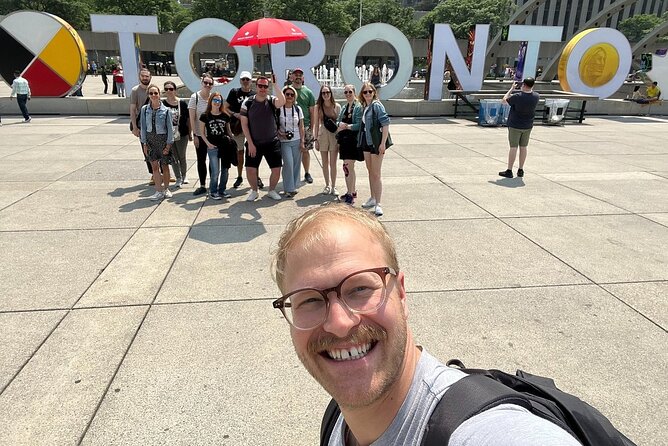
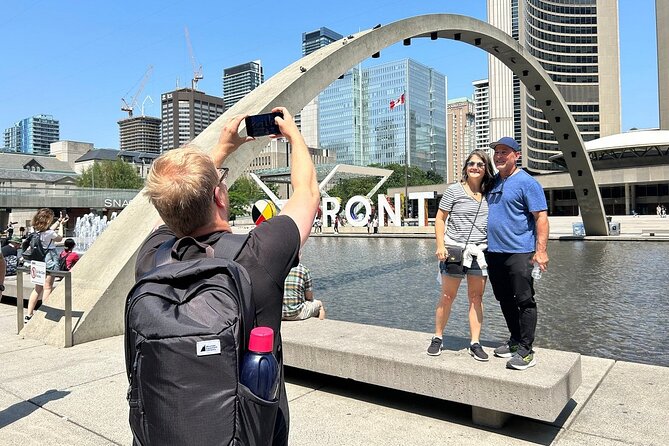
Nathan Phillips Square is both a landmark and a practical pause. The large Toronto Sign makes an easy photo stop, and the square often hosts markets or protests, so the scene can change from day to day.
The itinerary allows about 20 minutes here, including a 15-minute rest period. You can use the public toilet and buy something at a market if one is operating. This break matters because the tour may be long, with much of the time spent standing on city streets.
The Toronto Sign is also a good moment for solo visitors. Joel has been praised for taking photos of people in front of the sign, and other guides may help with group pictures when time allows. I would still ask rather than assume, especially if the group is large.
Brookfield Place connects banking and hockey
Brookfield Place is a striking interior stop, with high ceilings, white arches, and an older banking facade. It offers a welcome change from the open streets and gives you a strong photo setting.
The guide uses the building to talk about hockey and the Hockey Hall of Fame, one of Canada’s best-known attractions. The scheduled stop is about 10 minutes, so this is an introduction rather than a visit to the hall itself.
If hockey is a priority for you, note the location and return later. The walking tour gives you the story and the setting, but it does not include admission to the Hockey Hall of Fame.
Toronto’s theatre and concert landmarks fill in the cultural picture
The route also points out an intimate concert venue known for its acoustics and home to the Toronto Symphony Orchestra. Another stop highlights an ornate, century-old Beaux-Arts theatre used for touring plays and musicals.
You also see where the Toronto International Film Festival takes place. These short references help you understand why downtown Toronto remains active after office hours, even if the walk does not include performances or building interiors.
The benefit is practical. You can note the venues you want to revisit and ask your guide for local suggestions. The limitation is time. A three-hour walk covering this much ground cannot give every theatre or concert hall a full explanation.
Union Station ends with practical city advice
Near the end, the route passes Toronto Union Station, the city’s main transport hub. It sits across from the Fairmont Royal York and helps explain both the growth of downtown and the reach of the PATH.
This is a useful final stop because your guide can answer questions about the TTC, GO Train, VIA Rail, and bus services. If you have just arrived in Toronto, it can help you understand how to move around for the rest of your stay.
The stated meeting point is Berczy Park, while the route description places Union Station near the end and says the activity ends back at the meeting point. Since the route information is not perfectly clear on that point, confirm the final arrangement with the operator before you go.
How long, how hard, and how personal is the walk?
The official duration is about three hours. In practice, the route may cover roughly 7 km, and one guide may walk faster or spend longer at a stop than another.
That variation matters. Some people have completed the walk comfortably in their eighties, while others found the pace or distance difficult. One participant with a below-knee amputation needed more frequent seating and slower movement, but the guide did not adjust enough. If you need regular benches, a slower pace, or frequent breaks, contact the operator before booking and explain your needs clearly.
Children may also find this tour demanding. The route contains a lot of spoken information, and an early guide can spend nearly two hours on the first four stops if explanations run long. Families wanting constant movement and short talks may prefer a simpler sightseeing option.
Bring water and, if you like, a snack. There is a break near the Toronto Sign, but three hours in a city can feel longer in heat, rain, snow, or strong wind. Comfortable shoes matter more than stylish ones.
What the guides do especially well
The strongest part of the experience is the guide’s personality. Maya has been praised for witty trivia and keeping a long walk engaging. Joel is noted for drawing people into conversation and helping with photographs. Alex used a book of historic images to make the past easier to picture.
Maria has been described as friendly and effective even on a very cold day. Zak, Henry, Wei Ting, and other guides have also received praise for clear explanations, local suggestions, and personal attention. The overall rating is 4.7 from 290 reviews, with 93 percent recommending the experience.
That said, the guide can also be the main risk. A few participants found the explanations too long, the walking too fast, or the tip request too direct. The company has also had reported problems with short-notice cancellations and delayed communication when minimum numbers were not met. The stated policy offers a full refund if the operator cancels for that reason, but you should keep your phone and email available on the day.
Who should book this Toronto walking tour?
I would choose this tour if you want a first-day orientation and like learning through stories. It suits solo visitors, couples, business visitors with a spare afternoon, and anyone who wants to understand how Old Toronto connects with the modern core.
It is also a good fit if you enjoy architecture but do not want a tour limited to old buildings. You get the Flatiron Building, Old City Hall, Campbell House, banking towers, PATH interiors, theatres, public squares, hockey, and Terry Fox in one route.
I would hesitate if you want a short, relaxed stroll, a tour designed around children, or a guaranteed slow pace. The gratuity model also requires a little planning. You pay only $5 to reserve, but you should decide what tip feels fair before arriving.
Free cancellation is available up to 24 hours before the start time. Changes or cancellations within 24 hours are not refundable, and the operator may cancel if the minimum number is not reached.
Should you book it?
Book it if you want a lively overview that gives you useful bearings and plenty of ideas for the rest of your Toronto visit. The PATH, Berczy Park, Old City Hall, the Entertainment District, and the Toronto Sign make the route varied, while guides such as Maya, Joel, Alex, and Maria can add the humor and detail that make a city walk stick.
Skip it if you need guaranteed accessibility, dislike gratuity-based pricing, or prefer a tour with more walking and less talking at each stop. For most reasonably mobile visitors who arrive prepared with water, good shoes, and realistic expectations, $5 is a strong starting value, provided you also budget for the guide’s tip.
FAQ
How long is the Old Town Toronto Highlights tour?
The tour lasts approximately three hours.
How much does the tour cost?
The listed price is $5 per person. This is a booking fee, and gratuities are not included because the guides work for tips.
What languages are available?
The tour is offered in English, with Spanish available when selected.
Where does the tour start?
The meeting point is Berczy Park at 35 Wellington Street East, Toronto, Ontario M5E 1C6.
Where does the tour end?
The activity information says it ends back at the meeting point. The route also lists Toronto Union near the end, so confirm the final meeting arrangement with the operator.
Is the tour wheelchair accessible?
The information says most people can participate, but it does not confirm full wheelchair accessibility. The route may cover about 7 km, and a participant needing frequent seating reported difficulty with the pace and breaks.
Does the tour enter the PATH?
Yes. The route enters the PATH through Commerce Court and spends about 20 minutes explaining the underground network and its different building designs.
Can I cancel for a refund?
You can cancel at least 24 hours before the start time for a full refund. Cancellations or changes made within 24 hours are not refundable, and an operator cancellation due to insufficient numbers comes with an offered alternative or full refund.
More Three-Hour Walks in Canada
- Calgary: City Highlights Walking Tour | 3-Hour
★ 4.6 · 271 reviews - Eat Like a Local: Venice 3-Hour Small-Group Food Tasting Tour
★ 5.0 · 3,137 reviews - Experience Porto’s Charm: 3-Hour Guided Walking Tour
★ 5.0 · 2,432 reviews - Valletta: 3-Hour Walking Tour
★ 4.7 · 2,219 reviews
New routes in Canada
- Toronto: Private Walking Tour with a Local★ 4.7 · 150 reviews
- Toronto: Dark History Nighttime Walking Tour★ 4.7 · 273 reviews
- Toronto: 2-Hour Downtown Walking Tour★ 4.4 · 101 reviews
- Toronto: City Walking Tour★ 4.9 · 185 reviews
- Toronto: Distillery District Historic Walking Tour★ 4.8 · 267 reviews
- Quebec City: Christmas Magic Walking Tour in Old Quebec★ 4.7 · 146 reviews
- Quebec City: Old Quebec Classic Walking Tour with Funicular★ 4.9 · 695 reviews
- Ottawa: Private Walking Tour with a Local★ 4.5 · 80 reviews
Toronto Walking Tours, compared.

Show me the City! A Small Group Walking Tour of Toronto
Read our review →