
Review · BUDAPEST
Budapest: Buda Castle District Walking Tour with a Historian
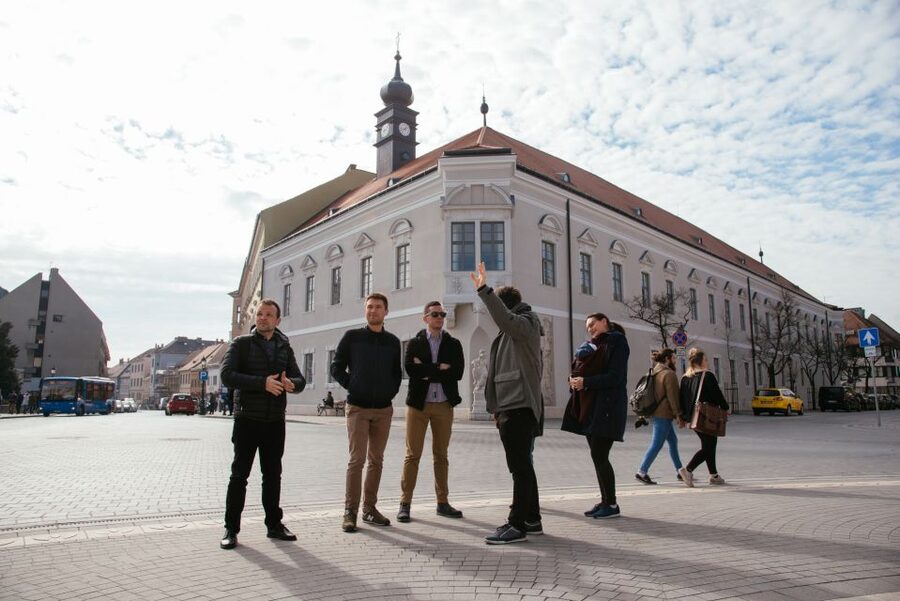
Buda Castle District is far more than a grand palace on a hill. It is a living quarter of winding lanes, government buildings, church towers, rebuilt facades, and lookout terraces above the Danube. This 2.5-hour walk with a historian gives you the story that ties those pieces together, from medieval kings to the damage of World War II.
I especially like the included visit to Matthias Church, since its interior is easy to miss if you explore the hill alone. I also like the coffee stop, which gives your feet a break and creates room for questions. The main consideration is that much of the tour is outdoors, so rain, fog, heat, or crowded viewpoints can affect the experience.
Key points at a glance
- Matthias Church admission included: Spend about 45 minutes inside one of Budapest’s most striking churches, with live commentary.
- History from the Middle Ages to World War II: The guide connects royal power, occupation, rebuilding, and modern Budapest.
- Fisherman’s Bastion views: Look across the Danube toward Parliament and the Pest side of the city.
- A small-group feel: Many departures have been small enough for easy questions and conversation.
- Coffee break included: Pause during the walk for coffee and a short rest.
- English-speaking historians: Guides such as Judit, Petra, Monica, Barika, Raymond, Gábor, and Gabriel bring different personalities to the same route.
Why this Buda Castle walk is worth your morning
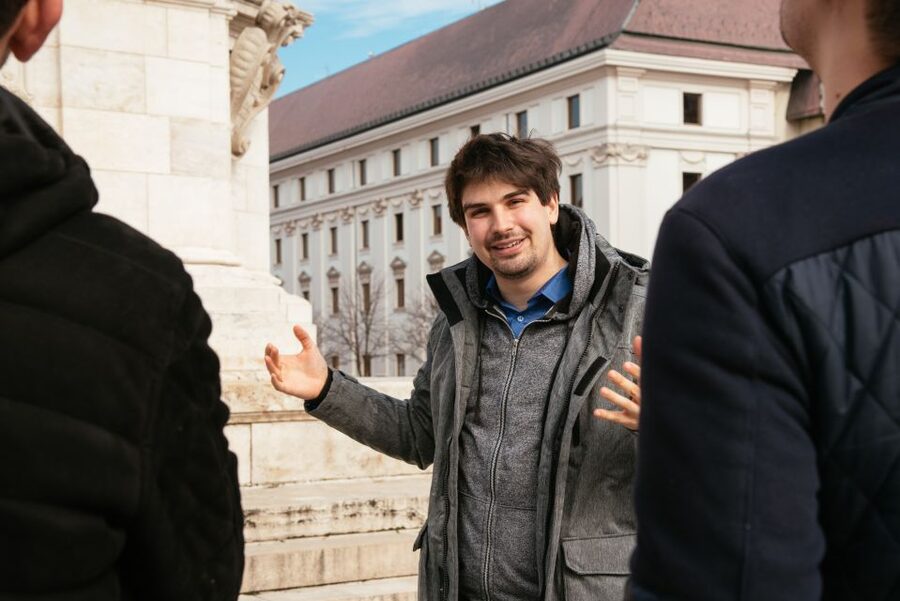
Buda Castle District makes a poor self-guided history lesson unless you already know what you are looking at. A palace wall may be medieval in origin but heavily rebuilt. A quiet street may have survived centuries of change, only to suffer major destruction in 1944 and 1945. A guide helps you read those layers instead of seeing only handsome stonework.
This tour is strongest when the guide turns the district into a sequence of human stories. Guides including Judit, Petra, Monica, and Gábor have been praised for clear explanations, humor, and a talent for putting Hungarian history in order. That last point matters. Hungary’s story can become a blur of kings, empires, occupations, revolutions, and political changes. A good guide gives you a framework before the details start flying.
The route also mixes major sights with smaller observations. You’ll see the Royal Palace, the Hungarian Presidential Palace, Alexander Palace, Matthias Fountain, the Palace Gardens, Savoy Terrace, the funicular area, and the equestrian statue of András Hadik. You won’t spend the whole time inside a museum, but you will get a useful orientation to the whole hill.
At $63 per person, this is not a bargain-priced stroll. Still, the fee covers a professional guide, the walking tour, live English commentary, admission to Matthias Church, and a coffee stop. I see the best value here for a first visit, especially if you want context rather than a quick photo tour. If you prefer to wander at your own speed, stop often, and read plaques on your own, the price may feel high.
More Castle and Palace Walking Tours in Budapest:
- Budapest: Buda Castle Walk with Saint Stephen’s Hall
★ 4.5 · 3,012 reviews - Budapest: Buda Castle District Walking Tour
★ 4.6 · 2,108 reviews - Budapest: 3-Hour Grand City Tour and Castle Walk
★ 4.3 · 1,437 reviews
Meeting at Holy Trinity Square
The walk begins at the Holy Trinity column on Szentháromság tér, in front of Matthias Church. You can reach the square by taxi, on foot, or by buses 16, 116, and 216.
This is a sensible starting point because you are already in the heart of the Castle District. It also means you should allow enough time to reach the hill before the stated start time. The meeting point is not at the bottom of the hill, so check your route carefully rather than assuming the tour begins near the Danube.
The square gives you an immediate sense of the district’s character. Matthias Church and Fisherman’s Bastion are close by, while narrow streets lead toward the palace quarter. Your guide may begin with a broad explanation of more than 1,100 years of Hungarian heritage, which helps you understand why Buda matters before the walk gets into individual buildings.
Forty-five minutes inside Matthias Church
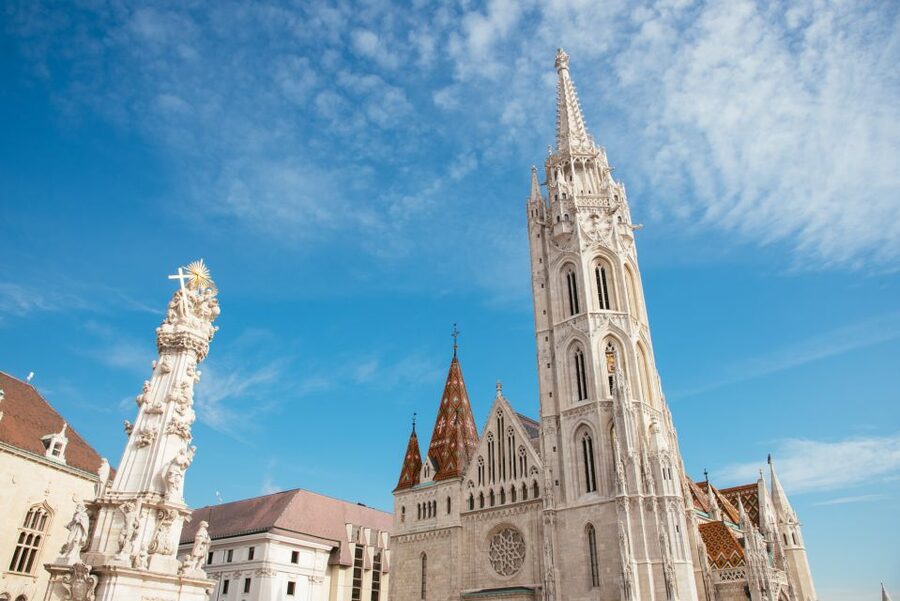
The longest scheduled stop is Matthias Church, also known as the Church of Our Lady. The admission ticket is included, and the guide provides live commentary inside for roughly 45 minutes.
I consider this the tour’s essential stop. The outside is famous, but the interior carries much of the surprise. The church has a powerful visual character, and the guides focus on its architecture, religious role, and place in Hungarian history rather than treating it as a quick photo stop.
Several guides have also timed visits well enough for the group to hear the organ. That cannot be promised, but it can add a memorable sound to the visit when it happens. The stop is long enough to ask questions and look carefully, yet short enough to keep the walking tour moving.
This is also where a guide earns the admission price. Without explanation, you may notice patterns, colors, and details without understanding their meaning. With commentary, the church becomes part of the wider story of Buda’s changing rulers and fortunes.
Fisherman’s Bastion and the postcard view
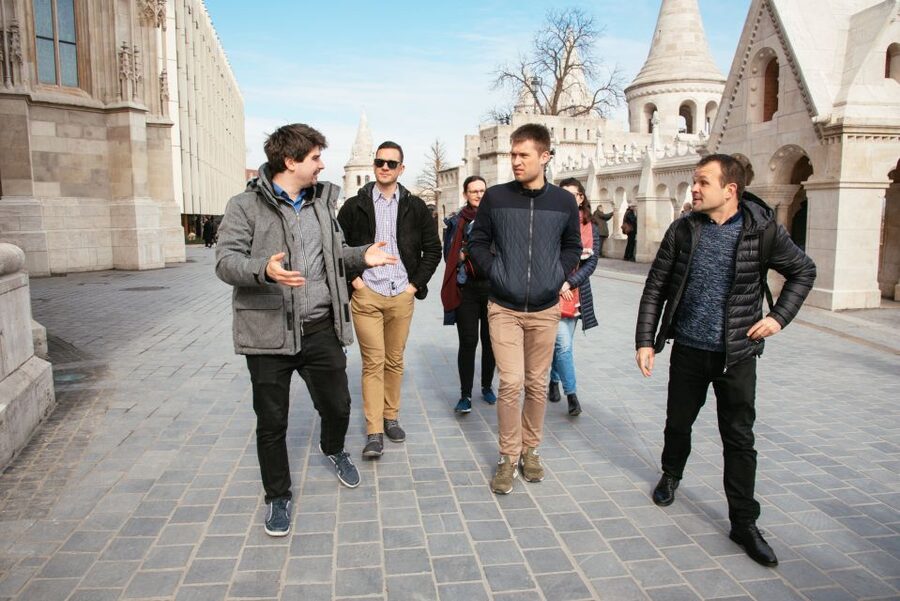
After the church, the group stops at Fisherman’s Bastion for about 15 minutes. This is the place for the classic view across the Danube to Parliament and the Pest side of Budapest.
The stop is brief, so use it wisely. Take your photographs early, then listen for the guide’s explanation of the bastion and its role in the Castle District. The terraces are especially useful for getting your bearings. From here, the city’s two halves make visual sense: Buda rises behind you, while Pest spreads across the river.
Crowds can gather around the best viewpoints, and one person specifically wished for a microphone or earpiece in crowded areas. That is a fair caution. Stay close to the guide and do not drift behind while taking pictures. The tour is conducted in English, and hearing every sentence matters when the guide is explaining dates, names, and political changes.
Fog does not ruin the stop, but it can hide Parliament and the far bank. One January group still enjoyed the tour in fog, but clear weather gives you the full reward of this viewpoint.
More Walking Tours in Budapest:
- Big Bus Budapest Hop-On Hop-Off Bus and Walking Tour
★ 3.5 · 2,206 reviews - Budapest City Landmarks Walking Tour in 2 Hours
★ 5.0 · 2,048 reviews - 3-Hour Orientation Walking Tour of Buda and Pest
★ 4.8 · 1,834 reviews - Budapest Historical Sightseeing – Free Walking Tour
★ 5.0 · 1,302 reviews
András Hadik, streets, and smaller details
The next scheduled stop is the equestrian statue of András Hadik, with about 15 minutes for sightseeing. It is a useful change of pace after the church and the crowded bastion.
This part of the walk shows why a guided route is more useful than simply ticking off famous buildings. The guide can explain why a particular figure matters and how military, royal, and civic stories overlap in the district. You also get time to see the streets as a neighborhood rather than a string of monuments.
That local feel is one of the tour’s strengths. Thousands of people live in the Castle District, and it is also a place for evening walks, city lights, and everyday errands. You are not being led through an empty museum set. The area has a working, residential side that is easy to miss on a rushed visit.
The Royal Palace quarter and its wartime scars
The route then turns toward Buda Castle, with about 30 minutes of sightseeing around the palace complex. Expect discussion of the Royal Palace, Palace Gardens, Alexander Palace, and the Hungarian Presidential Palace.
The word castle can create the wrong picture. The complex is not one perfectly preserved medieval fortress waiting behind a single gate. It is a large district shaped by royal building, later political use, destruction, restoration, and ongoing change. Your guide helps separate what is old, what was rebuilt, and what serves a modern role.
The World War II story is especially important here. Buda Castle suffered heavy damage during the siege of Budapest, and the district’s present appearance reflects years of reconstruction and changing ideas about what should be restored. One person wanted more time focused on the castle itself, partly because construction has affected what you can see. That is worth keeping in mind: this walk explains the palace quarter, but it is not a full interior tour of the Royal Palace.
The history reaches from the Middle Ages through World War II and into present-day Budapest. I like that broad range because it prevents the district from becoming a single-era attraction. You see how the hill kept changing purpose as Hungary changed around it.
The funicular area and Matthias Fountain
The walk includes about 15 minutes near the Budapest Castle Hill Funicular. Even if you do not ride it, the area helps explain how the hill connects with the riverside and the lower city.
The funicular is a useful landmark for understanding the topography. Buda Castle sits above the Danube, and the climb is part of the district’s identity. The tour does not present the funicular as a ride included in the price, so treat this as a sightseeing stop rather than a transport add-on.
A further 15-minute stop brings you to the Fountain of King Matthias. The fountain adds a more decorative and royal note to the route. Here, the guide can connect art, monarchy, and the palace setting, giving you another way to read the complex beyond its military and wartime past.
These stops are not as famous as Matthias Church or Fisherman’s Bastion, but they make the route feel complete. You get a better sense of how the palace grounds, public squares, terraces, and city approaches fit together.
Savoy Terrace and the final palace views
The final scheduled stop is Savoy Terrace, where you spend about 15 minutes on a guided visit, sightseeing, and photographs. The walk ends at Budavári Palota, the palace itself.
Savoy Terrace is a good closing point because it returns your attention to the city below. By now, the guide has introduced the hill’s royal, religious, military, and modern roles. The view works better after that context. You are no longer looking at Budapest as a pretty panorama only. You can place the river, Parliament, Pest, and the Castle District within the story you have just heard.
The tour ends at the palace, not at your hotel or back in the lower city. That gives you freedom to continue exploring, visit another nearby attraction, or find lunch. Several guides have offered food and sightseeing suggestions at the end, and one helped a participant find the correct bus back to a hotel. Still, make your own onward plan rather than expecting a guided return.
The coffee stop and the pace of the walk
The coffee stop is a small feature with real practical value. A walking tour of two and a half hours needs a pause, especially when the route includes viewpoints, stone streets, and standing inside a church.
The break also changes the tone. You can sit, use the restroom, ask a question, and talk with the guide and the rest of the group. Some groups have enjoyed a more personal exchange about European cultures and local life during this pause. It is not a full meal, so have breakfast beforehand if you need something substantial.
The pace appears adjustable when the group is small. One group of six moved at a comfortable speed, and several people valued being able to stop for questions. That is a major advantage over a large coach-style tour. The tradeoff is that group size and guide style can vary by departure, so do not assume every session will feel identical.
What the guides do best
The strongest part of this experience is the human delivery. Guides named in the feedback include Judit, Petra, Monica, Barika, Raymond, Gabriel, Gábor, Noemi, Anna, Andrea, Zsuzsanna, and Dorit.
The praise is remarkably consistent in specific areas: clear storytelling, strong historical background, humor, patience with questions, and a personal connection to Hungary. Judit is often described as especially good at laying out Hungarian history in a logical order. Gabriel is known for an energetic style and humor, while Raymond brings both historical and modern economic perspective. Gábor has impressed even another local guide with his command of lesser-known details.
The guide matters a great deal here because the same stones can feel dry or memorable depending on the storyteller. You should expect an English tour, though one guide switched to Spanish when asked. That language flexibility is not presented as a standard feature, so book this as an English-language experience.
Weather, footwear, and practical planning
The walk is mostly outside. Bring an umbrella or rain jacket if the forecast is poor, and expect the route to be modified toward more indoor locations in heavy rain.
Comfortable shoes are a sensible choice because you will spend much of the 2.5 hours on foot and standing at sights. In warm weather, carry water. In cold or foggy weather, the exposed terraces may feel raw, even if the church and coffee stop offer relief.
The tour is available with free cancellation up to 24 hours before the start, and you can reserve now and pay later. Those terms are useful if your Budapest schedule is still shifting. The tour is also advertised with skip-the-ticket-line access for the church, which can save time during busy periods.
Who should book this tour?
I would choose this walk if you are visiting Budapest for the first time, enjoy history, and want the Buda side to make sense rather than simply look attractive. It suits couples, families with older children, and solo visitors who prefer questions and conversation over an audio guide.
It is also a good fit if you have only a limited time in the city. In one morning or afternoon, you get the major viewpoints, the church, the palace quarter, and a useful introduction to Hungarian history.
I would be more cautious if you want extensive time inside the Royal Palace, a relaxed photography walk, or a tour conducted in another language. The route covers many places, so the palace itself receives context and exterior sightseeing rather than a long indoor visit. Crowds and poor weather can also make it harder to hear the guide.
At $63, I see solid value if the church ticket and an expert guide are priorities. The price is less compelling for someone who only wants the views, since you can reach the Castle District independently. You are paying mainly for the explanations, the organized route, the church access, and the chance to ask questions.
Should you book the Buda Castle District walk?
Book it if you want a clear story of Buda, a proper look inside Matthias Church, and a guide who can connect medieval Hungary with the destruction and rebuilding of the twentieth century. The small-group feel, coffee pause, and strong guide personalities make the long walk easier to enjoy.
Skip it if you already know Budapest’s history well or want to explore every palace room at your own pace. For most first-time visitors, though, this is a practical way to get your bearings on the hill and leave with more than a collection of photographs.
FAQ
How long does the Buda Castle walking tour last?
The tour lasts 2.5 hours.
What is the price?
The listed price is $63 per person.
Where does the tour begin?
It begins in front of the Holy Trinity column on Szentháromság tér.
How can I reach the meeting point?
You can walk, take a taxi, or use bus numbers 16, 116, or 216.
Is Matthias Church included?
Yes. The entrance ticket and live English commentary inside Matthias Church are included.
How long is the church visit?
The guided visit to Matthias Church lasts about 45 minutes.
Is the tour conducted in English?
Yes. The listed tour language is English.
Does the tour include Fisherman’s Bastion?
Yes. The route includes a 15-minute photo stop at Fisherman’s Bastion, with views toward Parliament and Pest.
Is coffee included?
The experience includes a coffee stop. The provided information does not specify the exact drink selection.
What happens if it rains?
Bring an umbrella or rain jacket because most of the walk is outside. In heavy rain, the route may be changed to include more indoor locations.
Can I cancel the booking?
You can cancel up to 24 hours in advance for a full refund. Reserve now and pay later is also available.
New routes in Budapest
- Budapest: Street Art and Underground Movements Walking Tour★ 5.0 · 365 reviews
- Jewish Quarter of Budapest Walking Tour★ 4.7 · 369 reviews
- Budapest 3-Hour Walking Tour in Italian★ 4.6 · 217 reviews
- Budapest: Walking Tour to the Shoes Memorial and Parliament★ 4.7 · 151 reviews
- Budapest: Castle District Walking Tour★ 4.8 · 223 reviews
- Budapest: Jewish History Guided Walking Tour with Historian★ 4.8 · 205 reviews
- Budapest: Walking Tour and Photoshoot with Digital Photos★ 4.7 · 82 reviews
- Budapest: Inner City Walking Tour in German★ 5.0 · 76 reviews
Budapest Walking Tours, compared.
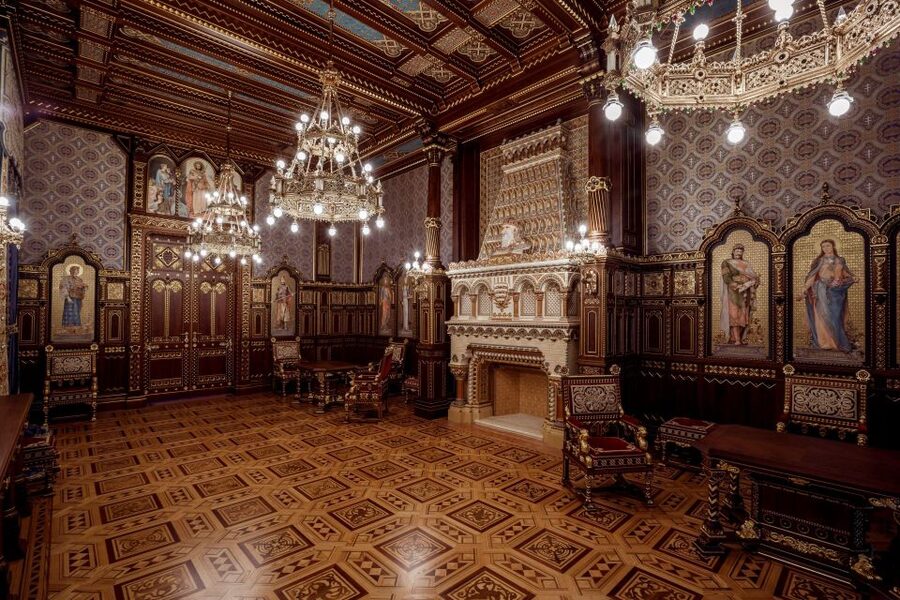

Big Bus Budapest Hop-On Hop-Off Bus and Walking Tour
Read our review →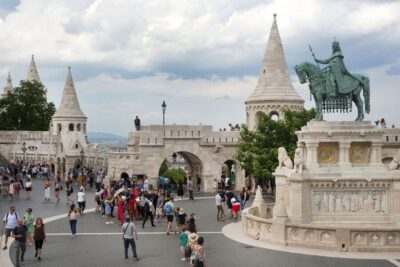
Budapest City Landmarks Walking Tour in 2 Hours
Read our review →
3-Hour Orientation Walking Tour of Buda and Pest
Read our review →
Budapest Historical Sightseeing – Free Walking Tour
Read our review →
Budapest All in One Small Group Walking Tour with Strudel Stop
Read our review →Browse the lists this tour appears in