
Review · VALLETTA
The Original Valletta Walking Tour
Valletta is compact, but its story is anything but small. This three-hour walk takes you from the modern City Gate through streets shaped by the Knights of St John, past grand palaces and churches, and out to sweeping views of the Grand Harbour. It is a useful way to get your bearings fast, especially if you have only one morning in Malta’s capital.
I like two things in particular: the guides bring real depth to buildings you could otherwise simply photograph, and the route mixes major sights with quieter historical details. Guides including Matthew, Mario, Carmel, and Giulia have been singled out for clear English, humor, patience, and strong local knowledge. The main consideration is that some guides explain at length, so you may spend quite a bit of time standing in one place.
Key points at a glance
- Three hours in Valletta: A solid first look at the capital without requiring a full day.
- A route packed with landmarks: See City Gate, Parliament, the Royal Opera House ruins, Barrakka Gardens, St John’s Co-Cathedral, and the Grand Master’s Palace.
- Small-group format: Groups are capped at 25, with some departures much smaller.
- Strong storytelling: Guides such as Mario, Matthew, Carmel, and Giulia explain art, architecture, politics, and Malta’s past.
- Harbour views included: The Upper and Lower Barrakka Gardens provide one of the tour’s best visual pauses.
- Tickets are extra: Entry to St John’s Co-Cathedral, the Grand Master’s Palace, and the new Museum of Fine Arts is not included.
Why a three-hour walk works well in Valletta
At $26.60 per person, this is priced as an affordable introduction rather than a full sightseeing package. You are paying for a guide and a carefully ordered walk, not admission to every major interior.
That distinction matters in Valletta. You can walk its streets on your own for free, but the city’s stones do not explain themselves. A guide can connect the Great Siege, the Knights of St John, Baroque art, British rule, wartime damage, and modern Malta in a way that makes the buildings easier to read.
The route is also efficient. Valletta is small enough to cover on foot, yet there is plenty to stop for. You will not spend the morning crossing town by bus or waiting in lines for transport. Instead, the walk moves between a series of central sights, with time for questions and a short break during the longer outing.
The tour is especially useful at the start of a Malta trip. Afterward, you can return to the places that caught your interest, such as St John’s Co-Cathedral or the Grand Master’s Palace, with a better idea of what you are seeing.
More Walking Tours in the world:
- Magical London: Harry Potter Guided Walking Tour
★ 4.7 · 22,044 reviews - Reykjavik Food Walk – Local Foodie Adventure in Iceland
★ 5.0 · 18,952 reviews - History and Hauntings of Salem Guided Walking Tour
★ 5.0 · 14,564 reviews
Starting at City Gate and the New Parliament
The meeting point is in front of the New Parliament Building on Republic Street. This is a central spot, but it deserves a little care because two tours may use similar meeting arrangements, and one past departure created confusion between a shorter and longer walk.
Look for the guide’s stated meeting point and confirm that you are joining the three-hour tour. Some guides use a yellow shirt and yellow umbrella, so it is sensible to check the tour length before setting off rather than simply joining the first group you see.
The opening section gives you a quick orientation to Valletta’s layout and origins. The city was built by the Knights of St John in 1565 and is now protected as a UNESCO World Heritage Site. That is not just a label for the guide to recite. It helps explain why Valletta feels so planned, fortified, and grand despite its small footprint.
The New Parliament provides an interesting modern counterpoint. Its contemporary design marks the present-day entrance to a city known for older stone buildings. Nearby, the ruins of the Royal Opera House show how Valletta has changed over time. The site was damaged during the Second World War and later became an open-air cultural space.
You stop only briefly at both locations, but they set up an important theme of the walk: Valletta is not frozen in the age of the knights. Ancient institutions, war damage, modern architecture, and daily city life all sit close together.
Churches, auberges, and the story of the Knights
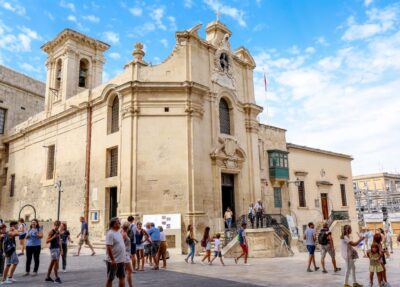
From the entrance, the route moves toward Our Lady of Victories Church. This small church carries an important place in Valletta’s early story, and the guide explains which famous Maltese figure was buried there.
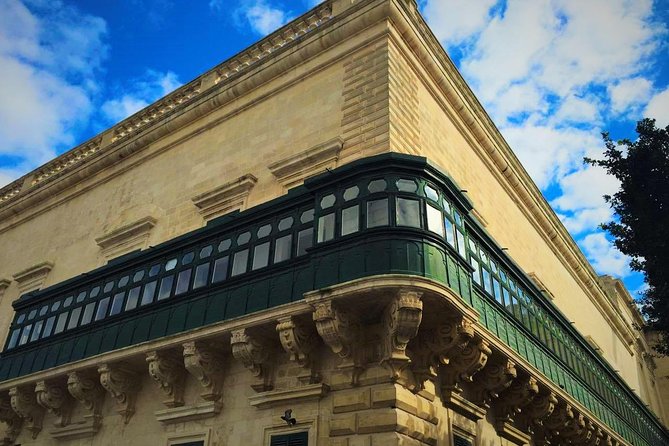
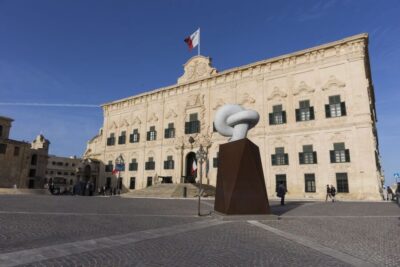
Next comes the Auberge de Castille, one of the most impressive facades in the city. An auberge was a residence and headquarters for one of the langues, or language groups, of the Knights of St John. The building now serves as the office of Malta’s prime minister, which gives the stop both historical and modern importance.
This is where a good guide earns the fee. Rather than simply pointing out a decorated facade, your guide can explain how the Knights organized themselves, how power worked in Valletta, and why these large residences were built to project authority.
The pace is not strenuous. You walk from stop to stop, then pause while the guide talks. Still, this is not a rapid photo circuit. Guides may spend several minutes on one building, and Mario in particular has been praised for going into fine detail about geography, art, architecture, and political history.
That level of detail will suit you if you enjoy context. If you prefer to keep moving, it may feel slow at times. The best approach is to treat the walk as a guided history lesson with regular movement, not as a quick checklist of landmarks.
Upper Barrakka Gardens and the Grand Harbour
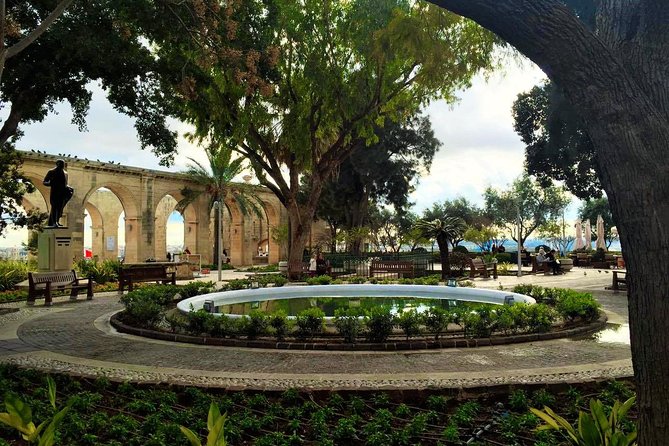
The Upper Barrakka Gardens are one of the tour’s best stops. You have about 30 minutes here, giving you time to take in the Grand Harbour and the fortified Three Cities across the water.
The view gives physical meaning to Malta’s location. The harbour was a military prize, a trading gateway, and a key reason Valletta became so important. From the gardens, you can see why the city was planned as a defensive stronghold and why Malta has drawn outside powers for centuries.
The gardens also provide a welcome pause after the opening stretch of streets and monuments. Some departures include a short coffee break around the middle of the tour, although the exact break can depend on the guide and group. Ask if you need a moment to sit or get a drink.
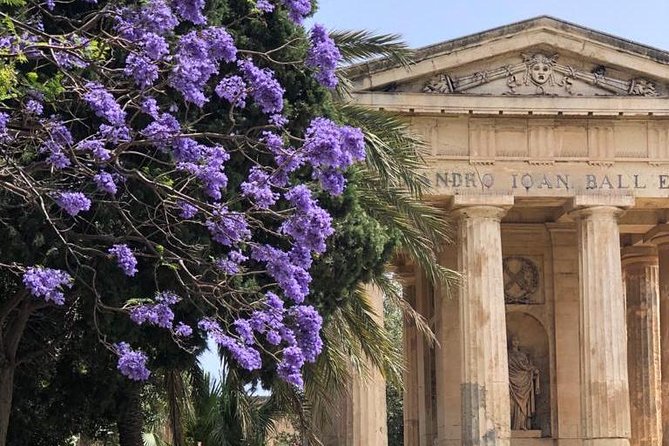
The Lower Barrakka Gardens are also part of the wider route and add another viewpoint over the water. Along the way, your guide discusses the Great Siege Monument, the Siege Bell Memorial, and Fort St Elmo. These sites connect the city’s scenic views with its military past.
The harbour is one of the places where the tour shifts from facts to perspective. You are not just hearing dates. You are looking at the water, walls, and entrances that shaped Malta’s history.
Same streets, a different guide:
- New Orleans Premier Ghost, Voodoo and Vampire Walking Tour
★ 4.5 · 12,856 reviews - Amsterdam Anne Frank: Small-Group Walking Tour & Local Guide
★ 4.8 · 12,789 reviews - Edinburgh: Harry Potter Magical Guided Walking Tour
★ 4.8 · 11,944 reviews - Edinburgh Castle: Guided Walking Tour with Entry Ticket
★ 4.7 · 11,699 reviews
Piazza Regina, the Auberge d’Italie, and Palazzo Parisio
The walk continues through Piazza Regina, a central public space with a more open feel than the narrow streets around it. The tour then passes the Auberge d’Italie, home to Malta’s new Museum of Fine Arts.
Admission to the museum is not included, and the stop is brief. That is useful if you want to mark it for a later visit, but it does not replace going inside. The same applies to several other major buildings along the way: the tour explains their role and appearance, while entry requires a separate ticket.
Palazzo Parisio provides another chance to connect a building with a famous historical figure. The guide explains who once lived there and why the palace matters. These smaller stories help break up the larger military and religious themes.
You might remember only a portion of the names and dates. That is normal. The value is in gaining a framework. Once you know how Valletta’s main institutions fit together, a later visit to a museum or church becomes easier to follow.
St John’s Co-Cathedral and the Baroque heart of Valletta
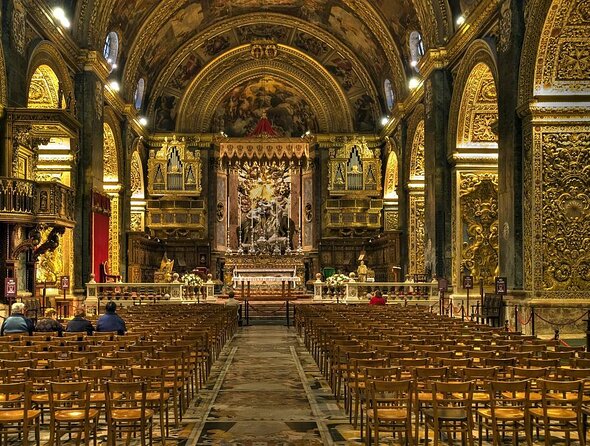
St John’s Co-Cathedral is one of the most important stops, even though admission is not included. The guide discusses the artists whose work appears inside and explains the cathedral’s place in the life of the Knights.
The name can confuse first-time visitors. It is a co-cathedral because it shares the bishop’s seat with St Paul’s Cathedral in Mdina. Inside, the decoration is famously elaborate, with a strong connection to the Order of St John and the art of the Baroque period.
The walk may not include entry, so plan to return if you want to see the interior properly. One useful piece of advice from a guide was to make a point of going inside when possible. On one occasion, a visitor found the cathedral closed for a holiday, then happened to see it open for a service later. That kind of opportunity cannot be guaranteed, but the guide’s recommendation made the difference.
St John’s is also a good example of why the tour can save you time. You learn what to look for before entering, instead of wandering through a grand interior without knowing which artists, chapels, or symbols matter.
St George’s Square and the Grand Master’s Palace
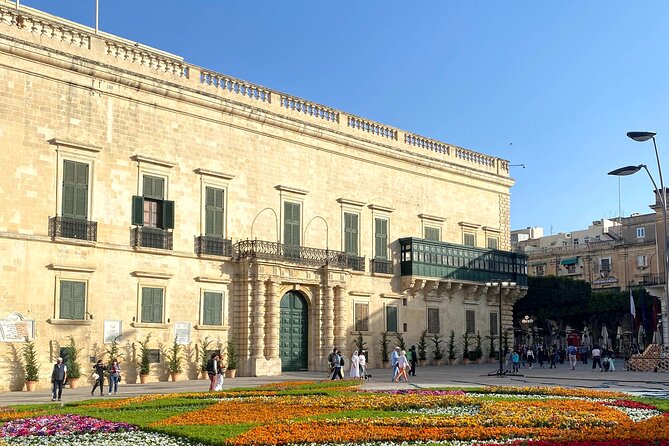
The final part of the route reaches St George’s Square and the Grand Master’s Palace. The square is Valletta’s main ceremonial space, while the palace has served important roles across several centuries.
Your guide explains why the building mattered to the Knights and how its function changed over time. The palace is another optional paid interior, so check your schedule and budget if you want to visit after the walk.
Ending in central Valletta is practical. You are not left at an out-of-the-way point or required to retrace the whole route. From St George’s Square, you can continue exploring, find lunch, return to a museum, or make your way toward the harbour.
The tour also discusses Valletta’s role as European Capital of Culture in 2018. That detail brings the story into the present and shows how the city uses its historic setting for modern cultural life.
The guides make the biggest difference
The strongest part of this experience is the quality of the guiding. Mario has been praised for his background in teaching and for covering geography, history, art, and architecture with unusual depth. Matthew is noted for answering questions, offering practical tips, and keeping the tour relaxed. Carmel is described as combining facts with anecdotes, while Giulia is praised for clear delivery and enthusiasm for Malta.
Names can vary by departure, so you cannot book a specific guide from the information available. Still, the pattern is clear: the experience depends heavily on who leads the group and how much detail you enjoy.
English is the offered language. The guides are expected to communicate clearly, and several departures have been especially praised for easy-to-follow English. If you like asking questions, this format gives you a better chance than a large coach excursion.
The group limit is 25 people. That is not a private tour, but it is small enough to hear the guide more easily and ask questions without shouting across a crowd. Some groups may be much smaller, even just a few people, which can make the walk feel almost tailored.
Walking comfort, meeting tips, and extra costs
Most people can take part, and the walking is described as manageable rather than physically demanding. You will spend time on your feet, though, and the tour includes repeated stops for explanations. Comfortable shoes and water are sensible choices.
The route is near public transportation, and service animals are allowed. Hotel pickup and drop-off are not provided, so you need to reach central Valletta yourself.
If you arrive from a cruise ship, one practical route is to turn right from the port, walk roughly 200 meters, and use the elevator up toward the city. The return elevator fare has been listed as 1 euro. From there, walk through the gardens, pass through the arched gate toward the square, and look for the modern Parliament building before reaching the bridge. The walk from the port can take about 15 minutes using the elevator, rather than the much longer route that a phone map might suggest.
Paid admissions are the other cost to plan for. St John’s Co-Cathedral, the Grand Master’s Palace, and the Museum of Fine Arts are not included. The tour remains good value if you mainly want orientation and outside views, but your total spending rises if you add all three interiors.
You can cancel for a full refund up to 24 hours before the start time. Cancellations or changes inside that window are not refunded or accepted. The experience also requires a minimum number of people, so a cancellation by the operator would result in another date or a full refund.
Who should book this Valletta walk?
I would choose this tour if you are visiting Valletta for the first time, arriving by cruise ship, or working with only a few hours. It gives you a sensible route through the capital and enough background to make later independent exploring more rewarding.
It also suits people who enjoy history, architecture, and stories about institutions. Guides may spend a long time explaining an artist, building, or political event, so you should be happy to listen as well as walk.
I would look elsewhere if you want a fast-paced tour with little commentary, a fully private experience, or admission to the main interiors included in the price. The route is central and efficient, but the teaching style can be detailed and sometimes requires patience.
Should you book The Original Valletta Walking Tour?
At $26.60, this is a strong-value introduction to Valletta. The 4.9 rating from 2,719 reviews and 98 percent recommendation rate match the tour’s clearest strengths: strong guides, careful pacing, and a useful mix of famous sights and less obvious stories.
Book it early if your schedule is tight, since it is often reserved about 28 days ahead. Check the meeting point carefully, confirm that you are joining the three-hour walk, and budget separately for any church, palace, or museum visits.
If you want to understand Valletta before exploring it on your own, I would book it. If you already know the city well or prefer silent wandering, the same streets are easy to walk without a guide.
FAQ
How long is The Original Valletta Walking Tour?
The tour lasts approximately three hours.
What is the price?
The listed price is $26.60 per person.
Where does the tour start?
It starts at the New Parliament Building on Republic Street in Valletta, Malta.
Where does the tour finish?
The tour ends at St George’s Square on Republic Street in central Valletta.
What language is the tour offered in?
The tour is offered in English.
What sights are covered?
The route includes City Gate, the New Parliament, the Royal Opera House ruins, Our Lady of Victories Church, Auberge de Castille, the Upper Barrakka Gardens, Auberge d’Italie, Palazzo Parisio, St John’s Co-Cathedral, St George’s Square, and the Grand Master’s Palace.
Are entrance tickets included?
No. Admission to the Museum of Fine Arts, St John’s Co-Cathedral, and the Grand Master’s Palace is not included.
Can I cancel for a refund?
Yes. You can cancel at least 24 hours before the start time for a full refund. Cancellations or changes made less than 24 hours before the start time are not refunded.
New routes in the world
- Baltimore Walking Foodie Tour in Fells Point★ 5.0 · 182 reviews
- Baku Oil Heritage & Old Town Walking Tour★ 5.0 · 232 reviews
- Baku Walking Tour (Old City)★ 5.0 · 127 reviews
- The Madam’s Curse Walking Ghost Tour★ 4.5 · 103 reviews
- Austin Small Group Morning Walk★ 5.0 · 412 reviews
- Austin Haunted Pub Crawl Walking Tour★ 4.5 · 232 reviews
- Austin Downtown Private Walking Food Tour With Secret Food Tours★ 5.0 · 71 reviews
- Austin Murder Walk★ 5.0 · 310 reviews
Valletta Walking Tours, compared.

Valletta: Street Food and Culture Walking Tour
Read our review →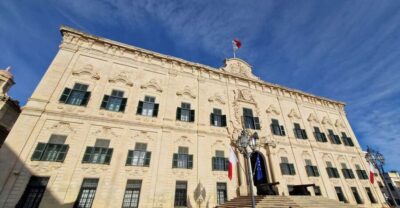
Browse the lists this tour appears in