
Review · BUDAPEST
Budapest: 3-Hour Walking Tour of Pest with a Historian
Budapest’s Pest side is where grand avenues, political history, café-lined streets, and everyday city life come together. This three-hour walk gives you a useful first look at central Budapest, then carries you out along Andrássy Avenue to Heroes’ Square by the old Millennium Underground.
I like the small group of no more than 10, which makes it easier to ask questions and adjust the conversation. I also like that your ticket to St. Stephen’s Basilica and the subway ride are included, so the $57 price covers more than a standard stroll between monuments.
The main consideration is pace. You cover a lot of ground in three hours, including a subway ride, so this is best for you if you enjoy walking and want an energetic introduction rather than a slow visit focused on one neighborhood.
Key points at a glance

- A full Pest introduction: See the Danube Promenade, Gresham Palace, the Academy of Sciences, Zrínyi Street, St. Stephen’s Basilica, Andrássy Avenue, and Heroes’ Square.
- Inside St. Stephen’s Basilica: The entrance ticket is included, giving you time to see Budapest’s largest church beyond its exterior.
- History with room for questions: The English-speaking historian guides discuss Hungary’s past, current life, politics, and the different outlooks of Pest and Buda.
- A ride on the Millennium Underground: Use the oldest underground railway on the continent as part of the route, with subway tickets included.
- Personal local insight: Guides such as Judit, Greg, Barbara, Monica, Andrea, and Gergely have been praised for clear explanations and personal stories.
- Useful for a first visit: The route helps you get your bearings quickly and gives you ideas for what to see and where to eat afterward.
Starting in the heart of Pest
The tour begins in front of Kempinski Hotel Corvinus Budapest at Erzsébet tér 7, facing the Ferris wheel. This is a convenient central meeting point at Deák Ferenc tér, where Budapest’s M1, M2, and M3 subway lines meet, along with several buses and trams.
That location matters. You can reach it easily from many parts of the city, and you begin in the middle of Pest rather than spending your first part of the tour finding a distant meeting place. If you arrive early, Erzsébet tér gives you a clear public spot to wait.
Your guide is an English-speaking historian, and the group is limited to 10 people. That size is a real advantage on a city walk. You can hear the explanations more easily, ask about a building or street while you are standing beside it, and have a more natural conversation than you usually get in a large group.
The guides named in the feedback include Judit, Barbara, Monica, Andrea, Raymond, Greg, Noemi, Gergely Molnár, and others. Their approach varies by personality, but the strongest pattern is clear: you should expect history explained through stories, personal experience, and questions rather than a string of dates.
More Three-Hour Walks in Budapest:
- 3-Hour Orientation Walking Tour of Buda and Pest
★ 4.8 · 1,834 reviews - Budapest: 3-Hour Grand City Tour and Castle Walk
★ 4.3 · 1,437 reviews - Budapest 3-Hour Walking Tour in Italian
★ 4.6 · 217 reviews
The Danube Promenade and Pest’s grand center
The opening section introduces central Pest and takes in the Danube Promenade, one of the city’s best places to understand how Budapest faces its river. You also see Gresham Palace, the Academy of Sciences, and the handsome streets around the center.
This part of the tour is less about ticking off individual buildings and more about learning how Pest developed as an urban center. The guide explains the difference between Pest and Buda, including the different mentality traditionally associated with residents on the two sides of the river.
That comparison gives the rest of the walk a useful frame. Buda and Pest are now one city, but their character is not identical. On this tour, the guide connects the grand public buildings around you with the way people live in Budapest today.
The route includes Zrínyi Street, with its cobblestones and direct view toward St. Stephen’s Basilica. Streets such as this help you see how Budapest shifts from grand civic spaces to intimate urban corners within only a few minutes.
You can ask about Hungary’s past and present as you go. The guides have discussed the Austro-Hungarian Empire, World War II, the Communist period, current Hungarian politics, and daily life. If you want only architecture, you can focus on the sights. If you want context, this is where the tour becomes more useful than a guidebook caption.
Inside St. Stephen’s Basilica

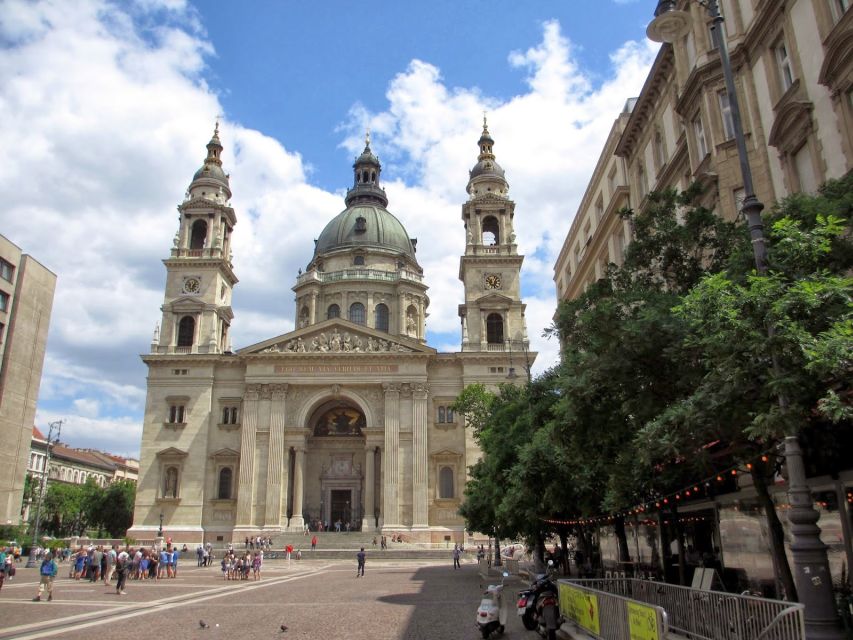
St. Stephen’s Basilica is one of the tour’s central stops, and your entrance ticket is included. The church is described as Budapest’s largest, so this is not simply a quick photo stop from the pavement.
The visit gives you a chance to connect the city’s religious and national history with the wider story of Hungary. Your guide can explain the building and its place in Budapest while you look around inside, rather than leaving you to interpret the exterior on your own.
I particularly like this inclusion because many walking tours keep entry fees separate. Here, the church visit is built into the $57 cost, along with the subway tickets. You still need to remember that the tour is only three hours, so the interior visit forms one part of a wider route rather than a long independent exploration.
The experience also benefits from the guide’s ability to answer follow-up questions. Judit, for example, was praised for giving detailed answers and discussing current affairs, while another guide, Gergely Molnár, began with a short overview of Hungarian history that helped make the later sights easier to follow.
Andrássy Avenue and the Millennium Underground
From central Pest, the route continues toward Andrássy Avenue, a UNESCO World Heritage site. This is one of Budapest’s major ceremonial avenues, and walking along it gives you a sense of the city’s scale and ambition.
The avenue is more than a pleasant route between stops. It links the inner city with Heroes’ Square and helps you see how Budapest’s major institutions, public spaces, and cultural buildings relate to one another. The tour also points out the Hungarian State Opera.
The route then uses the Millennium Underground. Described as the oldest underground railway on the continent, it is not just a practical transfer. It is part of Budapest’s transport history and gives you a different way to experience the city.
Your subway tickets are included. This also breaks up the walking, which is helpful on a warm day or if you have already spent the morning on your feet. At the same time, the tour remains an active outing, so comfortable shoes and a willingness to walk are sensible choices.
The underground ride is especially useful for a first visit because it shows how Budapest’s historic center connects with the area around Heroes’ Square. You are not simply looking at a map and hearing that these places are related. You travel between them as part of the story.
More Walking Tours in Budapest:
- Budapest: Buda Castle Walk with Saint Stephen’s Hall
★ 4.5 · 3,012 reviews - Big Bus Budapest Hop-On Hop-Off Bus and Walking Tour
★ 3.5 · 2,206 reviews - Budapest: Buda Castle District Walking Tour
★ 4.6 · 2,108 reviews - Budapest City Landmarks Walking Tour in 2 Hours
★ 5.0 · 2,048 reviews
Heroes’ Square and 1,000 years of Hungary
Heroes’ Square is the final major part of the route and the place where the tour turns most directly to Hungary’s long national story. The focus is on the influential historical figures represented there and on roughly 1,000 years of Hungarian history.
This can be a lot to absorb, especially if Hungary is new to you. That is why the quality of the explanation matters. A clear guide can help you understand the broad sequence without burying you in names and dates.
The strongest feedback describes guides who keep the material engaging and at a sensible pace. Greg was praised for condensing thousands of years of history into a short explanation, while Andrea was noted for balancing major events with smaller details and less obvious parts of the city.
You should not expect a full history course in 10 minutes. You should expect a framework that helps later visits make more sense. After the tour, you will have a better idea of how the imperial period, World War II, and the Communist era fit into the story your guide has outlined.
What the guides add to the route
The guide is the main reason to choose this tour over following a self-guided route. The sights themselves are easy to locate, but the connections between them are harder to see without local interpretation.
Judit has been praised for mixing historical detail with personal insight and even sharing two popular Hungarian sweets during one tour. Monica brought stories from growing up in Hungary, which added a personal layer to the larger historical account.
Barbara was noted for offering suggestions about what to see and where to eat, a useful benefit if this is your first time in Budapest. Gergely Molnár connected past events with present-day life in Hungary, and several guides were praised for answering questions at length.
The tour is also likely to feel different depending on the guide assigned to your departure. That is not a reason to avoid it. It simply means you should book this for the format and route first, then view the individual guide as an important bonus.
If the group is smaller than expected, the conversation can become more flexible. One person had a private experience because no one else had booked that departure, and another guide adjusted the meeting arrangement when circumstances allowed. These details are not guaranteed, but a small group gives the guide more room to respond to the people in front of them.
Pace, walking, and practical comfort
Three hours is a good length for a first orientation, but the route covers several areas. You walk through central Pest, visit the basilica, continue along Andrássy Avenue, ride the underground, and finish at Heroes’ Square.
That means you should plan for steady movement rather than long periods of sitting. The tour does not present itself as a gentle, short stroll around one square. If you want to see many key sights early in your stay, the pace should suit you. If you prefer long stops for photographs or detailed interior visits, you may find the schedule tight.
Weather is another practical point. One guide continued to provide a good experience despite poor weather, but rain can make a long city walk less pleasant. Bring suitable clothing and shoes, since much of the experience takes place outdoors.
The English-language format is straightforward. The tour is not advertised with several language options, so it is best suited to you if you are comfortable following historical explanations in English.
Is $57 a fair price?
At $57 per person, this is not the cheapest way to walk around Pest. You can see the exteriors of many buildings without paying for a tour, and Budapest’s public transport is inexpensive compared with many major European cities.
The value comes from the combination of a historian guide, a three-hour route, entry to St. Stephen’s Basilica, and included subway tickets. You are paying for interpretation and structure, not just transportation or access to one monument.
I think the price makes the most sense early in your stay. A good introduction can save you time later, since you will know which streets and sights deserve a longer return visit. The tour also helps you understand what you are seeing instead of treating Pest as a collection of attractive buildings.
The 4.9 rating from 81 reviews supports the idea that the guide quality is usually strong. Still, value depends on your interests. If you already know Hungarian history well and prefer to explore alone, the price may feel high. If you want clear context, local conversation, and a well-planned route, it is easier to justify.
Who should book this Pest walk?
I would recommend it to first-time visitors who want a quick but meaningful orientation. It is also a good fit if you have limited time in Budapest and want major sights, history, and local perspective in one outing.
History fans should find plenty to enjoy, especially if you want to ask about the Austro-Hungarian Empire, World War II, Communism, or present-day Hungary. The tour also suits people who prefer a guide willing to discuss more than the official story.
It works well for solo visitors and couples because the group is small enough for conversation. Families with older children may also appreciate the mix of walking, a church visit, public transport, and large public spaces, though the steady pace may not suit very young children.
I would be less likely to choose it if your main goal is a long interior visit at St. Stephen’s Basilica, a food tour, or a slow photography walk. You may get a little local food advice and perhaps a taste during a flexible private tour, but food is not the central purpose.
My verdict on this Budapest experience
Book this tour if you want Pest explained by someone who can connect its buildings with Hungarian history and current life. The route is broad, the group is small, and the included basilica entry and subway tickets add useful value.
The best reason to go is the guide-led conversation. Judit, Greg, Barbara, Monica, Andrea, and Gergely Molnár are among the guides praised for clear storytelling, personal experience, and thoughtful answers. You are not just shown where to look. You are given a way to understand what you are seeing.
Choose it near the start of your Budapest stay if possible. You will leave with a working map of Pest, a clearer sense of the city’s history, and practical ideas for what to explore next.
FAQ
Where does the tour meet?
It meets in front of Kempinski Hotel Corvinus Budapest at Erzsébet tér 7, facing the Ferris wheel.
How can I reach the meeting point?
You can reach the meeting point by the M1, M2, or M3 subway lines at Deák Ferenc tér. Several buses and trams also serve the area.
How long is the walking tour?
The experience lasts three hours.
What language is the tour conducted in?
The live tour guide speaks English.
Is entry to St. Stephen’s Basilica included?
Yes. The entrance ticket to St. Stephen’s Basilica is included.
Are subway tickets included?
Yes. Subway ticket or tickets for the Millennium Underground are included.
How large is the group?
The group is limited to 10 participants.
New routes in Budapest
- Budapest: Street Art and Underground Movements Walking Tour★ 5.0 · 365 reviews
- Jewish Quarter of Budapest Walking Tour★ 4.7 · 369 reviews
- Budapest 3-Hour Walking Tour in Italian★ 4.6 · 217 reviews
- Budapest: Walking Tour to the Shoes Memorial and Parliament★ 4.7 · 151 reviews
- Budapest: Castle District Walking Tour★ 4.8 · 223 reviews
- Budapest: Jewish History Guided Walking Tour with Historian★ 4.8 · 205 reviews
- Budapest: Walking Tour and Photoshoot with Digital Photos★ 4.7 · 82 reviews
- Budapest: Inner City Walking Tour in German★ 5.0 · 76 reviews
Budapest Walking Tours, compared.

Big Bus Budapest Hop-On Hop-Off Bus and Walking Tour
Read our review →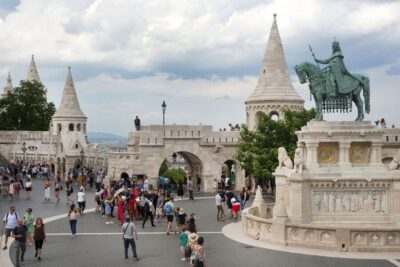
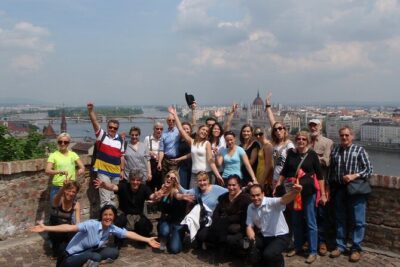
Budapest City Landmarks Walking Tour in 2 Hours
Read our review →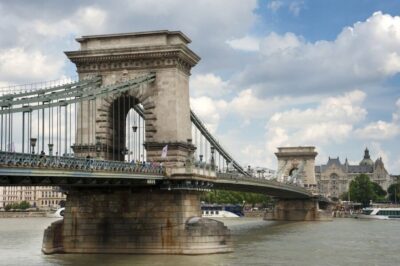
3-Hour Orientation Walking Tour of Buda and Pest
Read our review →
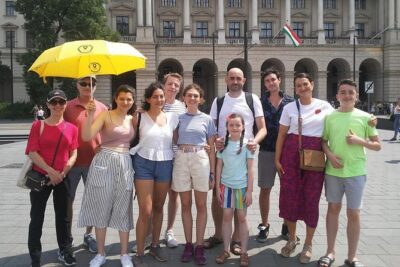
Budapest Historical Sightseeing – Free Walking Tour
Read our review →
Budapest All in One Small Group Walking Tour with Strudel Stop
Read our review →Browse the lists this tour appears in