
Review · BUCHAREST
Bucharest: 3-Hour Walking Tour
Bucharest’s story comes at you in layers: royal ambition, French flair, Ottoman links, communist rule, revolution, and the Dracula legend. This three-hour walk connects those threads from Revolution Square to the Old Princely Court, giving you a useful first look at the capital without burying you in dates.
I like the route for two clear reasons. It pairs big landmarks with quieter details, such as the courtyard at Stavropoleos Monastery and the old inn of Hanul Lui Manuc. I also like the small-group format, capped at 12, and the chance to hear practical food and sightseeing tips from guides such as Andrea, Mara, Elena, or Ioana.
The main consideration is pace. You cover a lot of central Bucharest on foot, and the Old Town’s cobbles can be tiring. The tour includes one traditional covrig, not a full meal, so bring comfortable shoes, sunscreen, and a hat in summer.
Key points to know before you book
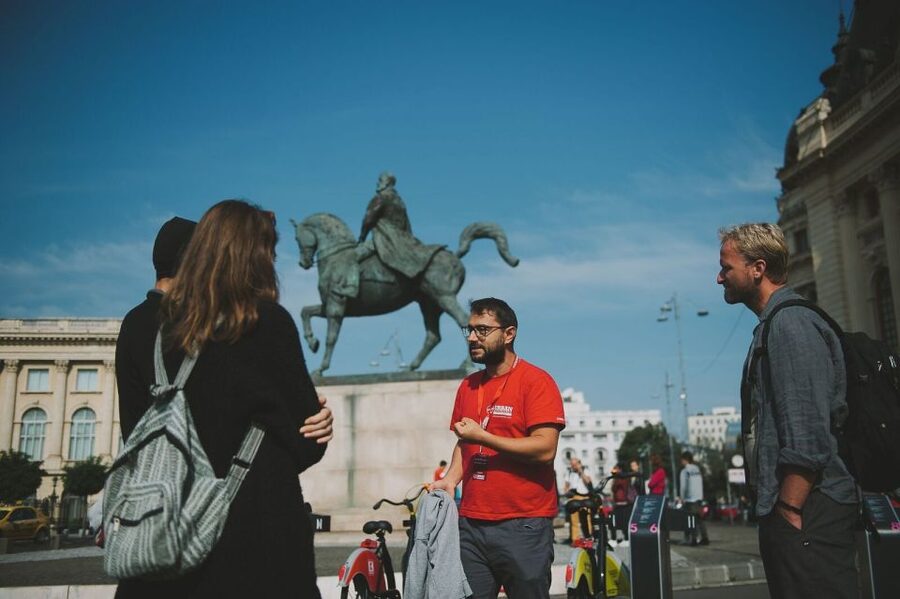
- Begin at Revolution Square: Meet beside the Carol I statue, the only horse statue in the square.
- Follow the 1989 revolution: Learn why the former Palace Square became one of Romania’s most important political sites.
- Walk Victory Avenue: See the Romanian Athenaeum, Kretzulescu Church, palaces, museums, and the Athenee Palace Hilton.
- Explore medieval Bucharest: Old Town brings cobbled lanes, cafés, restaurants, Stavropoleos Monastery, and Hanul Lui Manuc.
- Taste a simple local snack: Your included covrig is Romania’s soft-pretzel-style street food.
- Finish with Dracula’s real setting: The Old Princely Court links modern Bucharest to Vlad Tepes, the ruler who inspired the Dracula story.
Why this route works for a first look at Bucharest
Bucharest can feel scattered at first. Grand buildings sit beside worn facades, lively cafés share streets with quiet courtyards, and the city’s past does not always announce itself clearly. This walk gives you a thread to follow.
You begin in the political heart of the city, move down its grand ceremonial avenue, then turn into the older commercial quarter. That progression matters. Instead of seeing isolated buildings, you get a sense of how Bucharest changed from a medieval settlement into a modern capital.
I would choose this tour early in a city break. The guides often add useful ideas about places to eat and things to see later, and the route gives you a working map of central Bucharest. Andrea, Alex, Mara, Elena, and Ioana have each been praised for clear explanations, good humor, and practical suggestions. Your assigned guide may be different, but the format is designed around local storytelling rather than a recorded script.
The mood is casual rather than formal. You can ask questions about politics, culture, food, buildings, and Romania’s changing governments. That makes the walk a better fit for curious first-time visitors than for someone who wants only a quick list of monuments.
More Three-Hour Walks in the world:
- Prague: 3-Hour Walking Tour of Old Town & Prague Castle
★ 4.7 · 5,696 reviews - Eat Like a Local: Venice 3-Hour Small-Group Food Tasting Tour
★ 5.0 · 3,137 reviews - Experience Porto’s Charm: 3-Hour Guided Walking Tour
★ 5.0 · 2,432 reviews
Revolution Square and the story of 1989
The meeting point is easy to identify: Revolution Square, in front of the statue of Carol I. It is the only equestrian statue in the square, so you should not have trouble finding the group.
This square was once called Palace Square. Its name changed because of the events of December 1989, when Nicolae Ceausescu gave a speech from this area and lost control of the crowd. That moment helped trigger the Romanian revolution and the end of his dictatorship.
The guide uses the square to explain modern Romanian history, not just point at buildings. You will see the former Royal Palace, now linked with the country’s royal and artistic past, along with the Romanian Athenaeum. The Athenaeum is Bucharest’s principal concert hall and one of the city’s most admired buildings.
Across the square is the Athenee Palace Hilton, built in 1914. Its earlier reputation as a meeting place for spies gives the area an extra layer of intrigue. It is the sort of detail that makes a building easier to remember than a date alone.
I appreciate starting here because the square gives you a quick lesson in Romania’s political shifts. Royal rule, communism, revolution, and modern public life all meet in one place. You should listen closely, since this is where the tour’s historical framework is set.
Victory Avenue and Bucharest’s grand public face

From Revolution Square, the walk heads south along Victory Avenue. The avenue took its name from Romania’s victory in the 1877 War of Independence. It is one of the city’s main historic routes and gives the tour a more formal architectural rhythm after the open space of the square.
Along the way, you pass palaces, museums, churches, and other major buildings. The guide explains why these places matter and how they fit into Bucharest’s development. This is also where you get a sense of the city’s French influence, grand civic ambitions, and mixture of architectural periods.
Kretzulescu Church is one of the key stops. Its red-toned exterior and ornate details make it easy to spot, but the useful part is hearing how it fits into the city’s religious and political past. The church is a reminder that Bucharest’s central avenues are not only about government buildings and grand concert halls.
The route is more about exterior sightseeing than extended interior visits. That keeps the group moving and allows you to cover more ground, but it also means you should not expect a museum tour or a long concert-hall visit. If you want to see the interiors of the Athenaeum, museums, or churches, ask the guide for advice about returning later.
Carturesti Carusel and a taste of local street food
One of the most appealing stops is Carturesti Carusel, often described as one of the world’s most beautiful bookstores. The name means Carousel of Light, and the store is known for its elegant interior and sweeping balconies.
This stop adds variety to the walk. You are not looking only at old churches and political monuments. You also see how Bucharest uses a historic building for modern city life. The bookstore is a good place to pause, browse, and take in the design, even if you do not plan to buy anything.
The food stop is simpler but useful. You receive a covrig, a traditional Romanian snack similar to a soft pretzel. It is one of the country’s most common street foods and gives you a small taste of everyday eating rather than a restaurant version of Romanian cuisine.
Keep your expectations in proportion. This is a snack, not a food tour. Additional food and drinks are not included, and the experience does not promise a full lunch. If you need a substantial meal afterward, the Old Town is the natural place to ask your guide for suggestions. Guides such as Andrea and Anita have been especially helpful with restaurant recommendations.
More Walking Tours in the world:
- Magical London: Harry Potter Guided Walking Tour
★ 4.7 · 22,044 reviews - Reykjavik Food Walk – Local Foodie Adventure in Iceland
★ 5.0 · 18,952 reviews - History and Hauntings of Salem Guided Walking Tour
★ 5.0 · 14,564 reviews - New Orleans Premier Ghost, Voodoo and Vampire Walking Tour
★ 4.5 · 12,856 reviews
Old Town’s lanes, courtyards, and old inns

Bucharest’s Old Town is the heart of the walk. Its winding, cobbled streets mark the medieval center, once positioned between eastern and western worlds. The district has seen merchants, Ottoman officials, Transylvanian princes, and generations of local business.
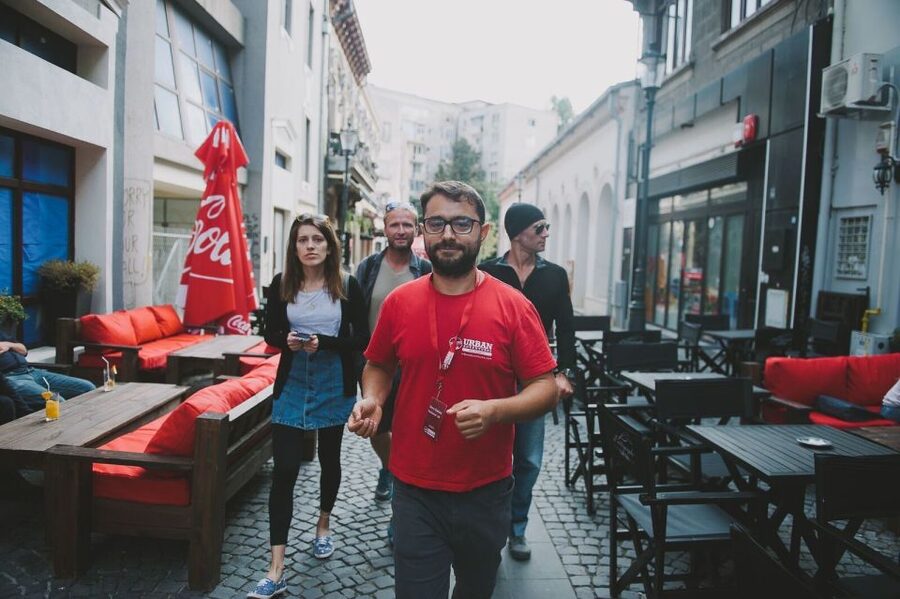
Today, the same streets are lined with bars, cafés, shops, and restaurants. The atmosphere can be lively, especially at popular times, but the walk also shows you quieter corners. You are not simply being led along the busiest restaurant street.
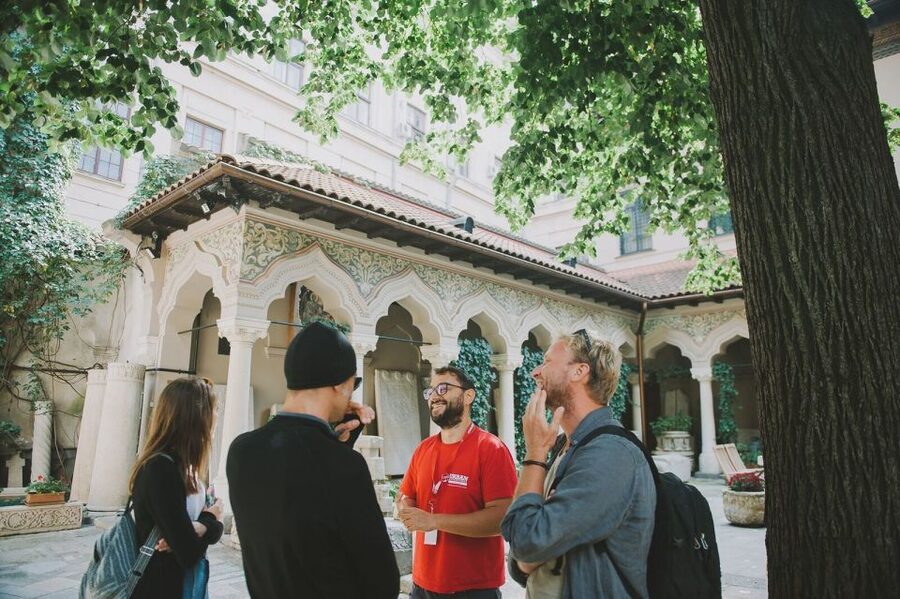
Stavropoleos Monastery is one of the best pauses. Its courtyard offers a welcome break from the noise of the Old Town, with detailed stonework and a calm setting. The guide can help you understand why this small religious site matters in a city known for larger, more imposing buildings.
Hanul Lui Manuc provides a different view of the past. This wooden inn recalls the era when travelers, merchants, and traders needed places to meet and stay. Its design gives you a stronger sense of historical Bucharest than a modern street frontage can provide.
The Old Town is also where the route feels least polished. Cobblestones can be uneven, and the mix of historic buildings, commercial signs, cafés, and modern activity may not suit anyone seeking a tidy open-air museum. I see that as part of the point. Bucharest is a working capital, not a preserved stage set.
The Old Princely Court and the Dracula connection
The walk ends at the ruins of the Old Princely Court. The site dates to the 15th century and is associated with Vlad Tepes, the ruler whose reputation helped inspire the Dracula character.
The stop is valuable because it separates fact from legend. Vlad Tepes was a real historical figure, and the court connects him to Bucharest’s early political life. The tour does not need to rely on castle theatrics. The ruins and the guide’s explanation are enough to show how a real ruler became part of one of the world’s most famous fictional stories.
This is a good ending because it brings the route back to medieval Bucharest. You have moved from the 1989 revolution through royal and national history, then into the old commercial district and finally to the city’s earlier political center.
Do not expect a grand intact palace. The attraction is the historical connection and the location, not a fully reconstructed residence. If Dracula is your main reason for booking, you may find this stop brief. If you want a grounded introduction to the man behind the legend, it works well.
How much walking and what the three hours feel like
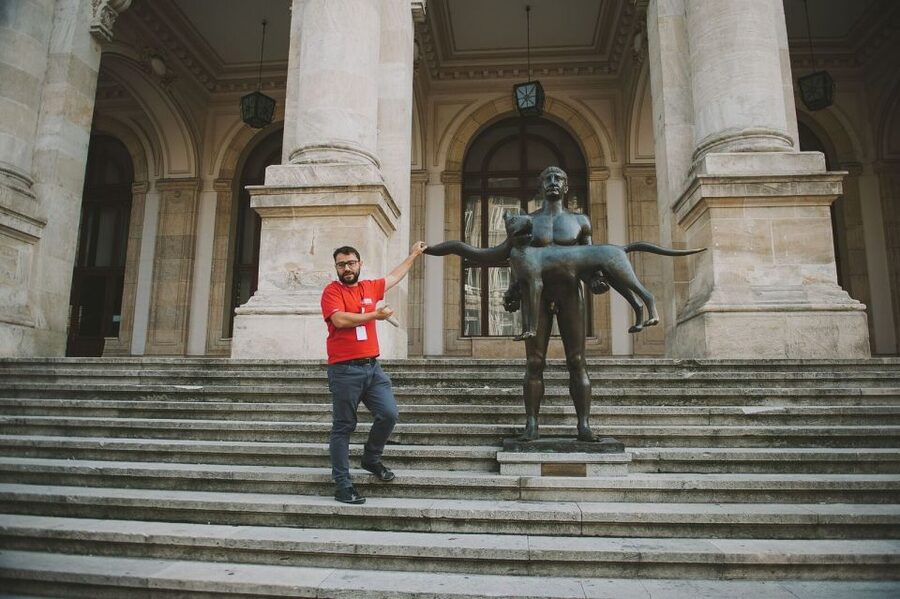
The tour lasts three hours and remains on foot. The path includes paved streets, cobblestones, open squares, and busy central areas. Comfortable shoes are essential, especially if you are not used to spending several hours walking through an old district.
Summer requires a little planning. Sunscreen and something to cover your head are specifically useful because the sun can be intense. In colder weather, the tour still operates outdoors, so wear layers. One winter group completed the route in snow and cold, with the guide keeping the mood light, but that does not make warm clothing optional.
A group of up to 12 is small enough for questions and conversation. You may occasionally have a much smaller group, and some departures can feel almost private. That is a major advantage if you want the guide to adjust explanations to your interests.
The walk is suitable for children. Children ages 6 through 11 use the child rate, while children under 6 can join free of charge if you mention them when booking. Still, the historical content and walking time may suit older children best. A young child who tires quickly could make the three-hour route harder for everyone.
Is $53 a fair price?
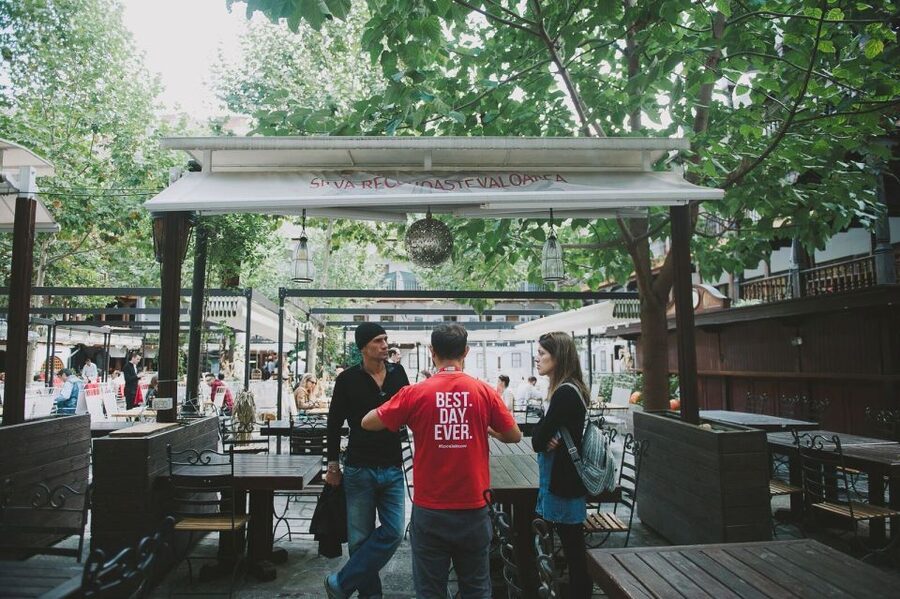
At $53 per person, this is not the cheapest way to stroll around Bucharest. You can walk through Revolution Square, Victory Avenue, and Old Town without paying an admission fee. The value comes from the guide’s interpretation, the efficient route, the small group, and the time saved figuring out what you are looking at.
I think the price is reasonable if this is your first visit and you want context rather than a series of photographs. The tour covers political history, architecture, religion, local food, medieval Bucharest, and the Dracula connection in one morning or afternoon.
The value is weaker if you already know central Bucharest well or prefer to explore at your own pace. You also need to remember that extra food, drinks, souvenirs, and personal shopping cost more. The included covrig is a thoughtful local touch, but it should not be counted as a meal.
The flexible booking terms help if your plans are uncertain. You can reserve now and pay later, and cancellation is free up to 24 hours before the start time. Check the available departure times when booking, since the schedule can vary.
Who should book this Bucharest walk?
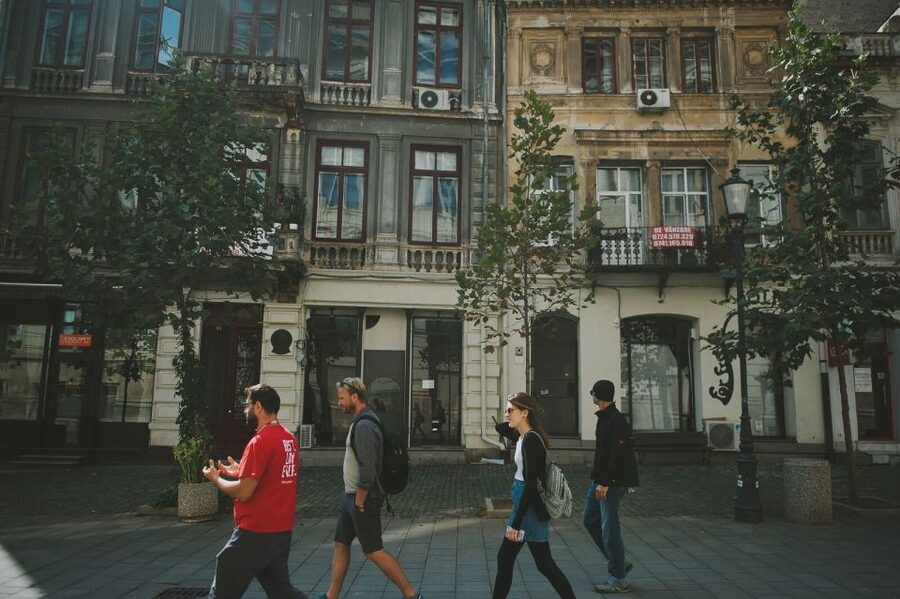
I would recommend it most strongly to first-time visitors, short-break visitors, solo travelers who want local orientation, and anyone interested in how politics shaped the city. It also works well for people who enjoy architecture but want the human stories behind the facades.
It suits travelers who ask questions. Guides have handled topics ranging from old governments and revolutions to food and local customs, and the experience improves when you use that access.
Families can join, provided children are ready for three hours outside. History fans will appreciate Revolution Square and the Old Princely Court, while food-focused visitors should treat the covrig as an introduction rather than the main event.
You may want a different activity if you need wheelchair-free certainty, a seated tour, extensive museum interiors, or a full meal. The supplied details do not specify accessibility arrangements, and the route includes cobbled Old Town streets. Ask before booking if that matters for your group.
Should you book the 3-hour Bucharest Walking Tour?
Book it if you want a clear first framework for Bucharest and prefer stories, local tips, and real streets to a checklist of attractions. The route is well chosen: Revolution Square explains modern Romania, Victory Avenue shows the capital’s grand ambitions, Old Town supplies atmosphere, and the Old Princely Court adds the Vlad Tepes connection.
The strongest reason to go is the guide. Past departures have included Mara, Andrea, Alex, Elena, Ioana, Anita, Adrian, Daniel, and others, with particular praise for friendly delivery, strong English, humor, and useful restaurant advice. Since the guide shapes the experience, bring questions and take notes on recommendations.
Skip it if you want a slow museum visit, a full food itinerary, or a tour with very little walking. For most first-time visitors, though, $53 buys a practical and engaging introduction to the city, with enough history to make the rest of your Bucharest stay more rewarding.
FAQ
Where does the Bucharest walking tour begin?
It begins at Revolution Square, in front of the Carol I statue. The statue is the only horse statue in the square.
How long does the tour last?
The tour lasts three hours.
What language is the tour conducted in?
The tour is conducted in English with a live local guide.
What sights are included on the route?
The route includes Revolution Square, the former Royal Palace, the Romanian Athenaeum, Athenee Palace Hilton, Victory Avenue, Kretzulescu Church, Bucharest’s Old Town, Stavropoleos Monastery, Hanul Lui Manuc, Carturesti Carusel, and the Old Princely Court.
Is food included?
One traditional Romanian covrig is included. Additional food and drinks are not included.
Is the tour suitable for children?
Yes. Children ages 6 through 11 are permitted at the listed child rate. Children under 6 may join free of charge if you mention them when booking.
How large is the group?
The group can include a maximum of 12 people.
What should I bring?
Bring comfortable shoes. In summer, sunscreen and something to cover your head are also recommended because the sun can be intense.
New routes in the world
- Baltimore Walking Foodie Tour in Fells Point★ 5.0 · 182 reviews
- Baku Oil Heritage & Old Town Walking Tour★ 5.0 · 232 reviews
- Baku Walking Tour (Old City)★ 5.0 · 127 reviews
- The Madam’s Curse Walking Ghost Tour★ 4.5 · 103 reviews
- Austin Small Group Morning Walk★ 5.0 · 412 reviews
- Austin Haunted Pub Crawl Walking Tour★ 4.5 · 232 reviews
- Austin Downtown Private Walking Food Tour With Secret Food Tours★ 5.0 · 71 reviews
- Austin Murder Walk★ 5.0 · 310 reviews
Bucharest Walking Tours, compared.
Bucharest: City Highlights Guided Walking Tour
Read our review →
Bucharest: Hidden Markets Walking Tour with Tastings
Read our review →
Bucharest: Ghost Stories & Romanian Mythology Walking Tour
Read our review →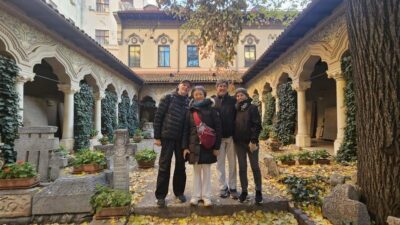
Bucharest: Guided Walking Tour with Romanian Snack
Read our review →
Bucharest: Relics of Communism 3-Hour Walking Tour
Read our review →Browse the lists this tour appears in