
Review · BELGIUM
Historical Walking Tour: Legends of Gent
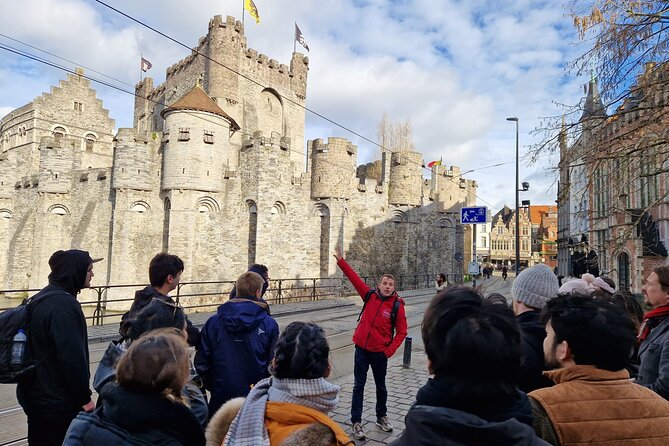
Ghent’s story comes alive best on foot, and this walk gives you a quick route through its medieval center without burying you in dates. From St Michael’s Bridge, you see the famous three towers, then follow canals, old trading streets, a castle, a graffiti lane, and grand churches. The guide’s storytelling is the main event, with local legends adding plenty of character.
I like the pay-what-you-want format, which lets you judge the experience for yourself, and I like the useful food, beer, chocolate, and sightseeing tips woven into the walk. The main caution is that the group can reach 35 people, and one serious booking complaint involved confusion over extra payment, so bring your confirmation and clarify the payment arrangement before setting out.
Key points at a glance
- The three towers begin the story: St Michael’s Bridge gives you one of Ghent’s best skyline views.
- Thirteen central stops fit into two hours: The route covers the city’s essential sights at a brisk but manageable pace.
- Local guides make the difference: Tatiana, Kasia, Kenny, Sophia, Robin, Florian, and others have been praised for humor, warmth, and clear storytelling.
- You see more than monuments: The walk includes the graffiti street Werregarenstraat and the old trading center at Graslei.
- It is a strong first-day activity: You get a city overview plus suggestions for places to eat, drink, and explore afterward.
- Payment needs attention: The listed price is $3.62 per person, but the experience also uses a pay-what-you-want model at the end.
Start at St Michael’s Bridge with Ghent at your feet
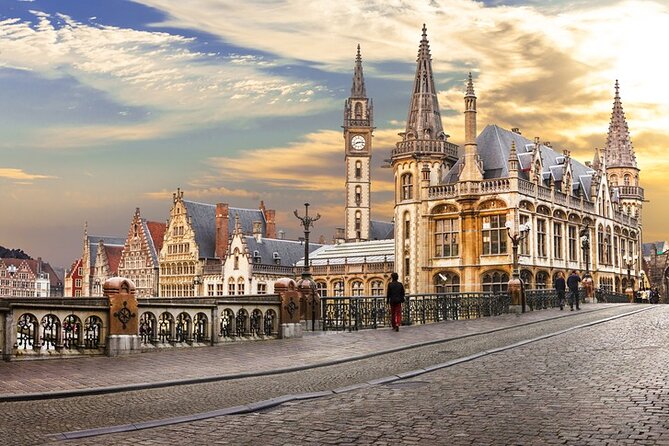
Meet at Hostel Uppelink on Sint-Michielsplein, near St Michael’s Bridge. This is a smart starting point because the view gathers several of Ghent’s signature sights in one frame.
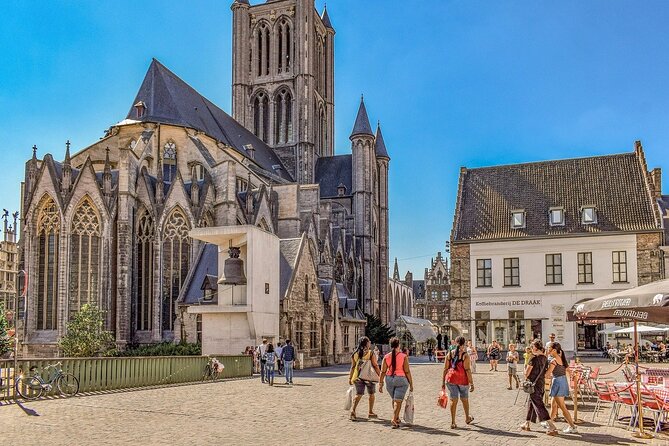
Your guide begins with Ghent’s role as a medieval trading center. From here, you are introduced to the three towers that shape the city skyline: St Bavo’s Cathedral, the Ghent Belfry, and St Nicholas’ Church. This opening gives you a useful visual map before the group moves into the narrower streets.
I especially like this first stop for orientation. Ghent can feel like a maze of canals, lanes, squares, and Gothic façades, but the three towers give you fixed points to recognize later. The stop lasts about 15 minutes and requires no admission ticket.
The group size can reach 35 people. That is not a tiny private walk, so your position matters. Stay close to the guide, especially when crossing busy areas or moving away from the bridge. Some guides use a microphone, which helps, but you should still avoid drifting to the back.
More History Walking Tours in Belgium
- Historical Walking Tour: Legends of Bruges
★ 5.0 · 2,541 reviews - Historical Walking Tour: Legends of Antwerp
★ 5.0 · 1,837 reviews - Brussels: Historical Walking Tour with Chocolate & Waffle Tasting
★ 5.0 · 1,165 reviews
Graslei and Korenlei reveal the working port
The next stop takes you along Graslei and Korenlei, the picturesque canal-front streets at the heart of old Ghent. Today, this is one of the city’s prettiest areas. The guide explains how the buildings once served trading activity when the waterway functioned as Ghent’s port.
This is where the city’s beauty gains context. Instead of seeing a row of attractive façades, you begin to understand why the buildings are there and how commerce shaped the center. The walk pauses here for about 10 minutes.
Do not expect a long architectural lecture. The pace keeps moving, and this tour is designed as an overview rather than a close study of every building. Still, this short stop helps connect Ghent’s canals with its past as a place of trade and power.
Design Museum Gent and the stubborn side of the city
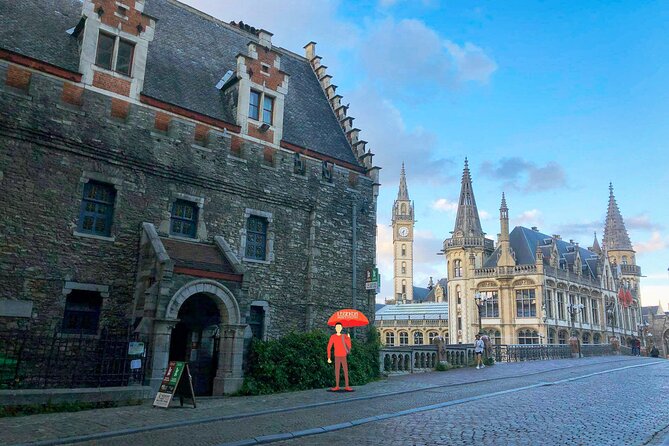
At Design Museum Gent, the guide points out a feature that symbolizes the stubborn, rebellious character of the Gentenaars, the people of Ghent. The supplied details do not specify exactly which design element you will examine, so the value depends on how your guide explains the connection.
That uncertainty is not necessarily a weakness. A good guide can use the stop to show that Ghent is more than a preserved medieval setting. The city’s identity also includes resistance, independence, and a willingness to challenge authority.
The museum itself is not included in the walk. You are seeing the exterior and hearing the story, not receiving a museum visit. If design is a major interest, you can return later with a separate admission ticket.
Het Groot Vleeshuis adds a darker note
Across the water, you get a view of Het Groot Vleeshuis, the medieval covered Great Butchers’ Hall. The building is impressive, but the guide focuses on darker facts connected with it.
This change in tone is useful. The walk does not treat Ghent as a polished postcard town where every story is cheerful. Medieval trade, food, punishment, religion, and power often had unpleasant sides, and the guide brings some of that into the tour.
The stop is free and takes about 10 minutes. Because you are viewing the building from across the water, this is more about explanation and atmosphere than going inside.
More Crime and Mystery Walking Tours in Belgium:
- Historical Walking Tour: The Story of Bruges – by Legends
★ 4.7 · 483 reviews - Private Historical Tour: Legends of Antwerp
★ 5.0 · 125 reviews - Bruges Guided Walking Tour: Stories, Mysteries and People
★ 4.2 · 71 reviews - Prague: Ghost Walking Tour Where Legends Come To Life
★ 4.4 · 5,253 reviews
Gravensteen puts a castle in the middle of the city
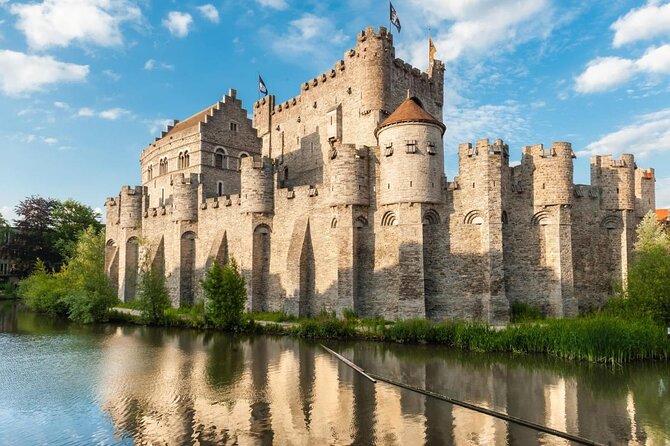
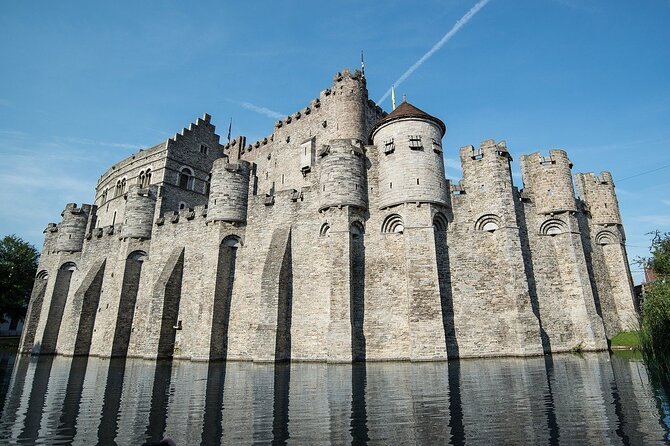
Gravensteen, the Castle of the Counts, is one of the strongest stops on the route. Unlike many castles that sit outside a city, this well-preserved medieval fortress occupies a central position in Ghent.
Your guide explains its past from outside. That distinction matters. Admission to the castle is not included, and this walk does not replace a full interior visit. You will get the background and a chance to decide if you want to return for a closer look.
The 10-minute stop is short, but it gives the castle a role in the wider story rather than presenting it as a stand-alone photo stop. If you have only one day in Ghent, the outside view and explanation may be enough. If medieval buildings are your priority, plan extra time after the tour.
St Veerleplein explains a square of death and life
The square in front of Gravensteen is known both as the square of death and the square of life. The guide explains the reason behind those contrasting names.
This is the sort of stop that gives the tour its title. You are not simply ticking off landmarks. You are hearing the local stories attached to places, including the uneasy legends and events that remain part of Ghent’s identity.
The square is free to visit and takes around 10 minutes. The subject matter may be darker than the canal views and church façades, but it adds balance and makes the city easier to remember.
Huis van Alijn tells the story of a medieval hospital
The House of Alijn was a hospital and is the only remaining god house in Ghent. A god house was a charitable institution connected with care and shelter. Here, the guide explains the unfortunate circumstances that led to its use as a hospital.
This stop gives you a glimpse of everyday life beyond rulers, merchants, and monumental buildings. It also shows how old religious and charitable institutions shaped the city’s social structure.
You do not enter the museum as part of the walk. The stop is free and lasts about 10 minutes. If you like social history, this may interest you as much as the grander landmarks.
Vrijdagmarkt connects public space with power
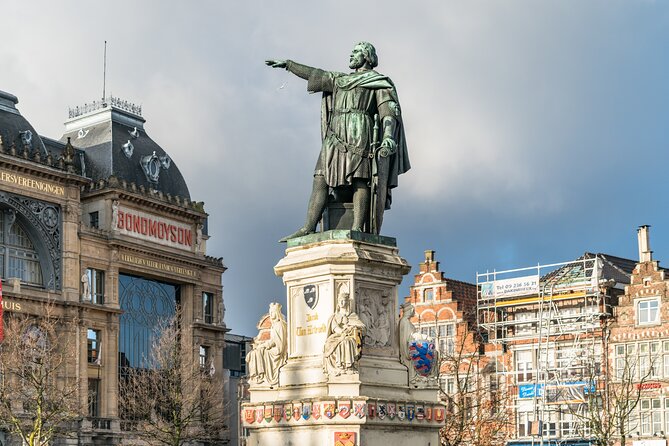
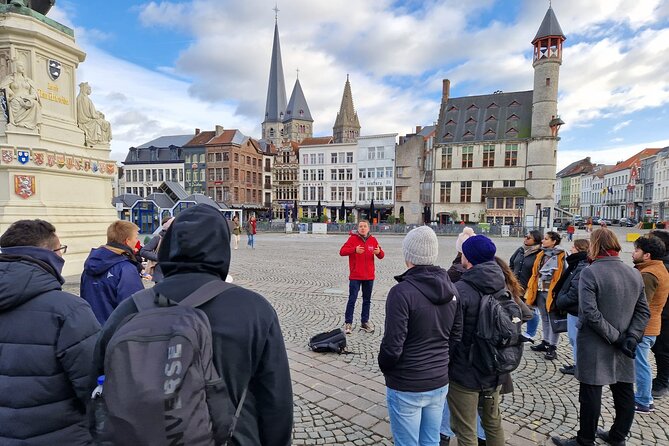
Vrijdagmarkt is one of Ghent’s major historic squares. The guide explains its role in the city’s past and discusses the man represented by the statue in the middle.
A central square like this helps you see how public life once worked. Markets, gatherings, ceremonies, and political statements all took place in open spaces such as Vrijdagmarkt. The guide’s job here is to connect the statue and the square to broader events in Ghent.
The stop is free and takes about 10 minutes. It is also a useful place to pause, look around, and notice how modern city life shares space with old architecture.
Werregarenstraat shows Ghent’s creative compromise
Werregarenstraat is Ghent’s designated graffiti street. The city created this area so street artists could work without covering the city’s historic monuments.
This is one of the route’s most refreshing stops. It shows a practical compromise between protecting old buildings and allowing modern expression. The appearance of the lane can change, so what you see will depend on recent artwork.
The guide walks you through the street for about 10 minutes. It is a good reminder that Ghent is not only about Gothic stone and medieval legends. Contemporary street art is part of the city’s daily character too.
Town Hall explains why the façade looks confused
Ghent Town Hall has an unusual appearance because different sections reflect different periods and styles. The guide uses the building to explain the most important conflict in Ghent’s history.
This is a helpful way to read architecture. Rather than telling you that the building simply looks mismatched, the guide gives you the political reason behind its appearance. The city hall becomes evidence of arguments, changing power, and competing ambitions.
Admission is not included, and the stop lasts about 10 minutes. You see the exterior and hear the explanation. Look carefully at the façade while the guide speaks, because the building itself is the visual evidence.
St Bavo’s Cathedral and the Ghent Altarpiece
St Bavo’s Cathedral is one of the tour’s major highlights. It has a long religious and artistic story, and it houses important works, most famously the Ghent Altarpiece by the Van Eyck brothers.
The guide introduces the cathedral and explains why the altarpiece matters. You should be clear about the scope: this is not described as a dedicated art visit, and the short stop cannot provide a full examination of the cathedral’s treasures.
Still, the introduction is valuable. It gives you enough background to return later with better questions and a sharper eye. The cathedral stop is free and lasts around 10 minutes.
The Belfry turns independence into stone
The Ghent Belfry is known as the people’s tower. The guide connects it with the city’s stubbornness, power, and independence, then adds a strange legend linked to the building’s former use as a prison.
This is another stop where the guide’s delivery matters. The facts provide the structure, but the legend gives the tower personality. The belfry is not just a tall landmark to photograph. It represents civic pride and Ghent’s long struggle to control its own affairs.
Admission to the Belfry is not included. The tour ends at Sint-Baafsplein beside the tower, which makes the location convenient if you want to visit inside afterward. Allow extra time if you plan to do so, since the walk itself is only about two hours.
St Nicholas’ Church closes the route
The final stop is St Nicholas’ Church, a building dating from the early 12th century overlooking Korenmarkt. Its patron saint, St Nicholas, protects merchants and sailors, and the façade reflects a legend about him.
This is a fitting ending because it brings together several themes from the walk: religion, trade, architecture, and storytelling. The church also returns you toward the canal and central city areas, so you finish in a useful location for continuing your day.
The stop is free and lasts about 10 minutes. The tour officially ends at the Belfry, so expect the final church explanation to be part of the closing stretch rather than a separate church visit.
What the two-hour pace feels like
The listed duration is about two hours, with roughly 10 minutes at most stops and 15 minutes at the first. That makes the pace efficient. You cover a large portion of central Ghent without spending long periods inside any one attraction.
You will be on your feet for the full walk. The route is not described as difficult, but cobblestones can be uncomfortable for some people, and the city center involves ordinary walking between stops. Wear supportive shoes and keep your schedule flexible.
The pace works best if you want a first look at Ghent. It is less suitable if you prefer long museum visits, detailed architectural study, or extended time at each church and monument.
Guides, group size, and the human element
The strongest part of this experience is the guide. Tatiana has been praised for professional, energetic storytelling. Kasia is described as warm, informed, and attentive in hot weather. Kenny, Sophia, Robin, Florian, Camilla, Hans, Liedewei, and others have also led highly regarded walks.
The recurring strengths are clear: humor, a friendly manner, a good command of local stories, and practical advice. You can expect recommendations for food, beer, chocolate, and places to continue exploring.
One point needs balance. A single account found the commercial recommendations too frequent, especially repeated chocolate references. If you prefer history without shopping suggestions, this may occasionally test your patience. The guide can also vary, so the tone will not be identical on every departure.
Is $3.62 good value?
The listed price is $3.62 per person, which looks unusually low for a two-hour guided city walk. At the same time, the experience is described as pay what you want at the end, with the guide relying on that payment.
That makes the value attractive if you want to control your spending and reward the guide according to the experience you receive. You are getting a broad introduction to the city, local stories, and practical recommendations without admission charges for the walk itself.
There is one important practical warning. A serious complaint described being asked for more than 200 euros for a family of seven after already paying through a booking platform, with confusion about which platform was valid. Because this conflicts with the stated arrangement, bring your confirmation, show it at check-in, and ask clearly how the end-of-tour payment works. Do not assume an unexpected charge is part of the advertised price.
Who should book this Ghent walking tour?
I would choose this for a first morning or afternoon in Ghent. It gives you a mental map, introduces the major sights, and helps you decide where to spend more time later.
It suits couples, solo visitors, families with older children, and anyone who wants history delivered through stories rather than a long academic lecture. English is the offered language, and most people can participate. Service animals are allowed, and the meeting point is near public transportation.
It is less ideal for anyone who wants a private experience, since the group may reach 35 people. It also is not the right choice if you want every major building entered and examined in detail.
Free cancellation is available up to 24 hours before the start time. Changes or cancellations inside that window are not refunded, and poor weather or too few bookings can lead to a new date or a full refund.
Should you book it?
Yes, if you want a lively orientation to Ghent with a strong mix of landmarks, local legends, and useful food and drink advice. The route is broad, the price is low, and the best guides turn a short walk into a memorable introduction.
Book with two expectations: you will walk continuously for about two hours, and some stops are exterior explanations rather than admissions. Keep your confirmation handy and clarify the pay-at-the-end arrangement. If that suits you, this is a practical way to begin discovering Ghent before returning to the Belfry, Gravensteen, St Bavo’s Cathedral, or the canal district on your own.
FAQ
How long does the Historical Walking Tour: Legends of Gent last?
The tour lasts approximately two hours. You stop for about 10 minutes at most locations and about 15 minutes at St Michael’s Bridge.
Where does the tour begin and end?
It begins at Hostel Uppelink, Sint-Michielsplein 21, near St Michael’s Bridge. It ends at the Belfry of Ghent on Sint-Baafsplein.
Is the tour offered in English?
Yes. English is the listed language for this experience.
Are admission tickets included?
The tour includes all listed fees and taxes, but admission to attractions such as Design Museum Gent, Gravensteen, Ghent Town Hall, and the Belfry is not included. Several outdoor stops are free.
How does the payment work?
The listed price is $3.62 per person, and the experience also describes a pay-what-you-want payment at the end based on your experience. Bring your booking confirmation and clarify the arrangement before the walk begins.
Can I cancel for a full refund?
Yes, if you cancel at least 24 hours before the experience begins. Cancellations or changes made less than 24 hours in advance are not refunded. Poor weather or too few bookings may result in a different date or a full refund.
New routes in Belgium
- Walking Tour: Highlights of Antwerp★ 5.0 · 98 reviews
- Historical Walking Tour in Antwerp Old City★ 5.0 · 277 reviews
- Private Historical Tour: Legends of Antwerp★ 5.0 · 125 reviews
- Evening Walking Tour: The Dark Side of Antwerp★ 5.0 · 193 reviews
- Brussels: Private 3-Hour Sightseeing Walking Tour★ 4.6 · 112 reviews
- Historical Walking Tour: The Story of Bruges – by Legends★ 4.7 · 483 reviews
- Antwerp: Historical Walking Tour in the Old City★ 4.8 · 373 reviews
- Ghent: Belgian Chocolate Walking Tour with Tastings★ 4.9 · 259 reviews
Belgium Walking Tours, compared.
Small Group Boat Cruise and Guided Walking Tour
Read our review →
Walking Tour, Canal Boat Trip w/Beer Tasting Option
Read our review →

Historical Walking Tour with Chocolate & Waffle Tasting
Read our review →
Brussels Walking and Tasting Tour (Beers,Chocolates&Fries/Waffle)
Read our review →
Browse the lists this tour appears in