
Review · ATHENS
Athens: Acropolis, Parthenon Guided Walking Tour
The Acropolis is not simply a monument you stroll up to. It is a steep climb over worn stone, followed by some of the most important buildings in Western history. This two-hour guided walk helps you make sense of the site instead of wandering past columns with no idea what you are seeing.
I like the clear route through the Theater of Dionysus, Propylaea, Parthenon, and Erechtheion. I also like the practical pacing, with guides such as Orestes, Angel, Simon, and Sissy noted for adding rest stops, shade, picture time, and strong historical detail. The catch is simple: this is a climb, and the ticket arrangements can be confusing if you do not choose the admission option carefully.
Key points at a glance
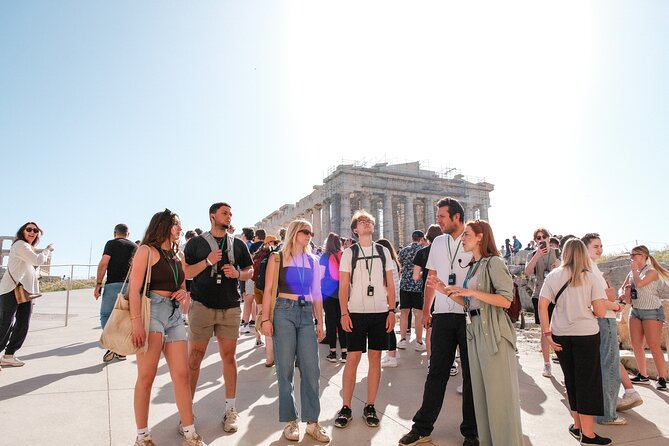
- The climb begins before the Parthenon: Expect steep paths, steps, uneven stone, and slippery spots after rain.
- The route covers the essential monuments: You see the Theater of Dionysus, Herodion, Propylaea, Temple of Athena Nike, Parthenon, and Erechtheion.
- Ticket choice affects the price: The advertised price is $41.13 per person, but Acropolis admission costs extra unless you select the ticket option.
- A guide adds real value here: The ruins are easier to understand when someone explains their purpose, design, and place in Athenian history.
- Timing matters: Early morning or late afternoon can be more comfortable than the busiest morning period.
- The group can reach 24 people: Groups larger than five receive disposable earphones, though sound can suffer when many tour systems are operating nearby.
Why a guide helps on the Acropolis
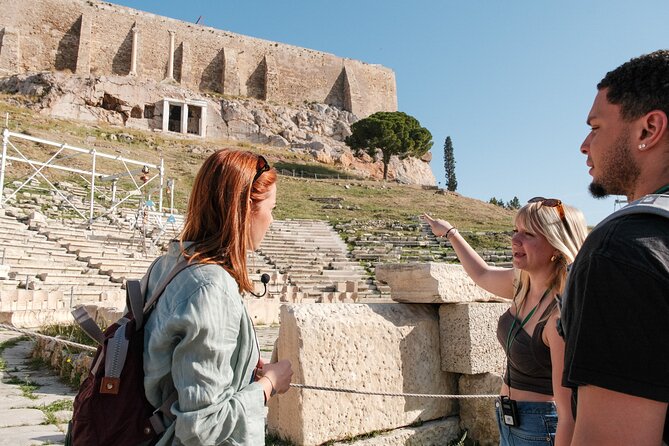
The Acropolis is famous enough that you can recognize the Parthenon from a postcard. The harder part is understanding how the whole hill fits together. A guide gives you a route and a story, pointing out buildings that are easy to miss while you are focused on the climb.
The main benefit is not just historical information. It is efficiency. The hill is broad, busy, and full of paths that can make a first visit feel scattered. Your guide keeps the group moving in a sensible order and explains what matters before you move on.
The strongest guiding style reported for this experience combines detail with humor and patience. Orestes, for example, was praised for entertaining delivery and sensible pacing. Angel was noted for pointing out safer paths over slippery stone and using shady areas for breaks. Simon made time for a restroom stop before the uphill section and kept the group together.
Guide quality can vary, as it does on any group tour. Most feedback describes clear explanations and enthusiastic staff, but one account found the guide impatient and monotone. That is worth remembering if you prefer exploring at your own speed. A group tour gives you structure, but not complete freedom.
Groups can reach 24 people. That is manageable for a major sight, though it will not feel like a private visit. If your party wants a more personal experience, the private option offers a starting time arranged upon request.
More Guided Walks in Athens:
- Athens: Acropolis and Parthenon Guided Walking Tour
★ 4.6 · 5,882 reviews - Acropolis and Parthenon Guided Walking Tour
★ 5.0 · 4,755 reviews - Acropolis: Acropolis and Parthenon Guided Walking Tour
★ 4.7 · 3,442 reviews
Starting at the Theater of Dionysus
The meeting point is at Mitseon 2, near public transportation. From there, the route brings you toward the Acropolis area and the Theater of Dionysus, where ancient Greek comedies and tragedies were first performed.
This is a smart place to begin. It shows that the Acropolis was not only a religious center. Performance, civic life, festivals, and worship were tied closely together in ancient Athens. You get useful context before reaching the monuments most people came to see.
The theater itself is open-air and set into the lower slope of the Acropolis. The approach also gives you an early taste of the terrain. You are not yet facing the highest part of the hill, but the ground is uneven and the route begins to rise.
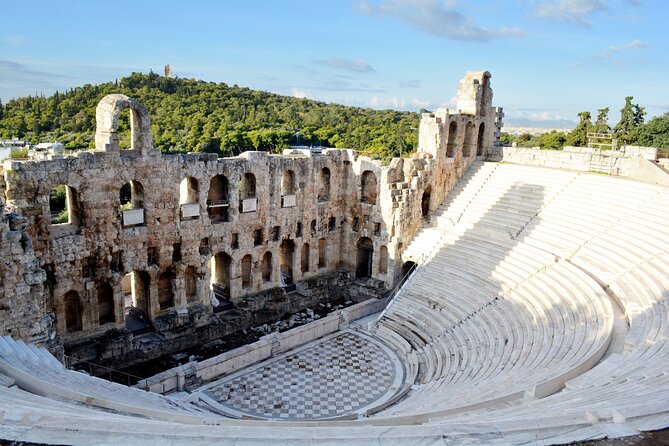
The itinerary also includes the Roman Herodion theater, built in memory of the wife of Herodes Atticus. This structure is especially striking because it remains a major performance venue, linking ancient Athens with the city’s later cultural life.
You should not expect a long, quiet examination of every stone. The tour lasts about two hours, and the Acropolis contains far more than can fit into that time. The value comes from seeing the key places in a logical order and getting enough explanation to understand why they matter.
Climbing through the Propylaea
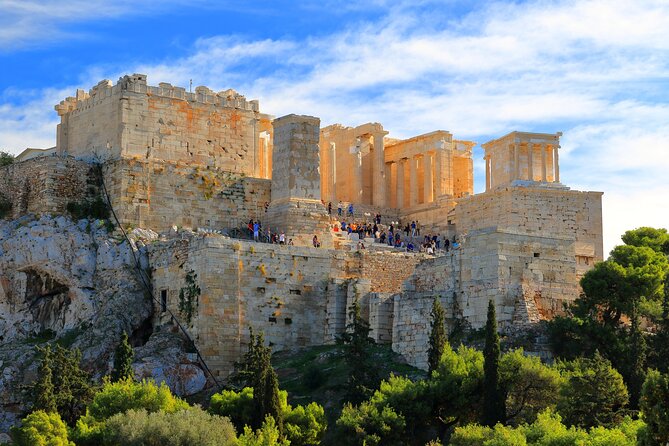
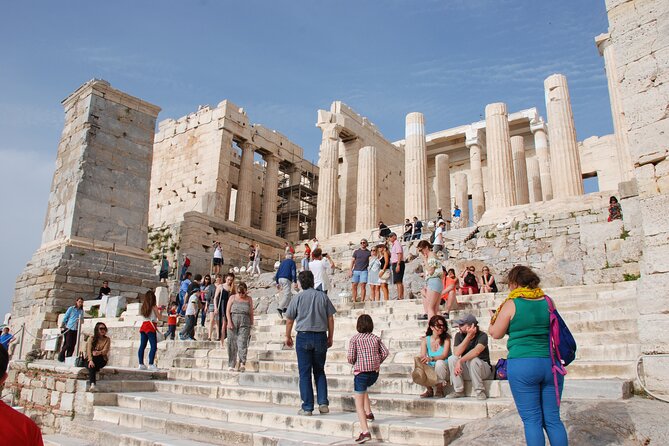
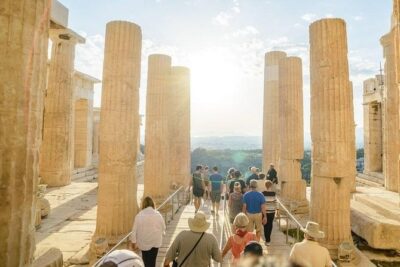
The Propylaea is the grand gateway to the Acropolis. Reaching it means climbing farther up the hill, with views opening out over Athens as you rise.
The gateway was designed to feel imposing. It marks the transition from ordinary city space to the sacred hilltop above. Your guide will also point out the nearby Temple of Athena Nike, a small but important monument dedicated to Athena in her aspect as a goddess of victory.
This is where preparation starts to pay off. The Acropolis is a citadel on a relatively steep hill, not a flat archaeological park. The stones can be slick, particularly after rain, and the paths include steps and uneven surfaces. Solid walking shoes are more important than stylish ones.
The tour information advises you to bring water, a hat, sunglasses, and an umbrella on rainy days. There is no cafe-bar on the site, although there is a water fountain. Carrying your own bottle is the sensible choice, especially during hot weather.
The guides generally build in pauses. Shade is limited, but experienced guides know where the group can stop for a short rest. That makes a difference on the uphill sections, especially when the sun is strong or the group includes people with different walking speeds.
Standing before the Parthenon
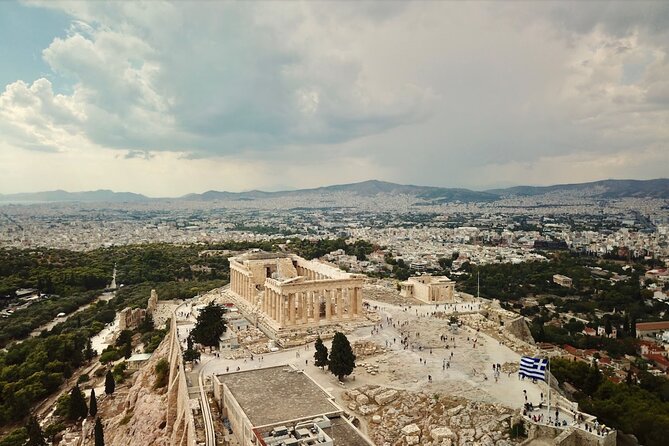
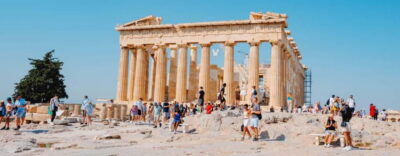
The Parthenon is the main event for most people, and the route allows about 30 minutes in this area. Dedicated to Athena, patron goddess of Athens, it represents the high point of fifth-century BCE Doric architecture.
A guide helps you look past the familiar outline. You can learn why the building matters as an architectural achievement, how it served the city, and how its appearance has changed through time. You will also have space for photographs, although the area can become crowded and the group needs to stay together.
The Parthenon is not a complete building in the way a modern visitor might expect. Much has been lost, damaged, or removed. That can be disappointing if you arrive expecting a perfectly preserved temple, but it also makes a guide more useful. The surviving columns and sculptural details carry more meaning when someone explains what once surrounded them.
Crowds are the biggest threat to your enjoyment here. One account described morning conditions as extremely intense, with cruise-ship arrivals and many other groups converging on the hill. Other experiences found early starts helpful, particularly an 8 a.m. or 9 a.m. visit. Late afternoon was also recommended as a calmer choice.
There is no guaranteed quiet time. The Acropolis is one of Athens’ major sights, and the tour cannot control how many other groups enter. Still, choosing your start carefully can improve the experience. If heat bothers you, aim for early morning. If your schedule allows only a later visit, late afternoon may offer better comfort than the busiest part of the morning.
More Walking Tours in Athens:
- Greek Food Walking Tour in Athens
★ 5.0 · 4,740 reviews - Athens: Guided Greek Food Walking Tour with Tastings
★ 4.9 · 2,859 reviews - Acropolis monuments & Parthenon Walking Tour with Optional Acropolis Museum
★ 5.0 · 2,678 reviews - Athens Acropolis and Parthenon Walking Tour
★ 4.5 · 1,355 reviews
The unusual design of the Erechtheion
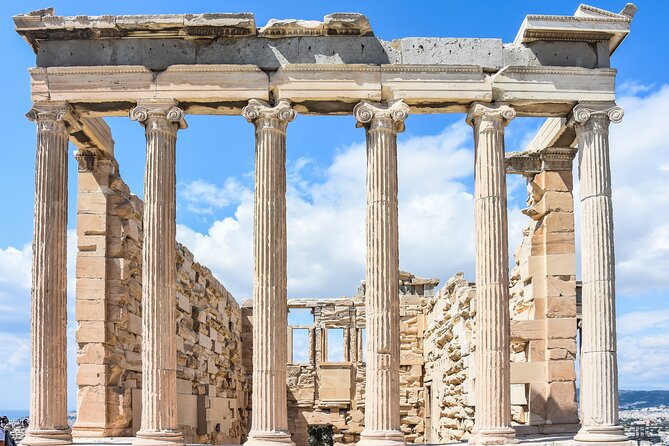
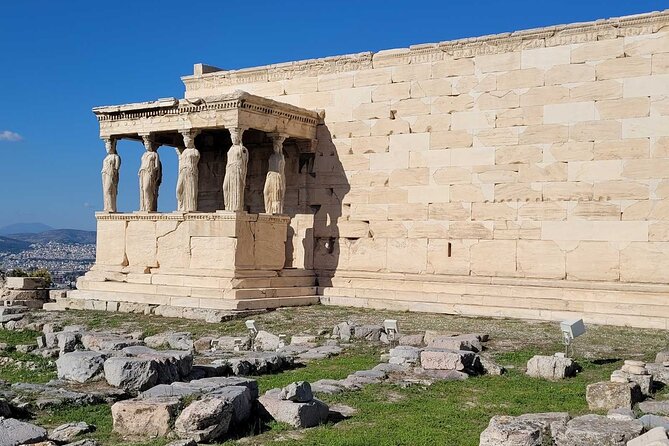
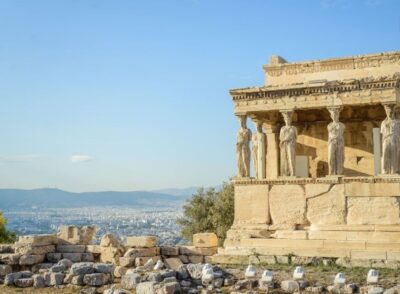
The final major stop is the Erechtheion, known for its unusual asymmetrical design and the sculpted female figures that support part of the structure.
This is a good counterpoint to the Parthenon. The Parthenon looks orderly and balanced, while the Erechtheion responds to a more complicated site and set of religious traditions. Its irregular shape is not a mistake. It reflects the need to work around sacred places already associated with the hill.
The sculpted female supports are often the feature visitors remember best. Your guide can help separate the original architectural elements from later copies and explain why the building looks so different from the temple next door.
The tour ends at the Acropolis of Athens. The route gives you the main monuments, but you should not expect time to study every viewpoint or linger as long as you might on an independent visit. If you want an unhurried photography session, consider staying after the guided portion if site rules and opening hours allow.
Tickets, price, and what you actually pay
The listed price is $41.13 per person. That is the guide cost, but the final price depends on the admission option you select.
Acropolis admission is listed at €30 per person unless included. The ticket option also lets the provider arrange the entrance tickets in advance and skip the ticket-office line. Without that option, the provider may buy tickets in advance for you, but you need to carry cash and arrive on time. You can also buy your own ticket, though any delay at the ticket office could cause you to miss the scheduled start.
The important distinction is that skipping the ticket-office queue does not mean skipping every line at the Acropolis. The tour information specifically states that no one can skip the lines at the Acropolis entrance itself. That is a useful correction to the usual skip-the-line wording.
If you choose tickets included, the guide hands them to you in paper form at the meeting point on the date and time of the visit. Read the booking details closely before paying. One person found the separate guide and admission charges confusing, so do not assume the $41.13 covers everything.
The Acropolis Museum is separate. Its admission is listed as €20 per person unless that option is selected. Adding the museum can be worthwhile because it gives you a protected place to see sculpture and learn more about objects connected with the hill. Several people found the museum a strong follow-up, particularly after an early Acropolis visit.
For value, this tour makes the most sense if you want explanations and help with the route. If you already know the site well and prefer to move alone, the guide fee may feel less worthwhile. For a first visit, the structure and context can justify the cost, provided you understand the admission charges.
Group size, audio, and the pace of the walk
Groups can include up to 24 people. That is not tiny, but it is small enough for a guide to keep everyone together if the group pays attention.
Groups larger than five receive disposable earphones. These help you hear the guide while standing near the Parthenon or moving through crowded paths. Audio quality may suffer when several nearby groups use similar equipment, so stay reasonably close to the guide.
The pace is designed for a broad range of participants, but this remains a physical outing. You will walk uphill, cross uneven surfaces, and manage steps. The activity is not suitable for children under six or people with mobility impairments. Strollers are not allowed, and group tours cannot use the elevator at the Acropolis Hill.
Most people who can manage a fairly strenuous climb should be able to take part. Still, be honest about your stamina. The best guides pause and offer shade, but they cannot remove the hill from the experience.
How to plan your morning or afternoon
Arrive at Mitseon 2 early enough to find the meeting point without rushing. The guide needs to begin on schedule, particularly when tickets have been arranged for a fixed entry time.
For cooler conditions and smaller crowds, choose an early departure if you can. An 8 a.m. or 9 a.m. start may also leave you with time for lunch afterward. A late-afternoon start can be another good choice, especially if morning crowds are heavy.
The order of the monuments may change. Guides can adjust the sequence to reduce discomfort, deal with crowd levels, or make the walk easier for the group. Do not worry if your route does not match the order described at booking.
Bring:
- Water for the uphill walk
- Shoes with a firm grip
- A hat and sunglasses in sunny weather
- An umbrella if rain is possible
- Cash if you choose the option without admission tickets
The meeting point is near public transportation, and no private transportation is included. You make your own way there and leave from the Acropolis area at the end.
Free cancellation is available up to 24 hours before the scheduled start time. Changes or cancellations made less than 24 hours ahead are not accepted for a refund.
Who should book this Acropolis tour
I would choose this tour for a first visit to Athens, especially if you want the essential monuments explained without spending half a day finding your way around the hill.
It suits you if you enjoy history, want a guide who can answer basic questions, and prefer a set route. It is also helpful for visitors who want practical support with pacing, rest stops, and staying together in a crowded place.
You may prefer an independent visit if you need an accessible route, dislike group schedules, or want to spend long stretches taking photographs. The inability to use the elevator on group tours is an important limitation.
The museum option is worth considering if you want more than the outdoor monuments. The Acropolis shows you the buildings in their setting. The museum can add sculpture, artifacts, and more room for detailed explanations. They work well together, but you should budget for the separate admission.
Should you book it?
Book this tour if you want the Acropolis to make sense, not just appear in your holiday photographs. The guide-led route covers the Theater of Dionysus, Herodion, Propylaea, Temple of Athena Nike, Parthenon, and Erechtheion in about two hours, with useful context and practical pacing.
Choose the ticket-inclusive option if you want fewer decisions at the meeting point. Pick an early or late-afternoon start when possible, wear shoes suited to stone, and bring water. If you prepare for the climb and understand that admission may cost extra, this is a solid way to meet Athens’ most famous ancient site.
FAQ
How long does the Acropolis and Parthenon tour last?
The tour lasts approximately two hours.
What language is the tour offered in?
The tour is offered in English.
Is admission to the Acropolis included?
Admission is included only if you select the ticket option. Otherwise, the Acropolis entry fee is listed as €30 per person.
Can I skip the entrance line at the Acropolis?
The ticket option lets you skip the line at the ticket offices. No one can skip the lines at the Acropolis entrance itself.
Is the Acropolis Museum included?
The museum is not included unless you select an option that includes its ticket. The listed museum admission is €20 per person.
Where does the tour start?
The meeting point is Mitseon 2, Athina 117 42, Greece.
Where does the tour end?
The tour ends at the Acropolis of Athens.
How large can the group be?
The maximum group size is 24 people. Groups larger than five receive disposable earphones.
Is the tour suitable for people with mobility impairments?
No. The tour is not suitable for people with mobility impairments. The Acropolis has steep paths, uneven ground, and slippery spots, and group tours cannot use the elevator.
What should I bring?
Bring water, sturdy walking shoes, a hat, and sunglasses. Bring an umbrella on a rainy day. If you choose the option without entry tickets, carry some cash because the provider may purchase the tickets in advance for you.
New routes in Athens
- The Acropolis, Athens Walking City Tour and Acropolis Museum★ 5.0 · 442 reviews
- Athens Street Food Walk★ 5.0 · 385 reviews
- Acropolis monuments, Parthenon and Plaka, Monastiraki walking tour★ 5.0 · 182 reviews
- Athens Shore Excursion: Acropolis Walking Tour★ 4.5 · 131 reviews
- Athens Street Art Walk★ 5.0 · 309 reviews
- Athens at Night Small-Group Walking Tour with Dinner★ 5.0 · 230 reviews
- Athens Off the Beaten Track Private City Walking Tour★ 5.0 · 304 reviews
- Athens Highlights: Myths & Philosophers Walking Tour★ 5.0 · 125 reviews
Athens Walking Tours, compared.


Acropolis monuments & Parthenon Walking Tour with Optional Acropolis Museum
Read our review →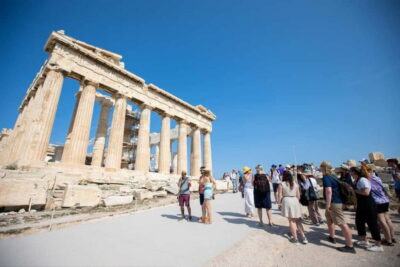
Acropolis, Parthenon & Athens Old City Heritage Walking Tour
Read our review →
The Acropolis Walking Group Tour with a French Guide
Read our review →
Athens Food Tour with 10+ Tastings of Greek Traditional Dishes
Read our review →Browse the lists this tour appears in