
Review · BELGIUM
Historical Walking Tour: Legends of Antwerp
Antwerp’s story unfolds quickly on this two-hour walking tour, from medieval guild houses and Brabo Fountain to Rubens, international trade, printing, fashion, and the tale of a boy and his dog. The route is compact but packed with useful context, making it a smart first look at the city.
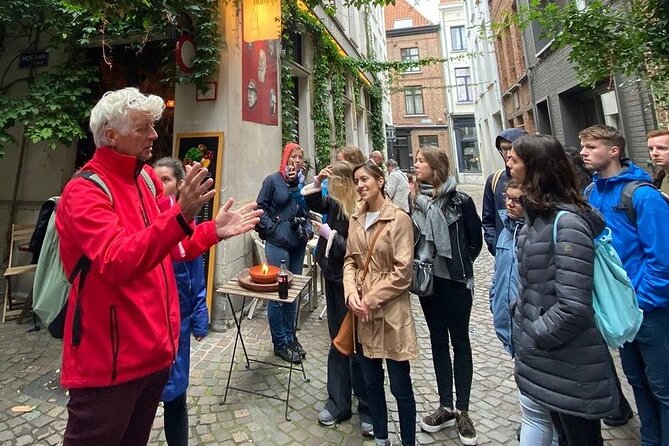
I like the way the tour combines major sights with easy-to-miss corners such as Vlaeykensgang, and I like the practical finish at the cathedral, where your guide offers ideas for the rest of your stay. The possible drawback is the group size, which can reach 35, so hearing every word may be harder in traffic or on a crowded square.
Key points at a glance
- A compact route through Antwerp’s old center: Grote Markt, the Bourse, Rubenshuis, Vlaeykensgang, and the cathedral all fit into roughly two hours.
- Legends add character: Hear the story behind Brabo Fountain and learn why the Nello and Patrasche statue draws visitors from far beyond Belgium.
- Strong guide-led storytelling: Arie, Luc, Beren, Marc, Marleen, Gaston, and others are praised for clear explanations, humor, and genuine affection for Antwerp.
- Useful for a first day: The final recommendations can help you choose museums, food stops, shopping, and evening plans.
- Very low upfront cost: The listed price is $3.62 per group of up to six, with the tour operating in the customary tip-based style described by the provider.
- Wear sensible shoes: You will be on foot for about two hours, with periods of standing and possible sun, rain, or city noise.
Why this route makes sense on your first day
I like this tour because it gives you a working map of central Antwerp without asking you to commit half a day. You begin at Grote Markt, the city’s grand central square, and finish beside the Cathedral of Our Lady. Between those points, the route links the city’s main themes: medieval power, Flemish art, global trade, books, fashion, and local folklore.
That mix matters. A tour that only ticks off monuments can leave Antwerp feeling like a row of handsome buildings. Here, the guide connects the buildings to the people and industries that shaped the city. You learn why Antwerp became a major trading center, how Rubens worked, why printing mattered, and how a small medieval lane survived.
The timing is also useful. Two hours is long enough for a proper introduction but short enough to leave room for a museum visit, lunch, or a return to the places you want to see more closely. If you have only one day, the route gives you a broad first impression without sending you far from the old center.
More History Walking Tours in Belgium
- Historical Walking Tour: Legends of Bruges
★ 5.0 · 2,541 reviews - Historical Walking Tour: Legends of Gent
★ 5.0 · 1,761 reviews - Brussels: Historical Walking Tour with Chocolate & Waffle Tasting
★ 5.0 · 1,165 reviews
Grote Markt and the city’s founding legends
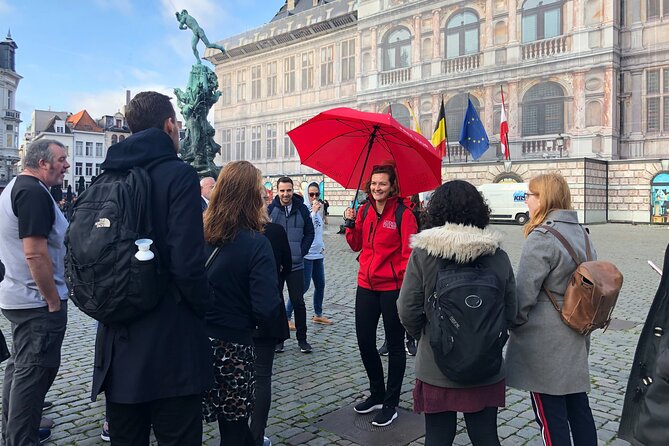
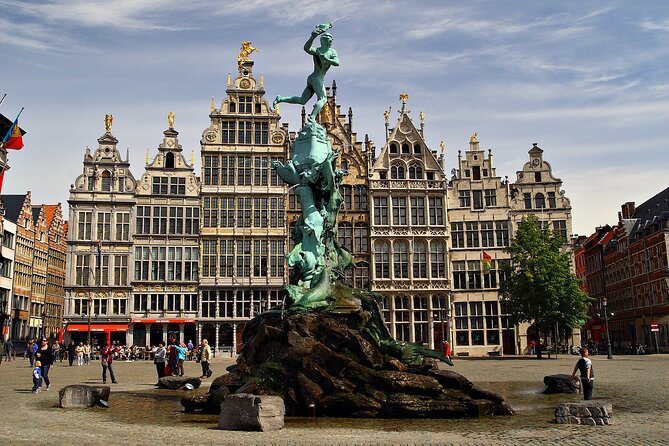
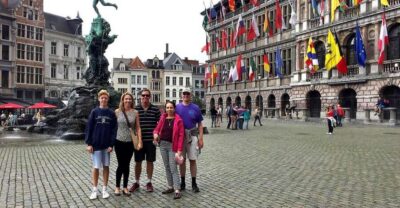
The tour starts at Grote Markt, where Antwerp’s medieval core is at its most photogenic. Ornate guild houses line the square, with the City Hall adding civic weight and Brabo Fountain occupying the center.
This is where the legend of Antwerp begins to take shape. Your guide explains the story connected with Brabo and the fountain, along with the history behind the buildings around the square. The point is not only to take a picture. It is to understand why this space became the symbolic heart of the city.
The stop lasts about 10 minutes. That is enough for an explanation and a look around, though you will not receive a long architectural lecture on every building. If you want detailed interior visits or a slower study of the façades, plan to return later.
Hendrik Conscience Square and a quieter side of Antwerp
From Grote Markt, you continue to the square named for Flemish writer Hendrik Conscience. The atmosphere changes here. Instead of the open drama of the market square, you get a more reflective setting tied to literature, learning, and religious architecture.
The square includes an impressive Baroque church and the old city library. Your guide uses the setting to explain Antwerp’s intellectual and cultural life, not just its commercial success. This five-minute stop is brief, but it helps widen your picture of the city beyond merchants and painters.
I would pay attention here if you enjoy architecture or books. The tour does not linger long, so note the details you want to investigate later.
Carolus Borromeus Church and Antwerp’s Baroque style
The next stop is Carolus Borromeus Church, one of the tour’s strongest art and architecture moments. This 17th-century Baroque church is closely linked with Peter Paul Rubens, whose work contributed to the paintings, interior design, and façade decoration.
The visit is included when the church is open. That qualification matters. Opening hours can affect what you see, so treat the interior visit as a welcome possibility rather than an absolute guarantee at every departure time.
Ten minutes goes quickly inside a church with this much decoration. Still, a guide can point out the connection between Rubens and the building far more effectively than a quick solo glance. If you have a special interest in Flemish Baroque art, return later for a slower look.
More Crime and Mystery Walking Tours in Belgium:
- Historical Walking Tour: The Story of Bruges – by Legends
★ 4.7 · 483 reviews - Private Historical Tour: Legends of Antwerp
★ 5.0 · 125 reviews - Bruges Guided Walking Tour: Stories, Mysteries and People
★ 4.2 · 71 reviews - Prague: Ghost Walking Tour Where Legends Come To Life
★ 4.4 · 5,253 reviews
Handelsbeurs, the world of early international trade
Handelsbeurs Antwerpen gives the tour a useful change of pace. Here, the subject moves from art and religion to money, shipping, merchants, and Antwerp’s rise during the 16th-century Golden Age.
The Bourse is described as the world’s first Wall Street, a phrase that captures its role as a meeting place for international trade. Your guide explains how Antwerp became an important commercial center and how the city’s fortunes were tied to business conducted far beyond its walls.
The visit is included during opening hours. As with the church, access depends on the building being open. The stop lasts around 10 minutes, enough to place Antwerp’s wealth and power in context without turning the tour into a specialist economics lesson.
For me, this is one of the most useful stops because it explains why the city developed such an ambitious cultural life. Art, architecture, printing, and trade were not separate stories. They grew together.
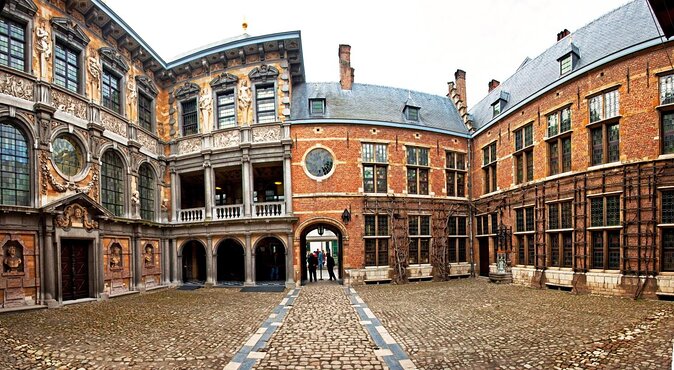
Rubenshuis and the making of a Baroque master
Rubenshuis was the home and workshop of Peter Paul Rubens. The tour uses the site to discuss the painter’s life and the reasons behind his success.
The house itself is an optional paid attraction, not part of the tour price. That distinction is important when you plan your day. You will hear about Rubens here, but the tour does not replace a full museum visit.
The 10-minute stop works as a preview. If your interest in Rubens is strong, mark the house for a separate visit and check its current admission and opening details. If you are less focused on art, the guide’s short account still gives you a useful link between the artist’s personal world and the church, paintings, and civic culture you see elsewhere on the route.
Antwerp fashion in the designer quarter
The route then moves through the area associated with MoMu, the Fashion Museum Antwerp, and Antwerp’s designer quarter. This part explains why the city is regarded as one of the world’s leading fashion capitals and points you toward possible shopping areas.
The museum admission is not included. The tour itself offers orientation rather than a museum visit, with about 10 minutes devoted to the subject.
That is valuable for shoppers because it gives a little direction before you begin browsing. It also keeps Antwerp from being reduced to its medieval center. The city’s identity includes old guild halls and cathedrals, but also contemporary design and fashion.
Museum Plantin-Moretus and the power of printing
Museum Plantin-Moretus is one of the most rewarding stops for anyone who likes unusual museums. It presents the long story of books and printing, and the site’s historic garden is usually included when the museum is open.
The museum was the first to receive UNESCO World Heritage listing, which gives this 10-minute stop extra weight. More important for your visit, it shows how ideas, news, religion, and scholarship could spread through Antwerp’s printing trade.
The tour does not give you enough time for a full museum visit. Think of this stop as a strong recommendation to return. The historic garden may be included during opening hours, but the exact experience can depend on access that day.
Vlaeykensgang, the lane you might miss alone
Vlaeykensgang is a narrow medieval lane that is easy to overlook if you explore without a guide. Its preserved character offers a sharp contrast with the broad squares and major monuments earlier in the walk.
The guide takes you through the alley and explains how it connects with Antwerp’s medieval past. It is also one of the city’s most photographed spots, so expect it to be popular and compact rather than empty and private.
This is exactly the kind of place that makes a walking tour worthwhile. You might pass close by without realizing what is behind the entrance. Allow yourself time to look up, notice the old surfaces, and take in the change of mood.
Nello and Patrasche, Antwerp’s most touching tale
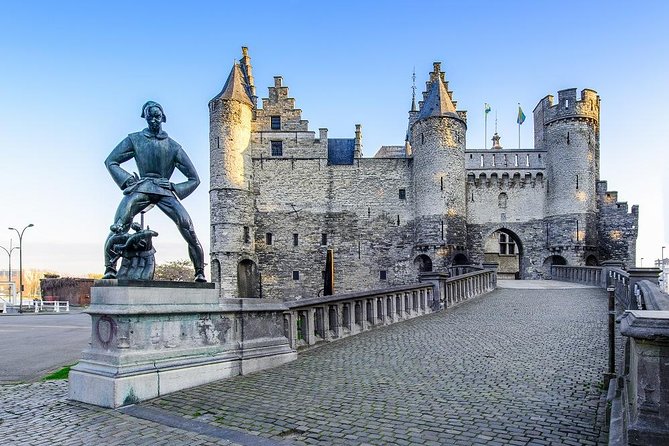
The Nello and Patrasche statue is a small but memorable stop near the end of the route. Your guide tells the story of Nello and his dog, Patrasche, a tale that has encouraged many visitors, especially from Asian countries, to seek out Antwerp.
The stop takes about five minutes. It is less about grand architecture than about the emotional and literary associations attached to the city. The story is not familiar to every local, which makes the guide’s explanation particularly useful.
I like this part because it shows how a city’s appeal can travel across borders through a story rather than a monument. The statue is also a good reminder that Antwerp’s identity is shaped by legend as much as by trade and art.
Cathedral of Our Lady and useful advice for the rest of your stay
The tour ends at Handschoenmarkt, in front of the Cathedral of Our Lady. Your guide covers the cathedral’s construction and shares curious facts before offering suggestions for what to do next.
This final 15-minute stop is practical. You can ask about museums, food, shopping, or other parts of Antwerp, then continue directly into your next activity. Since the route has already introduced Rubens and the old center, the cathedral is a natural place to decide what deserves more of your time.
The tour ends outside rather than as a full cathedral visit. The cathedral’s admission is not listed as an included extra, so check current access details if you want to go inside afterward.
The guides make the difference
The strongest part of this experience is the guide. Names associated with especially warm and effective tours include Arie or Ari, Luc, Beren, Marc, Marleen, Gaston, Sergio, Flip, and Birke.
The guide style can vary, but the best examples share several traits: clear English, a good sense of pace, humor, personal stories, and a willingness to answer questions. Luc is praised for a voice that carries well and for keeping children involved. Beren is noted for managing crowds and adding humor. Marc is described as presenting Antwerp’s story in chronological order, which helps you keep the many dates and names straight.
The guides are volunteers, according to the tour information, and the low fee follows a tip-based model. That can bring an appealing personal touch, but it also means the quality depends on the individual guide and the energy of the group. At $3.62 per group of up to six, the upfront price is unusually low for a two-hour city orientation. You should view the price as an invitation to join, not as the full measure of the guide’s work.
Group size, pace, and the practical trade-offs
The maximum group size is 35. That is manageable in quiet spaces, but it can make listening difficult on Grote Markt or near traffic. One useful tip is to stay close to the guide and avoid drifting toward the back of the group.
Most people can take part, and service animals are allowed. The route is near public transportation, and the mobile ticket makes arrival simple. Wear comfortable shoes, since the tour involves repeated walking and standing over about two hours.
Weather can change the experience. On a hot day, long explanations in the sun may feel tiring. Rain is possible too, so dress for the forecast. One account described the tour as not an excessive amount of walking, while another found the standing difficult in 32-degree heat. Both points can be true. The distance is reasonable, but the conditions and your comfort with standing matter.
The tour is offered in English. It is usually booked about 14 days ahead, so reserve early if your dates are fixed, especially during a busy season or holiday period.
Who should book this Antwerp walk?
I would choose this tour for a first visit, a short stay, or a day when you want an efficient introduction before choosing museums. It suits families, couples, solo visitors, and anyone who likes history explained through stories rather than displayed only on plaques.
It is also a good choice if you want local suggestions at the end. The route covers enough ground to help you decide if you want to return to Rubenshuis, Museum Plantin-Moretus, the cathedral, the fashion quarter, or another part of central Antwerp.
You may want a different format if you need a very quiet, slow-paced walk, a small private group, or guaranteed access inside every building. The 35-person maximum and changing opening hours create limits. On a crowded day, a guide who speaks clearly, such as Luc was reported to do, can make a real difference.
Cancellation is flexible if you act early. You can receive a full refund by canceling at least 24 hours before the start time. Changes or cancellations inside that window are not refunded, and the provider may offer another date or a full refund if the minimum number of participants is not reached.
Should you book Legends of Antwerp?
Yes, if you want a low-cost, story-led introduction to Antwerp’s old center. The route gives you far more than a list of photo stops, linking medieval legends with Rubens, trade, printing, fashion, and local literature.
Book it early in your visit, wear good shoes, and stay near the guide in larger groups. If you have only one day, this walk is a sensible way to get your bearings before choosing where to spend the rest of your time. If your main goal is a detailed museum visit or a private experience, use the tour as an orientation and plan separate visits afterward.
FAQ
Where does the Historical Walking Tour: Legends of Antwerp start?
The tour starts at Grote Markt, 2000 Antwerpen, Belgium.
Where does the tour end?
It ends at Handschoenmarkt, 2000 Antwerpen, Belgium, in front of the Cathedral of Our Lady.
How long does the walking tour last?
The tour lasts approximately two hours.
What language is the tour offered in?
The tour is offered in English.
What is included in the price?
All fees and taxes are included. Visits inside certain places depend on opening hours, and admission to Rubenshuis and MoMu is not included.
What is the listed price?
The listed price is $3.62 per group of up to six people. The tour information also describes the low-fee experience as tip based.
Is the tour suitable for most people?
Most people can participate. Comfortable shoes are recommended because the experience involves walking and standing.
Is the tour accessible by public transportation?
Yes. The meeting area is near public transportation.
Can I cancel for a full refund?
Yes. You can cancel at least 24 hours before the start time for a full refund. Cancellations or changes made less than 24 hours before the start time are not refunded.
New routes in Belgium
- Walking Tour: Highlights of Antwerp★ 5.0 · 98 reviews
- Historical Walking Tour in Antwerp Old City★ 5.0 · 277 reviews
- Private Historical Tour: Legends of Antwerp★ 5.0 · 125 reviews
- Evening Walking Tour: The Dark Side of Antwerp★ 5.0 · 193 reviews
- Brussels: Private 3-Hour Sightseeing Walking Tour★ 4.6 · 112 reviews
- Historical Walking Tour: The Story of Bruges – by Legends★ 4.7 · 483 reviews
- Antwerp: Historical Walking Tour in the Old City★ 4.8 · 373 reviews
- Ghent: Belgian Chocolate Walking Tour with Tastings★ 4.9 · 259 reviews
Belgium Walking Tours, compared.
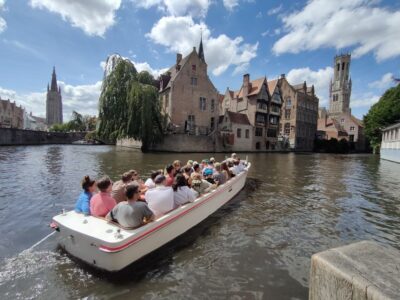
Small Group Boat Cruise and Guided Walking Tour
Read our review →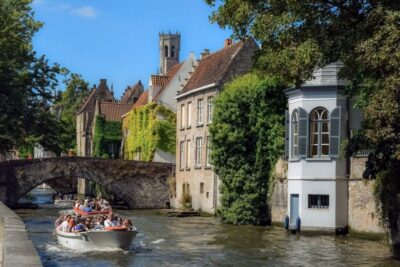
Walking Tour, Canal Boat Trip w/Beer Tasting Option
Read our review →
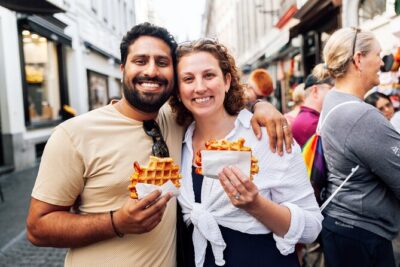
Historical Walking Tour with Chocolate & Waffle Tasting
Read our review →
Brussels Walking and Tasting Tour (Beers,Chocolates&Fries/Waffle)
Read our review →
Browse the lists this tour appears in