
Review · ATHENS
Athens: Women in Ancient Greece Guided Walking Tour
Ancient Athens is usually told through generals, philosophers, and lawmakers. This walking tour asks a better question: Where were the women in that story? Over two hours, you follow their traces through Monastiraki, the Agora, Pnyx, and the streets beneath the Acropolis, hearing about daily duties, myths, marriage, education, work, and women who pushed against the rules.
I like the fresh point of view and the way the tour connects famous figures such as Sappho, Aspasia, and Agnodice with ordinary women. I also like the conversational style associated with guide Maelle, who asks questions, welcomes discussion, and links ancient customs with issues that still matter today. The main drawback is practical: you will climb steps and walk over uneven ground, and the tour does not include entry to the archaeological sites.
Key points at a glance
- Women’s stories at familiar sights: Hear a different account of Hadrian’s Library, the Agora, Pnyx, and the Acropolis.
- Mythology with a social purpose: Athena, Penelope, Demeter, and Pandora help explain how Greek culture imagined women’s roles.
- Rare historical figures: Learn about Sappho, Aspasia, and Agnodice, women who became poets, thinkers, and doctors.
- A conversational guide: Maelle is known for asking questions and making the walk feel like a discussion rather than a speech.
- A short but active route: The two-hour walk includes steps, hills, and outdoor stops, ending around Filopappou Hill.
- Good value for a second look at Athens: At $44.04 per person, the price pays for interpretation and context, not site admission.
Why this Athens walk feels different

The strength of this tour is not the number of monuments. Athens has plenty of tours that can point out columns, temples, and civic buildings. The difference here is the question behind each stop: What did this place mean to women, and what evidence do we have about their lives?
That shift matters because the surviving record is uneven. Ancient writers often focused on men, public life, war, philosophy, and politics. Women appear less often, and sometimes only through laws, myths, household advice, or stories written by men. A good guide has to explain both what is known and what remains uncertain.
The tour also avoids treating women in ancient Greece as one single group. A citizen woman in Athens had a very different life from a foreign resident, an enslaved woman, a worker, a priestess, or a woman from another Greek city. The discussion includes women from different social positions, which gives you a more useful picture than the simple idea that women either had no role or enjoyed the same freedoms as men.
If Maelle leads your walk, expect a friendly and questioning style. She has been praised for her command of Greek history and mythology, her humor, and her habit of inviting participants into the conversation. That approach works well here because the subject raises difficult questions. You are not only memorizing names. You are considering who got to speak, who controlled property, who could move freely, and who was left out of the written record.
More History Walking Tours in Athens:
- Acropolis, Parthenon & Athens Old City Heritage Walking Tour
★ 4.5 · 876 reviews - Athens: History of Rebellion Walking Tour
★ 5.0 · 110 reviews - History and Hauntings of Salem Guided Walking Tour
★ 5.0 · 14,564 reviews
Starting at Monastiraki with the city all around you
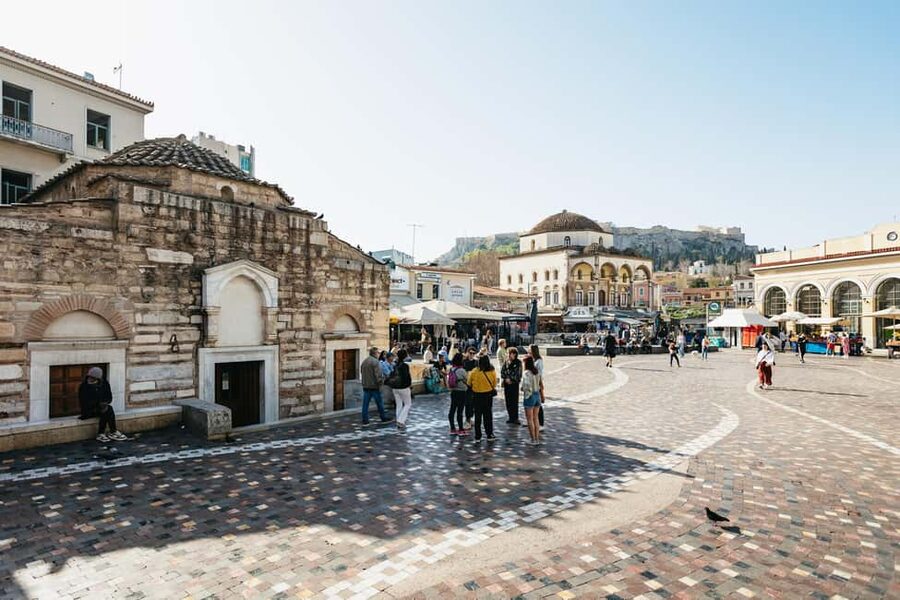
The meeting point is Monastiraki Square, in front of the Holy Church of the Virgin Mary Pantanassa. Look for a guide holding a sign marked Women in Ancient Greece.
Monastiraki is a practical starting place. It is central, easy to recognize, and already full of modern Athens life. The tour begins in the middle of the city rather than at a quiet museum, so the contrast between present-day street life and ancient social rules arrives immediately.
Your first short stop is Monastiraki itself. The guide sets the subject in place before leading you toward the ancient center. This is useful if you have already visited the Acropolis and want to understand the surrounding streets as part of a larger civic area, not just as a route to the hilltop.
The walk is outdoors, so come prepared for sun. A hat, sunscreen, and water are specifically recommended. The shade can vary along the route, and one past walk was adjusted with shady stopping places on a hot day, but you should still plan for exposed pavement.
Hadrian’s Library and the limits of public life
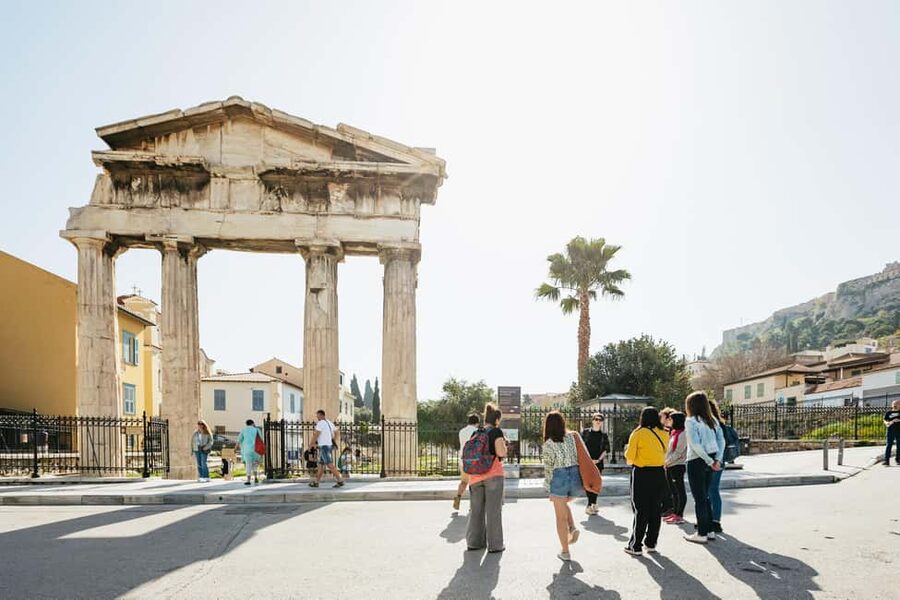
Hadrian’s Library is one of the early landmarks on the route. The stop is brief, with about five minutes set aside for guided sightseeing, so do not expect a long architectural lecture or interior visit.
The value here is the setting. A library and civic complex naturally lead into questions about literacy, learning, and access to public culture. Who was educated? Who could take part in intellectual life? Which women were remembered, and which women’s work disappeared?
The tour does not claim that women were absent from every form of learning. Instead, it places well-known exceptions such as Sappho and Aspasia against the wider limits placed on women in Athenian society. That contrast is important. A remarkable woman tells you what was possible, but she does not necessarily tell you what was normal.
Plaka, Athena, and stories behind the rules

The route continues through Plaka, where you spend about ten minutes with the guide. Plaka is one of Athens’s most atmospheric areas, but this is not mainly a shopping or food stop. It is a chance to connect the city’s modern streets with older stories and social customs.
Greek mythology receives serious attention here. Athena, Penelope, Demeter, and Pandora are not treated merely as colorful characters. Their stories helped shape ideas about intelligence, loyalty, motherhood, curiosity, danger, and feminine virtue.
Athena is especially useful for showing the tension between powerful female figures in myth and the restricted lives of many real women. Greek culture could imagine a goddess of wisdom and warfare while limiting the public authority of ordinary Athenian women. That contradiction gives the tour some of its best material.
The stories of Pandora and Demeter also open discussion about blame, fertility, family, and survival. You get more than a list of myths. You hear how stories can support social expectations, explain suffering, or give a culture a way to think about women’s power.
More Guided Walks in Athens:
- Athens: Acropolis and Parthenon Guided Walking Tour
★ 4.6 · 5,882 reviews - Acropolis and Parthenon Guided Walking Tour
★ 5.0 · 4,755 reviews - Acropolis: Acropolis and Parthenon Guided Walking Tour
★ 4.7 · 3,442 reviews - Athens: Guided Greek Food Walking Tour with Tastings
★ 4.9 · 2,859 reviews
The Gate of Athena Archegetis and the public city
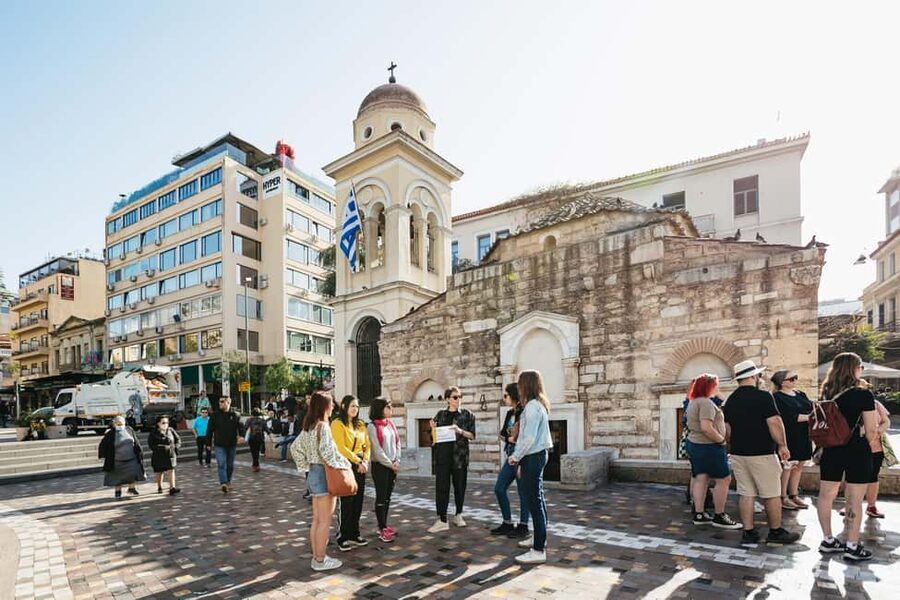
At the Gate of Athena Archegetis, the tour pauses for about ten minutes. This landmark helps bring the mythology and civic life together. Athena was not only a figure in a story. She was tied to the identity of Athens itself.
This is a good place to consider the difference between symbolic importance and legal power. A city could honor a goddess while real women had limited control over public decisions. A woman could be celebrated in religion or myth without being allowed to vote, speak in an assembly, or manage her own affairs in the same way as a man.
The guide also introduces stories that are less familiar than the usual accounts of the Acropolis. The tale of kidnapped Spartan girls and the strange women’s festival in Athens add a social and sometimes unsettling edge to the route. These episodes show that women were not simply passive figures in ancient stories, even when the societies around them were strongly controlled by men.
The secret stop and the value of small details
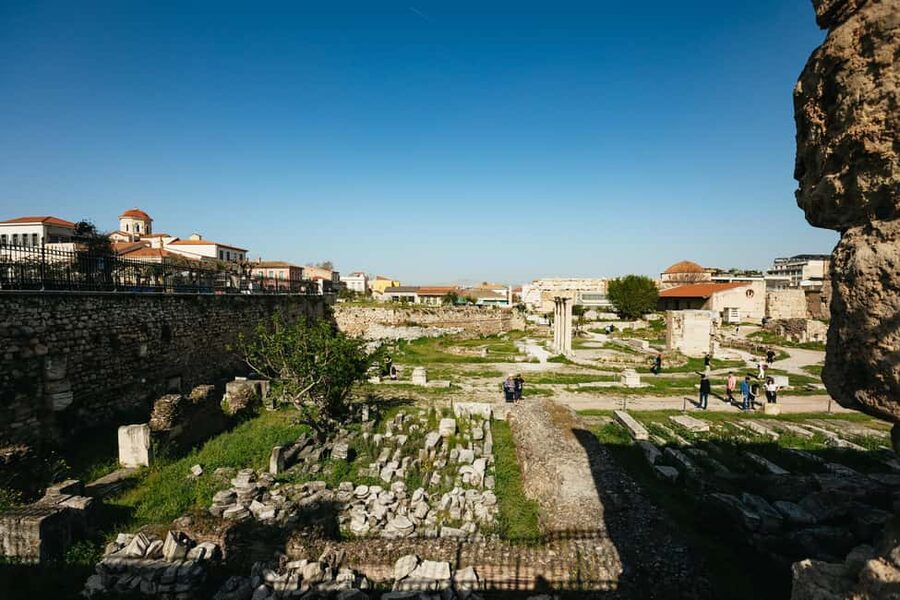
One stop is described only as a secret stop, with roughly ten minutes of guided sightseeing. Because the exact location is not given, you should not book this expecting a named monument or a major archaeological site.
That uncertainty is part of the tour’s appeal, but it also makes the experience harder to assess in advance. The important feature is likely the story attached to the place, not the sight itself. A guide-led stop can turn an ordinary corner into a prompt for discussing women’s work, religion, household life, or public reputation.
This is where the quality of the guide matters most. The subject cannot rely only on grand ruins. It needs clear explanation, careful use of evidence, and the ability to make small details meaningful without presenting speculation as fact.
The Ancient Agora and the women left outside politics
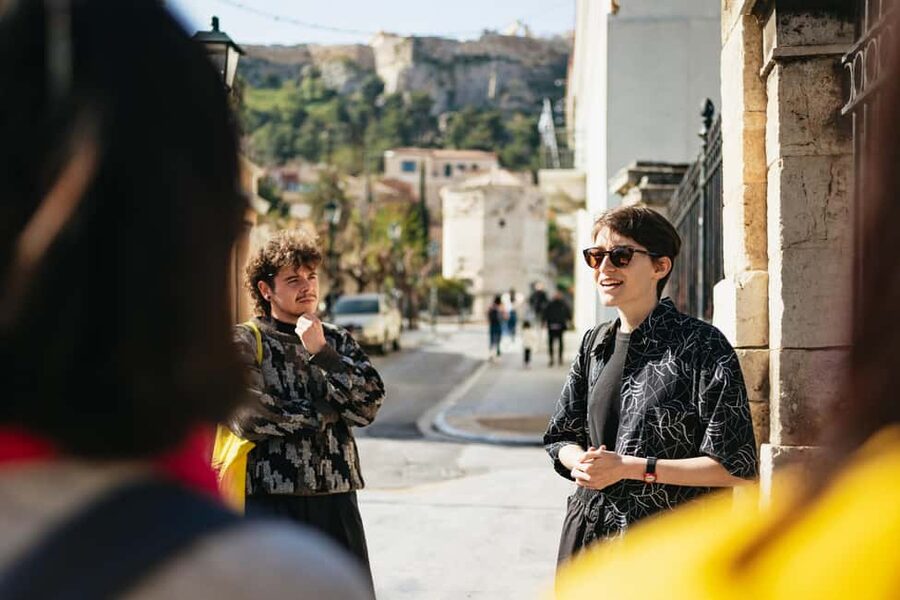
The Ancient Agora is the heart of the route. The guided stop lasts about ten minutes, and the tour views the site from outside rather than including archaeological admission.
The Agora was central to public life, trade, discussion, and political activity. It is also the place where the tour’s central contrast becomes sharpest. Athens is often praised as the birthplace of democracy, but the people included in that democracy were a limited group. Women were not part of the voting citizen body in the way adult male citizens were.
This does not mean women had no influence. They managed households, raised children, took part in religious practice, worked in various roles, and shaped family networks. But influence is not the same as formal political rights. The tour is strongest when it keeps that distinction clear.
You should also remember that an exterior viewing does not replace a proper visit inside the Agora. If you want the ruins, museum displays, and a longer look at the site, you will need a separate archaeological ticket and extra time. This walk gives you the interpretation and the surrounding route, not full admission.
Pnyx and the question of democracy
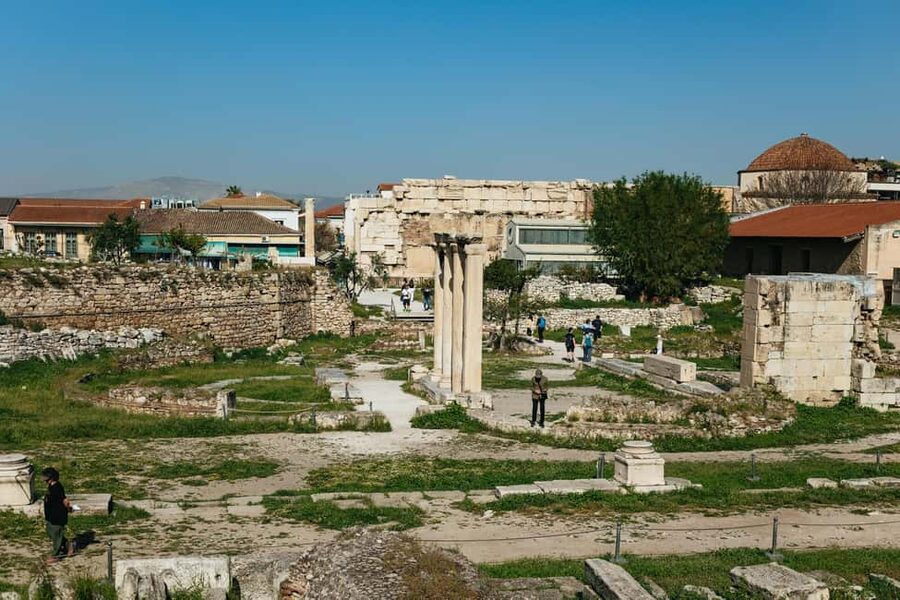
From the Agora, the route continues toward Pnyx, with about fifteen minutes devoted to the site. This is one of the most meaningful stops because Pnyx is associated with the first democratic votes.
The setting makes the lesson physical. You are not merely hearing that ancient Athenians gathered to debate and vote. You are standing near the place tied to that political experiment, while considering who could participate and who could not.
I like this part because it avoids easy praise. Democracy in Athens was innovative, but it was also narrow. Women, enslaved people, and others without citizen status were excluded from the political community. The tour encourages you to hold both facts together.
The discussion can also lead toward the women who challenged convention. Aspasia is especially important because she is linked with intellectual and political circles, even though much of what is written about her is filtered through male authors and later interpretation. Agnodice offers another striking example, as she is remembered as a woman who became a doctor despite the barriers around women’s medical practice.
The guide’s interactive style is well suited to Pnyx. You may be asked to think about who gets a voice in public life and how modern societies continue to define citizenship and belonging.
The Acropolis view and the climb to Filopappou Hill

The route includes a viewpoint on the way, followed by a final guided stop at Filopappou Hill. You get a scenic look toward the Acropolis, but this is not an Acropolis entry tour.
The view is a fitting ending. The Acropolis is the postcard image of Athens, yet the walk has spent its time asking which people were missing from the postcard version of the past. From the hill, the monuments become a backdrop for the stories rather than the whole subject.
Filopappou Hill also confirms that this is an active walk. There are steps and uphill sections, and the activity is not suitable for wheelchair users or people with mobility impairments. It is also listed as unsuitable for people with heart problems. Wear comfortable shoes and bring water, even though the tour lasts only two hours.
The route information lists a drop-off at the Kiosk on Rovertou Galli 69, while the meeting details say the activity ends back at the meeting point. Since these descriptions differ, confirm the exact ending point when you book. Either way, plan your next activity with a little flexibility.
What the $44.04 price really covers
At $44.04 per person, this is not a cheap way to tick off Athens monuments. It can be good value if you want a focused subject, a live guide, and a more thoughtful reading of places you may otherwise pass without context.
Your fee covers the walking tour, guide, and a small gift. It does not cover food, drinks, or tickets to archaeological sites. Since the stops are exterior views, the cost is mainly for the guide’s interpretation and the design of the route.
The private option changes the value calculation. A private group can make sense if you want to ask many questions, are traveling with friends, or prefer a slower discussion. A regular group may be the better deal if you simply want the central theme and a lively introduction to the city.
The booking terms are fairly flexible. You can cancel up to 24 hours before the tour for a full refund, and a reserve-now, pay-later option is available. English and French tours are offered.
Who will enjoy this walk most?
I would choose this tour if you have already seen the standard Athens highlights and want a new way to read them. It also suits anyone interested in women’s history, mythology, social customs, ancient medicine, poetry, or the limits of democracy.
It is a strong choice for friends traveling together because the format invites questions and discussion. It can also work well for older children or teenagers who are ready to think beyond dates and famous buildings, though the physical route and serious subject matter may not suit very young children.
You should skip it if you want extended time inside the archaeological sites, a conventional Acropolis tour, or a flat route with little walking. You should also look elsewhere if your priority is food, shopping, or transport between monuments.
Should you book the Women in Ancient Greece tour?
Book it if you want Athens to feel less like a parade of famous men and more like a society made up of many kinds of people. The route is short, the subject is unusual, and the best parts connect mythology, ordinary household life, exceptional women, and democratic ideals.
The main reasons to book are the rare focus on women’s lives and the chance to discuss sites such as the Agora and Pnyx with a guide who treats history as a conversation. Just remember that you are paying for interpretation, not admission, and that the route includes hills and steps.
For a first visit, pair it with a separate Acropolis or Agora visit. For a return visit, this may be exactly the fresh angle that makes familiar Athens feel worth seeing again.
FAQ
How long does the Women in Ancient Greece tour last?
The walking tour lasts two hours.
Where does the tour begin?
Meet your guide in Monastiraki Square, in front of the Holy Church of the Virgin Mary Pantanassa. The guide will hold a Women in Ancient Greece sign.
Where does the tour end?
The activity information says it ends back at the meeting point. The route also lists a drop-off at the Kiosk on Rovertou Galli 69, so confirm the exact ending point when booking.
Which languages are available?
The tour is offered in English and French.
Is this a private tour?
A private group option is available. The standard group arrangement is not specified.
Are archaeological-site tickets included?
No. Tickets are not included, and the tour provides exterior views of the archaeological sites.
Does the tour include food or drinks?
No. Food and drinks are not included.
Is the route suitable for wheelchair users?
No. The activity is not suitable for wheelchair users or people with mobility impairments.
Are there many steps?
Yes. The tour includes steps and is not suitable for people with health or mobility difficulties.
What should I bring?
Bring water, sunscreen, and a sun hat. Comfortable shoes are also a sensible choice because the route includes walking and hills.
New routes in Athens
- The Acropolis, Athens Walking City Tour and Acropolis Museum★ 5.0 · 442 reviews
- Athens Street Food Walk★ 5.0 · 385 reviews
- Acropolis monuments, Parthenon and Plaka, Monastiraki walking tour★ 5.0 · 182 reviews
- Athens Shore Excursion: Acropolis Walking Tour★ 4.5 · 131 reviews
- Athens Street Art Walk★ 5.0 · 309 reviews
- Athens at Night Small-Group Walking Tour with Dinner★ 5.0 · 230 reviews
- Athens Off the Beaten Track Private City Walking Tour★ 5.0 · 304 reviews
- Athens Highlights: Myths & Philosophers Walking Tour★ 5.0 · 125 reviews
Athens Walking Tours, compared.



Acropolis monuments & Parthenon Walking Tour with Optional Acropolis Museum
Read our review →
Acropolis, Parthenon & Athens Old City Heritage Walking Tour
Read our review →
The Acropolis Walking Group Tour with a French Guide
Read our review →
Athens Food Tour with 10+ Tastings of Greek Traditional Dishes
Read our review →Browse the lists this tour appears in