
Review · ATHENS
Athens: The Acropolis Guided Walking Tour in Dutch
The best part of this Acropolis walk comes before you reach the Parthenon. You begin at the Theatre of Dionysus, where ancient drama took shape, then climb the sunny southern slope past an early hospital and the Odeon of Herodes Atticus. I like that the route gives Athens a story before it gives you its most famous monument.
I especially like the Dutch-language guiding and the short, focused format. Guides such as Jessica add pictures and clear explanations that help you understand why the temples look the way they do. The main drawback is the price: at $95 per person for 90 minutes, this makes the most sense if you value a guide and want to avoid figuring out the Acropolis alone.
Key points
- Start with ancient theater: Visit the Theatre of Dionysus before climbing to the hilltop temples.
- Dutch-speaking guidance: A licensed guide explains the myths, design, and practical meaning of the ruins in Dutch.
- See more than the Parthenon: The route includes the Asklepieion, Odeon, Propylaea, Erechtheion, and Temple of Athena Nike.
- Skip the ticket line: Entry to the Acropolis and ticket pre-booking fees are included.
- Expect uphill walking: The route uses uneven ground and can be slippery, with no elevator available.
- Finish with Athens below you: Free time at the Parthenon lets you take photographs and enjoy the 360-degree view.
Starting beside the Acropolis metro station
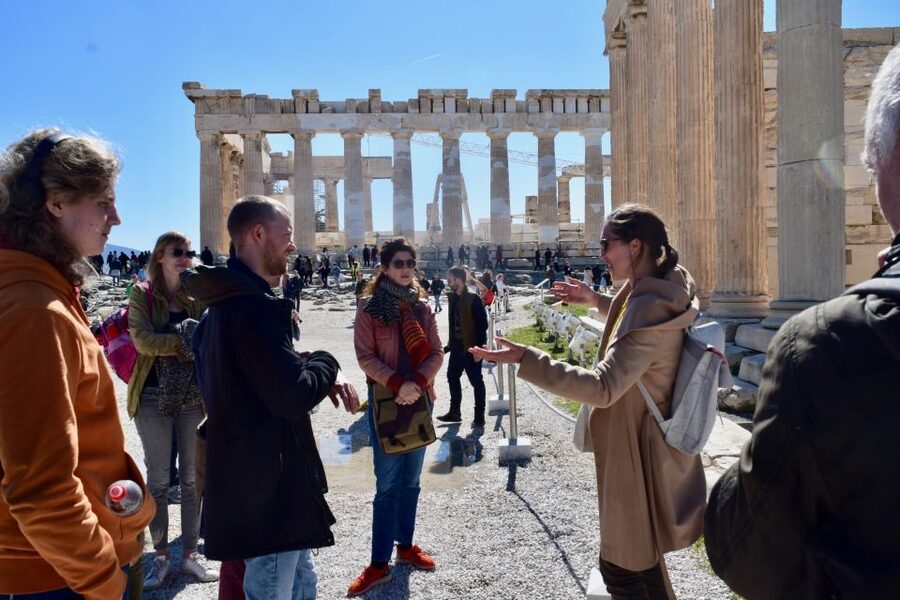
Your meeting point is outside Acropoli Metro station, using the Makriyianni and Dionysiou Areopagitou exit. This is a useful place to meet because it sits close to the Acropolis south entrance and is easy to reach by public transport.
Do not head straight toward the main hill entrance without checking the exit name. Athens has several paths and entrances around the Acropolis, and the correct meeting point matters when your tour has a fixed start time.
From the metro station, you walk for about two minutes to the Acropolis area. The tour begins at the side entrance rather than taking you immediately to the hilltop. That choice gives the visit a natural sequence: theater first, temples later.
The tour lasts 1.5 hours. That is enough time for a clear introduction and the major sights, but it is not a slow archaeological study. You will need to stay with the group and keep moving uphill. After the guided portion, you have free time to explore the site on your own.
More Guided Walks in Athens:
- Athens: Acropolis and Parthenon Guided Walking Tour
★ 4.6 · 5,882 reviews - Acropolis and Parthenon Guided Walking Tour
★ 5.0 · 4,755 reviews - Acropolis: Acropolis and Parthenon Guided Walking Tour
★ 4.7 · 3,442 reviews
The Theatre of Dionysus sets the scene
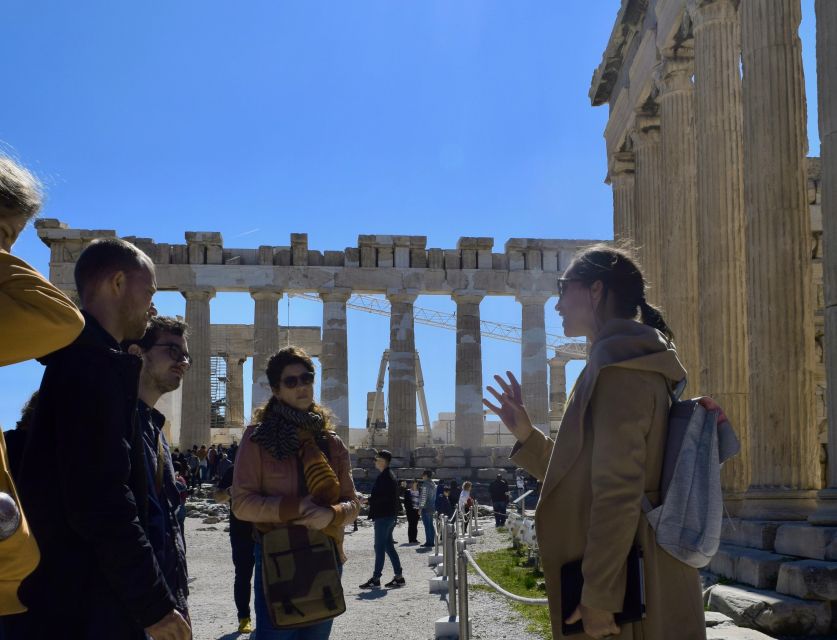
The first main stop is the Theatre of Dionysus, one of the most important places in the history of Greek drama. You can take in the ancient stone seating and understand the scale of a performance space built into the southern slope of the Acropolis.
This is a strong opening because the theater feels different from the temples above. Instead of looking at broken columns and trying to imagine their purpose, you are standing in a place designed for public performance. The shape of the seats and the open setting help you picture how an audience once gathered here.
Your guide explains the theater’s connection to ancient Greek drama and the legends attached to the Acropolis. If you enjoy stories more than dates, this part may be the most memorable section of the walk.
The seating and ground are ancient, uneven, and not designed for modern comfort. You may be able to pause on one of the stone seats, but do not expect a smooth or easy approach. Comfortable shoes are important from the first stop.
Walking past the Asklepieion and Odeon
From the theater, the route continues along the southern side of the Acropolis. This side is exposed and sunny, so the heat can build quickly, especially in summer. Bring water, sunglasses, and a sun hat, and use sunscreen before you arrive.
Along the way, you pass the Asklepieion, an ancient healing center often described as one of the first hospitals in Athens. The remains are less famous than the Parthenon, but they add an important human touch to the visit. The Acropolis was not only a place of temples and political symbols. It was also connected to care, ritual, and daily life.
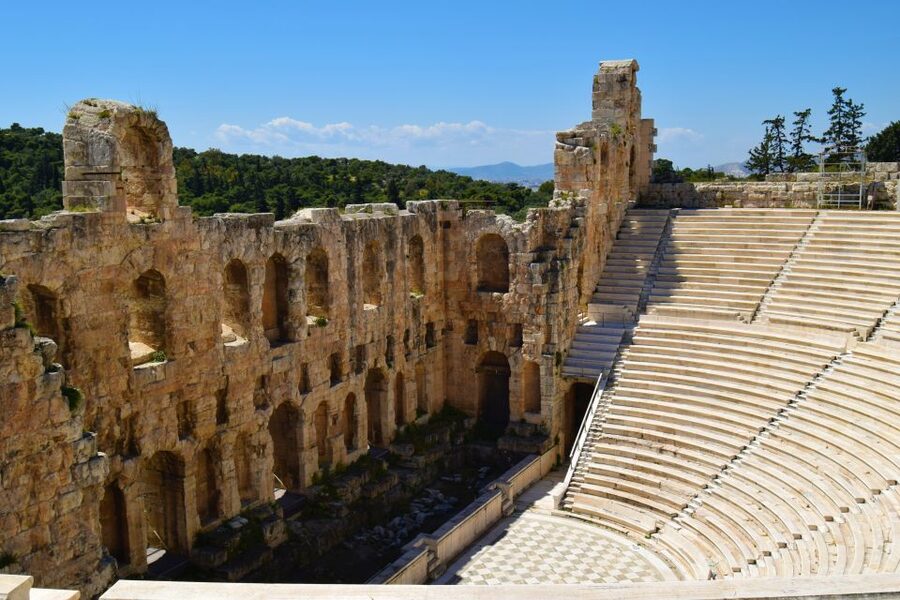
The next major view is the Odeon of Herodes Atticus. This ancient theater is still one of the most striking structures on the southern slope. You see it from the route rather than attending a performance, but its curved form and preserved walls make it easy to understand why it remains such a powerful part of the hill.
I like this middle section because it broadens the visit. You are not simply checking off four famous buildings at the top. You are seeing how theaters, healing spaces, sacred buildings, and public monuments worked together around the Acropolis.
Passing through the Propylaea
The climb brings you to the Propylaea, the monumental gateway to the Acropolis. It is the formal threshold between the approach and the hilltop sanctuary.
The Propylaea can be easy to overlook if you are focused on getting to the Parthenon. Your guide helps you stop and look at the structure as an architectural problem. The uneven terrain, large blocks, changing levels, and carefully planned approach show that reaching the temples was part of the experience.
This is also where the uphill effort becomes most noticeable. You are walking on old stone surfaces, and some sections may be slippery. The tour is not suited to people with mobility impairments, and there is no elevator. If you have knee, balance, or walking problems, consider that limitation seriously before booking.
The entrance area may also feel crowded at times, since it is the main passage toward the hilltop. The short format helps you keep your bearings, but you will not have unlimited time to pause at every stone.
More Walking Tours in Athens:
- Greek Food Walking Tour in Athens
★ 5.0 · 4,740 reviews - Athens: Guided Greek Food Walking Tour with Tastings
★ 4.9 · 2,859 reviews - Acropolis monuments & Parthenon Walking Tour with Optional Acropolis Museum
★ 5.0 · 2,678 reviews - Athens Acropolis and Parthenon Walking Tour
★ 4.5 · 1,355 reviews
The Temple of Athena Nike and the first hilltop views
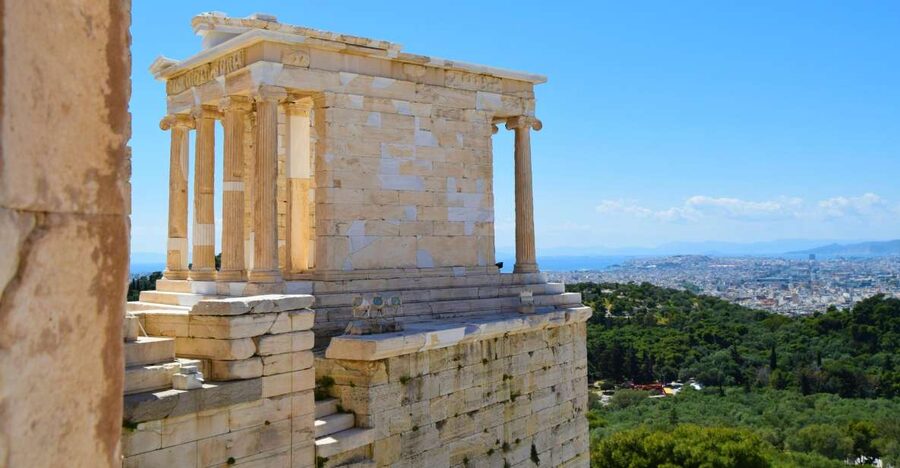
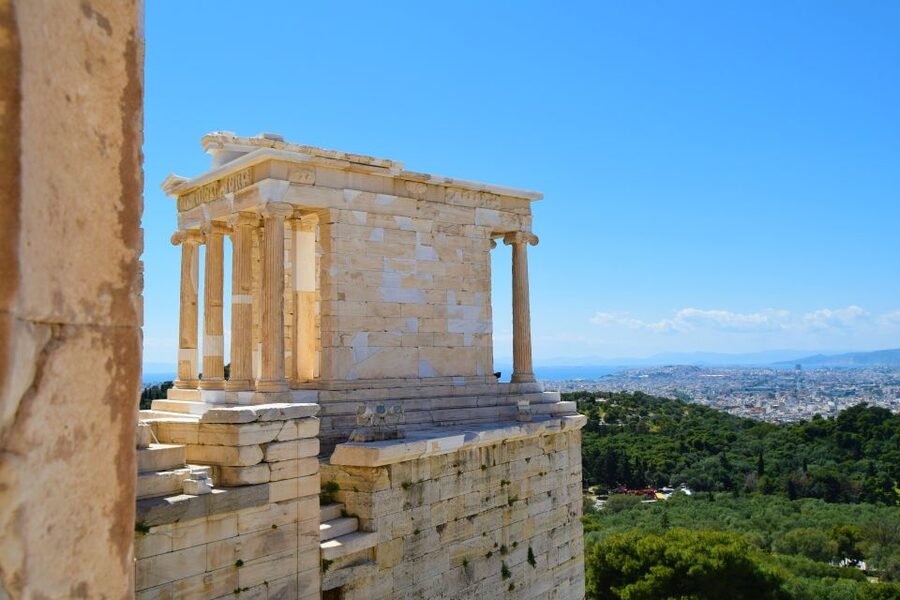
Near the entrance, you see the Temple of Athena Nike. This small temple has a compact form, but its position gives it a major role. It sits at the edge of the Acropolis, where the view opens across Athens.
The guide points out the myths and ideas tied to the temple. This is where the tour’s focus on architecture becomes useful. Rather than hearing only that the building is old, you learn how its placement and design supported its religious purpose.
The Temple of Athena Nike is also a good reminder that the Acropolis is not one building. It is a collection of sacred structures with different sizes, roles, and visual effects. The Parthenon gets most of the attention, but the smaller temple helps you see the whole hill as a planned complex.
The Erechtheion and its unusual design
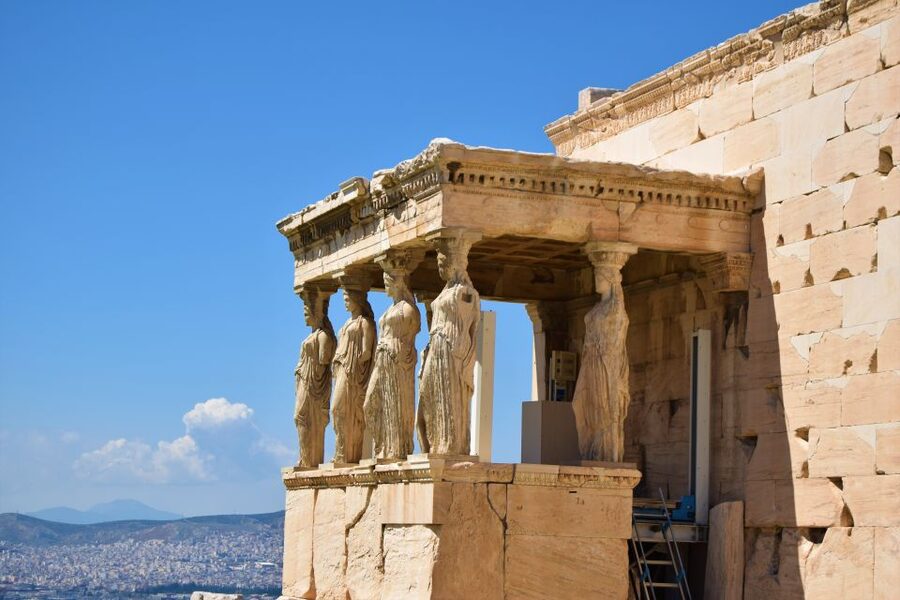
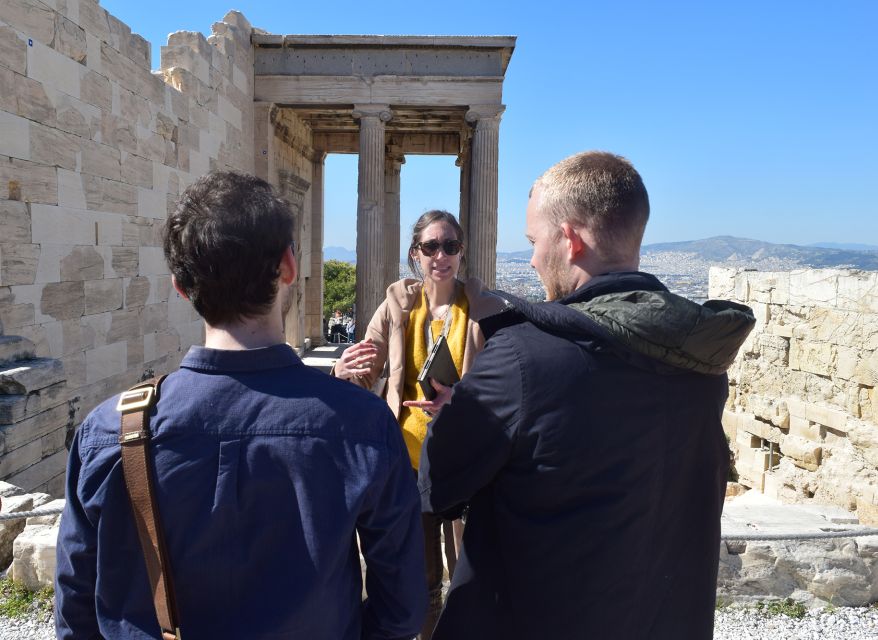
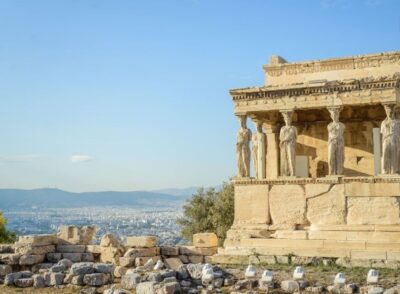
The Erechtheion is one of the most distinctive buildings on the Acropolis. Its layout is less symmetrical than the Parthenon, and its famous porch with female figures gives it a look unlike any other structure on the route.
Your guide explains the design tricks used by the ancient builders. This part is especially helpful because many details are hard to understand from a photograph. Slight curves, visual adjustments, and the way the building sits on uneven ground all make more sense when someone points them out in front of you.
The temple is also tied to myths involving Athena and other ancient gods. Stories give the ruins a human scale. You begin to understand why particular places mattered, not just how many columns remain.
The Erechtheion is a good stop for anyone who likes architecture. It also rewards careful looking. The Parthenon is grand and direct, while the Erechtheion asks you to notice smaller details and unusual choices.
The Parthenon, Athens’ great symbol
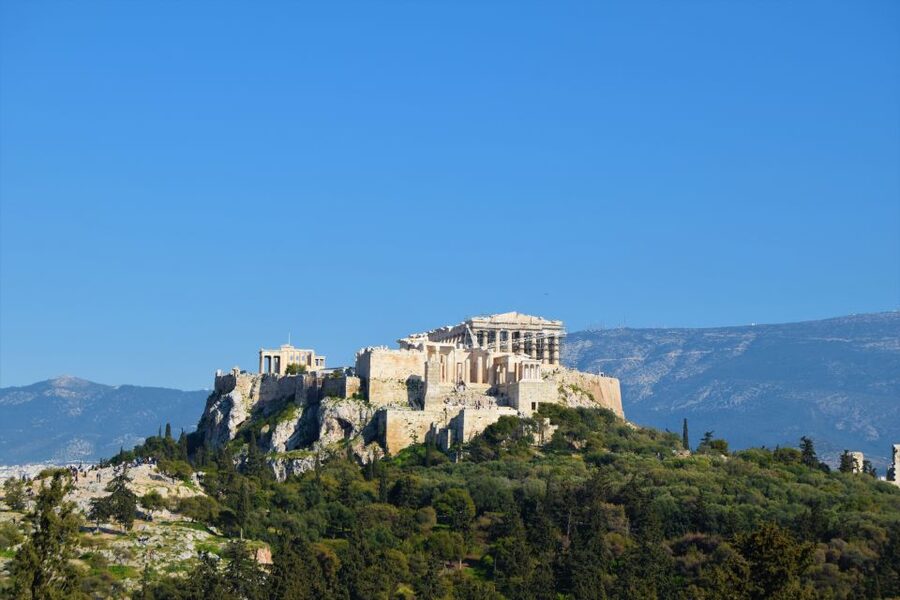
The Parthenon is the final major focus of the guided route. Even with scaffolding, missing sculptures, and centuries of damage, its size and proportions make an immediate impression.
The guide discusses the building methods, architectural corrections, and myths connected to the monument. This information helps you look beyond the familiar outline. You learn to notice the relationship between the columns, the platform, and the visual balance of the building.
Do not expect to walk inside the Parthenon. The visit takes place around the exterior, where you can study the structure from several angles. You will have time for photographs and free exploration after the guided portion.
This is one reason the tour’s order works well. By the time you reach the Parthenon, you have already seen the theater, healing center, odeon, gateway, and smaller temples. The famous building feels like the high point of a connected visit rather than the only thing worth seeing.
What the 360-degree view adds
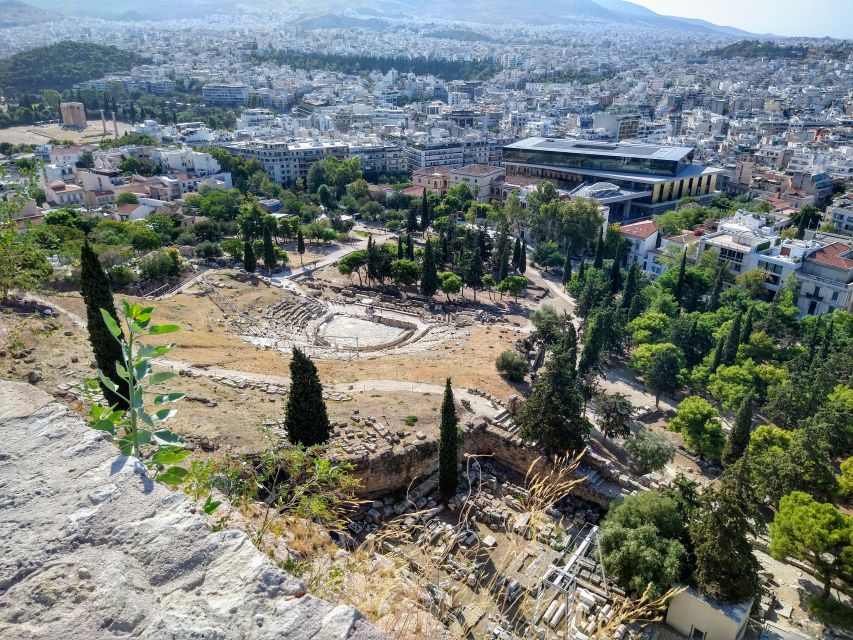
The tour ends at the top of the Acropolis, where you can take in a 360-degree view of Athens. This is not just a photo stop. It helps explain why the hill mattered so much.
From above, the city spreads around the rocky summit, and the height makes the Acropolis’ position clear. Your guide can connect the temples to the city below, while your free time gives you a chance to look at your own pace.
Bring your sunglasses and hat for this final section. The top is exposed, and shade may be limited. The route is also more enjoyable if you carry only what you need, since large bags, luggage, food, and drinks are not allowed inside the site. Water is essential before you enter, even though food and drinks are not permitted on the Acropolis itself.
Why the Dutch guide matters
A Dutch-language tour is useful if you prefer to hear history in your strongest language. Ancient names, myths, and architectural terms can be hard to follow in a second language, especially while walking over uneven ground in the heat.
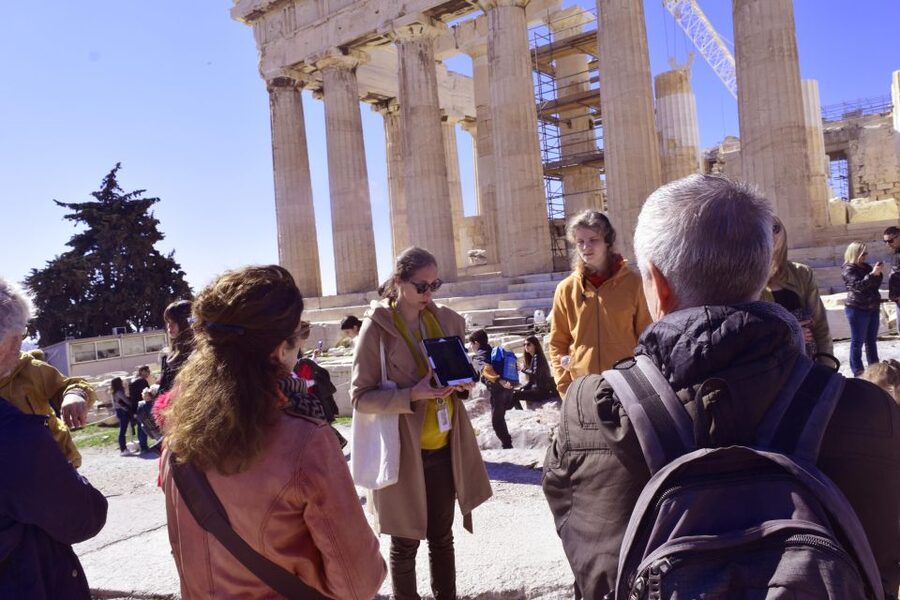
Jessica is named as one of the guides associated with this experience. Her approach includes visual material that helps you picture the Acropolis as it may have appeared in earlier periods. She also gives practical suggestions for other things to do in Athens after the tour.
The strongest praise focuses on her storytelling, enthusiasm, and ability to connect the ancient site with the present. That matters here because the Acropolis can otherwise become a parade of names: Parthenon, Erechtheion, Propylaea, Nike. A good guide turns those names into places with separate purposes and personalities.
The tour can also feel personal when the group is small. Some departures may have only a few people, though the exact group size is not guaranteed. Families have found the 90-minute length workable for children as young as six, but the uphill route and strong sun still require preparation.
Is $95 a fair price?
At $95 per person, this is not the cheapest way to enter the Acropolis. You are paying for the admission ticket, ticket pre-booking, a licensed guide, and the convenience of skipping the ticket line.
The price makes more sense for you if you want clear explanations in Dutch, prefer a planned route, or have limited time in Athens. In 90 minutes, you cover the major highlights without spending energy studying a map or deciding which remains to visit first.
For a family, the total cost can rise quickly. One family specifically found the tour expensive, even while enjoying it. If you are traveling with several people and are comfortable reading on your own, an entry ticket without a guide may cost less.
The best value comes when you actively use the guide. Listen for the architectural details, ask about the myths, and pay attention to the connection between the southern slope and the hilltop. If you only want a quick photograph of the Parthenon, the guided price may feel high.
Timing, heat, and what to bring
The southern route is sunny, and heat was a concern during at least one summer visit. Early morning or later-day availability may be more comfortable, but you need to check the available starting times when booking.
Wear shoes with a firm sole. The ground is uneven, and it can be slippery on occasion. Sandals with poor grip are a bad choice for this walk.
Bring:
- Passport or ID card
- Water for before and after the site visit
- Sunglasses
- Sun hat
- Comfortable walking shoes
Baby strollers, pets other than assistance dogs, luggage, large bags, food, and drinks are not allowed. The tour does not include hotel pickup, drop-off, food, or drinks, so plan your route to and from the Acropolis yourself.
You can cancel up to 24 hours in advance for a full refund, and the reserve-now, pay-later option keeps your plans flexible. Those terms are useful if your Athens schedule is still changing.
Who should book this Acropolis walk?
I would choose this tour if you want a short but meaningful introduction to the Acropolis, especially in Dutch. It suits first-time visitors, families with older children, and anyone who prefers stories and explanation over wandering independently.
It is also a good fit if you want to see more than the Parthenon. The Theatre of Dionysus, Asklepieion, Odeon, Propylaea, Temple of Athena Nike, and Erechtheion give the visit variety.
I would hesitate if you have limited mobility, dislike uphill walking, or want a slow visit with long pauses. I would also compare the total cost carefully if you are booking for a large family.
For most Dutch-speaking visitors who value a licensed guide, skip-the-line entry, and a clear 90-minute route, I think the experience is worth considering. Book it for the interpretation and structure, not simply for admission. The Acropolis is impressive on its own, but the right guide helps you understand why each stop matters.
FAQ
Where does the Acropolis tour meet?
Meet outside Acropoli Metro station at the Makriyianni and Dionysiou Areopagitou exit. The Acropolis entrance is about a two-minute walk from the meeting point.
How long does the tour last?
The guided walking tour lasts 1.5 hours. You also receive free time to explore the site after the guided portion.
What language is the tour conducted in?
The tour is conducted in Dutch by a live licensed guide.
Is the Acropolis entry ticket included?
Yes. The price includes the Acropolis entry ticket and the administration fee for pre-booking the ticket.
Is the route suitable for people with limited mobility?
No. The tour is not recommended for people with mobility impairments. You walk uphill over uneven surfaces, some areas may be slippery, and there is no elevator.
What should I bring to the tour?
Bring your passport or ID card, comfortable shoes, sunglasses, a sun hat, and water. Food, drinks, luggage, large bags, baby strollers, and pets are not allowed inside the site, although assistance dogs are permitted.
New routes in Athens
- The Acropolis, Athens Walking City Tour and Acropolis Museum★ 5.0 · 442 reviews
- Athens Street Food Walk★ 5.0 · 385 reviews
- Acropolis monuments, Parthenon and Plaka, Monastiraki walking tour★ 5.0 · 182 reviews
- Athens Shore Excursion: Acropolis Walking Tour★ 4.5 · 131 reviews
- Athens Street Art Walk★ 5.0 · 309 reviews
- Athens at Night Small-Group Walking Tour with Dinner★ 5.0 · 230 reviews
- Athens Off the Beaten Track Private City Walking Tour★ 5.0 · 304 reviews
- Athens Highlights: Myths & Philosophers Walking Tour★ 5.0 · 125 reviews
Athens Walking Tours, compared.


Acropolis monuments & Parthenon Walking Tour with Optional Acropolis Museum
Read our review →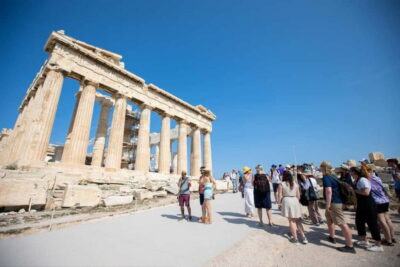
Acropolis, Parthenon & Athens Old City Heritage Walking Tour
Read our review →
The Acropolis Walking Group Tour with a French Guide
Read our review →
Athens Food Tour with 10+ Tastings of Greek Traditional Dishes
Read our review →Browse the lists this tour appears in