
Review · ATHENS
Athens: The Acropolis Guided Walking Tour in German
The best part of this German-language Acropolis tour is its route. You approach from the southern side, beginning at the Theater of Dionysus before climbing toward the monuments most people come to Athens to see. I like that the tour gives the Parthenon a wider setting, rather than treating it as an isolated photo stop. I also like the advance ticket arrangement, which saves you from handling one more detail at a busy archaeological site.
Guides such as Jessica bring an easy, engaging tone, with time for questions and visual aids to explain how the ancient buildings were designed. The main consideration is the short 1.5-hour duration: you will get a well-organized introduction, but not a slow, detailed study of every ruin. The uphill walk, uneven ground, and lack of an elevator also make this a poor choice if you have limited mobility.
Key points to know before booking
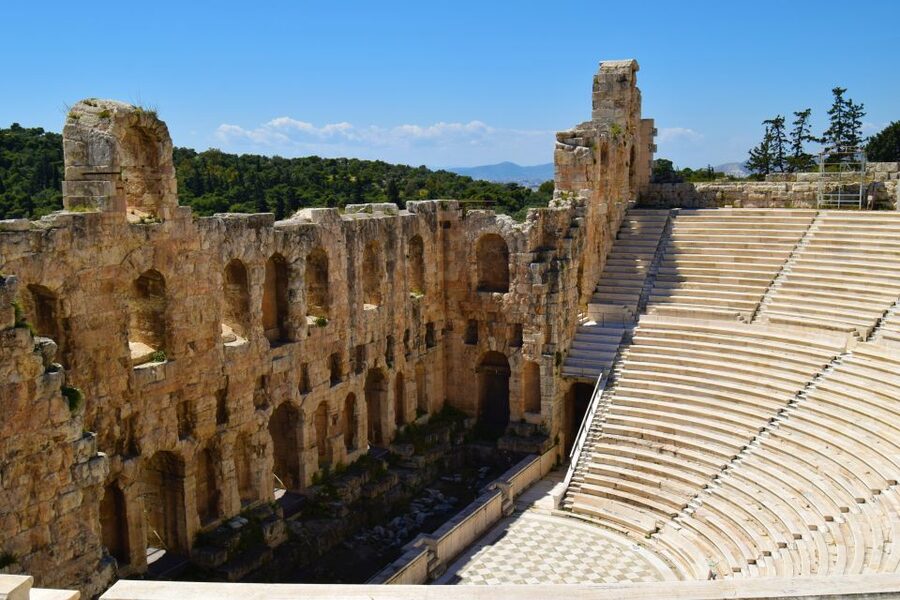
- The southern route tells the story in stages: Start with Greek theater, pass the Asklepieion and Odeon, then enter the hill through the Propylaea.
- German is the working language: This is useful if you want history, myths, and architectural explanations in your first language.
- The ticket is handled for you: Entry to the Acropolis and ticket pre-booking fees are included, with skip-the-ticket-line access.
- The tour ends near the Parthenon: You receive free time afterward, and the ticket is valid for the rest of the day.
- Expect a real uphill walk: Wear solid shoes and prepare for uneven, sometimes slippery surfaces.
- The view is part of the reward: From the summit, you get a 360-degree panorama of Athens.
Why this German Acropolis walk works well
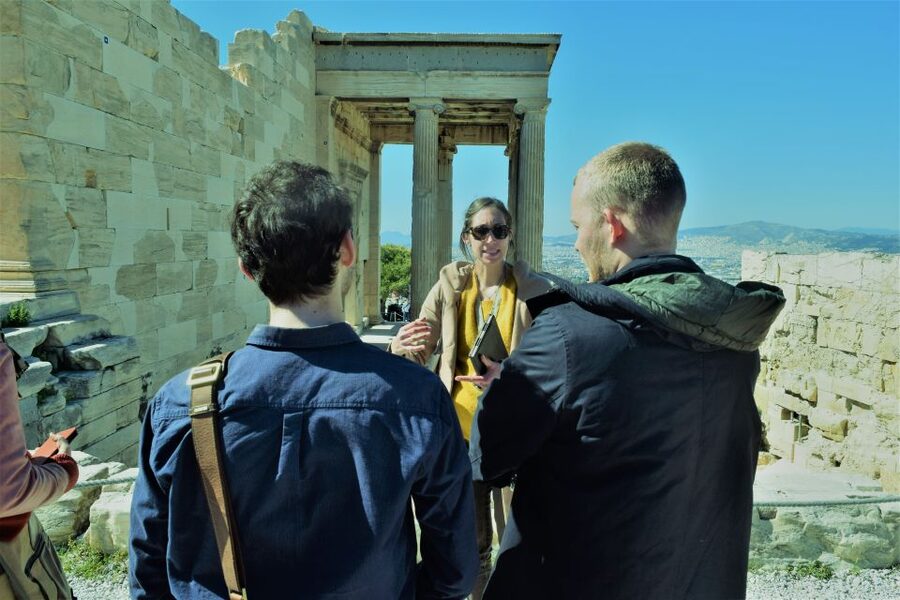
The Acropolis is easy to admire and surprisingly easy to misunderstand. A guide helps connect the stones, myths, theaters, temples, and political ideas into one clear visit. That matters here because the hill is not simply one building. It is a collection of monuments from different periods, with much of the original structure now missing.
This tour costs $95 per person. That is a serious price for 90 minutes, but it includes the Acropolis admission, a licensed guide, advance ticket administration, and free time to continue on your own. You are paying partly for interpretation and partly for convenience. If you would otherwise spend time finding the correct entrance, arranging a ticket, and trying to make sense of the monuments from a guidebook, the price may feel fair.
The German language is the main reason to choose this particular departure. A good explanation in a language you understand well can turn architectural details into something you remember. The tour also appears suited to people who prefer a small, social group. One recent group had nine people, though group size can vary.
The meeting point depends on the option you book. Check that detail carefully before setting out. The activity begins near the Acropolis, with a short walk of about two minutes before the guided visit starts.
More Guided Walks in Athens:
- Athens: Acropolis and Parthenon Guided Walking Tour
★ 4.6 · 5,882 reviews - Acropolis and Parthenon Guided Walking Tour
★ 5.0 · 4,755 reviews - Acropolis: Acropolis and Parthenon Guided Walking Tour
★ 4.7 · 3,442 reviews
Beginning at the Theater of Dionysus
The southern entrance gives the tour a strong opening. Instead of heading straight for the summit, you first reach the Theater of Dionysus, where ancient Greek drama developed as a public art form.
You can sit briefly on one of the ancient stone seats and look across the theater space. That physical setting helps you understand the scale of performances in a way a small museum label cannot. The theater is not just another pile of old stones. It shows how religion, civic life, music, performance, and public gatherings once shared the same place.
Your guide explains what happened here and points out features that are easy to miss when you are walking uphill alone. The stop also gives you a gentler start before the steeper parts of the climb.
The theater is exposed to the sun, so bring water, sunglasses, and a hat. The southern approach is described as sunny, and there is limited reason to expect much shade along the route. Comfortable shoes are not optional. Ancient paving and worn stone can be uneven underfoot.
Passing the Asklepieion and the Odeon
From the theater, the path continues along the southern side of the Acropolis. This section adds two important stops before the grand entrance.
First comes the Asklepieion, one of the first hospitals in ancient Greece. Its presence gives you a different view of the Acropolis complex. The hill was not only a place for temples and ceremonies. It also connected with healing practices and religious care.
The guide can explain the site’s role while you look at the remaining foundations. You should not expect an intact hospital building. What makes the stop worthwhile is the glimpse into ordinary needs behind the famous monuments: illness, treatment, prayer, and hopes for recovery.
Next, you see the Odeon of Herodes Atticus, often called the Odeon of Herodes. This ancient performance space remains one of the most striking structures on the southern slope. The tour includes a guided look at it rather than simply rushing past on the way up.
The contrast between the theater and the Odeon is useful. One introduces the early world of Greek theater, while the other shows a later Roman-era performance building. In a short time, you see how the Acropolis area continued to be used and reshaped over many centuries.
Entering through the Propylaea
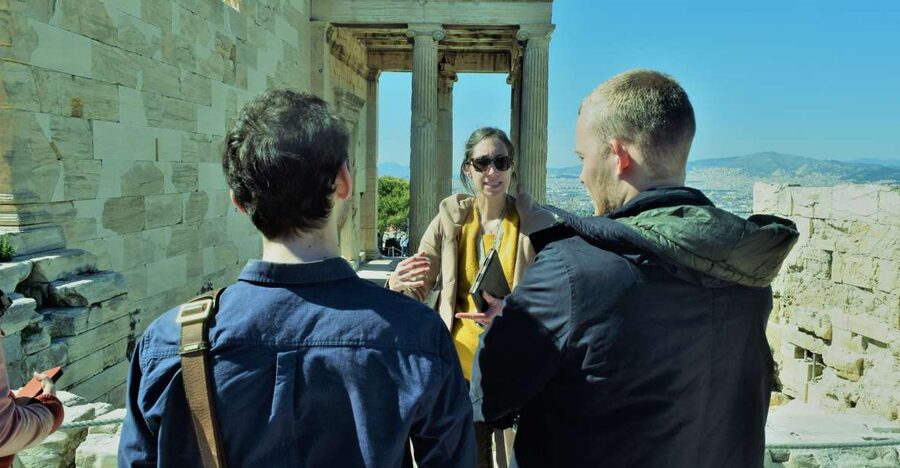
The Propylaea is the monumental gateway to the upper Acropolis. Reaching it after the southern slope makes the entrance feel like a transition, not just another stop on a list.
Your guide points out how the builders used proportion, symmetry, and careful planning to make the approach feel grand. The ancient architects were dealing with a rocky hill, steep ground, and demanding construction conditions. The entrance had to function as a passage while also setting the tone for the sacred area beyond it.
This is where the guide’s use of images and visual explanations becomes useful. The ruins can be difficult to read on their own. Columns, broken walls, and scattered blocks make more sense when someone shows you how the original design fitted together.
The Propylaea can also be a practical bottleneck. You are moving through a major entrance with other people nearby, so listen closely and stay with the group. There is no promise of a long stop at every angle. The guide needs to keep the visit moving toward the upper monuments.
More Walking Tours in Athens:
- Greek Food Walking Tour in Athens
★ 5.0 · 4,740 reviews - Athens: Guided Greek Food Walking Tour with Tastings
★ 4.9 · 2,859 reviews - Acropolis monuments & Parthenon Walking Tour with Optional Acropolis Museum
★ 5.0 · 2,678 reviews - Athens Acropolis and Parthenon Walking Tour
★ 4.5 · 1,355 reviews
The Temple of Athena Nike
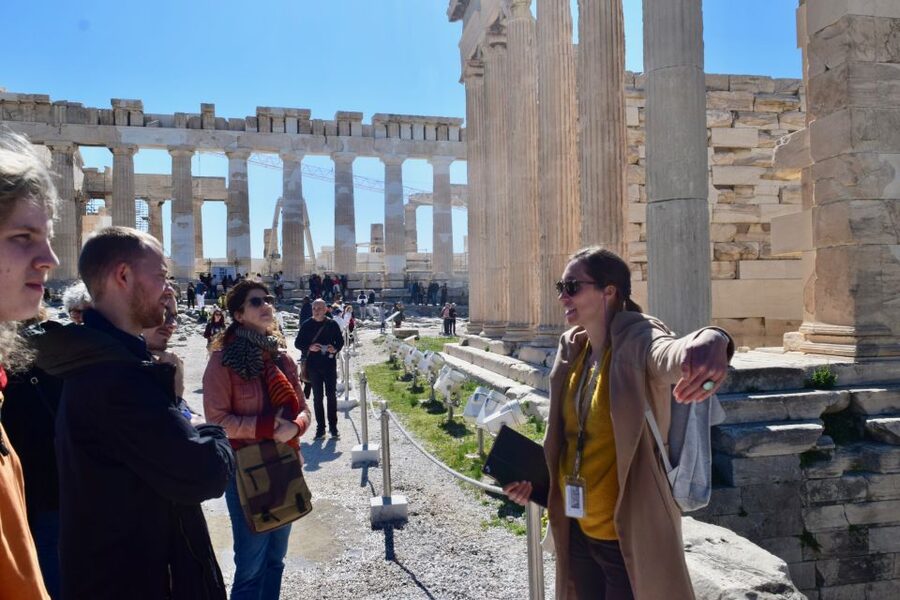
Near the entrance, you see the Temple of Athena Nike. It is a small temple compared with the Parthenon, but its position gives it unusual impact.
The temple was dedicated to Athena in her role as Nike, or victory. Your guide explains the myths and ideas linked to the monument, along with the architectural choices that helped it fit its tight position beside the approach.
This is one of the places where a German explanation can add real value. The building is easy to photograph, but its size and location raise questions. Why was it placed there? Why does it seem so compact? What did its position mean to people approaching the Acropolis?
You will not spend the whole tour at this one temple, and that is sensible. Its importance comes from its relationship to the entrance and the wider sacred hill.
The Erechtheion and its unusual design
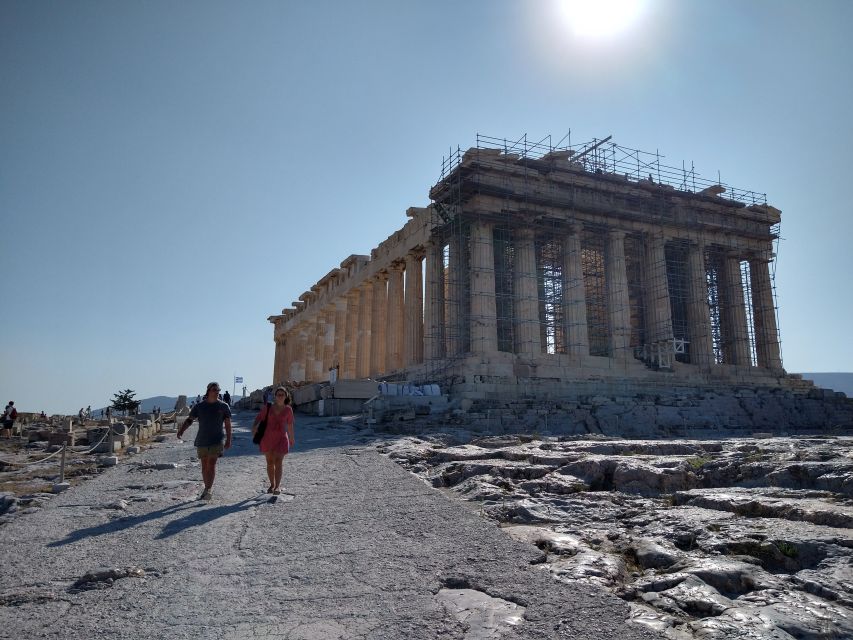
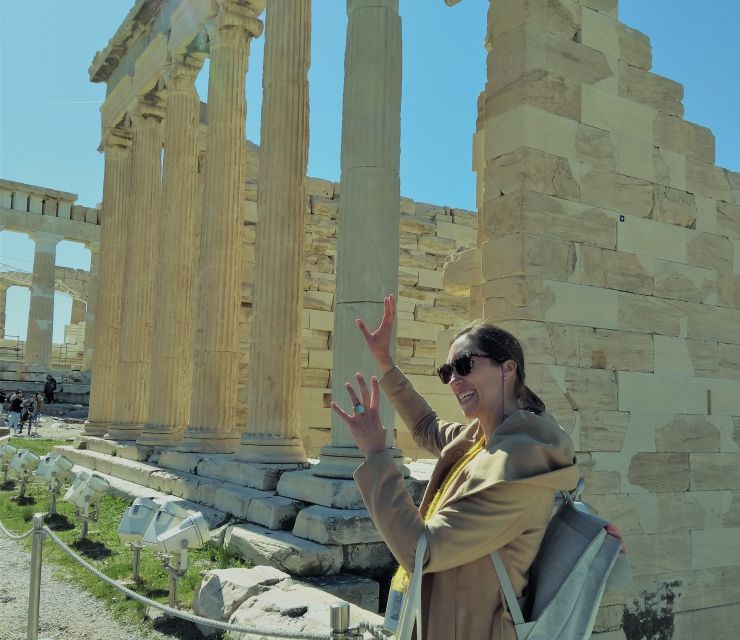
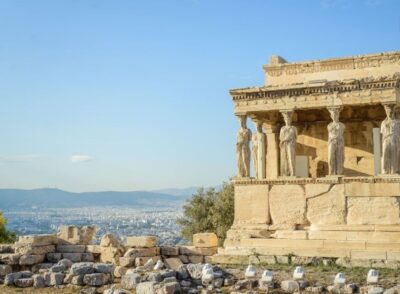
The Erechtheion is one of the most fascinating buildings on the summit because it does not have the simple, regular shape many people expect from a Greek temple.
Its complex form reflects the different sacred traditions associated with the site. The guide discusses the myths connected with the building and explains the architectural tricks used by its designers. This is an especially good moment to pay attention to details that a quick solo visit might miss.
The famous female-shaped supports, known as Caryatids, are among the most recognizable features. The information provided for this tour emphasizes architectural explanation and myth, so you can expect the guide to put those details into a wider story rather than treating the figures as decoration alone.
The original sculptures are not all exposed in the same way, and the site contains many delicate remains. Look closely, but follow any instructions about where you may stand. You may find the Erechtheion more visually complicated than the Parthenon, which is part of its appeal.
The Parthenon, explained rather than rushed
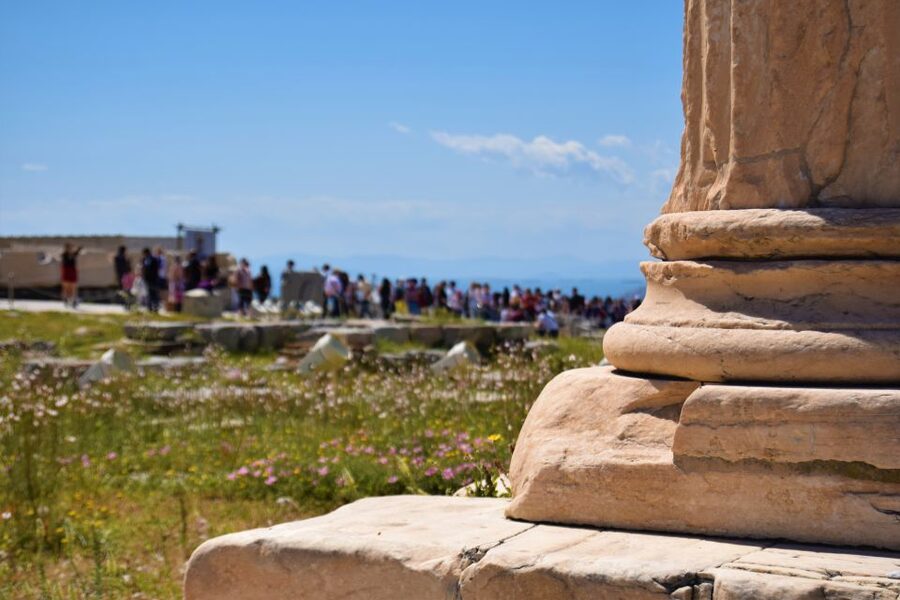
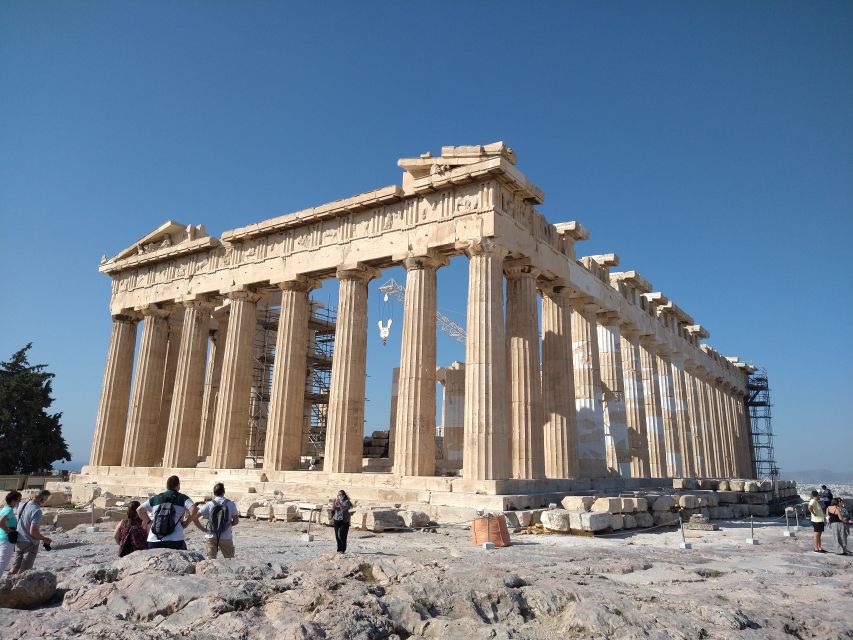
The Parthenon is the main event for most people, but a good visit needs more than a quick photograph. The tour explains the building’s design, construction methods, and the myths surrounding the Acropolis.
The guide points out the optical refinements used by the architects. Ancient builders adjusted lines and proportions so the temple would appear balanced when viewed from the ground. These details are hard to understand from a distance, especially when the building is partially ruined, so a clear explanation makes the monument much more impressive.
You also learn how the Parthenon relates to the other temples around it. From the summit, the building is not just a famous facade. It is part of a carefully planned sacred precinct, approached through the Propylaea and viewed alongside the Erechtheion and Temple of Athena Nike.
The tour does not end with you being pushed straight off the hill. After the guided portion, you have free time to explore the archaeological site and take additional photographs. The ticket remains valid for the day, according to the tour information, so you can return to favorite spots after the guide finishes.
That is a useful arrangement. The guided portion gives you context while the monuments are fresh in your mind. The later free time lets you slow down, revisit the Parthenon, or take photographs without needing to keep up with the group.
The 360-degree view from the summit
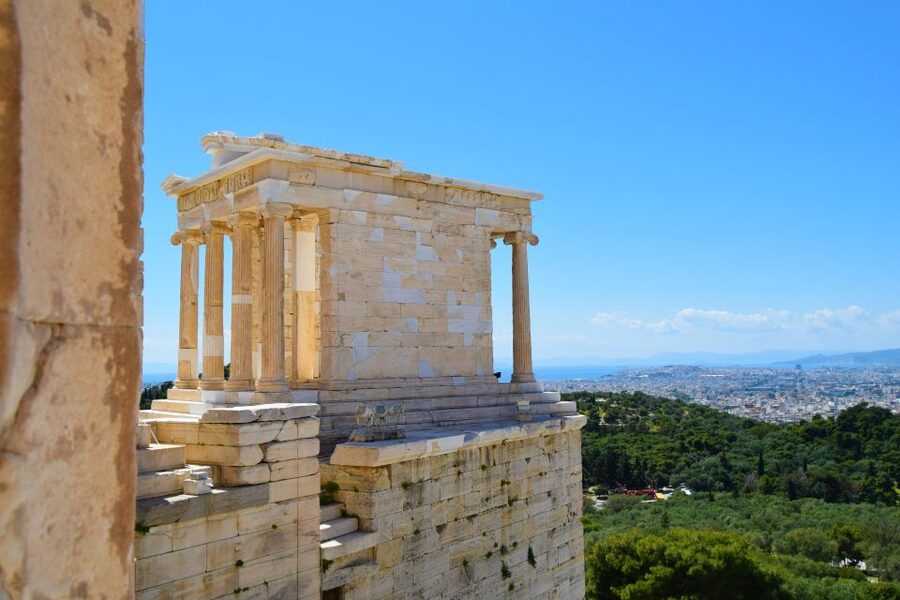
The final panoramic view is one of the strongest reasons to visit the Acropolis in person. From the top, Athens spreads in every direction, and the city’s relationship with the hill becomes clear.
This is not only a photo opportunity. The view helps you understand why the Acropolis has been such an important point in the city for so long. You see how high the hill rises above the surrounding urban area and how the ancient monuments still shape the way Athens is perceived.
Bring sunglasses and water, especially in warm weather. The summit is exposed, and the walk has already taken you uphill over uneven ground. Give yourself time to pause, look outward, and recover before continuing with your own exploration.
What the guide adds in German
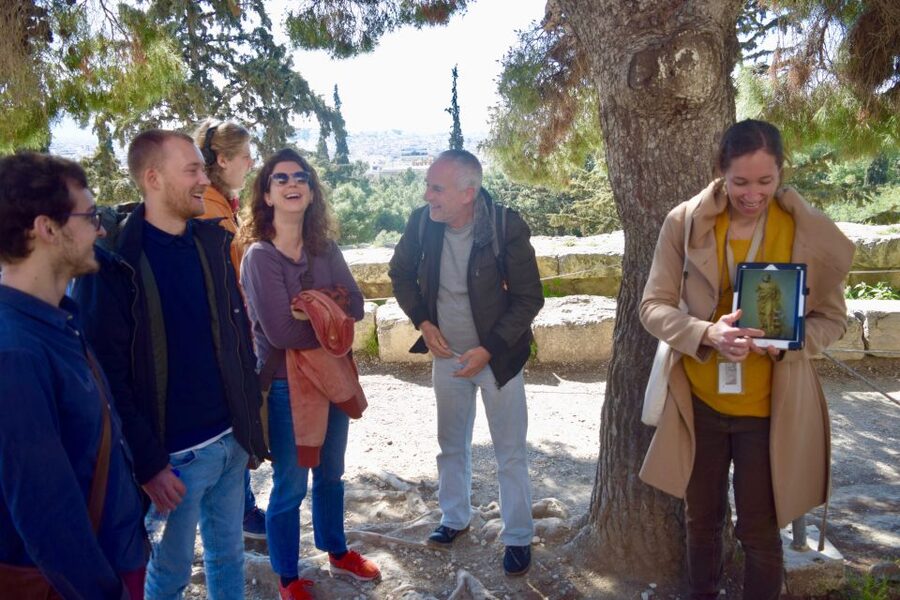
The guide is the heart of this activity. Recent departures have included Jessica, who uses humor, questions, and visual material to make the subject easier to follow. She also gives the group time to ask questions rather than delivering one long speech without a pause.
That style matters at the Acropolis. You will hear many names, dates, myths, and architectural terms in a short period. A guide who keeps the explanation lively and clear can help you remember the main ideas instead of leaving you with a blur of ancient names.
The tour is conducted in German, not simply translated through an audio device. If German is your preferred language, you can ask questions and follow explanations about the Parthenon, Erechtheion, Propylaea, and other monuments without working through a second language.
Guide availability can change, so do not assume Jessica will lead every departure. The important point is that the tour is designed around a live German-speaking guide and a group walking together.
Practical concerns about the 1.5-hour format
Ninety minutes is enough for an organized overview, but you should set your expectations correctly. You will see the major landmarks and receive explanations at the key points. You will not have unlimited time for every inscription, foundation, or side path.
I would choose this format if you want a strong introduction before exploring Athens independently. It also suits you if your sightseeing schedule is tight and you want to avoid spending your first Acropolis visit figuring out the route.
I would choose a longer visit, or plan extra independent time afterward, if ancient architecture is your main interest. The included free time helps, especially since the ticket remains valid for the day, but the guided part itself moves at a useful pace.
The tour is not recommended for people with mobility impairments. There is no elevator, and you must walk uphill across uneven surfaces that can sometimes be slippery. Baby strollers, large bags, luggage, food, and drinks are not allowed. Assistance dogs are allowed, while other pets are not.
Bring a passport or identity card. A copy is accepted, according to the tour information. This is an easy detail to overlook, so put it with your phone and booking information before leaving.
Who should book this Athens tour?
I would recommend it most strongly to German-speaking visitors who want a live explanation of the Acropolis without arranging admission on their own. It is also a good fit for first-time visitors who want to understand the order of the monuments and leave room for independent photographs afterward.
Families with older children may appreciate the short duration and the theater, myths, and architectural stories. The uphill walk still requires care, and the no-stroller rule makes this a poor fit for families who need to bring one.
The $95 price makes the most sense if you value a licensed guide, German-language commentary, and advance entry arrangements. If you only want to walk around and take pictures, a guided tour may feel expensive. If you want the Acropolis to make sense as a complete site, the added explanation earns its keep.
Cancellation is free up to 24 hours before the activity, and you can reserve now and pay later. Those terms help if your Athens plans are still shifting, but they should not replace checking the exact meeting point and starting time before booking.
Should you book it?
Book this tour if you want the Acropolis explained in German, prefer a guided route that begins with the Theater of Dionysus, and value having your entry ticket arranged in advance. The combination of major temples, ancient theater, southern-slope monuments, and free time afterward gives you a useful first look at Athens’ most important archaeological site.
Skip it if you need step-free access, want a very long archaeological lecture, or plan to spend the entire day exploring without a group schedule. For the right visitor, this is a focused and practical way to see the Acropolis, with enough time afterward to return to the Parthenon and enjoy the view at your own pace.
FAQ
Is the Acropolis ticket included?
Yes. The price includes entry to the Acropolis, administration fees for advance ticket booking, and skip-the-ticket-line access.
What language is the tour conducted in?
The live guided tour is conducted in German.
How long does the tour last?
The guided walking tour lasts 1.5 hours. Afterward, you have free time to explore the archaeological site.
Where does the tour begin?
There are two possible starting location options near Acropoli. The exact meeting point may vary depending on the option you book, so check your booking details carefully.
What should I bring?
Bring comfortable shoes, sunglasses, a sun hat, water, and a passport or identity card. A copy of the passport or identity card is accepted.
Is the tour suitable for people with limited mobility?
No. The tour is not recommended for people with mobility impairments because there is no elevator, and the route includes an uphill walk over uneven surfaces that may sometimes be slippery.
New routes in Athens
- The Acropolis, Athens Walking City Tour and Acropolis Museum★ 5.0 · 442 reviews
- Athens Street Food Walk★ 5.0 · 385 reviews
- Acropolis monuments, Parthenon and Plaka, Monastiraki walking tour★ 5.0 · 182 reviews
- Athens Shore Excursion: Acropolis Walking Tour★ 4.5 · 131 reviews
- Athens Street Art Walk★ 5.0 · 309 reviews
- Athens at Night Small-Group Walking Tour with Dinner★ 5.0 · 230 reviews
- Athens Off the Beaten Track Private City Walking Tour★ 5.0 · 304 reviews
- Athens Highlights: Myths & Philosophers Walking Tour★ 5.0 · 125 reviews
Athens Walking Tours, compared.


Acropolis monuments & Parthenon Walking Tour with Optional Acropolis Museum
Read our review →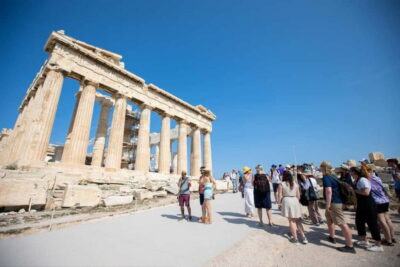
Acropolis, Parthenon & Athens Old City Heritage Walking Tour
Read our review →
The Acropolis Walking Group Tour with a French Guide
Read our review →
Athens Food Tour with 10+ Tastings of Greek Traditional Dishes
Read our review →Browse the lists this tour appears in